Basel 3 Capital Requirements: Why Banks Hold 11.5%
Ask ten CAIIB candidates what the minimum capital an Indian bank must hold is, and you will hear three different answers — 8%, 9%, 11.5%. Nobody is lying. Those numbers belong to different layers of the same rulebook, and the Basel 3 capital requirements that RBI actually enforces stack up in a fixed order. Once you see the order, the numbers stop competing with each other and start adding up neatly.
The 60-second revision reel below walks that stack from the bottom up. Watch it once, then read on — the article fills in what a reel cannot: where each layer comes from, what happens the day a bank slips below one of them, and the exact way examiners phrase this in BFM.
Basel 3 updates — BFM CAIIB · Watch on YouTube
The five numbers you are actually being asked about
Capital under Basel III is not one number. It is a ladder, and each rung has its own name, its own quality of capital, and its own consequence for breaching it. Here is the whole ladder as RBI has prescribed it for scheduled commercial banks in India.
| Layer | Minimum (% of RWA) | What counts here |
|---|---|---|
| Common Equity Tier 1 (CET1) | 5.5% | Paid-up equity, reserves, retained earnings — the purest loss-absorbing capital |
| Additional Tier 1 (AT1) | 1.5% (maximum credited) | Perpetual instruments with no maturity, loss-absorbing while the bank is a going concern |
| Total Tier 1 | 7.0% | CET1 + AT1 |
| Tier 2 | 2.0% | Subordinated debt, revaluation reserves — gone-concern capital |
| Minimum Total Capital (CRAR) | 9.0% | Tier 1 + Tier 2 |
| Capital Conservation Buffer (CCB) | 2.5% | Pure CET1, held on top of the 9% |
| Effective total | 11.5% | CRAR 9% + CCB 2.5% |
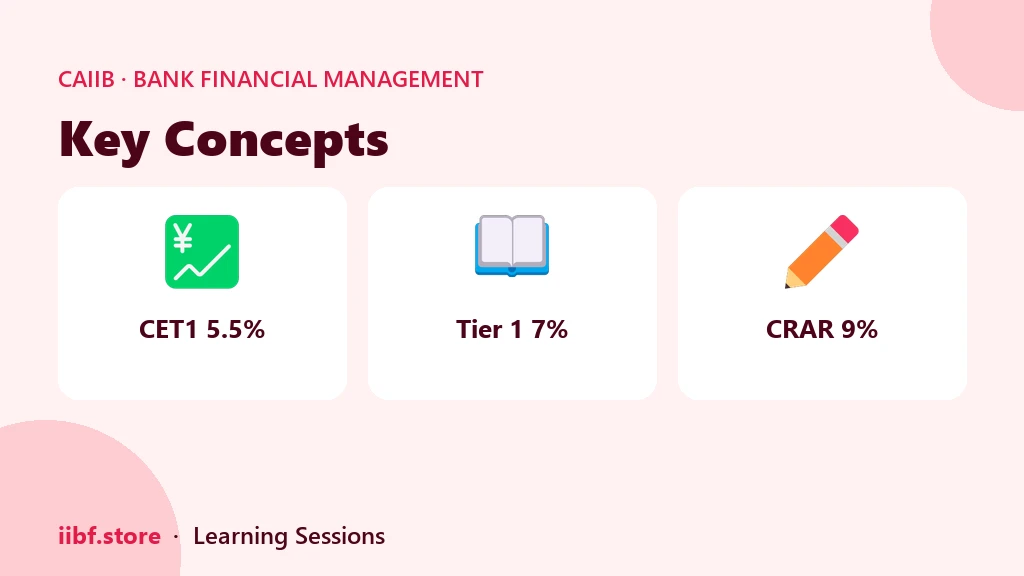
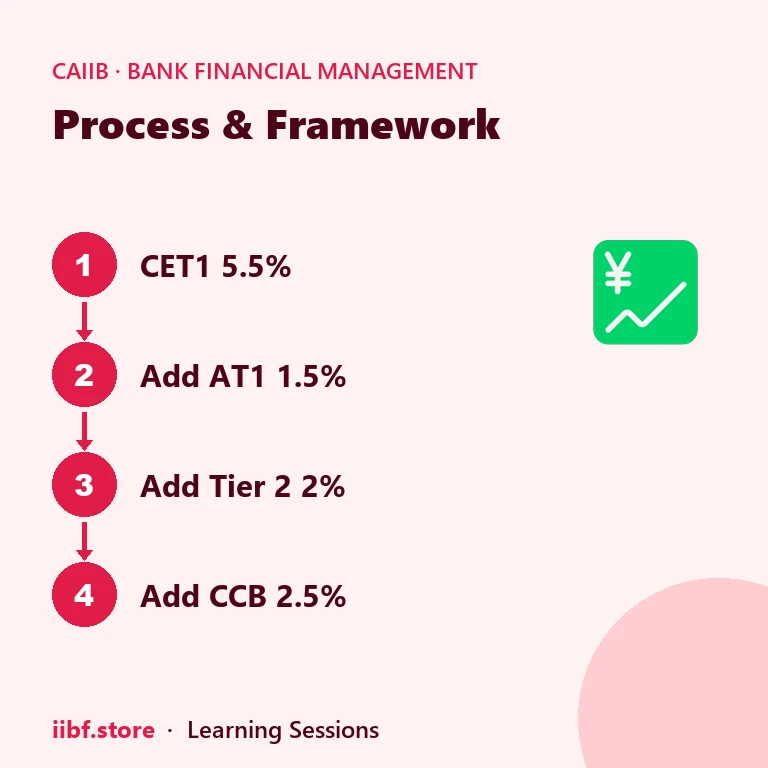
Read the table downwards once and the arithmetic becomes obvious. CET1 of 5.5% plus AT1 of 1.5% gives Tier 1 of 7%. Add Tier 2 of 2% and you land on the headline CRAR of 9%. Sit the conservation buffer of 2.5% on top of that and the number a bank realistically has to run at is 11.5%.
Why RBI's Basel 3 capital requirements start at 9%, not 8%
The Basel Committee's global minimum total capital ratio is 8%. RBI has always run one percentage point tighter. The reasoning is supervisory rather than mathematical: Indian banks carry a credit-heavy balance sheet, recovery through the legal system is slower than in many jurisdictions, and a domestic cushion above the international floor buys the supervisor time. So when a question says "as per Basel III" you use 8%; when it says "as per RBI" or "for banks operating in India" you use 9%. Exam papers exploit that difference constantly, and the safest habit is to read the stem for the words "in India" before you pick an option.
The same logic explains the CET1 figure. Basel prescribes a 4.5% CET1 minimum globally; RBI prescribes 5.5%. Tier 1 globally is 6%; RBI says 7%. Every rung is lifted by one percentage point, which makes the Indian ladder easy to reconstruct in the hall even if you blank out.
The conservation buffer: mandatory, but a breach is not a licence issue
The Capital Conservation Buffer is the layer students most often misread. It is not part of the minimum 9%; it sits above it and must be met entirely with CET1. Its purpose is behavioural. In a good year a bank builds it; in a bad year it is allowed to draw the buffer down instead of shrinking its loan book at exactly the moment the economy needs credit.
Crucially, falling into the buffer is not the same as breaching the minimum. A bank that drops below 11.5% but stays above 9% is not in violation of the Basel 3 capital requirements — it is in the buffer range, and the penalty is a restriction on discretionary distributions. Dividends, share buybacks and discretionary bonus payments get progressively curtailed the deeper the bank sits inside the buffer. Fall below 9% and it becomes a supervisory action matter entirely.
Where AT1 and Tier 2 actually sit
AT1 instruments are perpetual — no maturity date, and the coupon can be skipped without triggering default. They absorb losses while the bank is still trading, which is why they count towards Tier 1. Note the wording in the table: AT1 can contribute a maximum of 1.5% towards the 7% Tier 1 requirement. A bank with 7% CET1 and zero AT1 is perfectly compliant. A bank with 4% CET1 and 3% AT1 is not, because CET1 has its own floor of 5.5%.
Tier 2 is gone-concern capital: subordinated debt with a minimum original maturity of five years, plus items like revaluation reserves at a discount. It protects depositors when the bank is being wound up, not while it is running. That distinction — going concern versus gone concern — is a favourite one-liner in BFM.
A worked example you can reuse
Suppose a bank has risk-weighted assets of ₹2,00,000 crore. Its regulatory floors work out as follows: CET1 of ₹11,000 crore (5.5%), Tier 1 of ₹14,000 crore (7%), total capital of ₹18,000 crore (9%), and a conservation buffer of ₹5,000 crore (2.5%) on top — so ₹23,000 crore in total to stay clear of distribution restrictions.
Now flip the question, which is how the paper usually asks it. If the same bank holds ₹21,000 crore of total capital, its CRAR is 10.5%. It clears the 9% minimum comfortably, but it is 1 percentage point inside the conservation buffer, so dividend payout gets capped. Candidates who memorised only "11.5%" mark this as a breach and lose the mark.
Quick revision checklist
- 5.5 → 7 → 9 → 11.5 is the sequence. CET1, Tier 1, CRAR, CRAR plus CCB.
- CCB is pure CET1 and sits above the minimum, never inside it.
- Basel global figures are one percentage point lower at every rung than RBI's.
- The Countercyclical Capital Buffer framework exists in India but has not been activated, so add nothing for it unless a question says otherwise.
- D-SIBs carry an additional CET1 surcharge on top of all of this — the 11.5% is a floor for an ordinary bank, not a ceiling for a large one.
That last point is where most of the follow-up questions come from, and it is worth a session of its own. If you are revising the whole module, work through the ratio topics in one sitting on the CAIIB course page, then push the numbers into memory with the chapter-wise mock tests. Candidates who are also sitting ABM will find the linked treatment of capital in Advanced Bank Management useful, and the current policy rates you need for the numerical questions are kept updated on the RBI rates page. Revising the Basel 3 capital requirements straight after the ratio chapters is the sequence that makes both stick.
Get this ladder right and a surprising amount of BFM falls into place, because leverage ratio, D-SIB surcharges and the buffer framework all hang off the same skeleton. Spend twenty minutes on the sequence today and it will hold for the whole paper.
Frequently asked questions
Is the minimum capital requirement for Indian banks 9% or 11.5%?
Both, depending on what is being asked. The regulatory minimum CRAR is 9% of risk-weighted assets. The Capital Conservation Buffer of 2.5% sits on top, so a bank that wants to pay dividends freely needs 11.5%. Falling between 9% and 11.5% restricts distributions but is not a breach of the minimum.
Why does RBI prescribe 9% when Basel III says 8%?
RBI has consistently kept Indian minimums one percentage point above the global floor, given the credit-heavy balance sheets of domestic banks and slower recovery timelines. The same one-point gap applies to CET1 at 5.5% against 4.5%, and Tier 1 at 7% against 6%.
Can a bank meet Tier 1 entirely with AT1 instruments?
No. CET1 has an independent floor of 5.5% of RWA, and AT1 can be credited only up to 1.5% towards the 7% Tier 1 requirement. A bank may hold no AT1 at all provided its CET1 alone reaches 7%.
Do the Basel 3 capital requirements include the countercyclical buffer?
The Countercyclical Capital Buffer framework is in place in India, with a prescribed range of 0% to 2.5% of RWA, but RBI has not activated it. Unless a question states a specific CCyB rate, treat it as nil and stop your calculation at 11.5%.
Quick quiz on this topic
5 exam-style questions from our free test bank — check yourself before you move on.
Practice this topic
Take a free mock test, download chapter PDFs, or watch a video class — all included on iibf.store.
Keep reading