Enterprise Service Bus in Banking: CAIIB ITDB Guide (2026)
Every core banking system in India talks to dozens of other systems every second — payment switches, CRM, credit bureaus, UPI rails, and mobile apps. An enterprise service bus in banking is the middleware layer that lets all these systems exchange messages without being wired directly to one another. For CAIIB ITDB candidates, this topic sits at the heart of how modern bank IT architecture actually works behind the screen.
Most bankers only see the app or the teller screen, never the plumbing that moves a transaction from the mobile app to the core banking system and back in under a second. This article breaks down what this middleware layer does, how it is built, where it fits into the exam syllabus, and the practical governance points examiners like to test.
🔌 What Is an Enterprise Service Bus in Banking
An enterprise service bus in banking (ESB) is a software architecture pattern that acts as a common communication backbone between applications. Instead of each system building a custom, one-off connection to every other system it needs to talk to, every application connects once to the bus. The bus then routes, transforms, and delivers messages to the correct destination.
Think of it as a central telephone exchange rather than a tangle of direct wires between every pair of houses. When the core banking system needs to notify the SMS gateway, the CRM, and the fraud engine that a transaction just happened, it sends one message to the bus. The bus copies, converts, and forwards that message to each subscriber in the format each one expects.
This pattern became popular in Indian banks as core banking systems, internet banking, mobile banking, UPI, and third-party fintech APIs multiplied through the 2010s and 2020s. Without a shared integration layer, IT teams would need to build and maintain hundreds of brittle, point-to-point interfaces. The chapter on hardware, software, networking and data communications lays the technical groundwork you need before this topic makes full sense.
🏗️ How the Architecture Fits Into a Bank's IT Stack
In a typical layered bank architecture, the enterprise service bus in banking sits between the core banking system at the back and the channel layer — internet banking, mobile app, ATM switch, and UPI handle — at the front. It also connects sideways to CRM, loan origination, credit bureau interfaces, and regulatory reporting feeds.
The bus exposes standard interfaces, commonly using XML or JSON messages over protocols like HTTP, JMS, or MQ. Each connected application only needs to understand the bus's contract, not the internal data format of every other system. This is what IT architects call "loose coupling" — systems can be upgraded or replaced independently as long as they still speak the bus's language.
Banks that have gone through business process reengineering typically introduce this kind of middleware at the same stage they automate manual, paper-based workflows into straight-through digital ones. The business process reengineering and banking automation chapter covers why this sequencing matters — you cannot automate a process cleanly if the underlying systems cannot exchange data reliably.
💡 Exam Tip: If a question describes "a common integration layer that decouples applications and routes messages," it is almost always pointing at an enterprise service bus, not an API gateway or a database.
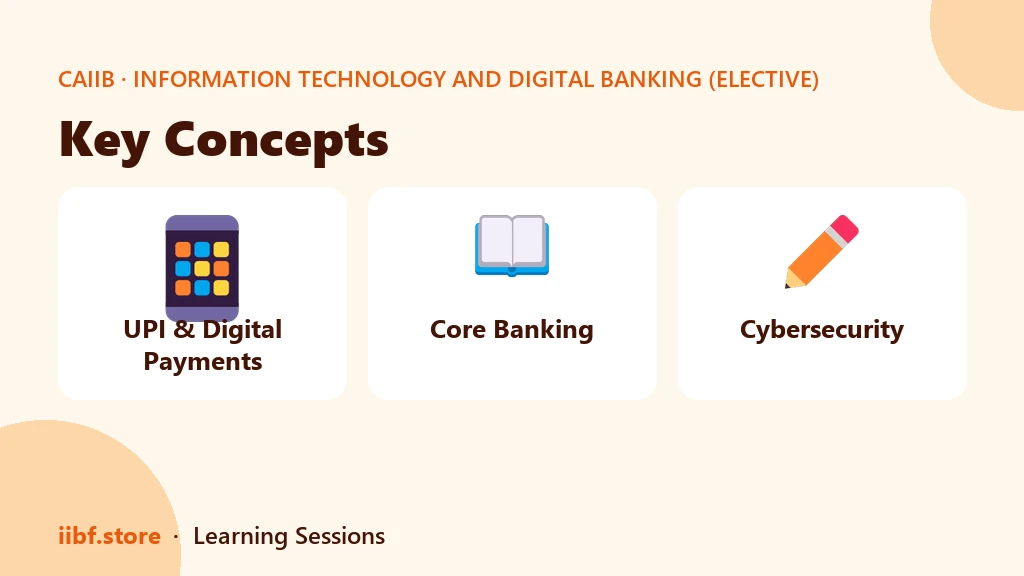
⚙️ Key Components and Message Flow
This kind of system integration layer is built from a small set of recurring components. The adapter connects to a specific source or target system and translates its native format into the bus's common format. The message router decides which subscriber should receive a given message, often based on content or transaction type. The transformation engine converts data between formats — for example, turning a core banking record into the ISO 8583 or ISO 20022 structure a payment network expects.
Orchestration logic sequences multi-step processes, such as validating a beneficiary, checking balance, debiting one account, and crediting another, all as one logical unit. A monitoring and logging layer records every message for troubleshooting and audit, which is directly relevant to the governance questions this exam likes to ask.
Compare this to older point-to-point integration, where every new connection meant new custom code on both ends. The table below sets out how the common integration approaches differ.
| Integration Approach | Coupling | Best Fit | Central Monitoring | Scales to Many Systems |
|---|---|---|---|---|
| Point-to-point integration | Tight | 2-3 systems, simple links | ❌ | ❌ |
| Enterprise service bus | Loose | Many internal systems, complex routing | ✅ | ✅ |
| API gateway | Loose | External or partner-facing APIs | ✅ | ✅ (for API traffic) |
| Batch file transfer | Very loose | End-of-day reconciliation, MIS feeds | ❌ | Limited |
⚠️ Common Mistake: Candidates often confuse an ESB with an API gateway. An API gateway manages and secures external-facing APIs; this kind of middleware is usually the internal backbone connecting core systems to each other.
💳 Role in Payments, Clearing and Card Systems
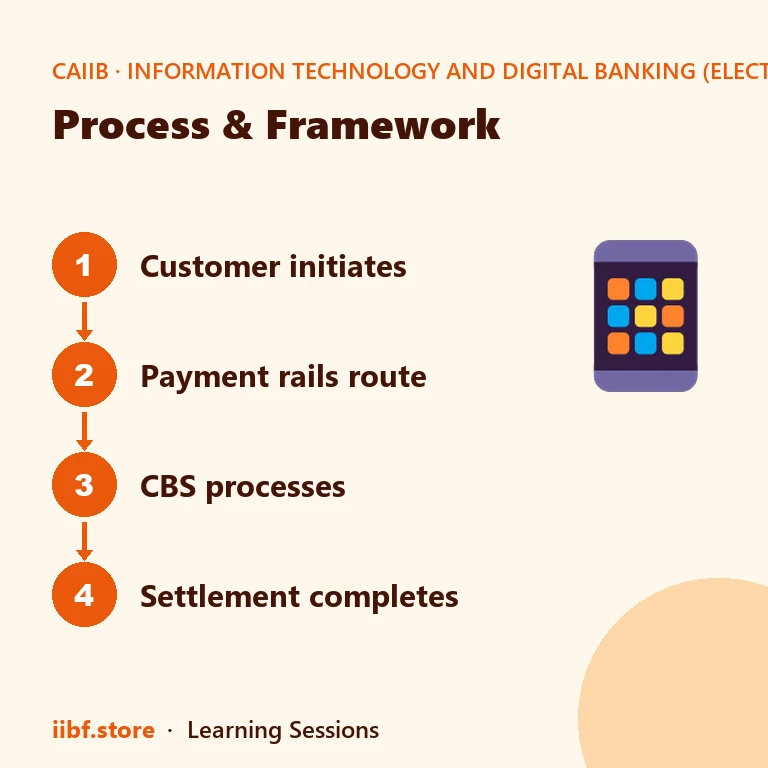
Payment and settlement processing leans heavily on this middleware. When a customer initiates a fund transfer, the message typically passes through the enterprise service bus in banking before it reaches the clearing and settlement network, so the bus can validate the message, log it, and route it to the correct downstream system. The electronic clearing and settlement system chapter explains the settlement side of this flow in detail.
Card and plastic money transactions follow a similar pattern: the ATM or POS switch talks to the bus, which then talks to the fraud engine, the core banking ledger, and the card network. The security requirements around this flow are covered in the chapter on security controls and guidelines for plastic money, which pairs naturally with this topic in exam papers.
Because the bus sits in the critical path of live transactions, banks build redundancy into it — clustered bus instances, failover routing, and message persistence so that a transaction is never silently lost if one instance goes down mid-message.
🔒 Security, Logging and Governance
Because every inter-system message can pass through it, this middleware layer is a natural control point for security and compliance. Banks apply message-level encryption, mutual authentication between the bus and connected systems, and strict access control lists that define which application can send or receive which message type.
Every routed message should be logged with a timestamp, source, destination, and outcome, creating an audit trail that examiners and internal auditors can review. This logging discipline overlaps with the broader IT governance syllabus, and candidates preparing for this exam should read the dedicated guide on the IT governance framework for banks alongside this article.
Bus configuration itself needs change management discipline — an unreviewed routing rule change can silently misdirect live transaction traffic. This is one reason RBI expects banks to treat middleware changes with the same rigour as core banking changes, a theme also explored in our guide to the RBI Cyber Security Framework.
📌 Remember: The bus is middleware, not a data warehouse — it should route and transform messages in transit, not become a long-term store of sensitive customer data.
📈 Benefits, Trade-offs and Exam-Relevant Facts
The main benefit of an enterprise service bus in banking is reduced integration complexity: adding a new channel or fintech partner means connecting once to the bus rather than building separate interfaces to every existing system. This also shortens the time needed to roll out new digital products, since much of the new development work only touches the bus adapter, not every downstream system. The SDLC in banking IT projects guide walks through how this changes testing and release planning.
The trade-off is that the bus itself becomes a single, business-critical component: if it is poorly sized or badly configured, it can become a bottleneck or a single point of failure for the whole bank. Many banks are now layering lightweight API gateways and microservices alongside a traditional bus rather than replacing it outright, since new fintech-style integrations and older core banking interfaces often need different integration styles side by side.
The data this middleware carries eventually feeds downstream analytics and risk systems too — for instance, transaction flows captured here support processes like the securitisation of standard assets covered in the BFM syllabus, where clean, well-integrated transaction data is essential for accurate loan pool valuation.
🧠 Practice MCQs: Enterprise Service Bus in Banking
Q1. What is the primary function of an enterprise service bus in a bank's IT architecture? (a) Store customer KYC documents permanently (b) Act as a message-based integration layer between disparate applications (c) Replace the core banking system entirely (d) Provide biometric authentication for ATMs
Answer: (b) — An ESB is a middleware backbone that routes, transforms and delivers messages between applications; it does not store KYC data or replace core banking.
Q2. Which older integration pattern does an ESB primarily replace to reduce architectural complexity? (a) Cloud-native microservices (b) Point-to-point interfaces (c) Batch file transfer only (d) Manual data entry by branch staff
Answer: (b) — Point-to-point integration requires a separate custom connection for every pair of systems; an ESB replaces this web of connections with one shared bus.
Q3. In ESB terminology, the component that converts a message from one format or protocol into another is best described as the: (a) Message broker only (b) Adapter or transformation engine (c) Load balancer (d) Perimeter firewall
Answer: (b) — Adapters and the transformation engine translate data between the native format of a connected system and the bus's common message format.
Q4. Which of the following best describes a key benefit of using an enterprise service bus in banking for payment and settlement integration? (a) It removes the need for RBI compliance checks (b) It creates loose coupling between the core banking system and payment or card switch systems (c) It eliminates the need for network security controls (d) It guarantees zero downtime without any redundancy design
Answer: (b) — Loose coupling lets core banking, card switches and clearing systems evolve independently while still exchanging messages reliably.
Q5. From an IT governance standpoint, what should accompany ESB deployment in a bank as good practice? (a) No monitoring, since middleware is considered self-managing (b) Access controls, message-level logging and audit trails for routed transactions (c) Using only the vendor's default configuration permanently (d) Ignoring message queue failures as a low-priority issue
Answer: (b) — Because the bus handles live transaction traffic, banks must log every message and enforce access controls to support audit and incident response.
Want chapter-wise mock tests with 100+ MCQs? Start practising free →
❓ Frequently Asked Questions
What is the difference between an enterprise service bus and an API gateway in banking?
This kind of middleware is usually the internal backbone that connects core systems like core banking, CRM and payment switches to each other. An API gateway sits at the edge and manages, secures and throttles APIs exposed to external partners, fintechs or mobile apps. Many banks run both together.
Why do banks need middleware instead of connecting systems directly?
Direct, point-to-point connections multiply quickly as a bank adds channels and partners, becoming expensive to maintain and risky to change. Middleware gives every system one shared connection point, so new integrations and upgrades happen faster and with fewer breakages.
Is this architecture still relevant as banks move to microservices and cloud?
Yes. Many banks run a traditional bus for stable, high-volume core integrations while adding lightweight API gateways and microservices for newer, fast-changing digital products. The two approaches typically coexist rather than one fully replacing the other.
Which other CAIIB ITDB topics connect closely with this one?
Hardware, software and networking fundamentals, business process reengineering, electronic clearing and settlement systems, and IT governance are the topics examiners most often pair with system integration and middleware questions.
This middleware layer is one of those topics that rarely gets its own exam paper heading but shows up quietly inside architecture, integration and governance questions across the ITDB syllabus. Revisit the chapters linked above, work through the practice MCQs, and pair this reading with a full mock test on the CAIIB course page to see how examiners frame these concepts in context. For the regulatory backbone behind bank IT controls, the Reserve Bank of India website is the primary source worth bookmarking. You can browse more ITDB coverage on the Information Technology and Digital Banking tag hub.
Prefer revising from a printed book?
Chapter-wise books with MCQs after every chapter — minimal pages, complete coverage, delivered anywhere in India. Every book has a free sample to read first.

































Quick quiz on this topic
5 exam-style questions from our free test bank — check yourself before you move on.
Practice this topic
Take a free mock test, download chapter PDFs, or watch a video class — all included on iibf.store.