Call and Put Options Explained Simply for CAIIB BFM 2026
Derivatives is the chapter most CAIIB candidates postpone, and options are the reason. The vocabulary arrives all at once — strike, premium, writer, moneyness, Greeks — and the textbook rarely stops to explain the one sentence everything hangs on. That sentence is short: call and put options give the buyer a right, never an obligation. Get that straight and the rest of the chapter falls into place in a single sitting.
Call, put, premium and strike price explained · Watch on YouTube
Buyer versus writer: the asymmetry that defines everything
An option contract has two sides and they are deliberately unequal. The buyer pays a premium and receives a right. The writer, or seller, receives that premium and takes on an obligation — if the buyer exercises, the writer must perform.
That asymmetry produces the risk profile examiners love to test. The buyer's maximum loss is the premium paid, because the worst case is simply walking away from the right. The writer's risk is open-ended, which is why option writing attracts margin requirements while option buying does not. The premium itself is non-refundable: it is the price of the right, paid whether or not the right is ever used.
From there, only two flavours exist. A call gives the right to buy the underlying at the strike price. A put gives the right to sell at the strike price. "Long" simply means you have taken the buying position — long call, long put. Everything else in the chapter is a combination of these two building blocks, which is why call and put options are worth over-learning rather than skimming.
A worked example you can reproduce in the exam
Take a share of ABC Ltd trading at a spot price of ₹100. You expect it to rise, so you buy a call with a strike price of ₹110 expiring in one month, on a lot of 100 shares, paying a premium of ₹5 per share. Your total outlay is ₹5 × 100 = ₹500, and that ₹500 is gone regardless of what happens next.
One month later, compare the spot price on that day with your strike of ₹110.
| Spot at expiry | Right to buy at ₹110 is… | Moneyness | Intrinsic value per share | Net result after ₹5 premium |
|---|---|---|---|---|
| ₹140 | Valuable — market price is higher | In the money (ITM) | ₹30 | Profit of ₹25 per share, i.e. ₹2,500 |
| ₹110 | Neither better nor worse | At the money (ATM) | ₹0 | Loss limited to the ₹500 premium |
| ₹90 | Worthless — you can buy cheaper in the market | Out of the money (OTM) | ₹0 | Loss limited to the ₹500 premium |
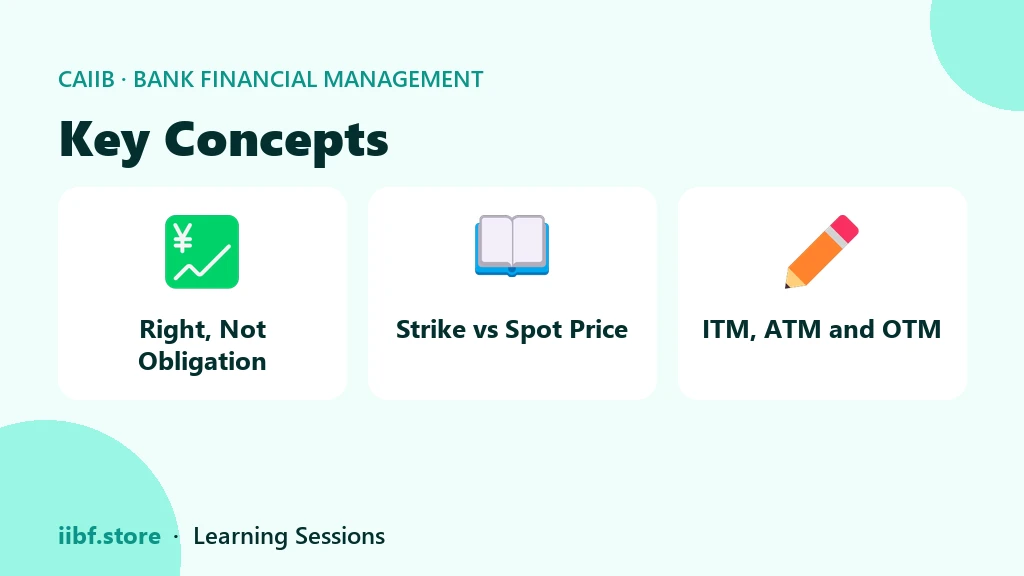
Two rules are hidden in that table and both are examinable. First, moneyness ignores the premium entirely — ITM, ATM and OTM compare strike with spot and nothing else. Profitability, by contrast, does count the premium, which is why your break-even here is ₹115, not ₹110. Second, intrinsic value can never be negative; the floor is zero. An OTM option has zero intrinsic value, not a negative one, because you would simply let the right lapse.
For a put, flip the comparison. A put with a strike of ₹110 is in the money when the spot falls below ₹110, because the right to sell above the market price is what carries value. Candidates lose easy marks by memorising "higher is better" instead of asking which right they hold.
Premium, time value and the five Greeks
The premium you pay is not one number but two components added together: intrinsic value plus time value. Intrinsic value is the immediate exercise value, floored at zero. Time value is everything you are paying for the possibility that the position improves before expiry, and it decays towards zero as expiry approaches.
One structural point specific to India: exchange-traded index and stock options here are European style, identified on the screen as CE and PE. They can be exercised only on the expiry date, not before, unlike American-style options. Stock options are also physically settled. If a question offers "can be exercised any time before maturity" as the description of a listed Indian option, it is the distractor.
The Greeks measure how sensitive the premium is to a change in one underlying factor. There are five in the syllabus:
| Greek | Measures sensitivity to | Exam handle |
|---|---|---|
| Delta | Change in the underlying price | Directional exposure; a delta of 0.60 means roughly ₹0.60 of premium movement per ₹1 move |
| Gamma | Change in delta itself | The curvature — how fast delta is moving |
| Vega | Change in volatility | Rising volatility lifts option premiums |
| Theta | Passage of time | Time decay; usually negative for long options, so the clock works against the buyer |
| Rho | Change in interest rates | Interest rate sensitivity of the option's value |
Theta is the one worth internalising rather than memorising. As expiry nears, the option has less time left to make a favourable move, so time value bleeds away. That is why a buyer who is directionally right but early can still lose money, and why writers are, in effect, selling time.
How to revise this for the exam
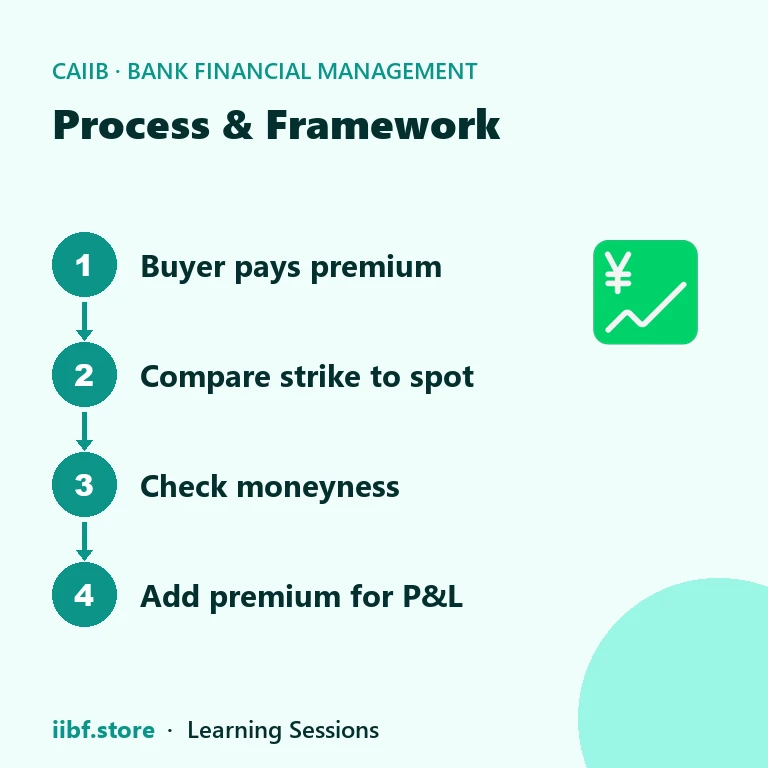
Work three numericals on call and put options daily for a week and the chapter stops being intimidating. Always write the strike and the spot side by side before touching the premium; label the moneyness; then, and only then, bring the premium in for the profit or loss. Nearly every mistake in this topic comes from doing those steps in the wrong order.
Build the base with our CAIIB study material, drill the derivatives chapter through the CAIIB mock tests, and schedule the revision blocks on the study planner. Related explainers on treasury and risk sit on the blog. Contract specifications for Indian equity derivatives are published by the National Stock Exchange.
Frequently asked questions
What is the difference between a call and a put in one line?
A call gives the buyer the right to buy the underlying at the strike price; a put gives the right to sell at the strike price. In both cases the buyer holds a right and the writer carries the obligation.
Is the premium refunded if I do not exercise the option?
No. The premium is paid for the right itself and is non-refundable, which is why the buyer's maximum loss equals the premium paid.
Do ITM, ATM and OTM take the premium into account?
No. Moneyness compares only the strike price with the spot price. The premium is brought in separately when you calculate profit, loss or break-even.
Are Indian exchange-traded options American or European style?
European style — index and stock options on Indian exchanges can be exercised only on the expiry date, and are quoted as CE and PE.
Quick quiz on this topic
5 exam-style questions from our free test bank — check yourself before you move on.
Practice this topic
Take a free mock test, download chapter PDFs, or watch a video class — all included on iibf.store.
Keep reading