Capital Adequacy Norms for Small Finance Banks: 15% CRAR Rules
Capital adequacy norms for small finance banks are deliberately tighter than the norms applied to universal commercial banks, and that single design choice explains almost everything the IIBF SFB paper asks on this topic. A small finance bank is licensed to lend to the most credit-sensitive segments of the economy — micro enterprises, marginal farmers, unorganised sector workers and low-income households — largely through small-ticket, thinly collateralised loans. RBI's answer to that concentrated risk profile is not a longer list of restrictions but a simple, blunt capital rule: hold more capital per rupee of risk-weighted asset than a universal bank has to. Once you internalise that logic, the individual numbers stop being isolated facts to memorise and become a coherent framework you can reason through in the exam hall.
This article walks through the minimum CRAR, the Tier 1 floor, the treatment of buffers, how risk weights behave on microfinance and retail exposures, and the capital raising and listing obligations that come with an SFB licence.
🏦 Why SFBs Carry a Higher CRAR Than Universal Banks
The starting point is the RBI Operating Guidelines for Small Finance Banks, which require an SFB to maintain a minimum capital to risk-weighted assets ratio (CRAR) of 15 per cent of risk-weighted assets on a continuous basis, subject to any higher percentage that RBI may prescribe for a particular bank. A universal bank in India operates under a materially lower minimum total capital requirement, supplemented by buffers. The gap is not accidental.
Three structural features of the SFB model justify it. First, the asset book is concentrated: an SFB must extend a large majority of its lending to the priority sector and keep a substantial share of its portfolio in small-value loans, which prevents the diversification a universal bank enjoys across corporate, infrastructure, treasury and retail books. Second, a large part of the portfolio is unsecured or weakly secured — group loans, income-generation loans and micro enterprise credit — so recovery in stress depends on borrower cash flow rather than on realisable collateral. The lending discipline behind this is examined in detail in the chapter on principles of lending. Third, SFBs are young institutions with thin loss histories and a deposit base that is still maturing, so supervisory comfort has to come from capital rather than from track record.
There is a second, quieter reason. Because SFBs are not subjected to the full Basel III apparatus, RBI does not levy a separate capital charge on them for market risk and operational risk in the way it does for larger banks. The higher headline CRAR is partly a simplification — a single, conservative number that absorbs the risks a more granular framework would have priced separately.
📊 The 15% CRAR: Tier 1, Tier 2 and How the Numbers Stack Up
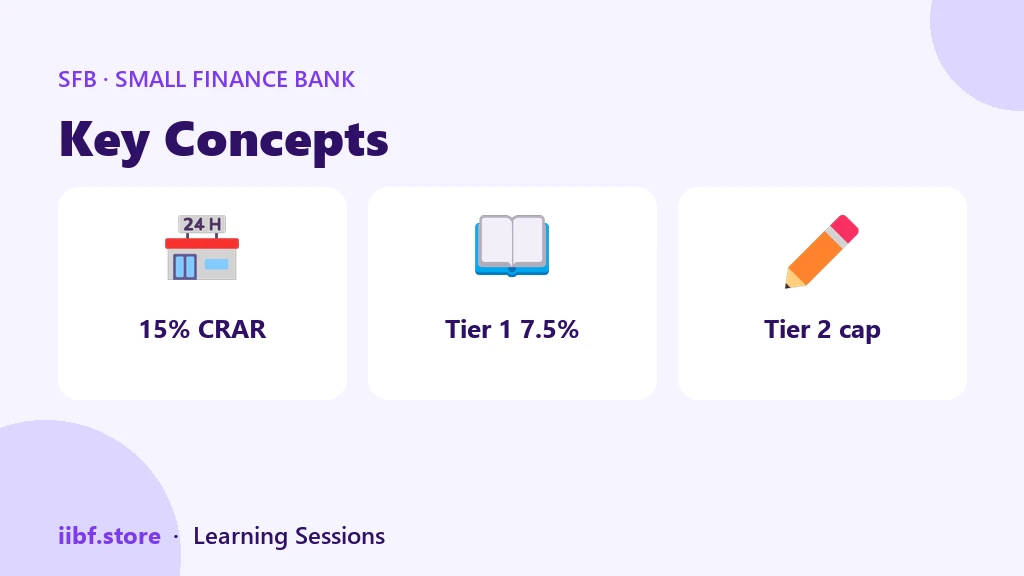
Inside the 15 per cent total requirement sits a quality-of-capital rule. Tier 1 capital must be at least 7.5 per cent of risk-weighted assets. Tier 2 capital is admitted for CRAR purposes only up to 100 per cent of Tier 1 capital — so an SFB cannot manufacture compliance by stacking subordinated debt on a thin equity base. In practice this means an SFB running exactly at the floor would hold 7.5 per cent Tier 1 and up to 7.5 per cent Tier 2, and a bank with weaker Tier 1 finds its admissible Tier 2 shrinking in step.
The table below is the comparison examiners most often build questions around. Treat the universal bank column as the Basel III baseline and the SFB column as the specialised carve-out.
| Capital element | Small Finance Bank | Universal bank (Basel III) | Applies to SFBs? |
|---|---|---|---|
| Minimum total CRAR | 15% of RWAs, continuous | 9% of RWAs | ✅ |
| Minimum Tier 1 | 7.5% of RWAs | 7% of RWAs | ✅ |
| Separate CET1 floor | Not separately prescribed | 5.5% of RWAs | ❌ |
| Capital conservation buffer | Not applicable at present | 2.5% of RWAs in CET1 | ❌ |
| Countercyclical capital buffer | Not activated for SFBs | Framework in place, 0% currently | ❌ |
| Tier 2 admissibility cap | Up to 100% of Tier 1 | Residual within total CRAR | ✅ |
| Capital charge for market and operational risk | Not separately prescribed | Prescribed | ❌ |
💡 Exam Tip: Questions rarely ask "what is the CRAR" in isolation. They ask which combination is valid — for example, a bank with 6% Tier 1 and 9% Tier 2 shows 15% total but still fails, because Tier 1 is below 7.5% and admissible Tier 2 is capped at Tier 1.
🧮 Risk Weights on Microfinance and Retail Exposures
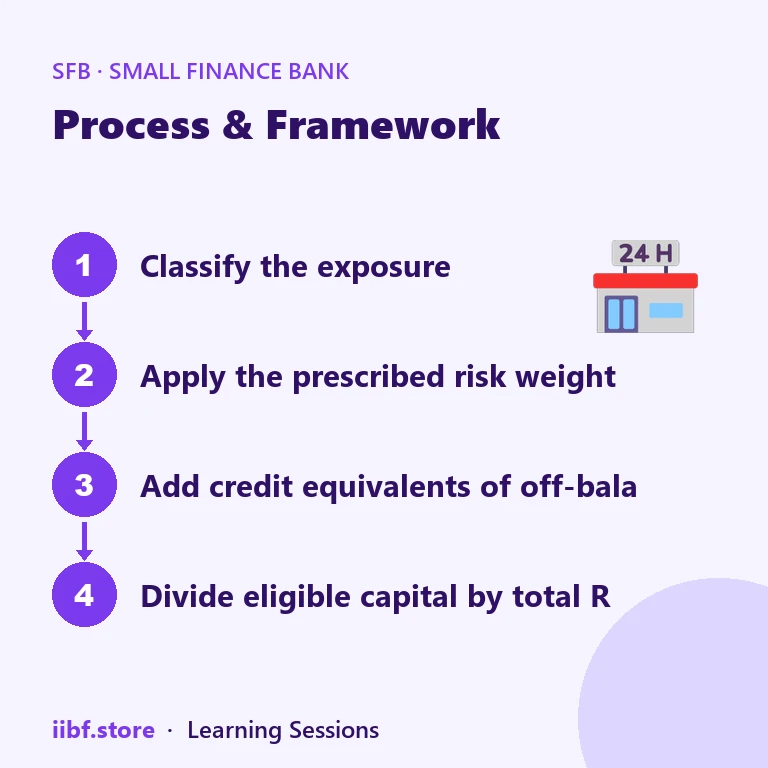
CRAR is a ratio, so the denominator matters as much as the numerator. For credit risk, SFBs compute risk-weighted assets under the standardised approach, applying the risk weights RBI prescribes by exposure class rather than using internal models. This is where most of the practical capital management in an SFB actually happens.
Small-ticket loans to individuals and small businesses generally qualify for the regulatory retail treatment, which carries a concessional risk weight, provided the exposure satisfies the qualifying tests — an orientation criterion (the borrower is an individual or small business), a product criterion, a granularity criterion limiting how much of the total retail pool any one counterparty may represent, and a low-value criterion capping aggregate exposure to a single counterparty. A loan that fails any of these tests drops out of the retail bucket and attracts a higher weight. Loans secured by residential property attract graded risk weights linked to loan-to-value ratio and ticket size, while unsecured consumer credit has been the subject of repeated revision — RBI raised risk weights on certain consumer credit in late 2023 and subsequently recalibrated parts of that increase, so always verify the figure in the current master circular rather than quoting a number from an older textbook. Microfinance loans that meet the qualifying microfinance definition have generally been treated differently from ordinary consumer credit in these revisions; the underlying regulatory framework is set out for the non-bank side in NBFC-MFI regulations in India.
Two further points bite in practice. Non-performing advances attract punitive risk weights that step down only as specific provisioning coverage rises, so asset quality feeds straight back into CRAR. And undrawn commitments, guarantees and letters of credit are converted into credit equivalents before weighting — a nuance covered in the chapter on priority sector advances, where exposure classification is discussed alongside PSL categories.
⚠️ Common Mistake: Candidates assume every small loan automatically gets the concessional retail risk weight. It does not — the exposure must clear all four qualifying criteria, and a breach of the granularity or low-value test pushes it into a higher-weighted bucket.
🛡️ Capital Buffers and the Basel Framework Applicable to SFBs
This is the section candidates get wrong most often. The capital conservation buffer and the countercyclical capital buffer, which are central to the Basel III regime for universal banks, have not been made applicable to small finance banks under the operating guidelines as they stand. RBI's stated reasoning is that the 15 per cent minimum already builds in a conservative cushion, and that layering Basel III buffers on top of it would impose a disproportionate burden on institutions whose business model is deliberately simple.
The practical consequence is that an SFB does not face the Basel III style restrictions on dividend distribution and discretionary bonus payments that are triggered when a universal bank dips into its conservation buffer. Its constraint is binary: stay at or above the prescribed minimum, or face supervisory action. That makes internal capital planning less about buffer zones and more about maintaining a management cushion voluntarily above 15 per cent — most SFBs in fact operate well above the floor, both to absorb growth in risk-weighted assets and to reassure rating agencies and depositors.
Equally, SFBs are not required to compute and disclose the full Basel III suite. Leverage ratio, liquidity coverage and net stable funding requirements apply to SFBs in the manner RBI has specified for them rather than automatically in the universal bank form, and the disclosure architecture is correspondingly lighter. Because RBI has signalled that these treatments may be revisited as the sector matures — particularly where an SFB is seeking to convert to a universal bank — you should read the position as current rather than permanent. The conversion route, and the capital consequences of taking it, are covered in our note on the small finance bank to universal bank transition.
📈 Capital Raising Routes and the Listing Requirement
Meeting the ratio is one problem; funding it as the balance sheet grows is another. Because an SFB's risk-weighted assets expand quickly in the early years, capital consumption outpaces internal accruals, and the bank has to keep returning to the market.
The licensing framework sets the entry bar with a minimum net worth requirement for a new small finance bank, and the on-tap licensing guidelines fixed that at ₹200 crore, with a lower initial threshold and a phased build-up permitted for urban co-operative banks voluntarily transitioning into the SFB structure. Beyond incorporation, the standard routes are retained earnings, fresh equity through rights issues and private placements, and Tier 2 instruments such as subordinated debt — remembering always that Tier 2 counts only up to the level of Tier 1. Because the Basel III framework does not apply to SFBs in full, the range of hybrid instruments an SFB may issue is narrower than that available to a universal bank, so equity does the heavy lifting.
The listing obligation is the rule most likely to appear as a one-mark question. An SFB is required to get its shares listed on a recognised stock exchange within three years of its net worth reaching ₹500 crore. Below that threshold, listing is voluntary but RBI encourages it. Listing serves two supervisory purposes at once: it widens access to capital markets for future issuances, and it imposes continuous disclosure discipline on a bank serving vulnerable customers — a discipline that complements the conduct standards discussed in customer grievance redressal and internal ombudsman arrangements, and the customer-facing duties covered in the chapter on bankers special relationship.
📌 Remember: The ₹500 crore trigger is a net worth test, not a deposit or asset test, and the three-year clock starts from the date net worth crosses it — not from the date of licence.
Capital planning also interacts with who the bank lends to. Since the mandated customer profile drives the risk-weight mix, revising the target segment of small finance banks alongside this topic will make the capital arithmetic far easier to reconstruct under exam pressure. More SFB material is collected on the small finance bank topic hub, and current policy rates are listed on our RBI rates page.

🧠 Practice MCQs: Capital Adequacy for Small Finance Banks
Q1. What is the minimum CRAR a small finance bank must maintain on a continuous basis? (a) 9% (b) 15% (c) 11.5% (d) 12%
Answer: (b) — RBI's operating guidelines require SFBs to maintain a minimum CRAR of 15% of risk-weighted assets, higher than the universal bank minimum.
Q2. The minimum Tier 1 capital an SFB must hold, expressed as a percentage of risk-weighted assets, is (a) 5.5% (b) 6% (c) 7.5% (d) 9%
Answer: (c) — Tier 1 must be at least 7.5% of RWAs, which is half of the 15% total requirement.
Q3. For CRAR computation, Tier 2 capital of a small finance bank is admitted up to (a) 100% of Tier 1 capital (b) 50% of Tier 1 capital (c) 2% of risk-weighted assets (d) 25% of total capital funds
Answer: (a) — Tier 2 is limited to 100% of Tier 1, so a bank cannot substitute subordinated debt for a weak equity base.
Q4. Which of the following is currently NOT applicable to small finance banks? (a) Minimum CRAR of 15% (b) Standardised approach for credit risk (c) Tier 1 floor of 7.5% (d) Capital conservation buffer
Answer: (d) — the capital conservation buffer has not been made applicable to SFBs, as the 15% minimum is treated as already conservative.
Q5. A small finance bank must list its shares on a stock exchange within three years of its net worth reaching (a) ₹200 crore (b) ₹500 crore (c) ₹1,000 crore (d) ₹100 crore
Answer: (b) — the mandatory listing obligation is triggered when net worth reaches ₹500 crore, with a three-year window to complete listing.
Want chapter-wise mock tests with 100+ MCQs? Start practising free →
❓ Frequently Asked Questions
Why is the CRAR for small finance banks higher than for universal banks?
SFBs run concentrated, small-ticket and largely unsecured portfolios in the priority sector, with limited diversification and short loss histories. The higher 15% minimum compensates for that risk profile and also substitutes for the separate market and operational risk capital charges that universal banks compute under Basel III.
Do capital buffers apply to small finance banks?
The capital conservation buffer and countercyclical capital buffer have not been made applicable to SFBs under the current operating guidelines. RBI treats the 15% minimum as already carrying the necessary cushion. Since this position can be revised, always confirm against the latest RBI circular before an exam.
How much Tier 2 capital can a small finance bank count towards CRAR?
Tier 2 capital is admitted up to 100% of Tier 1 capital. If an SFB holds Tier 1 of 8% of RWAs, it can count at most a further 8% of Tier 2, and any excess subordinated debt issued beyond that is ignored for CRAR purposes.
When must a small finance bank get itself listed?
Listing on a recognised stock exchange is mandatory within three years of the bank's net worth reaching ₹500 crore. Voluntary listing before that threshold is permitted and encouraged, since it broadens future capital raising options and enforces continuous disclosure.
In summary: the capital rules for an SFB reduce to five numbers and one principle — 15% total CRAR, 7.5% Tier 1, Tier 2 capped at Tier 1, no Basel III buffers, and mandatory listing three years after net worth touches ₹500 crore, all flowing from the fact that a concentrated micro-lending book needs more capital per rupee of risk. Learn the logic first and the figures will follow. Test yourself on the full SFB syllabus with our chapter-wise mock tests, or work through the structured banking papers in the CAIIB course to build the wider regulatory context this topic sits in.
Source and further reading: Reserve Bank of India and the Indian Institute of Banking & Finance.
Practice this topic
Take a free mock test, download chapter PDFs, or watch a video class — all included on iibf.store.
Keep reading