MFI to SFB Conversion Norms: RBI's On-Tap Route in 2026
When a microfinance-focused NBFC decides to graduate into full-service banking, it must follow RBI's mfi to sfb conversion norms laid out under the on-tap licensing guidelines for Small Finance Banks. These norms replaced the one-off 2015-16 licensing round with a continuous window, letting eligible NBFC-MFIs, urban co-operative banks and other qualifying applicants apply for an SFB licence at any time, provided they clear RBI's fit-and-proper and capital tests. For CAIIB candidates studying the Small Finance Bank paper, this conversion pathway is a recurring exam theme because it stitches together licensing policy, capital adequacy, priority sector lending and financial inclusion into a single storyline examiners love to test.
🏦 What the MFI to SFB Conversion Route Covers
The on-tap framework, issued by RBI in December 2019, opened the SFB window to resident individuals with banking experience, NBFCs, MFIs (NBFC-MFIs and registered societies), local area banks and urban co-operative banks that voluntarily transition. An NBFC-MFI applying under this route must have a demonstrated track record of at least five years of stable operations and sound financial performance before it can even submit its application to RBI's Department of Regulation.
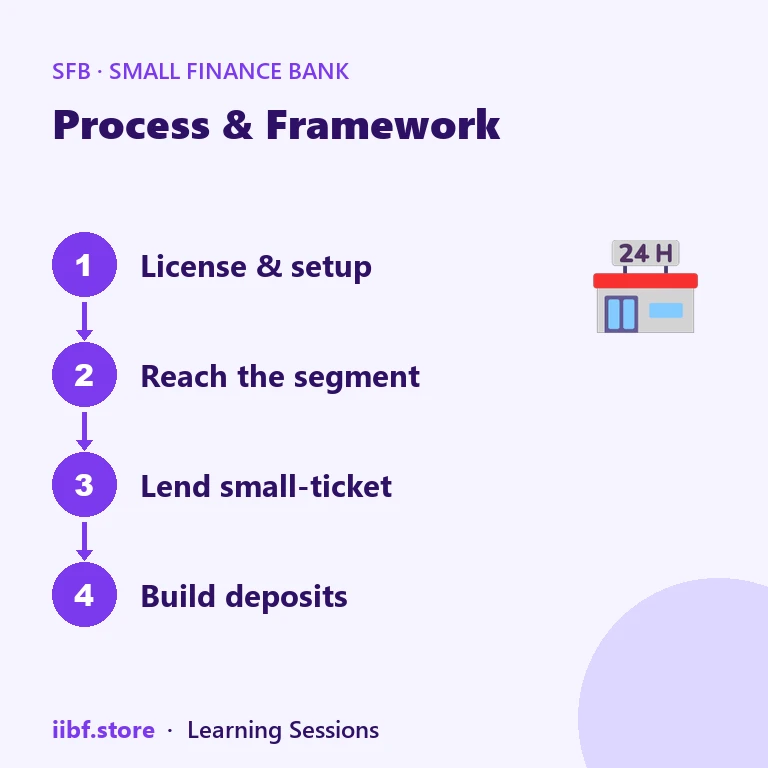
The route is deliberately structured as a graduated entry: an approved applicant first operates under an in-principle approval for up to 18 months, during which it must set up the core banking system, board, and branch network before RBI grants the final licence. This mirrors the process banking students see in the Operations of Banks chapter, where licensing and commencement conditions are treated as a single continuum rather than one event.
📋 Eligibility and Capital Conditions an NBFC-MFI Must Clear
RBI's promoter eligibility test looks at "fit and proper" status over the preceding five years — no adverse regulatory history, sound credit discipline in the MFI's own portfolio, and a demonstrated understanding of a diversified banking business rather than a single-product lending book. The applicant NBFC-MFI's shareholding, corporate structure and business plan are all scrutinised before an in-principle nod is given.
Minimum paid-up voting equity capital for a new SFB is Rs 200 crore, rising to Rs 1,000 crore for an SFB that later seeks to transition into a universal bank, as set out in RBI's licensing guidelines for Small Finance Banks. Promoters must hold at least 40% of paid-up voting equity at the time of licensing, locked in for five years, and the SFB must list on a recognised stock exchange within six years of reaching a net worth of Rs 500 crore. These capital gateways sit alongside the lending fundamentals covered in the Principles of Lending chapter.
💡 Exam Tip: Remember the promoter lock-in figure as "40% for 5 years" — a favourite one-mark question pairs it with the Rs 200 crore minimum capital requirement.
⚖️ Why NBFC-MFIs Choose the SFB Conversion Path
Converting from an NBFC-MFI to an SFB lets a lender accept public deposits — including low-cost CASA balances — instead of relying entirely on wholesale borrowing and securitisation to fund its loan book. That single change transforms the cost of funds and reduces dependence on bank lines that can tighten sharply during a liquidity stress cycle, as several MFIs experienced during past credit crunches.
An SFB licence also widens the product shelf beyond microloans: current accounts, term deposits, remittances, insurance distribution and secured lending against gold or property all become available, diversifying revenue and credit risk away from a single unsecured microfinance segment. This shift changes how documentation and charge creation work in practice, a topic explored further in the Documentation chapter. Readers comparing this route with an SFB's later journey upward can also see how those obligations evolve in small finance bank to universal bank transition rules once the institution outgrows the SFB tier itself.
⚠️ Common Mistake: Students often confuse the MFI-to-SFB conversion route with fresh greenfield SFB licensing — the two share broad eligibility principles but the conversion route carries additional continuity conditions on the existing loan book and staff.
💰 Priority Sector, CASA and Post-Conversion Obligations
Once licensed, a converted SFB must meet the same priority sector lending target as any other SFB — 75% of adjusted net bank credit — a far higher bar than the 40% target for universal banks, precisely because SFBs are meant to serve small borrowers, farmers and micro and small enterprises that the parent MFI already understood. At least 50% of the loan portfolio must consist of loans and advances of up to Rs 25 lakh, keeping the bank anchored to its small-ticket origins even after conversion. This sits close to the sub-target structure covered in the Priority Sector Advances chapter.
The newly converted SFB must also maintain CRR and SLR like every scheduled bank, extend at least 25% of branches in unbanked rural centres, and build the KYC and anti-money-laundering discipline expected of a deposit-taking institution — an area detailed in the KYC and AML chapter. Building genuine CASA share, rather than only bulk deposits, becomes the real post-conversion test of whether the transition delivered a cheaper funding base.
| Feature | NBFC-MFI (Pre-Conversion) | Small Finance Bank (Post-Conversion) |
|---|---|---|
| Can accept public deposits | ✗ No | ✓ Yes |
| Regulator | RBI (NBFC framework) | RBI (Banking Regulation Act) |
| CRR / SLR applicable | ✗ No | ✓ Yes |
| Priority sector lending target | Not mandated | 75% of ANBC |
| Minimum paid-up capital | Rs 5 crore (NBFC-MFI norm) | Rs 200 crore |
| Rural unbanked branch requirement | ✗ No | ✓ 25% of branches |
🚧 Practical Challenges in the Conversion Journey
Building a core banking system, treasury desk, deposit-mobilisation team and branch network from scratch within the 18-month in-principle window is the single biggest execution risk MFI promoters face. Talent that ran a lean, field-heavy microfinance operation must now also run cheque clearing, ATM networks and regulatory reporting that a universal bank takes for granted.
Asset quality management changes shape too — unsecured group-liability microloans behave very differently from secured retail and MSME advances, and portfolio diversification takes years to mature. Building genuine CASA franchises against established public and private banks is slow, which is why several converted SFBs still lean on term deposits and refinance lines in their early years. Business correspondents remain a bridge during this phase, a model examined in agent banking through business correspondents, while robust capital buffers stay essential — see capital adequacy norms for small finance banks for the CRAR mechanics that apply from day one of the new licence.
📌 Remember: The five-year track record requirement and the 18-month in-principle window are two separate clocks — one measures the applicant's past, the other measures its build-out future.
🌐 How This Links to Treasury and Broader Banking Study
A converted SFB's balance sheet also brings new treasury exposure once it starts holding SLR securities and managing interest rate risk on deposits, an area candidates often study alongside mark to market valuation of derivatives in the Treasury Management paper. Understanding both subjects together helps connect licensing policy to the balance-sheet risk it eventually creates. For a broader view of how SFBs are classified and regulated, browse the Small Finance Bank tag hub for related coverage, or check current benchmark rates at RBI rates resource before your next mock test.
🧠 Practice MCQs: MFI to SFB Conversion Norms
Q1. Under RBI's on-tap SFB licensing guidelines, what is the minimum track record an NBFC-MFI must demonstrate before applying for conversion? (a) 2 years (b) 3 years (c) 5 years (d) 10 years
Answer: (c) — RBI requires a demonstrated five-year track record of stable, sound operations before an NBFC-MFI can apply under the on-tap route.
Q2. What is the minimum paid-up voting equity capital required for a new Small Finance Bank? (a) Rs 50 crore (b) Rs 100 crore (c) Rs 200 crore (d) Rs 500 crore
Answer: (c) — The on-tap guidelines set minimum paid-up voting equity capital at Rs 200 crore for a new SFB.
Q3. What priority sector lending target applies to Small Finance Banks after conversion? (a) 40% of ANBC (b) 50% of ANBC (c) 60% of ANBC (d) 75% of ANBC
Answer: (d) — SFBs, including converted NBFC-MFIs, must lend 75% of adjusted net bank credit to priority sector categories.
Q4. For how long does a newly approved SFB applicant typically operate under an in-principle approval before receiving the final licence? (a) 6 months (b) 12 months (c) 18 months (d) 24 months
Answer: (c) — Approved applicants get up to 18 months under in-principle approval to build core banking infrastructure, board and branches.
Q5. What minimum share of an SFB's loan portfolio must consist of loans up to Rs 25 lakh? (a) 25% (b) 40% (c) 50% (d) 75%
Answer: (c) — At least 50% of an SFB's loan book must be advances of up to Rs 25 lakh, preserving its small-ticket lending focus.
Want chapter-wise mock tests with 100+ MCQs? Start practising free
❓ Frequently Asked Questions
Can any NBFC-MFI apply to become a Small Finance Bank?
Only NBFC-MFIs that clear RBI's fit-and-proper promoter test, hold a minimum five-year track record of stable operations, and can raise the required capital are eligible to apply under the on-tap route.
Does an NBFC-MFI lose its existing loan book on conversion to an SFB?
No, the existing microfinance portfolio typically continues under the new banking entity, subject to RBI's transition conditions, while the SFB simultaneously builds deposit-taking and other banking operations.
Why is the priority sector target higher for SFBs than for universal banks?
SFBs are licensed specifically to deepen financial inclusion for small borrowers, farmers and micro enterprises, so RBI sets their priority sector lending target at 75% of adjusted net bank credit versus 40% for universal banks.
What happens if a converted SFB fails to meet post-licence conditions?
RBI can impose supervisory action, restrict business expansion, or in serious cases review the licence, since the in-principle and final approval both carry binding conditions on capital, branch network and priority sector compliance.
🎯 Conclusion: Master This Topic Before Your CAIIB Exam
The mfi to sfb conversion norms are really a licensing story with capital adequacy, priority sector lending and financial inclusion woven through it — exactly the kind of cross-topic question CAIIB examiners favour. Revise the eligibility conditions, capital thresholds and post-licence obligations together, then test your recall with a full-length paper on the CAIIB course page to see how these numbers show up across different question formats.
Practice this topic
Take a free mock test, download chapter PDFs, or watch a video class — all included on iibf.store.
Keep reading