CASA Ratio for Small Finance Banks: Why It Matters
For most Small Finance Banks (SFBs), growing low-cost deposits is not optional — it is survival. The CASA ratio for small finance banks — the share of current and savings account balances in total deposits — decides how expensive or affordable the entire loan book becomes. Most SFBs started life as a microfinance institution (MFI) or an NBFC, which means they inherited a lending-heavy balance sheet and a thin deposit franchise. Building CASA is how that imbalance gets fixed, and it is a favourite examiner topic across JAIIB and CAIIB papers because it sits at the intersection of retail liability products, cost of funds, and regulatory design.
This article walks through why CASA matters so much for SFBs specifically, how it differs from a universal bank's CASA franchise, and the practical strategies banks use to build it — along with the exam angles you should watch for.
🏦 Why CASA Is a Bigger Deal for SFBs Than for Universal Banks
A universal bank with decades of branch presence usually has a large, sticky base of current and savings accounts built up over generations of customer relationships. An SFB does not have that luxury. Licensed under the RBI's small finance bank framework to extend the reach of formal banking to the unserved and underserved, most SFBs converted from an MFI or NBFC-MFI background where the core competency was lending, not deposit-taking.
That legacy shows up directly on the balance sheet. A bank that grew up disbursing joint liability group loans has field staff skilled at collections and credit appraisal, not at opening and servicing savings accounts. Building a CASA franchise from near-zero means training the same workforce for a completely different skill — trust-based relationship banking — while competing against banks that already have that trust.
Why does this matter beyond optics? CASA balances are the cheapest form of funding a bank can access, because current accounts typically pay no interest and savings accounts pay well below term-deposit or wholesale-borrowing rates. A higher CASA ratio directly compresses the cost of funds, which widens the net interest margin (NIM) — critical for SFBs whose priority-sector-heavy loan books already carry thinner spreads than typical unsecured retail lending. For deeper context on how SFBs are structured to serve financially excluded segments, see the Operations of Banks chapter.
💡 Exam Tip: If a question asks why SFBs are "more sensitive" to deposit cost than universal banks, the answer usually ties back to a thin CASA base plus priority sector lending obligations that cap the interest rates they can charge on a large share of their book.
💰 What Counts as CASA — and Why It's Cheap Money
CASA stands for Current Account and Savings Account deposits. Current accounts are non-interest-bearing transaction accounts typically used by businesses and traders for high-frequency operations; savings accounts are interest-bearing deposit accounts meant for individuals to park money while retaining liquidity. Together they form the cheapest, most stable source of bank funding — provided the depositor base is diversified and doesn't concentrate risk in a handful of large relationships.
For an SFB, savings accounts are usually the bigger lever. Because SFBs are mandated to serve small business units, marginal farmers, micro and small industries, and the unorganised sector, their natural customer base is individual and semi-urban or rural rather than corporate. That means the savings account — not the current account — is where most of the CASA growth opportunity lies.
The account-opening and maintenance rules that govern this business are covered in detail in the Maintenance of Accounts chapter, and the customer due diligence steps every new CASA account must clear are set out under KYC AML for small finance banks — a topic examiners frequently pair with deposit questions since every new account opening is also a KYC event.
⚠️ Common Mistake: Candidates often assume CASA and total deposits are interchangeable. They are not — term deposits (fixed and recurring) are a separate, costlier category. CASA is specifically the low-cost, on-demand portion.
📊 SFB CASA Profile vs Universal Bank CASA Profile
The table below summarises the structural differences that show up repeatedly in exam scenarios comparing SFBs with universal/scheduled commercial banks.
| Feature | Small Finance Banks | Universal Banks |
|---|---|---|
| Deposit insurance cover (DICGC) | Rs 5 lakh per depositor | Rs 5 lakh per depositor |
| Minimum Priority Sector Lending target | ✅ 60% of Adjusted Net Bank Credit | ❌ 40% of ANBC (standard domestic bank norm) |
| Typical CASA franchise maturity | Young — built largely post-conversion from MFI/NBFC | Established over decades of branch presence |
| Primary deposit-mobilisation channel | Physical branch trust + field staff relationships | Diversified — branch, digital, wholesale, corporate salary accounts |
| Legacy funding model | Lending-first (MFI/NBFC origin) | Deposit-first (traditional retail banking) |
Because a large share of an SFB's book must go toward priority sector advances (see the SFB priority sector lending target for the full 60% breakdown), the bank cannot simply chase high-cost bulk deposits to fund growth — that would crush margins on a loan book that is already yield-capped in parts. CASA is the only funding lever that keeps the arithmetic workable.
🎯 How SFBs Actually Build CASA
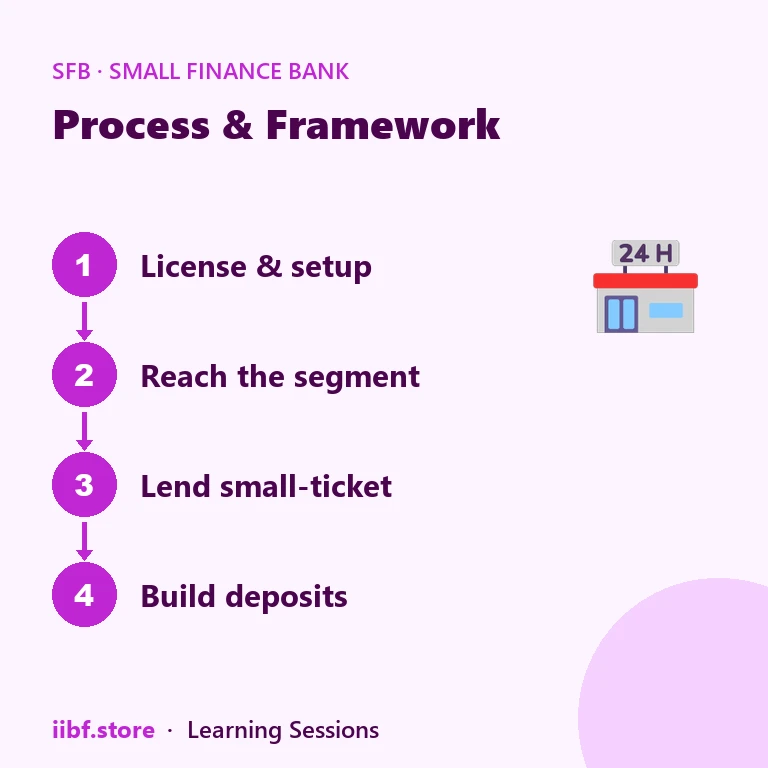
In practice, SFBs use a mix of product design, distribution, and technology to close the CASA gap:
- Tiered savings products with better-than-market interest slabs on smaller balances, aimed at first-time formal banking customers.
- Doorstep and micro-branch banking that mirrors the collection-agent model SFBs already use for loans, but repurposed for deposit pickup and account servicing.
- Salary and current account tie-ups with local businesses, traders, and self-help groups within the SFB's operating geography.
- Cross-selling to existing borrowers — a microfinance customer who already trusts the institution for credit is a natural savings-account prospect once the bank can service that relationship reliably.
- Digital onboarding (video-KYC, UPI-linked savings accounts) to cut the cost of acquiring small-ticket CASA customers who would be uneconomical to serve through a physical branch alone.
These strategies also connect to lending practice: an SFB with strong CASA penetration among its borrower base gets better repayment visibility and cross-sell data, which feeds back into underwriting. The principles behind matching deposit funding to lending strategy are part of the Principles of Lending chapter.
📌 Remember: CASA growth for an SFB is rarely just a marketing exercise — it is a funding-cost strategy that determines whether the bank can sustainably meet its 60% PSL obligation without bleeding margin.
⚖️ CASA, Treasury Deployment, and the Cost-of-Funds Chain
Once CASA balances are mobilised, the bank's treasury function decides how that liquidity is deployed — statutory reserves, investments, or fresh lending. A stronger CASA base gives treasury more stable, low-cost liquidity to work with, reducing reliance on costlier wholesale borrowing or bulk term deposits to fund the loan book or meet regulatory reserve requirements.
Interest rate and liquidity risk management sits alongside this — SFBs, like other banks, use treasury instruments to hedge exposure once their balance sheet grows more complex. Candidates studying SFB deposit and funding topics alongside broader bank treasury operations should also review currency options in bank treasury, which covers how banks hedge exposure once their balance sheet includes foreign-currency-linked assets or liabilities.
Special banker-customer relationships that arise from CASA products — such as a bank's duty of care to a savings account holder, or the legal position on a current account overdraft — are examined in the Bankers Special Relationship chapter, which pairs well with this topic for exam preparation.
🔍 Regulatory and Exam Angles to Watch
Examiners like to test whether candidates understand that CASA is not just a retail-banking buzzword but a regulatory and structural necessity for SFBs. Three angles come up repeatedly: first, the RBI's SFB licensing conditions require diversification of the deposit base over time, which pushes banks to prioritise granular CASA and retail term deposits over concentrated bulk funding. Second, a thin CASA base combined with the mandatory 60% priority sector target (detailed on the RBI's official priority sector lending framework) creates a margin squeeze that only deposit-cost management can offset. Third, KYC and account-opening compliance is inseparable from CASA growth — every new savings or current account is also a fresh KYC obligation.
For a full walkthrough of how deposits, advances, and reporting come together operationally at an SFB branch, the Kyc And Aml chapter is worth revisiting alongside this one, and the broader tag archive at Small Finance Bank articles collects related topics in one place.
🧠 Practice MCQs: CASA Ratio for Small Finance Banks
Q1. What does CASA stand for in banking? (a) Capital Adequacy and Solvency Assessment (b) Current Account and Savings Account (c) Credit Appraisal and Sanction Authority (d) Customer Account Servicing Agreement
Answer: (b) — CASA refers to Current Account and Savings Account deposits, the lowest-cost source of bank funding.
Q2. Why do most Small Finance Banks start with a relatively low CASA ratio? (a) RBI caps their savings account limits (b) They are barred from offering current accounts (c) Most converted from an MFI/NBFC background focused on lending, not deposits (d) CASA accounts are not permitted for SFBs
Answer: (c) — Their MFI/NBFC legacy means SFBs typically start with strong lending capability but an underdeveloped deposit franchise.
Q3. Under the Priority Sector Lending Directions 2025, what is the PSL target for Small Finance Banks? (a) 40% of ANBC (b) 75% of ANBC (c) 60% of ANBC (d) 50% of ANBC
Answer: (c) — SFBs must direct 60% of Adjusted Net Bank Credit to priority sector advances, higher than the standard 40% norm for domestic banks.
Q4. Which type of account normally does NOT earn interest for the depositor? (a) Savings account (b) Recurring deposit (c) Current account (d) Fixed deposit
Answer: (c) — Current accounts are transaction accounts and are typically non-interest-bearing.
Q5. Why does a higher CASA ratio matter most for an SFB's priority sector obligations? (a) It removes the PSL requirement entirely (b) It lowers cost of funds, easing margin pressure from yield-capped priority sector lending (c) It increases the DICGC insurance limit (d) It exempts the bank from KYC norms
Answer: (b) — Cheaper CASA funding offsets the thinner spreads on priority sector advances, keeping overall margins sustainable.
Want chapter-wise mock tests with 100+ MCQs? Start practising free →
Frequently Asked Questions
What is a good CASA ratio for a small finance bank?
There's no single regulatory benchmark, but a rising CASA share year-on-year is generally read as a sign that the bank's retail deposit franchise is maturing and cost of funds is improving.
Is CASA the same as total deposits?
No. CASA covers only current and savings account balances. Total deposits also include term deposits (fixed and recurring), which cost more to the bank.
Why do SFBs focus more on savings accounts than current accounts?
SFBs are mandated to serve small business units, marginal farmers, and the unorganised sector — a largely individual, retail customer base for whom savings accounts are the natural product, unlike corporate-heavy current account relationships.
How does CASA connect to priority sector lending for SFBs?
A stronger CASA base lowers the cost of funds, which helps offset the thinner margins that come from the mandatory 60% priority sector lending target under the PSL Directions 2025.
CASA building is one of those topics that looks like a pure retail-banking product question but is actually a funding-cost and regulatory-compliance question in disguise — exactly the kind of connection JAIIB and CAIIB examiners like to test. Strengthen this topic with chapter-wise practice on the CAIIB course page or attempt a timed mock at iibf.store/tests to see how well you can apply it under exam conditions.
Practice this topic
Take a free mock test, download chapter PDFs, or watch a video class — all included on iibf.store.
Keep reading