Currency Options in Bank Treasury: IIBF JAIIB/CAIIB Guide
Currency options in bank treasury sit at the exact point where a bank's dealing room meets a corporate customer's foreign exchange risk. Unlike a forward contract, which locks a rate for both parties, an option gives the buyer the right, but not the obligation, to exchange currency at an agreed rate on or before a set date. For JAIIB and CAIIB candidates this is a recurring exam theme because it sits across three chapters at once: derivative market mechanics, treasury desk structure, and RBI's forex regulatory perimeter. This article walks through how currency options are built, priced and controlled, and how a treasury actually uses them to hedge exposure.
💱 What Currency Options Are and Why Treasuries Use Them
A currency option is a contract that gives the holder the right to buy (a call) or sell (a put) one currency against another at a fixed strike price, on or before expiry. The buyer pays an upfront premium for this right; the seller (usually the bank) collects the premium and carries the obligation to perform if the buyer exercises.
This one-sided obligation is what separates options from every other instrument in the derivative market. A forward or a futures contract binds both sides — if the rate moves against you, you must still settle at the agreed rate. An option lets the buyer walk away and take the market rate instead, losing only the premium paid. That asymmetry is exactly why an exporter or importer with uncertain cash-flow timing prefers an option over a forward: it caps the downside while leaving the upside open.
Banks in India offer currency options mainly over the counter (OTC) to corporate customers under RBI's foreign exchange derivative framework, and increasingly also route standardised USD-INR options through exchanges such as NSE and BSE for resident participants. Both channels exist inside the bank's integrated treasury book, and both carry market risk that the treasury's risk desk must measure and limit every single day.
💡 Exam Tip: Remember the core distinction examiners test repeatedly — a forward/futures/swap is an obligation for both parties, while an option is a right for the buyer and an obligation only for the seller (the option writer).
📊 Call and Put Options: Structure, Premium and Payoff
A call option gives the buyer the right to buy the underlying currency at the strike rate — useful for an importer who wants to cap the rupee cost of a future dollar payment. A put option gives the buyer the right to sell the underlying currency at the strike rate — useful for an exporter who wants a floor under the rupee value of future dollar receivables.
The premium is driven mainly by four factors: the spot-to-strike distance (moneyness), time to expiry, interest rate differential between the two currencies, and implied volatility. Higher volatility and longer tenor both raise the premium, because they raise the probability that the option finishes in the money. A bank's treasury prices this premium using variants of the Garman-Kohlhagen model, an extension of Black-Scholes adapted for two interest rate curves instead of one.
At expiry, the buyer exercises only if it is profitable to do so. A call is exercised when the spot rate is above the strike; a put is exercised when the spot rate is below the strike. If neither condition holds, the option simply lapses and the buyer's loss is limited to the premium already paid — this capped downside is the single biggest reason corporates choose options over a plain forward cover.
- Call option: right to buy — importer's hedge against rupee depreciation
- Put option: right to sell — exporter's hedge against rupee appreciation
- Premium: non-refundable cost paid upfront by the buyer to the writer
🏦 Where Currency Options Sit in the Treasury Structure
Currency options are dealt from the front office of the treasury desk, priced and confirmed by the middle office for limit and risk checks, and settled and reconciled by the back office. This three-way split exists precisely so the person who books the trade is never the person who confirms or settles it — a basic control that examiners expect candidates to know cold.
In an integrated treasury, the domestic money market book, the forex book and the derivatives book are managed together rather than as silos, so that a currency option written to a corporate customer is immediately visible to the bank's overall market risk and liquidity position — not sitting in an isolated ledger the ALM desk cannot see.
Because an option written to a customer creates open market risk for the bank, the treasury usually hedges its own exposure back-to-back in the interbank market, or dynamically hedges the position (delta hedging) as spot rates move. Independent checks on this process matter: a concurrent audit of treasury reviews deal tickets, premium collection, and hedge confirmations on a near-real-time basis to catch unauthorised or mispriced deals before they compound into a larger loss.
⚠️ Common Mistake: Students often assume the option premium is refundable if the option is not exercised. It is not — the premium is the writer's income for taking on the risk, regardless of the outcome at expiry.
⚖️ RBI's Regulatory Framework for Currency Options
Authorised Dealer banks can write and deal in currency options under RBI's foreign exchange derivative regulations, which sit alongside the broader rules for the foreign exchange market. Corporates must generally demonstrate an underlying genuine exposure — an actual receivable, payable or forecast transaction — before a bank can write them a currency option; purely speculative option-writing to retail or unhedged corporate clients is restricted.
Every currency option a bank writes also adds to its overall foreign exchange exposure once converted to a delta-equivalent position, and that delta-equivalent must be captured within the bank's net open position limit — the same board-approved ceiling that governs the bank's spot, forward and futures exposure. A treasury that treats its options book as separate from its cash and forward book will misstate its true currency risk to the regulator.
The regulatory perimeter for derivatives sits within a wider pattern across Indian financial regulation of defining exactly who can offer a product and to whom — the same logic RBI applies, for instance, in its p2p lending platform norms for NBFC-P2P platforms outside the banking system. Candidates should read RBI's published master directions on risk management and inter-bank dealings directly for the current operative rules, since these are amended periodically.
🛡️ Hedging Strategies: Using Options to Cover Corporate Exposure
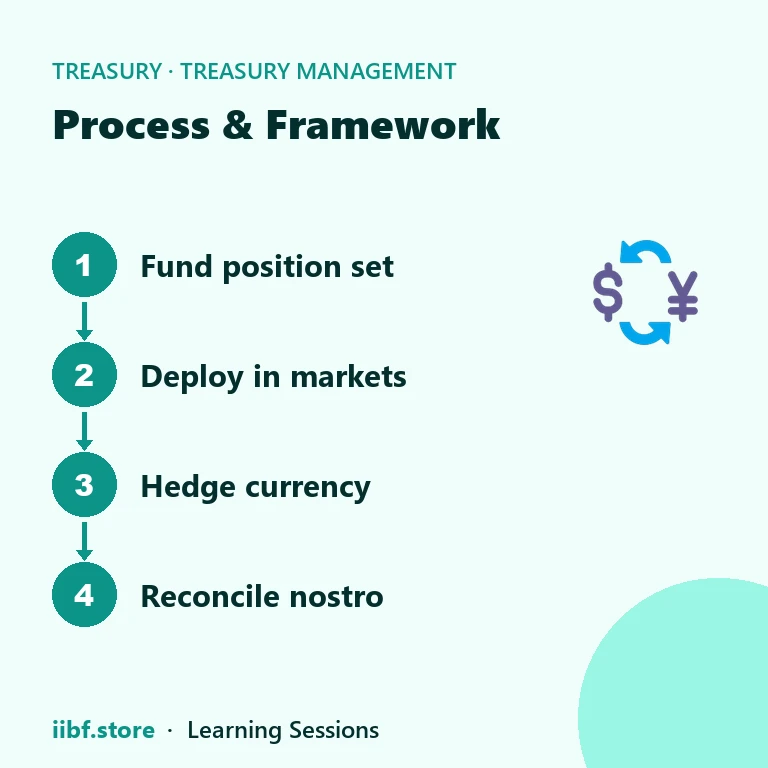
A plain vanilla call or put is the simplest hedge, but treasuries also structure combination strategies for corporate clients who want to lower the upfront premium cost. A range forward (collar) combines buying one option and selling another so the premiums largely offset, in exchange for giving up some of the favourable-move upside. A seagull option adds a third leg to narrow the cost further while capping the potential gain.
Options are frequently compared against a simple FCNR(B) deposits and forward cover approach: a forward is cheaper (no premium) and fully certain, but it removes any chance to benefit if the rate moves favourably. An option costs money upfront but keeps that upside alive — the right hedge depends on the customer's cash-flow certainty and risk appetite, and a good relationship manager explains this trade-off rather than defaulting to one product.
On the bank's own book, the treasury typically delta-hedges a written option position in the interbank spot or forward market and rebalances it as the spot rate and time-to-expiry change. This is more operationally intensive than hedging a simple forward, which is one reason option desks need tighter middle-office oversight and more frequent mark-to-market checks than a plain forward book.
The table below compares how the four main treasury derivative instruments differ in obligation, cost, and where they typically trade:
| Instrument | Obligation on Buyer | Upfront Premium | Exchange-Traded | Typical User |
|---|---|---|---|---|
| Forward contract | Firm obligation | None | ❌ OTC only | Corporate with certain cash flow |
| Currency futures | Firm obligation | Margin, not premium | ✅ Yes | Traders, smaller hedgers |
| Currency option | Right, not obligation | Yes, upfront | ❌ Mostly OTC | Corporate wanting upside flexibility |
| Currency swap | Firm obligation | None (rate exchange) | OTC only | Long-tenor borrowers, ALM desk |
📌 Remember: The premium is what you pay for the flexibility of an option. A forward and a futures contract are free to enter but bind you completely; an option costs money but lets you choose.
🧠 Practice MCQs: Currency Options in Bank Treasury
Q1. A currency option gives the buyer: (a) an obligation to transact (b) the right but not the obligation to transact (c) a guaranteed profit (d) a floating premium
Answer: (b) — The defining feature of an option is that the buyer has a right, not an obligation; the writer bears the obligation.
Q2. An importer worried about the rupee depreciating against the dollar should typically buy: (a) a put option (b) a call option (c) a currency swap only (d) nothing, since imports need no hedge
Answer: (b) — A call option gives the right to buy dollars at a fixed strike, protecting the importer if the rupee weakens.
Q3. If a currency option expires out of the money, the buyer's loss is: (a) unlimited (b) limited to the premium paid (c) equal to the notional value (d) refunded by the writer
Answer: (b) — The maximum loss for an option buyer is the premium paid; the option is simply allowed to lapse.
Q4. In a bank's treasury, an option written to a corporate customer must be reflected in the bank's: (a) staff welfare fund (b) net open position limit (c) fixed asset register (d) provident fund account
Answer: (b) — The delta-equivalent of every option position adds to the bank's overall currency exposure, which must stay within its board-approved net open position limit.
Q5. Which combination strategy offsets the cost of a currency option hedge by simultaneously buying and selling options at different strikes? (a) an overnight indexed swap (b) a range forward or collar (c) a certificate of deposit (d) a nostro reconciliation
Answer: (b) — A range forward, or collar, combines a bought and a written option so the two premiums largely net off, in exchange for a capped upside.
Want chapter-wise mock tests with 100+ MCQs? Start practising free →
Is a currency option cheaper than a forward contract?
No — a forward has no upfront cost but binds both parties completely, while an option requires an upfront premium in exchange for giving the buyer the choice not to exercise. Which is "cheaper" depends on whether the rate eventually moves in the buyer's favour.
Can a currency option be exercised before expiry?
It depends on the option style. American-style options can be exercised any time up to expiry, while European-style options can only be exercised on the expiry date itself. Most OTC currency options offered by Indian banks are European-style.
Do retail customers in India get access to currency options?
Retail participation is limited. Banks generally require a demonstrable underlying exposure before writing an OTC currency option to a customer, and exchange-traded currency options are available to resident individuals only within RBI-permitted limits and product scope.
How does a bank's treasury manage the risk of options it writes?
The treasury typically delta-hedges the position by taking an offsetting position in the interbank spot or forward market, and rebalances that hedge as the spot rate and time to expiry change, subject to middle-office limit monitoring and mark-to-market checks.
Currency options give a bank's treasury and its corporate customers a genuinely different risk profile from a forward or a swap — the right to walk away, at a price. For JAIIB and CAIIB, know the payoff mechanics, the front-middle-back office control split, and where options sit inside the net open position limit cold; these are the angles examiners return to most. Practise the concept further with a full-length CAIIB mock test, and browse more topics in our treasury management archive. For the current operative rules on derivative dealings, always cross-check RBI's published Master Directions directly.
Practice this topic
Take a free mock test, download chapter PDFs, or watch a video class — all included on iibf.store.