Channels of Cyber Crime in Banking: IIBF Exam Guide (2026)
Every fraud case a bank investigates eventually gets traced back to one entry point. Knowing the channels of cyber crime in banking — the actual doors an attacker walks through, whether it is an inbox, an ATM slot, a public Wi-Fi hotspot, or a careless app download — is the single most exam-relevant idea in the Prevention of Cyber Crime paper. Examiners rarely ask you to define "cyber crime" in the abstract. They ask you to match a scenario to its channel, its control, and its reporting step. This article walks through each channel in the order a real attacker would use them, ties every channel to the IIBF chapter that covers it in depth, and closes with practice questions built at exam difficulty.
🌐 What Are the Channels of Cyber Crime in Banking?
A "channel" is simply the medium an offender uses to reach a victim's money or data. Banking regulators group these channels because the prevention control usually depends on the channel, not the motive. A criminal who wants ₹50,000 from a savings account can reach it through a phishing link, a cloned card, a rogue mobile app, or a compromised bank server — and each of those paths needs a different defence. This is why the IIBF syllabus treats channels of cyber crime as a standalone topic rather than folding it into a general fraud chapter.
Broadly, examiners expect you to recognise four channel families: communication-based (email, SMS, voice calls), device-based (ATMs, POS machines, card readers), network-based (public Wi-Fi, unsecured APIs, server intrusions) and software-based (malware, ransomware, malicious apps). A useful exam habit is to read the scenario first and ask "what did the customer touch?" — a link, a card, a network, or a download. That single question usually points straight to the right answer option. For the conceptual foundation, revisit the introduction to cyber crimes chapter before attempting scenario-based questions.
📧 Communication Channels: Email, SMS and Voice
The oldest and still the most productive channel for criminals is direct communication. A message arrives claiming to be from the bank, the tax department, or a courier company, and it asks the customer to click a link, share an OTP, or call back a number. The underlying trick is always the same — create urgency, borrow the bank's brand, and get the victim to act before they think. Because these messages exploit trust rather than technology, no firewall stops them; only customer awareness and bank-side monitoring do.
Banks counter this channel with domain-name monitoring, SMS sender-ID registration, and mandatory customer education campaigns. On the customer side, the rule taught in every IIBF class is simple: banks never ask for a full card number, CVV, or OTP over a call, message, or email. Any communication that does is, by definition, not from the bank. This distinction — legitimate contact versus impersonation — is a favourite one-line MCQ trap, so read every option carefully for words like "always" or "never."
💡 Exam Tip: If a question describes a message urging "immediate action within 24 hours" to avoid account suspension, that urgency language is itself the red flag the examiner wants you to spot — not the specific bank name mentioned.
💳 Card, ATM and Point-of-Sale Channels
The second major channel runs through physical payment infrastructure — ATMs, point-of-sale terminals, and card networks. Here the attacker needs a device, not just a message: a hidden skimmer on a card slot, a pinhole camera above the keypad, or a cloned magnetic stripe. Because the fraud happens at a physical touchpoint, banks lean on hardware controls (anti-skimming bezels, jitter motors, EMV chip mandates) alongside transaction-pattern monitoring that flags a card being used in two distant cities within minutes.
For the exam, remember that EMV chip-and-PIN transactions are far harder to clone than magnetic-stripe swipes, which is exactly why regulators pushed banks to disable stripe-only fallback on ATMs. The deep-dive chapter on electronic card frauds covers the full taxonomy — skimming, shoulder surfing, card trapping, and counterfeit card use — and is worth a focused read before attempting numerical or scenario MCQs on this channel. A related sibling topic worth cross-referencing is card skimming fraud detection, which walks through the detection side in more depth.
| Channel | Typical Method | Needs Physical Access | Primary Control |
|---|---|---|---|
| Phishing email/SMS | Fake link or OTP request | ❌ | Customer awareness + domain monitoring |
| Vishing call | Impersonated bank agent | ❌ | Never share OTP/CVV verbally |
| ATM/POS skimming | Hidden card reader + camera | ✅ | Anti-skimming device + EMV chip |
| Malware/ransomware | Infected file or app | ❌ | Endpoint security + patching |
| Network intrusion | Unsecured Wi-Fi or server gap | ❌ | Encryption + firewalls |
🕵️ Hacking, Malware and Network Intrusion Channels
The third channel family is purely technical: an intruder targets the software and network layer directly, without ever contacting the customer. This includes system hacking, where an attacker exploits a weak password or an unpatched server to gain unauthorised access; malware, where a hostile program installs itself on a device or server to steal data or lock it for ransom; and network interception, where data travelling over an unsecured connection — think public Wi-Fi at a café — is captured mid-transit.
Unlike phishing, this channel does not rely on customer error at all, which is why it sits under a different control regime: intrusion-detection systems, regular vulnerability patching, network segmentation, and encrypted transmission (TLS/HTTPS) rather than customer messaging. The chapter on computer hackers classifies attacker types — white hat, black hat, grey hat, script kiddies — a classification examiners like to test directly. Pair it with cyber crime methods for the full list of technical attack techniques, and with computer insecurity for why systems remain vulnerable in the first place — weak configuration, outdated software, and poor access control are the recurring themes.
⚠️ Common Mistake: Students often assume every technical attack needs the victim to click something. Network-layer interception and server-side hacking need no customer action at all — that distinction is exactly what separates this channel from the communication channel above.
Banks that combine strong perimeter defence with periodic third-party testing catch most of these attempts before real damage occurs. If this technical layer interests you, the related cross-subject topic on vulnerability assessment and penetration testing in banks explains how banks proactively probe their own systems for the same weaknesses an attacker would exploit.
🛡️ Detection, Response and Prevention Across All Channels
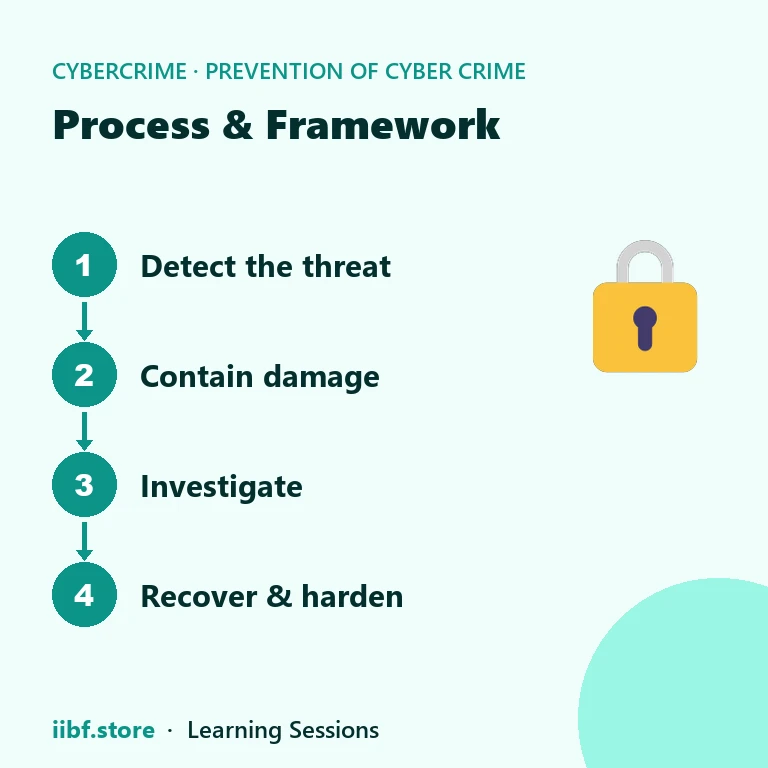
Once you can identify the channel, the exam usually pivots to the response: what should the bank do after the incident is detected? The IIBF syllabus treats this as a structured cycle — detect, contain, report, recover, review — rather than a single action. A bank that detects unusual card activity must first block the card, then trace the channel (skimming versus data breach versus customer-side compromise), then notify the affected customer, and only then move to recovery and process improvement. Skipping the containment step to jump straight to recovery is a classic wrong-option in scenario MCQs.
The chapter on incident management lays out this full response cycle and is essential reading regardless of which channel a question describes, since the response framework is largely channel-agnostic. Similarly, computer fraud protection covers the preventive controls banks deploy across all channels together — access control, encryption, audit trails, and customer education — rather than one channel at a time.
Regulatory guidance from the Reserve Bank of India reinforces this layered approach, requiring banks to maintain board-approved cyber security policies and to report significant incidents promptly; the official guidelines are published at rbi.org.in. A related channel worth remembering separately is account-based laundering, where stolen funds are routed through money mule accounts to break the money trail — this is less a "channel of attack" and more a "channel of concealment," and examiners sometimes test the difference. For the legal backbone underpinning all of this, the IT Act 2000 sections for cyber crime define what counts as an offence across every channel discussed here.
📌 Remember: Every channel needs three things covered in an exam answer — how the attack happens, what control prevents it, and what the bank does once it is detected. Missing any one of the three usually costs marks in descriptive answers.
Browse the full set of related concepts on the Prevention of Cyber Crime tag hub, which collects every article and chapter under this subject in one place.
🧠 Practice MCQs: Channels of Cyber Crime in Banking
Q1. A customer receives an SMS claiming to be from their bank, asking them to click a link and enter their net-banking password to "avoid account suspension." Which channel of cyber crime does this represent? (a) ATM skimming (b) Network intrusion (c) Communication-based phishing (d) Malware infection
Answer: (c) — This is a classic phishing attempt delivered through the communication channel, relying on urgency and brand impersonation rather than any technical exploit.
Q2. Which of the following best explains why EMV chip cards are harder to clone than magnetic-stripe cards? (a) Chips store data in encrypted, dynamic form for each transaction (b) Chips are physically larger (c) Chips do not require a PIN (d) Chips cannot be used at ATMs
Answer: (a) — EMV chips generate a unique transaction code each time, making static cloning of the kind used on magnetic stripes ineffective.
Q3. An attacker exploits an unpatched banking server to access customer data without any customer action. This falls under which channel? (a) Vishing (b) Card skimming (c) Network/system intrusion (d) SMS phishing
Answer: (c) — Server-side exploitation of unpatched vulnerabilities is a network/system-level channel that requires no victim interaction at all.
Q4. In the standard incident response cycle taught for banking cyber crime, what should happen immediately after an unusual transaction is detected? (a) Recovery and process review (b) Public disclosure to media (c) Containment, such as blocking the card or account (d) Customer is asked to resolve it independently
Answer: (c) — Containment comes before recovery and review; the compromised instrument must be blocked first to stop further loss.
Q5. Which statement about money mule accounts is correct in the context of cyber crime channels? (a) They are the initial channel used to steal funds (b) They are used to route and conceal stolen funds after the theft (c) They only apply to cash withdrawals at a branch (d) They are a form of ATM skimming
Answer: (b) — Money mule accounts are a concealment channel used after funds are stolen, not the initial attack vector itself.
Want chapter-wise mock tests with 100+ MCQs? Start practising free →
❓ Frequently Asked Questions
What is meant by a channel of cyber crime in banking?
A channel is the medium an attacker uses to reach a victim's funds or data, such as email, SMS, ATM hardware, malware, or an unsecured network. Identifying the channel determines which prevention control applies.
Are all cyber crime channels technology-based?
No. Communication-based channels like phishing and vishing rely mainly on social manipulation, while network intrusion and malware channels rely on technical exploitation. Both are covered separately in the IIBF syllabus.
Why do exam scenarios focus on identifying the channel first?
Because the correct prevention control or response step depends entirely on the channel involved — a card-based fraud needs a different answer than a network-based intrusion, even if the financial loss looks identical.
How can bank customers protect themselves across multiple channels?
By never sharing OTPs or CVVs over calls or messages, checking ATMs for tampering before use, keeping devices updated, and using only secure networks for banking transactions.
Mastering the channels of cyber crime in banking is less about memorising definitions and more about matching each scenario to its correct channel, control, and response step. Work through the linked chapters above, then test your recall with full-length mock tests on iibf.store/tests before your exam date.
Practice this topic
Take a free mock test, download chapter PDFs, or watch a video class — all included on iibf.store.