Succession Planning in Banks: Building the Next Leadership Bench
Every bank eventually loses a key leader — to retirement, resignation, or a sudden exit — and the ones that keep running smoothly are the ones that planned for it. Succession planning in banks is the structured process of identifying, developing, and readying internal talent to step into critical leadership roles before a vacancy actually happens. For CAIIB HRM candidates, this topic sits at the intersection of governance, talent management, and regulatory expectation, and it shows up in exam questions almost every cycle. This article breaks down the concept, the RBI angle, the process banks follow, and the mistakes examiners love to test.
📊 Why Succession Planning in Banks Matters Now
Indian banks have grown larger, more digital, and more exposed to reputational risk in the last decade, which means leadership continuity is no longer a "nice to have" HR exercise — it is a governance necessity. A sudden gap at the MD & CEO or business-head level can unsettle regulators, rating agencies, and depositors alike. Boards are now expected to treat leadership continuity as seriously as capital adequacy or credit risk, because an unplanned vacancy at the top disrupts strategy execution and can trigger short-term instability in stakeholder confidence. This is precisely why succession planning in banks has moved from being a peripheral HR activity to a standing board-level agenda item, reviewed alongside performance and remuneration matters. It also matters because banking careers have become more lateral — talented officers now move between functions, subsidiaries, and even industries — so the old assumption that the next-senior person will "naturally" step up no longer holds. A modern bank needs a visible, well-documented pipeline of ready candidates for every critical role, not an informal understanding among a handful of senior executives. Candidates preparing for CAIIB should also connect this theme to the broader HRM in Banks chapter, which frames succession planning as one pillar of strategic human resource management rather than a standalone activity.
💡 Exam Tip: If a question asks "why" succession planning matters for banks specifically (not generic corporates), the expected answer usually references governance continuity, regulatory expectation, and depositor/stakeholder confidence — not just cost savings.
🏦 The Regulatory Push Behind Succession Planning
The Reserve Bank of India has steadily tightened its expectations around bank governance, and succession planning sits squarely inside that framework. Under RBI's corporate governance guidelines for commercial banks, the board's Nomination and Remuneration Committee (NRC) is expected to periodically review the succession plan for the Managing Director & CEO and other Key Managerial Personnel (KMP), and to satisfy itself that credible internal candidates are being groomed for these roles. This is distinct from the "fit and proper" criteria RBI applies when vetting an actual appointment — succession planning is the forward-looking, developmental exercise that happens well before any name reaches the board for approval. Private banks, in particular, face closer scrutiny here because ownership and promoter influence historically created concentration risk at the top; RBI's push is meant to reduce dependence on any single individual. Public sector banks route senior appointments through the Banks Board Bureau process, but internal succession pipelines for the layer below top management remain each bank's own HR responsibility. For the most current wording of these expectations, candidates should always cross-check with RBI's own corporate governance circulars on rbi.org.in rather than relying on secondary summaries, since governance norms are amended periodically. This regulatory layer is what separates succession planning in banks from succession planning in a typical non-financial company — it is not purely a discretionary HR best practice, it is a supervisory expectation.
⚠️ Common Mistake: Candidates often confuse RBI's "fit and proper" criteria (used to evaluate a specific appointee) with succession planning (the ongoing process of developing multiple future-ready candidates). They test different things and appear as separate exam options.
🧭 The Succession Planning Process Inside a Bank
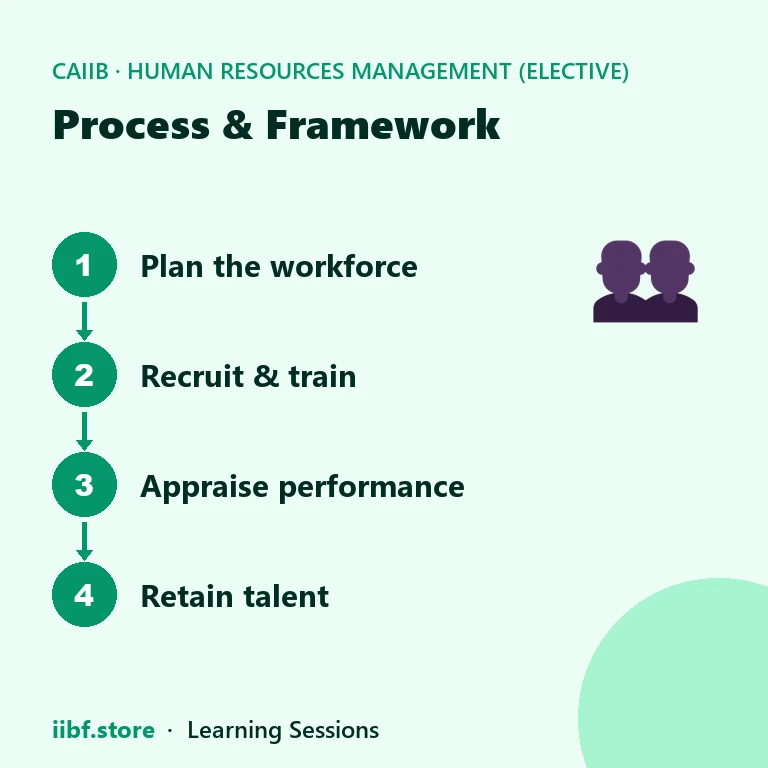
A workable succession plan follows a fairly standard sequence, and banks that skip steps usually end up with a plan that looks good on paper but fails when a real vacancy occurs. It starts with identifying critical positions — not every role needs a succession plan, only those whose sudden vacancy would materially disrupt operations, such as zonal heads, function heads, and CXO-level roles. Next comes talent identification, where HR and line managers jointly assess who has the potential to grow into these roles, typically using a competency framework tied to the bank's HR planning process, a theme also covered under Human Resource Planning. Many banks then plot candidates on a 9-box grid, mapping current performance against future potential, so that "ready now," "ready in 1-2 years," and "long-term potential" categories are clearly separated instead of left to memory. The development phase follows: identified successors are given stretch assignments, cross-functional rotations, mentoring by senior leaders, and targeted leadership programmes to close specific competency gaps. Finally, the plan is reviewed periodically — usually annually — because business priorities shift, people leave, and a successor mapped two years ago may no longer be the right fit. Throughout this cycle, knowledge transfer is critical so that institutional memory does not walk out the door with a retiring leader, which is why this topic pairs naturally with the Knowledge Management chapter in the CAIIB HRM syllabus.
🌱 Building the Leadership Bench: Tools Banks Actually Use
Identifying successors is only half the job; the harder half is actually developing them into leaders who can perform on day one. Job rotation across departments — credit, operations, treasury, branch banking — is one of the most common tools, because it exposes a potential leader to the full breadth of banking operations rather than a single silo. Mentoring and reverse-mentoring pairs high-potential officers with senior executives who can share tacit, hard-to-document judgment calls that no manual captures. Structured leadership development programmes, often delivered through the bank's own staff training college or in partnership with institutes, build capability in strategic thinking, stakeholder management, and regulatory awareness. Stretch assignments — leading a turnaround branch, heading a new product launch, or managing a crisis situation — test candidates under real pressure rather than a classroom simulation. Increasingly, banks also use structured feedback tools such as the Kirkpatrick model to judge whether these leadership programmes are actually producing better-prepared successors, a topic covered in depth in our piece on the Kirkpatrick Model of Training Evaluation. A well-built bench typically has at least two identified successors per critical role, at different readiness stages, so the bank is never left exposed if one candidate leaves or is not ready when the vacancy actually opens.
📌 Remember: A "ready now" successor in the 9-box grid means someone who could step into the role within weeks, not months — exam questions sometimes test this precise distinction between readiness tiers.
⚠️ Common Pitfalls in Bank Succession Planning
Even banks with a documented succession policy often get the execution wrong, and examiners like to test these failure modes because they reveal whether a candidate understands the concept beyond the textbook definition. The most frequent pitfall is the "heir apparent" trap — grooming a single obvious successor while ignoring a broader pool, which leaves the bank exposed if that one person leaves unexpectedly or turns out to be a poor cultural fit for the top role. A second pitfall is treating succession planning as a paperwork exercise done once a year to satisfy an audit or board review, rather than an ongoing conversation between HR and line management. A third is neglecting soft-skill and leadership competencies in favour of purely technical banking knowledge, producing successors who understand credit or treasury deeply but struggle with people management and stakeholder communication at the top. Poorly planned succession also tends to surface during organisational change or restructuring, when unclear reporting lines make it hard to tell who was actually being groomed for what — a dynamic explored further in our chapter on Organisational Change. Finally, banks sometimes confuse succession planning with workforce reduction exercises; the two are unrelated, and readers comparing planned exits with involuntary separations should see our guide on layoff and retrenchment in banks for that distinct process. Avoiding these pitfalls is what separates a succession plan that merely exists from one that actually protects the bank when a real vacancy hits.
📋 Succession Planning vs Replacement Planning at a Glance
Banks and HR textbooks frequently draw a line between succession planning and simple replacement planning, and this distinction is a favourite exam theme. The table below summarises the practical differences a CAIIB candidate should be able to recall quickly.
| Dimension | Succession Planning | Replacement Planning |
|---|---|---|
| Time horizon | Long-term, 3–5 years ✓ | Immediate, stop-gap only ✗ |
| Approach | Proactive talent development ✓ | Reactive backfill ✗ |
| Candidate pool | Multiple ready candidates per role ✓ | Usually one named backup ✗ |
| Development investment | Structured training, mentoring, rotation ✓ | Minimal, largely informal ✗ |
| Board-level review (NRC) | Reviewed periodically as governance practice ✓ | Not a standalone regulatory expectation ✗ |
🧠 Practice MCQs: Succession Planning in Banks
Q1. Under RBI's corporate governance guidelines for banks, which board committee is primarily responsible for periodically reviewing the succession plan for the MD & CEO and other Key Managerial Personnel? (a) Audit Committee (b) Risk Management Committee (c) Nomination and Remuneration Committee (d) Stakeholders Relationship Committee
Answer: (c) — The Nomination and Remuneration Committee (NRC) is tasked with reviewing succession plans for MD & CEO and KMP roles as part of board-level governance oversight.
Q2. In the 9-box grid used for succession planning, an employee rated high on both current performance and future potential is typically classified as: (a) Under-performer (b) Solid performer (c) High potential / future leader (d) Inconsistent performer
Answer: (c) — High performance combined with high potential places a candidate in the top box, marking them as a priority successor for critical roles.
Q3. What is the key difference between succession planning and replacement planning? (a) They are identical HR processes (b) Succession planning is reactive while replacement planning is proactive (c) Succession planning develops a pipeline of ready candidates over time while replacement planning identifies an immediate stand-in (d) Replacement planning applies only to clerical staff
Answer: (c) — Succession planning is a long-term, developmental process, whereas replacement planning is a short-term, reactive stop-gap arrangement.
Q4. Which of the following is NOT a standard tool used in bank leadership bench-building? (a) Job rotation across functions (b) Mentoring and coaching by senior executives (c) Structured leadership development programmes (d) Freezing all internal transfers
Answer: (d) — Freezing internal transfers blocks the cross-functional exposure that bench-building tools like job rotation are specifically designed to provide.
Q5. A common pitfall in succession planning in banks is: (a) Identifying multiple successors for critical roles (b) Relying on a single "heir apparent" without developing a broader talent pool (c) Periodic review by the board (d) Linking succession plans to competency frameworks
Answer: (b) — Over-reliance on one designated successor leaves the bank exposed if that individual leaves, is not ready, or is not the right fit when the vacancy actually occurs.
Want chapter-wise mock tests with 100+ MCQs? Start practising free →
❓ Frequently Asked Questions
What is succession planning in banks?
It is the structured, ongoing process by which a bank identifies critical leadership roles and develops multiple internal candidates to be ready to step into them, so that a sudden vacancy does not disrupt operations or governance continuity.
Why does RBI focus on succession planning for bank leadership?
Because an unplanned leadership vacancy at a bank can unsettle depositors, investors, and regulators alike, RBI expects boards — through the Nomination and Remuneration Committee — to periodically review succession plans for the MD & CEO and other Key Managerial Personnel as part of sound corporate governance.
How is succession planning different from replacement planning?
Succession planning is a long-term, proactive process that builds a pipeline of multiple developed candidates, while replacement planning is a short-term, reactive exercise that simply names an immediate stand-in for a role without structured development.
How should CAIIB HRM candidates prepare for succession planning questions?
Focus on the process flow (identify critical roles, assess talent, use tools like the 9-box grid, develop, review), the RBI governance angle, and the distinction from replacement planning — these three areas cover most exam variations on this topic.
Succession planning in banks is no longer a back-office HR checklist — it is a governance discipline that boards, regulators, and CAIIB examiners all take seriously, and understanding its process, tools, and common failure points will serve you well both in the exam hall and on the job. For related governance and people-management themes, browse our full HRM elective article archive, revisit the fundamentals in HRM in Indian Banks, or pivot to Bank Financial Management practice with our CAIIB BFM previous year questions set. Ready to test yourself further? Head to iibf.store/course/caiib for the complete CAIIB elective preparation package.
Quick quiz on this topic
5 exam-style questions from our free test bank — check yourself before you move on.
Practice this topic
Take a free mock test, download chapter PDFs, or watch a video class — all included on iibf.store.
Keep reading