CIRP under IBC 2016: The Complete Guide for 2026
The CIRP under IBC 2016 is the single most important process that every candidate preparing for the Insolvency and Bankruptcy Code certification must understand in complete detail. The Corporate Insolvency Resolution Process, commonly abbreviated as CIRP, is the structured, time-bound mechanism through which a financially distressed corporate debtor is either revived through a resolution plan or, failing that, sent into liquidation. Introduced by the Insolvency and Bankruptcy Code, 2016, the process shifted India from a fragmented, debtor-in-possession recovery regime to a creditor-in-control model administered through the National Company Law Tribunal. This article walks you through every stage of the CIRP, from the triggering default to the final distribution waterfall, in exam-ready depth.
Triggering the CIRP and NCLT Admission
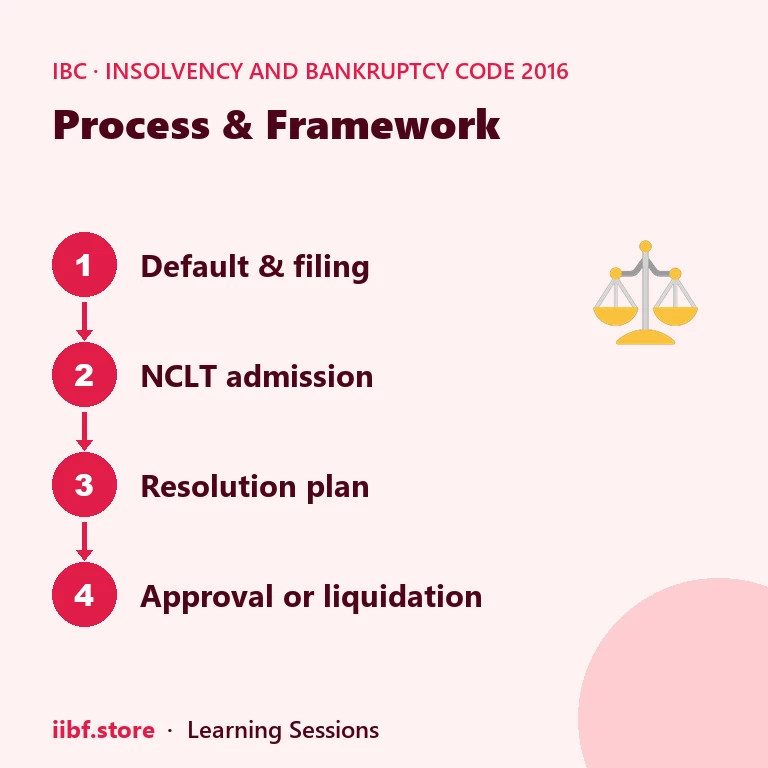
The Corporate Insolvency Resolution Process begins when a corporate debtor commits a default of at least one crore rupees, the threshold that was raised from one lakh through a notification in March 2020 to shield smaller businesses. Three categories of applicants may approach the adjudicating authority: a financial creditor under Section 7, an operational creditor under Section 9, and the corporate debtor itself under Section 10. The adjudicating authority for corporate persons is the National Company Law Tribunal, or NCLT. When a financial creditor files, the NCLT must be satisfied that a default has occurred and that the application is complete; it then has fourteen days to admit or reject the application. An operational creditor must first serve a demand notice and wait ten days for the debtor to either pay or point to a pre-existing dispute. Once the NCLT admits the application, the CIRP formally commences from the insolvency commencement date. Admission triggers three simultaneous consequences that define the entire process: the declaration of a moratorium, the public announcement inviting claims, and the appointment of an interim resolution professional. Understanding which section applies to which class of creditor, and the precise timelines the NCLT must follow, is among the highest-yield topics in this examination.
The Moratorium Under Section 14
The moratorium under Section 14 is the protective shield that makes the CIRP possible, and it is a favourite examination topic. From the insolvency commencement date, the NCLT declares a moratorium that freezes the corporate debtor in place so that its value is preserved during the resolution effort. During this calm period, four things are prohibited: the institution or continuation of any suit or proceeding against the corporate debtor, the transfer or disposal of any of its assets, any action to foreclose or enforce a security interest including under the SARFAESI Act, and the recovery of any property occupied by the debtor. This calming breathing space stops a chaotic race among creditors to seize assets, which would destroy the going-concern value the process is trying to protect. Certain essential goods and services to the debtor cannot be terminated or suspended during the moratorium, ensuring the business keeps running. The moratorium is not permanent; it lasts until the CIRP is completed, meaning until either a resolution plan is approved or a liquidation order is passed. Importantly, the moratorium protects the corporate debtor but does not extend to personal guarantors in the same manner, a distinction the Supreme Court has clarified and which candidates should note carefully for scenario-based questions.
The Resolution Professional and Committee of Creditors
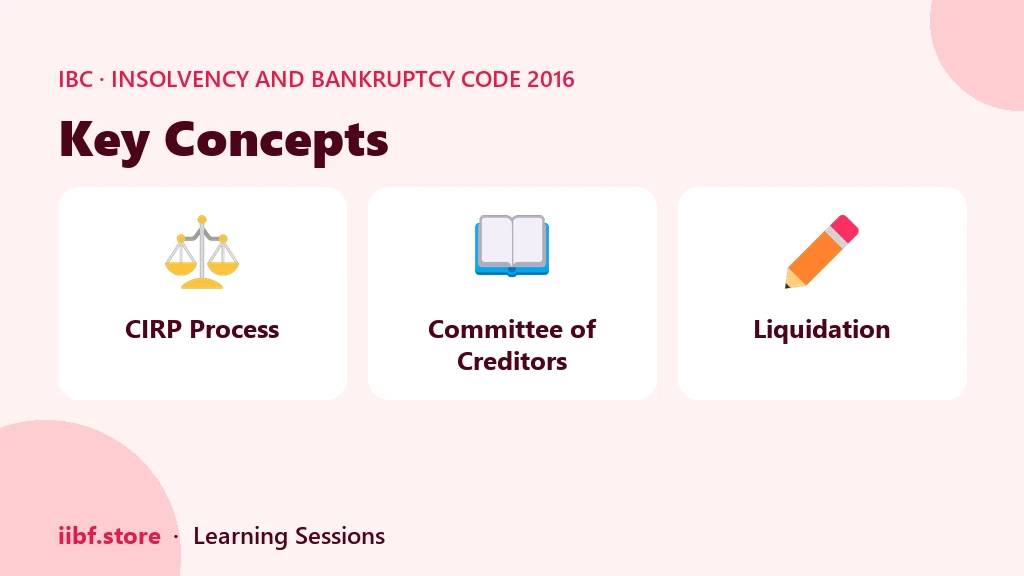
Once the CIRP commences, control of the corporate debtor passes from its board to an insolvency professional. First an interim resolution professional, or IRP, is appointed to manage the debtor as a going concern and to collect and verify claims from creditors. The IRP's most critical early task is constituting the Committee of Creditors, universally called the CoC. The CoC comprises the financial creditors of the corporate debtor, with voting rights allocated in proportion to the amount of financial debt owed to each member. Operational creditors do not get a vote unless their dues are large, though they may attend if their total dues exceed ten per cent of the debt. The CoC is the true decision-making engine of the process; it confirms or replaces the IRP with a resolution professional, or RP, who then runs the process to conclusion. Key CoC decisions require a sixty-six per cent voting majority, including approval of a resolution plan, while routine matters need fifty-one per cent. The RP invites resolution plans from prospective resolution applicants, checks each for compliance with Section 30, and places compliant plans before the CoC. The commercial wisdom of the CoC in choosing a plan is largely beyond judicial review, a principle the Supreme Court affirmed in the Essar Steel judgment. For the exam, master the composition of the CoC, its voting thresholds, and the respective roles of the IRP and RP.
The 330-Day Timeline and the Resolution Plan
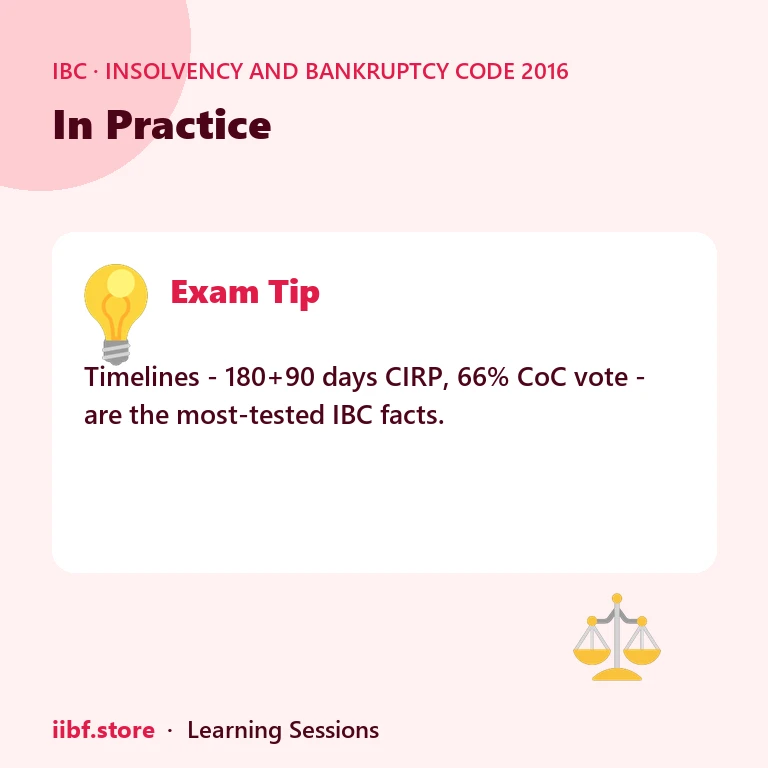
Time is the defining discipline of the CIRP under IBC 2016. The Code originally mandated completion within 180 days, extendable once by up to 90 days with CoC approval, giving an outer limit of 270 days. A 2019 amendment introduced a mandatory outer ceiling of 330 days, which is inclusive of any time spent in legal proceedings. This 330-day cap was designed to prevent the endless litigation that had begun to erode the Code's promise of speed, though tribunals may in exceptional cases permit a short extension where the delay is not attributable to the parties. Within this window, the resolution professional must run the process and secure an approved resolution plan. A resolution plan is a proposal by a resolution applicant to revive the corporate debtor; it must provide for payment of insolvency resolution process costs in priority, repayment of operational creditors at least at liquidation value, and management of the debtor's affairs after approval. The plan must not contravene any law and must be feasible and viable. Once the CoC approves a plan by the requisite sixty-six per cent majority, the RP submits it to the NCLT for final approval. An approved plan is binding on the corporate debtor, its employees, creditors, guarantors, and all stakeholders, giving the successful applicant a clean slate. You can test your grasp of these timelines with our targeted CIRP mock tests, which mirror the real examination pattern.
Liquidation and the Section 53 Waterfall
If no resolution plan is approved within the permitted timeline, or if the CoC decides at any point that the debtor cannot be revived, or if the NCLT rejects a plan, the corporate debtor proceeds to liquidation. The NCLT passes a liquidation order and appoints a liquidator, who is usually the resolution professional. The liquidator takes custody of the entire estate, forms a liquidation estate, and sells the assets to realise value. The distribution of the proceeds follows the strict order of priority laid down in Section 53, known as the waterfall mechanism. At the very top sit the insolvency resolution process and liquidation costs. Next come workmen's dues for the preceding twenty-four months together with debts owed to secured creditors who have relinquished their security. Below them are wages of other employees for the preceding twelve months, then unsecured financial creditors. Government dues and secured creditors who enforced their security outside the process rank lower still, followed by any remaining debts, preference shareholders, and finally equity shareholders. This waterfall is one of the most frequently examined provisions of the entire Code, and candidates must be able to reproduce the order accurately. The Insolvency and Bankruptcy Board of India, whose framework you can review on the IBBI website, regulates the professionals and the process at every stage. To see how liquidation interacts with older recovery tools, compare it with the SARFAESI enforcement route that secured creditors historically relied upon.
Conclusion: Master the CIRP for Certification Success
The CIRP under IBC 2016 is a tightly choreographed sequence: a default triggers an application to the NCLT, admission brings a moratorium under Section 14, an IRP and then an RP steer the debtor while the Committee of Creditors takes the commercial decisions, a resolution plan must be approved within the 330-day ceiling, and failure leads to liquidation governed by the Section 53 waterfall. Learn these stages, their timelines, and their voting thresholds cold, and you will confidently answer any CIRP question the certification throws at you. Ready to convert this knowledge into marks? Put your understanding to the test with our structured practice mock tests, deepen your regulatory foundation through the CAIIB preparation course, and keep pace with the newest circulars on our IIBF news page. You will also find more strategy and worked examples on the exam blog. Disciplined, targeted revision of high-yield processes like the CIRP is exactly what separates a comfortable pass from a top score.
What is the CIRP under IBC 2016?
The Corporate Insolvency Resolution Process is the time-bound mechanism under the Insolvency and Bankruptcy Code, 2016 through which a defaulting corporate debtor is either revived by an approved resolution plan or, if revival fails, sent into liquidation, all administered by the National Company Law Tribunal.
What happens during the moratorium under Section 14?
From the insolvency commencement date, all suits, asset transfers, security enforcement, and property recovery against the corporate debtor are frozen. This protective shield preserves the debtor's going-concern value while the resolution professional runs the process.
Who forms the Committee of Creditors and what is its role?
The Committee of Creditors is composed of the financial creditors of the corporate debtor, with voting rights proportional to the debt owed. It is the key decision-making body, approving resolution plans and major steps by a sixty-six per cent voting majority.
What is the maximum timeline for completing the CIRP?
The CIRP must ordinarily be completed within 330 days, inclusive of time spent in legal proceedings. This ceiling was introduced by a 2019 amendment to the original 180-day plus 90-day extension framework to keep the process fast and predictable.
Quick quiz on this topic
5 exam-style questions from our free test bank — check yourself before you move on.
Practice this topic
Take a free mock test, download chapter PDFs, or watch a video class — all included on iibf.store.