The voluntary liquidation under IBC: Process and Requirements
When a company or LLP is financially sound but its promoters simply want to close it down in an orderly, legally clean way, the Code offers a dedicated route: the voluntary liquidation under IBC process. Unlike liquidation that follows a failed resolution process, this is a solvent entity choosing to wind up on its own terms, under the supervision of an insolvency professional. For IIBF candidates, this chapter is a frequent source of MCQs precisely because it is often confused with ordinary liquidation under Chapter III of the Code.
📜 What Is Voluntary Liquidation Under IBC
Voluntary liquidation under IBC is governed by Section 59 of the Insolvency and Bankruptcy Code, 2016, read with the IBBI (Voluntary Liquidation Process) Regulations, 2017. It allows a solvent "corporate person" — a company, an LLP, or any other person incorporated with limited liability — to wind itself up outside the courtroom-driven route that follows a failed Corporate Insolvency Resolution Process.
The defining feature is solvency. This is not a distress mechanism; it exists for entities that have no outstanding debt problem but want a formal, IBC-governed exit instead of winding up under the Companies Act. A corporate person cannot use this route if it is already undergoing any insolvency resolution process, or if a winding-up petition against it is pending before any other forum.
The background of how liquidation provisions evolved within the Code is covered in the Evolution of Insolvency and Bankruptcy Code chapter, which sets useful context for why a separate voluntary route was carved out alongside the creditor-driven process.
🧾 Conditions and Declaration of Solvency
The process cannot begin without a formal declaration of solvency. A majority of the directors, or designated partners in the case of an LLP, must make this declaration, verified by an affidavit, stating two things: first, that they have made a full inquiry into the affairs of the corporate person and formed the opinion that it has no debt, or that it will be able to pay its debts in full from the proceeds of assets sold in the voluntary liquidation; and second, that the company is not being liquidated to defraud any person.
This declaration must be accompanied by the audited financial statements and record of business operations for the previous two years, or for the period since incorporation if the entity is younger, along with a valuation report of its assets prepared by a registered valuer, where one is available.
💡 Exam Tip: The declaration of solvency is filed by directors, but the trigger for commencement is the members' resolution that follows it — examiners often test which document actually starts the liquidation clock.
🗳️ Approval Process — Members and Creditors
Within four weeks of the declaration of solvency, the members must pass a special resolution requiring the corporate person to be liquidated voluntarily and appointing an insolvency professional as liquidator. Where liquidation is triggered by expiry of the entity's duration, or by an event specified in its constitutional documents, an ordinary resolution is sufficient instead.
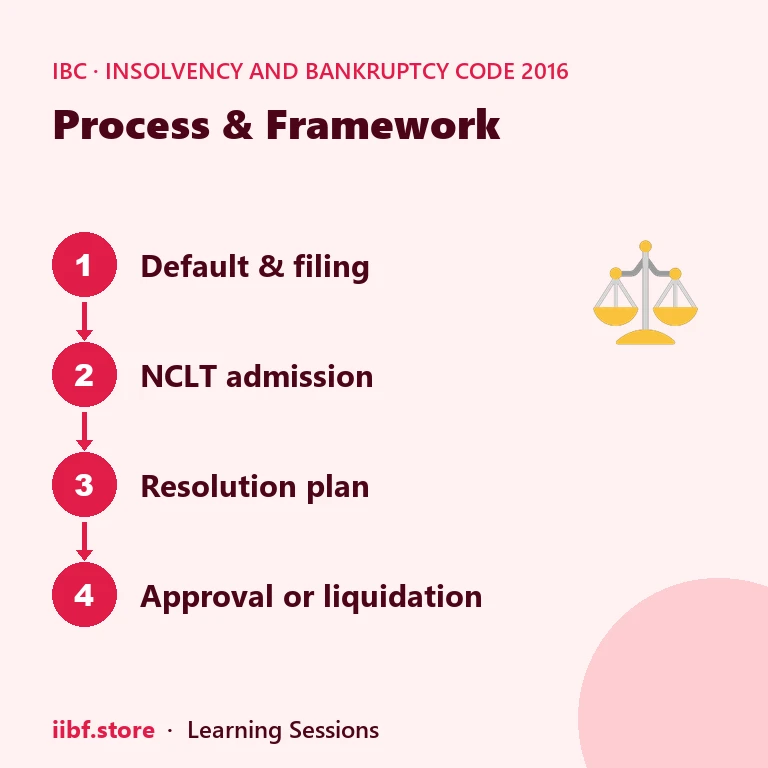
If the corporate person owes any debt to any person, the approval of creditors representing two-thirds in value must also be obtained, within seven days of the members' resolution. Once approved, the corporate person is required to notify the Registrar of Companies and the IBBI within seven days of the resolution, or of creditor approval where applicable. The date on which this resolution is passed (or creditor-approved) becomes the liquidation commencement date — a date that fixes every subsequent deadline in the process.
⚠️ Common Mistake: Candidates assume a special resolution alone is always enough. Where the entity has any outstanding debt, creditor approval by two-thirds in value is a mandatory additional step, not an optional formality.
👤 Role of the Liquidator in Voluntary Liquidation
The insolvency professional appointed as liquidator must make a public announcement within five days of appointment, calling on stakeholders to submit their claims within thirty days of the liquidation commencement date. This mirrors the claims process familiar from CIRP, but here the liquidator is answerable to solvent members rather than a distressed creditor committee.
The liquidator takes custody and control of all assets, property, and books of the corporate person, opens a dedicated liquidation account for all receipts and payments, and prepares a Preliminary Report along with an Asset Memorandum. Realised proceeds are distributed to stakeholders strictly in the order of priority set out in the Code's waterfall provisions, only after claims are received and verified. Throughout the process, the liquidator must keep the Registrar of Companies and the IBBI informed through periodic progress reports, a compliance duty examined further in the Regulatory & Miscellaneous Aspects chapter.
📅 Process Timeline and Dissolution
Voluntary liquidation is expected to be completed within twelve months from the liquidation commencement date where the corporate person's affairs need to be wound up and its assets sold. On completion, the liquidator prepares a final report showing that the affairs have been fully wound up and assets liquidated, and applies to the National Company Law Tribunal for an order of dissolution. The corporate person stands dissolved from the date of that NCLT order, and a copy is filed with the Registrar of Companies within the prescribed period.
| Feature | Voluntary Liquidation | Liquidation after Failed CIRP |
|---|---|---|
| Who initiates it | Solvent corporate person itself ✅ | Adjudicating Authority, after CIRP fails ❌ (not self-initiated) |
| Solvency required | Yes — declaration of solvency mandatory ✅ | No — entity is typically insolvent ❌ |
| Trigger document | Members' special resolution | NCLT liquidation order |
| Governing regulations | IBBI (Voluntary Liquidation Process) Regulations, 2017 | IBBI (Liquidation Process) Regulations, 2016 |
📌 Remember: Dissolution takes legal effect only from the date of the NCLT order, not from the date the liquidator submits the final report.
🧠 Practice MCQs: Voluntary Liquidation under IBC
Q1. Voluntary liquidation under IBC is primarily governed by which section of the Code? (a) Section 12A (b) Section 29A (c) Section 53 (d) Section 59
Answer: (d) — Section 59 of the IBC, read with the IBBI (Voluntary Liquidation Process) Regulations, 2017, governs voluntary liquidation.
Q2. Who must make the declaration of solvency before voluntary liquidation begins? (a) A majority of the directors/designated partners (b) The company's statutory auditor (c) The Adjudicating Authority (d) Any one shareholder
Answer: (a) — A majority of directors or designated partners must make and verify the declaration of solvency by affidavit.
Q3. If a corporate person owes debt, whose additional approval is required for voluntary liquidation? (a) The Registrar of Companies (b) Creditors representing two-thirds in value (c) The Insolvency and Bankruptcy Board of India (d) The stock exchange
Answer: (b) — Where debts are owed, creditors representing two-thirds in value must approve the resolution within seven days of the members' resolution.
Q4. Within how many days of appointment must the liquidator make a public announcement in voluntary liquidation? (a) 3 days (b) 5 days (c) 14 days (d) 30 days
Answer: (b) — The liquidator must make a public announcement within five days of appointment, inviting claims within thirty days.
Q5. A corporate person stands dissolved in voluntary liquidation from the date of: (a) the members' special resolution (b) the declaration of solvency (c) the NCLT's dissolution order (d) the liquidator's public announcement
Answer: (c) — Dissolution takes legal effect only from the date the NCLT passes the order of dissolution based on the liquidator's final report.
Want chapter-wise mock tests with 100+ MCQs? Start practising free →
❓ Frequently Asked Questions
Can an insolvent company opt for voluntary liquidation under IBC?
No. Voluntary liquidation is available only to a solvent corporate person that can pay its debts in full from asset sale proceeds. An insolvent entity must instead go through CIRP or liquidation under Chapter III of the Code.
What is the difference between voluntary liquidation and voluntary winding up under the Companies Act?
Voluntary liquidation under IBC is a distinct, IBC-governed process run by an insolvency professional under IBBI regulations, culminating in an NCLT dissolution order — separate from the winding-up mechanism under the Companies Act, 2013.
Does an LLP qualify for voluntary liquidation under the IBC?
Yes. Section 59 covers any "corporate person" as defined under the Code, which includes companies, limited liability partnerships, and any other person incorporated with limited liability under an existing law.
Who verifies claims during voluntary liquidation?
The liquidator appointed by the members (or by creditors, where their approval was required) receives and verifies stakeholder claims after the public announcement, before distributing realised proceeds in order of statutory priority.
Bring it back to the bigger picture
Voluntary liquidation is one small but exam-heavy corner of the IBC's liquidation framework, and it reads best alongside related exit routes covered under fresh start process under IBC and look-back period under IBC, and against the duties spelled out for a resolution professional under IBC. Bankers preparing on the regulatory side may also find it useful to contrast this with corporate exit rules under licensing of banking companies. For the full sweep of topics under this subject, browse the Insolvency and Bankruptcy Code 2016 tag, or build structured revision through the CAIIB course track on iibf.store.
Prefer revising from a printed book?
Chapter-wise books with MCQs after every chapter — minimal pages, complete coverage, delivered anywhere in India. Every book has a free sample to read first.
132 pages · 225 MCQs
Learning Sessions · Ashish Sir
188 pages · 435 MCQs
Learning Sessions · Ashish Sir
117 pages · 236 MCQs
Learning Sessions · Ashish Sir
Learning Sessions · Ashish Sir
118 pages · 299 MCQs
Learning Sessions · Ashish Sir
Learning Sessions · Ashish Sir
Learning Sessions · Ashish Sir
Learning Sessions · Ashish Sir
115 pages · 255 MCQs
Learning Sessions · Ashish Sir
Learning Sessions · Ashish Sir
334 pages · 936 MCQs
Learning Sessions · Ashish Sir
Learning Sessions · Ashish Sir
115 pages · 344 MCQs
Learning Sessions · Ashish Sir
107 pages · 240 MCQs
Learning Sessions · Ashish Sir
90 pages · 150 MCQs
Learning Sessions · Ashish Sir
Learning Sessions · Ashish Sir
131 pages · 672 MCQs
Learning Sessions · Ashish Sir
221 pages · 831 MCQs
Learning Sessions · Ashish Sir
128 pages · 524 MCQs
Learning Sessions · Ashish Sir
107 pages · 445 MCQs
Learning Sessions · Ashish Sir
148 pages · 478 MCQs
Learning Sessions · Ashish Sir
151 pages · 465 MCQs
Learning Sessions · Ashish Sir
148 pages · 375 MCQs
Learning Sessions · Ashish Sir
216 pages · 895 MCQs
Learning Sessions · Ashish Sir
109 pages · 300 MCQs
Learning Sessions · Ashish Sir
104 pages · 360 MCQs
Learning Sessions · Ashish Sir
82 pages · 297 MCQs
Learning Sessions · Ashish Sir
151 pages · 600 MCQs
Learning Sessions · Ashish Sir
98 pages · 282 MCQs
Learning Sessions · Ashish Sir
Quick quiz on this topic
5 exam-style questions from our free test bank — check yourself before you move on.
Practice this topic
Take a free mock test, download chapter PDFs, or watch a video class — all included on iibf.store.