Section 53 liquidation waterfall: IBC 2016 Guide
When a corporate insolvency resolution fails and a company heads into liquidation, one provision decides who gets paid and in what order: the Section 53 liquidation waterfall of the Insolvency and Bankruptcy Code, 2016. For anyone preparing the IIBF certification on the IBC, this is among the highest-yield topics in the syllabus, because it tests both memory of the exact priority order and the reasoning behind it. This article lays out the full waterfall, explains why secured creditors and workmen sit where they do, clarifies the treatment of government dues after landmark rulings, and connects the mechanics to a banker's real-world recovery decisions in 2026. Get the Section 53 liquidation waterfall right and a whole cluster of exam questions falls into place.
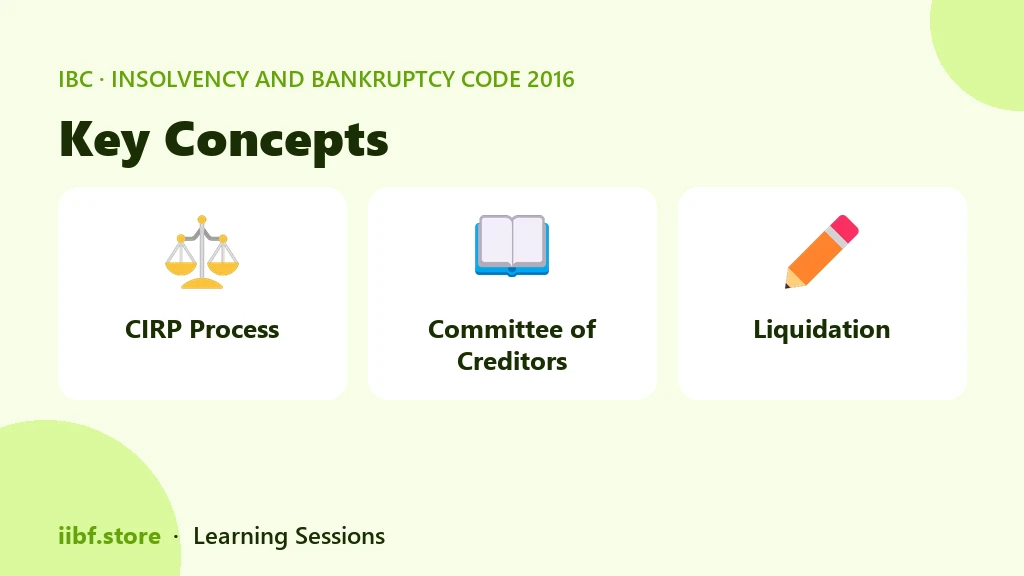
The waterfall exists to replace the chaotic, litigation-heavy priority disputes of the old regime with a clear, statutory pecking order — money flows down the tiers, and a lower tier receives nothing until the tier above is fully satisfied.
The Full Order of Priority Under Section 53
The Section 53 liquidation waterfall distributes liquidation proceeds in the following descending order:
- (a) Insolvency resolution and liquidation costs — paid in full first, including the liquidator's fees.
- (b) Workmen's dues (24 months) and secured creditors who relinquished their security — ranked equally (pari passu) at the second tier.
- (c) Wages and unpaid dues of other employees for 12 months.
- (d) Financial debts owed to unsecured creditors.
- (e) Government dues (up to 2 years) and secured creditors' unpaid amounts after enforcing security outside the process.
- (f) Any remaining debts and dues.
- (g) Preference shareholders.
- (h) Equity shareholders or partners — last in line.
The elegant logic here is worker protection at the top and equity holders at the bottom, reflecting the principle that owners bear residual risk. Committing this exact sequence to memory is non-negotiable for the exam. Reinforce it with rapid-recall drills on our IBC concept-match game and full practice on the mock test series.
Secured Creditors: Relinquish or Enforce?
A defining feature of Section 53 is the strategic choice it forces on a secured creditor — typically a bank. A secured creditor may either relinquish its security interest to the liquidation estate and rank high at tier (b) alongside workmen, or stand outside and enforce its security independently under Section 52, realising the collateral directly.
- If it relinquishes, it shares tier (b) pari passu with 24 months of workmen's dues — a strong, early position in the pool.
- If it enforces and the realisation falls short, the unpaid balance drops all the way down to tier (e), ranking with government dues.
This is a genuine commercial calculation: a bank weighs the expected recovery from enforcing its specific collateral against sharing the common pool at a higher rank. Where collateral value is strong and clean, standing outside can maximise recovery; where it is weak or contested, relinquishing and joining the pool is safer. This decision-making sits at the core of a lender's recovery strategy and links closely to the broader recovery toolkit covered in the CAIIB legal and banking modules.
Where Do Government Dues Rank?
One of the most consequential features of the IBC — and a frequent exam trap — is that government dues rank low, at tier (e), below unsecured financial creditors. This was a deliberate policy shift to make credit lending viable, and the Supreme Court has repeatedly upheld the primacy of the Code over conflicting tax statutes.
- Statutory dues such as income tax, GST, and other government claims fall to tier (e), capped at amounts relating to the two years before liquidation commencement.
- The Rainbow Papers ruling created debate on whether certain statutory security interests elevate the state to secured-creditor status, but the settled principle remains that the Section 53 order overrides general priority claims in other laws by virtue of Section 238's overriding effect.
- Amounts contributed by a secured creditor from enforcing security, if it fails to pay its share of costs, are also dealt with under this tier.
For candidates, the takeaway is simple: government does not jump the queue under the IBC. Always verify the current legal position from the primary regulator, the Insolvency and Bankruptcy Board of India, and follow evolving case law through our regulatory and legal news hub.
Why the Waterfall Matters to Bankers in 2026
Beyond the exam, the Section 53 liquidation waterfall shapes real lending and provisioning decisions. A banker who understands the waterfall prices credit better, structures security more carefully, and provisions more accurately once an account enters the insolvency process. Practical implications include:
- Recovery estimation — the tier a claim will land in drives the expected haircut and the Loss Given Default assumption feeding provisioning.
- Security perfection — properly created and registered charges preserve the option to enforce under Section 52 for maximum recovery.
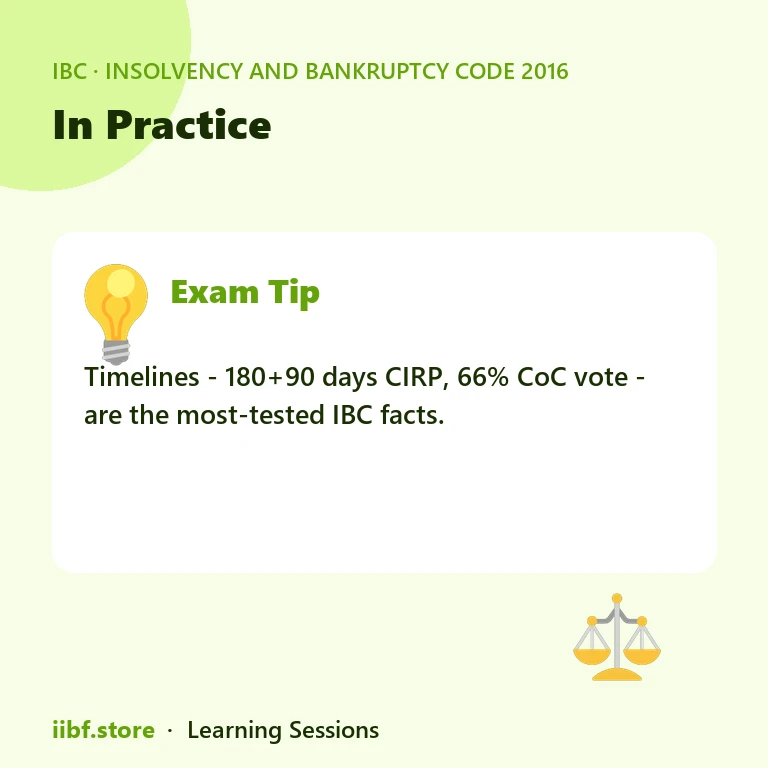
- Committee of Creditors strategy — during resolution, financial creditors weigh a resolution plan against their likely liquidation-waterfall outcome as the benchmark for any haircut.
In short, liquidation value under Section 53 is the floor against which every resolution plan is judged. Deepen your understanding with more explainers on the IIBF insolvency blog and keep your recall sharp before test day.
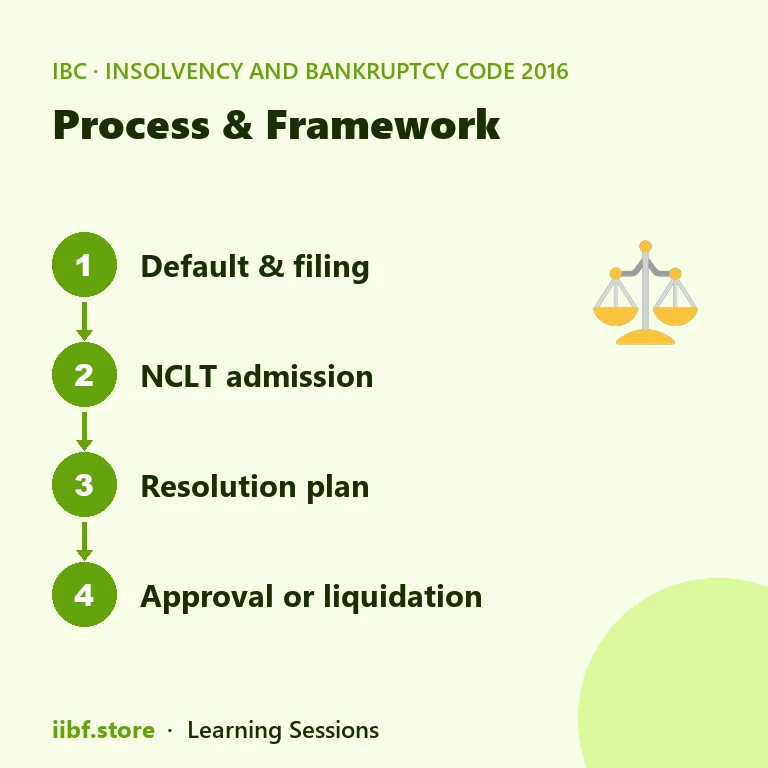
It also helps to place Section 53 in the wider architecture of the Code. The distribution waterfall only comes into play once liquidation is ordered under Section 33, which typically follows a failed corporate insolvency resolution process, a rejected resolution plan, or a Committee of Creditors' decision to liquidate. Before any of the tiers are paid, the liquidator forms the liquidation estate under Section 36, excluding assets held in trust and certain third-party assets. A landmark clarification worth remembering is that dues owed to the corporate debtor's own workmen from provident fund, pension fund, and gratuity fund are not part of the liquidation estate at all under Section 36(4), so they are paid ahead of the waterfall rather than ranked within it. Examiners occasionally test this subtlety, since many candidates wrongly slot these dues into tier (b). Finally, the entire mechanism is time-bound: the liquidation process is expected to conclude within one year, reinforcing the Code's overarching goal of time-bound, value-maximising resolution rather than indefinite recovery litigation.
Frequently Asked Questions
Related study material
Go deeper with the full chapter notes and the complete article hub for this subject:
- Credit Recovery Laws for Banks
- Evolution of Insolvency and Bankruptcy Code
- All Insolvency and Bankruptcy Code 2016 articles & notes
What is the Section 53 liquidation waterfall?
Section 53 of the IBC 2016 sets the order in which liquidation proceeds are distributed. It starts with resolution and liquidation costs, then workmen's dues and secured creditors, followed by other employees, unsecured financial creditors, government dues, remaining debts, preference shareholders, and finally equity shareholders.
Where do secured creditors rank in the waterfall?
A secured creditor that relinquishes its security ranks high at tier (b), pari passu with 24 months of workmen's dues. If it instead enforces its security independently under Section 52 and recovers less than owed, the unpaid balance drops to tier (e) alongside government dues.
Do government dues get priority under the IBC?
No. Government and statutory dues rank at tier (e), below unsecured financial creditors, and are capped at amounts relating to the two years before liquidation. Section 238 gives the Code overriding effect over conflicting priority claims in other laws.
Why does liquidation value matter during resolution?
The liquidation value under Section 53 is the benchmark floor against which any resolution plan is judged. Financial creditors on the Committee of Creditors compare a plan's proposed recovery to what they would receive in liquidation before accepting any haircut.
Conclusion: Master the Waterfall, Master the Paper
The Section 53 liquidation waterfall rewards precision — the exact tier order, the secured-creditor choice, and the low rank of government dues. Learn it as a logical hierarchy rather than a list to memorise, and you will confidently tackle the insolvency-distribution questions that appear every session. Ready to test your recall under real conditions? Attempt a full-length paper on our IBC mock tests and lock in your certification today.
Quick quiz on this topic
5 exam-style questions from our free test bank — check yourself before you move on.
Practice this topic
Take a free mock test, download chapter PDFs, or watch a video class — all included on iibf.store.