Compliance Risk Assessment for IIBF BCP: RCSA, Residual Risk and CCO Reporting
For candidates preparing the IIBF Banking Compliance Professional (BCP) certification, mastering compliance risk assessment is non-negotiable. The Reserve Bank of India expects every scheduled commercial bank to run a structured, evidence-backed process that identifies where regulatory breaches can occur, measures how severe they would be, and confirms that controls actually work. This article walks through the Risk and Control Self-Assessment (RCSA) methodology that sits at the heart of the compliance function, the residual-risk logic examiners test, and the reporting lines that connect the Chief Compliance Officer (CCO) to the Board. Whether you are revising Module D or building your first compliance dashboard on the job, a clear grip on compliance risk assessment will help you answer exam questions and defend your bank during an RBI inspection.
What Compliance Risk Assessment Means for a Bank
Compliance risk is the risk of legal or regulatory sanctions, material financial loss, or reputational damage a bank may suffer when it fails to comply with laws, regulations, RBI directions, codes of conduct, or its own internal policies. Compliance risk assessment is the disciplined exercise of locating those exposures across every business line and support function, then ranking them so that scarce compliance resources go where the danger is greatest. Under RBI's compliance function guidelines, this is not a one-off audit but a continuous, forward-looking activity owned by the compliance department and reviewed by senior management.
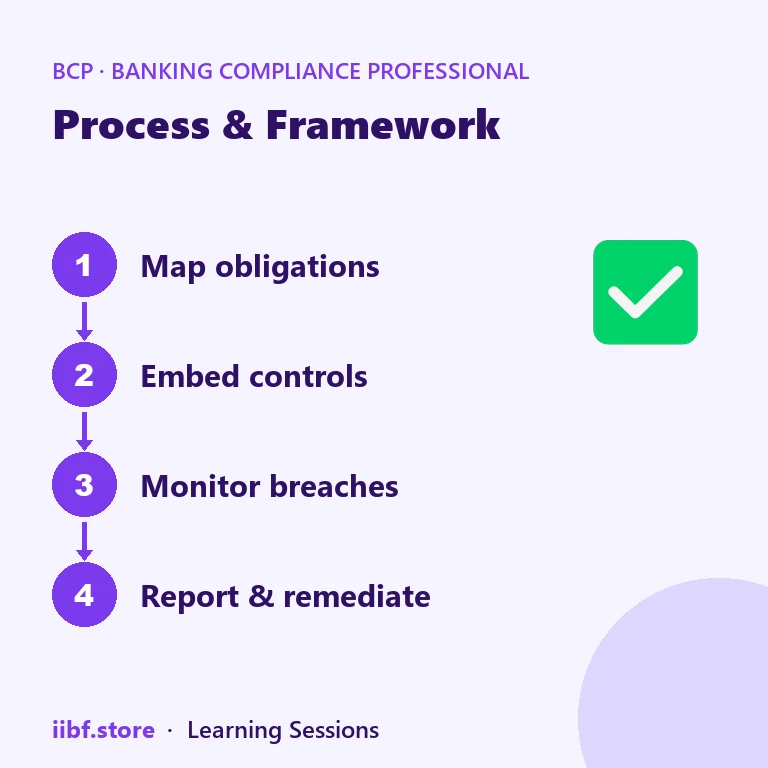
The assessment typically begins with a regulatory obligations register: a mapped inventory of every applicable circular, Master Direction, and statute — from KYC/AML rules to loan-pricing and exposure norms. Each obligation is tied to a process owner, a control, and a risk rating. The value of a good compliance risk assessment is that it turns a vague fear of "non-compliance" into a prioritised, testable list. For BCP aspirants, remember the golden thread the RBI insists on: identify, assess, monitor, and report. Skip any one step and the framework collapses. A well-run assessment also feeds the annual compliance programme and the compliance testing calendar, ensuring high-risk areas such as credit sanctioning and priority-sector reporting are examined more frequently than low-risk ones.
The RCSA Methodology Step by Step
Risk and Control Self-Assessment (RCSA) is the workhorse technique behind compliance risk assessment. In an RCSA workshop, the people who actually run a process — say, the branch credit team handling priority sector, MSME and microfinance advances — list the compliance risks they face, score the inherent (gross) risk, describe the controls in place, and then score the residual (net) risk after controls. The difference between inherent and residual risk is the exam-critical concept: controls should demonstrably pull the residual score into an acceptable band, and any gap becomes an action item with an owner and a due date.
Scoring usually combines likelihood and impact on a matrix, producing a heat-map of red, amber and green cells. Red cells demand immediate remediation; amber cells need a monitoring plan; green cells are logged and periodically re-tested. The self-assessment is deliberately bottom-up because frontline staff see failure modes that head-office rarely spots — for example, a documentation lapse in loans and advances regulatory restrictions. Crucially, RCSA is validated independently: internal audit challenges the ratings so the exercise does not become a self-congratulatory tick-box. This validation loop is what makes RCSA credible to the Board and to RBI supervisors during an inspection.
Inherent vs Residual Risk: The Scoring That Examiners Test
Understanding the maths of compliance risk assessment separates confident candidates from those who merely memorise. Inherent risk is the exposure before any control is applied; residual risk is what remains after controls operate as designed. The table below shows an illustrative rating scheme — the exact bands vary bank to bank, but the logic is standard across BCP study material and RBI-aligned frameworks.
| Risk Band | Likelihood × Impact score | Meaning | Required Action |
|---|---|---|---|
| High (Red) | 15–25 | Serious regulatory breach likely | Immediate remediation; escalate to CCO and Board |
| Medium (Amber) | 8–14 | Control weakness with material exposure | Time-bound action plan; enhanced monitoring |
| Low (Green) | 1–7 | Adequately controlled | Periodic re-testing; log and review annually |
Notice that a high inherent-risk area is acceptable only if strong controls drive the residual score into the green or lower-amber zone. Examiners love a scenario where a bank has strong inherent exposure in, say, large exposures and exposure norms, yet weak monitoring — so the residual risk stays red. The correct answer is always to strengthen the control, not to quietly re-rate the inherent risk downward. Documented rationale for every score is essential; if a bank cannot explain why a residual rating fell, RBI treats the assessment as unreliable. Keep this residual-risk discipline front of mind, because it recurs across the whole BCP syllabus and in real supervisory reviews.
Governance, Reporting and the CCO's Role
A compliance risk assessment is only useful if its findings travel up the governance chain and trigger action. RBI's framework places the Chief Compliance Officer at the centre: the CCO owns the compliance risk assessment, reports functionally to the Board's Audit Committee or a dedicated compliance committee, and enjoys sufficient seniority and independence to escalate without fear. The assessment output feeds a quarterly compliance report to senior management and the Board, flagging red-rated items, overdue remediation, and emerging regulatory changes. This reporting must be timely and candid — suppressing a known breach is itself a serious compliance failure.
The framework also connects to enterprise risk management, so compliance risk sits alongside credit, market, and operational risk in the bank's overall risk appetite statement. When the RBI conducts its supervisory assessment, it examines whether the compliance risk assessment is genuinely embedded — not a shelf document — and whether the Board actually discussed and acted on it. For deeper revision of the credit-side obligations that feed these assessments, review the chapters on lead bank scheme and government schemes, and browse the full Banking Compliance Professional resource hub. You can also confirm the authoritative wording of the compliance function expectations directly on the Reserve Bank of India website, which publishes the master circulars examiners draw from.
Frequently Asked Questions
What is compliance risk assessment in banking?
It is the structured process a bank uses to identify, measure, monitor, and report the risk of regulatory or legal breaches across its business lines. It ranks exposures by likelihood and impact so the compliance function can focus effort on the highest-risk areas, usually through a Risk and Control Self-Assessment (RCSA).
What is the difference between inherent and residual risk?
Inherent risk is the exposure before any control is applied, while residual risk is what remains after controls operate as designed. Effective controls should pull a high inherent risk down into an acceptable residual band. Examiners expect banks to strengthen controls rather than re-rate inherent risk to make numbers look better.
Who owns compliance risk assessment in a bank?
The Chief Compliance Officer (CCO) owns the compliance risk assessment. The CCO reports functionally to the Board's Audit or compliance committee, enjoys independence to escalate issues, and presents quarterly compliance reports covering red-rated items and remediation progress.
How does RCSA fit into the BCP syllabus?
RCSA is the core methodology taught for compliance risk assessment in the IIBF Banking Compliance Professional course. It appears across Module D, linking regulatory restrictions, exposure norms, and priority-sector obligations to a practical scoring and remediation framework you can apply on the job.
Conclusion and Next Step
Compliance risk assessment is the operating system of the banking compliance function: identify obligations, run an RCSA, score inherent and residual risk, and escalate red items to the CCO and Board. Master the inherent-versus-residual logic and the governance reporting chain, and you will handle most BCP exam scenarios with confidence. Ready to test yourself? Attempt a timed mock on iibf.store practice tests to lock in the concepts before exam day.
Practice this topic
Take a free mock test, download chapter PDFs, or watch a video class — all included on iibf.store.
Keep reading