RBI supervisory framework 2026: SPARC & PCA Guide
The RBI supervisory framework sits at the heart of every compliance officer's world, and in 2026 it has become sharper, more data-driven, and less forgiving of gaps than ever before. For candidates preparing for the IIBF Certificate in Banking Compliance, understanding how the Reserve Bank of India actually watches over regulated entities is far more useful than memorising the compliance function's org chart. This article walks through the modern supervisory architecture — the risk-based SPARC model, the Prompt Corrective Action (PCA) framework, off-site surveillance, and how a Chief Compliance Officer plugs into all of it. Get these concepts right and a large slice of the exam becomes straightforward.
Supervision is no longer an annual box-ticking inspection. RBI now runs a continuous, risk-focused cycle where the intensity of scrutiny scales with an institution's risk profile. That shift changes what compliance teams must produce and how quickly they must respond.
SPARC: Risk-Based Supervision in Practice
SPARC — the Supervisory Program for Assessment of Risk and Capital — is RBI's risk-based supervision (RBS) engine for commercial banks. Instead of inspecting every branch and transaction, supervisors build a Risk Assessment Report (RAR) that scores an entity across inherent business risks, control gaps, oversight quality, and capital adequacy. The output is an aggregate risk score and a supervisory rating that drives how often and how deeply the bank is examined.
For compliance professionals, SPARC matters because the framework treats compliance risk as a distinct, ratable risk category. Weak KYC/AML controls, delayed regulatory reporting, or unresolved inspection findings directly worsen the risk score. Key building blocks a candidate should know include:
- Inherent risk — the risk in a bank's activities before controls (credit, market, operational, compliance).
- Control effectiveness — how well policies, systems, and the three lines of defence mitigate that risk.
- Net risk and direction — residual risk plus whether it is rising, stable, or falling.
- Oversight and governance — quality of the board, senior management, and control functions including compliance.
RBI has been extending unified, risk-based supervision beyond banks to large NBFCs and urban co-operative banks, so the SPARC mindset now touches a much wider set of institutions. Reinforce these fundamentals with structured practice on our mock test series before exam day.
Prompt Corrective Action (PCA): The Escalation Ladder
When a bank's health deteriorates on specific indicators, RBI invokes the Prompt Corrective Action framework — a rules-based ladder of restrictions designed to restore financial health before a crisis develops. The revised PCA framework, effective for banks since 1 January 2022 and extended to government NBFCs from October 2024, tracks three core parameters:
- Capital — primarily the Capital to Risk-weighted Assets Ratio (CRAR) and CET-1.
- Asset quality — the Net NPA ratio.
- Leverage — the Basel III Leverage Ratio.
Breaching any threshold places the bank in one of three risk categories, each triggering progressively tighter mandatory and discretionary actions — from restrictions on dividend distribution and branch expansion to caps on lending to risky sectors and, in severe cases, limits on management compensation. Note that profitability (Return on Assets) was dropped as a trigger in the revised framework, a detail examiners love. Compliance teams must monitor these ratios continuously and ensure the board is alerted well before a threshold is crossed. Connect PCA thinking with capital concepts covered in the CAIIB curriculum for a fuller picture.
Off-Site Surveillance and Regulatory Reporting
Between on-site inspections, RBI relies on off-site surveillance — a stream of periodic returns and near-real-time data that lets supervisors spot stress early. The DAKSH supervisory platform and the Centralised Information Management System (CIMS) have digitised much of this, meaning late, inconsistent, or wrong returns are flagged automatically and count against a bank's supervisory standing.
For the compliance function this creates a clear mandate: regulatory reporting must be timely, reconciled, and auditable. A modern compliance calendar typically covers:
- Prudential returns on capital, NPAs, and large exposures.
- Fraud reporting through the Central Fraud Registry and FMR returns.
- AML reporting — STRs and CTRs filed with FIU-IND within prescribed timelines.
- Cyber-incident and outsourcing disclosures under RBI master directions.
Missing or delayed submissions no longer stay hidden; they surface directly in the supervisor's dashboard. Sharpen your recall of these reporting streams with quick drills on our concept-match game.
The Chief Compliance Officer's Role in Supervision
RBI's compliance-function circular fixed the Chief Compliance Officer (CCO) as a senior, independent functionary with a minimum assured tenure (generally not less than three years), board-approved appointment, and a direct reporting line to the MD/CEO or board-level committee. The CCO is the primary interface between the bank and supervisors, and in the SPARC world their credibility directly shapes the "oversight" component of the risk score.
Core CCO responsibilities that map to supervision include:
- Owning the annual, risk-based compliance programme and the compliance risk assessment (an RCSA-style exercise mapping regulations to controls).
- Tracking closure of RBI inspection findings and Risk Mitigation Plans within committed timelines.
- Escalating breaches promptly and maintaining an independent compliance testing programme.
- Ensuring new products and outsourcing arrangements clear compliance review before launch.
You can always confirm the latest master directions and circulars at the primary source, the Reserve Bank of India website, which every serious compliance candidate should bookmark. Track evolving regulatory changes through our regularly updated IIBF news and updates hub.
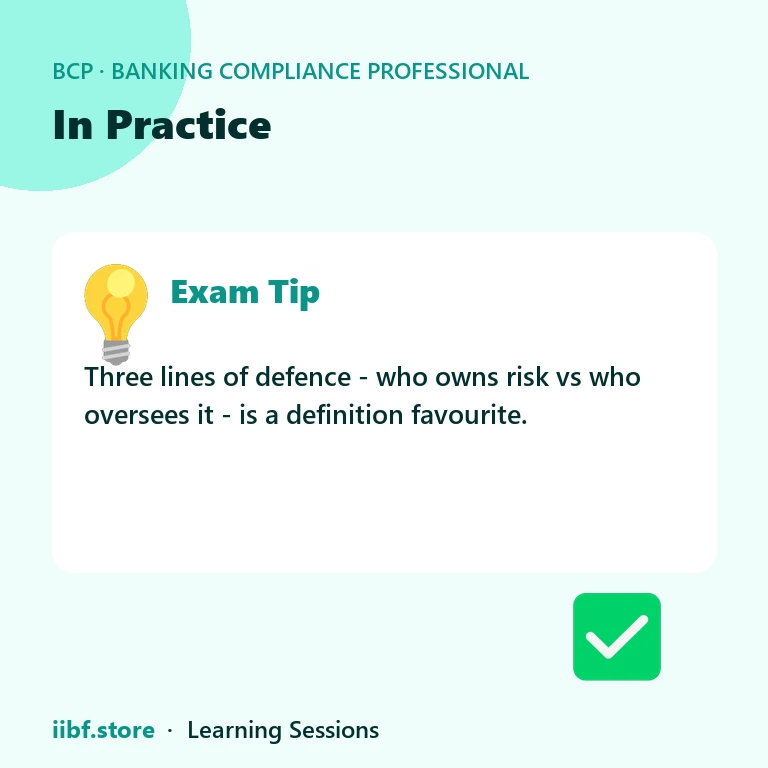
In practice, the CCO does not work alone. The supervisory framework assumes a functioning three lines of defence: business units owning risk in the first line, independent risk and compliance functions in the second, and internal audit providing assurance in the third. When examiners frame a scenario, they often test whether you can place an activity in the correct line — for instance, transaction monitoring is a first-line control, compliance testing is second-line, and audit's review of that testing is third-line. A common weakness RBI flags in its Risk Assessment Reports is "role confusion", where the compliance function is drawn into day-to-day operational tasks and loses its independence. Candidates should also remember that the CCO's annual compliance review and the board's compliance committee minutes are documents supervisors specifically call for during inspection, so the quality of this paper trail directly influences the oversight score. Keeping these governance layers distinct in your mind will help you decode most compliance-supervision questions quickly.
Frequently Asked Questions
Related study material
Go deeper with the full chapter notes and the complete article hub for this subject:
- Risk Management And Inter Bank Dealing
- Outsourcing Financial And It Services
- All Banking Compliance Professional articles & notes
What does SPARC stand for in the RBI supervisory framework?
SPARC is the Supervisory Program for Assessment of Risk and Capital — RBI's risk-based supervision model for commercial banks. It produces a Risk Assessment Report and an aggregate risk score that determines how intensively an institution is supervised.
Which parameters trigger Prompt Corrective Action?
The revised PCA framework tracks three parameters: capital (CRAR/CET-1), asset quality (Net NPA ratio), and leverage (Basel III Leverage Ratio). Breaching any threshold places the bank in one of three risk categories with escalating restrictions. Return on Assets was removed as a trigger in the revised framework.
How does off-site surveillance differ from on-site inspection?
Off-site surveillance is continuous monitoring using periodic returns and data submitted through platforms like DAKSH and CIMS, letting RBI detect stress between visits. On-site inspection is a physical, deep-dive examination. Modern supervision blends both, with off-site data feeding directly into the risk score.
Why is the Chief Compliance Officer central to supervision?
The CCO is the bank's independent interface with RBI, owns the compliance risk assessment, and drives closure of inspection findings. Because SPARC rates oversight quality, a strong, credible CCO directly improves the bank's supervisory standing.
Conclusion: Turn Framework Knowledge Into Exam Marks
The RBI supervisory framework rewards candidates who understand the flow — inherent risk to controls to net risk to supervisory action — rather than isolated definitions. Master SPARC, PCA, off-site surveillance, and the CCO's role together and you will handle most compliance-supervision questions with confidence. Ready to test yourself under exam conditions? Attempt a full-length paper on our Banking Compliance mock tests and lock in your preparation today.
Practice this topic
Take a free mock test, download chapter PDFs, or watch a video class — all included on iibf.store.
Keep reading