Computer Insecurity Threats in Banking: IIBF Exam Guide
Most bank staff think of cyber crime as something that happens to other people's branches — until an auditor asks why a teller's login was active at 2 a.m. from an unknown IP. Computer insecurity threats in banking are not a single event; they are the sum of every weak password, unpatched server, and careless click that gives an outsider a way in. For JAIIB/CAIIB candidates, this topic sits at the core of the Prevention of Cyber Crime paper because examiners test whether you can name the weakness, the channel it travels through, and the control that closes it — not just recite definitions.
This article maps what computer insecurity means for a bank, how criminals exploit it, who does the exploiting, and what happens the moment prevention fails.
💻 What Computer Insecurity Means in Banking
In IIBF terminology, computer insecurity is any condition that lets an unauthorised person access, alter, or disrupt a bank's computer systems or the data inside them. It covers technical gaps — an unpatched core banking server, a default admin password never changed — and human gaps, such as a branch employee who shares a screen-share link with a stranger claiming to be from IT support.
The IIBF chapter on computer insecurity breaks this down into hardware vulnerabilities, software vulnerabilities, and network vulnerabilities. A core banking application running an outdated library, a branch router still on factory credentials, or a laptop without disk encryption are all textbook examples examiners like to test with scenario-based questions.
What makes banking different from a generic IT setup is stakes: a single insecure endpoint can expose customer account data, KYC documents, or transaction rails feeding NEFT and RTGS. That is why the syllabus treats computer insecurity as the starting point for every fraud that follows, not a technical footnote. Every other topic — channels, hacker types, fraud protection, incident response — is really an answer to one question: given that insecurity exists, what happens next? Bookmark the broader Prevention of Cyber Crime topic hub on iibf.store for every related article in one place while you revise.
🕵️ Channels and Methods Cyber Criminals Use
A "channel" in this subject means the pathway an attacker uses to reach a bank's systems — email, a compromised website, a mobile app, a public Wi-Fi hotspot, or even a phone call that tricks an employee into installing remote-access software. The IIBF chapter on channels of cyber crimes lists these pathways separately from the "methods" used once inside, and the exam does distinguish between the two.
Methods, covered in the cyber crime methods chapter, include malware that silently logs keystrokes, structured query injection against a poorly coded web form, denial-of-service floods that knock a net banking portal offline during peak hours, and social engineering that manipulates a person rather than a machine. Each method usually rides on a specific channel — malware often arrives by email attachment, injection attacks target public-facing web applications, and social engineering typically starts with a phone call or a message.
Before the exam, work through a structured cyber crime prevention checklist for bankers — mapping each channel to its matching method is exactly how exam questions are framed.
⚠️ Common Mistake: Candidates often confuse a "channel" (how the attacker reaches you) with a "method" (what the attacker does once inside). The exam tests both separately — know which chapter each term belongs to.
🦹 Who Is Behind the Attacks
Not every intruder has the same skill or motive. The IIBF computer hackers chapter classifies attackers by intent and capability — from opportunistic script users running off-the-shelf tools, to organised groups running fraud as a business, to insiders who already have legitimate access and abuse it.
This distinction matters operationally as much as academically. A script-driven attack against a bank's public website usually gets caught by a web application firewall. An insider with valid credentials bypasses most perimeter defences entirely, which is why access reviews and segregation of duties matter as much as antivirus software. Banks that only invest in external defences while ignoring internal access controls remain exposed to the most damaging category of attacker.
For a full breakdown of attacker categories and how each maps to a different defence strategy, read our companion piece on types of hackers in cyber security. It pairs well with this article because most exam scenarios name the attacker type first and then ask which control would have stopped them — so knowing the categories cold saves time under exam pressure.
💡 Exam Tip: When a question describes an attacker with prior legitimate access to the system, the answer is almost always pointing to an insider threat control — dual authorisation or access logging — not a perimeter defence like a firewall.
🛡️ Computer Fraud Protection and the Regulatory Backbone
The computer fraud protection chapter covers the practical controls banks deploy: multi-factor authentication, transaction monitoring rules, encryption of data at rest and in transit, patch management cycles, and staff awareness training. None of these controls work in isolation — a bank with strong encryption but weak patch discipline is still exposed through the unpatched gap.
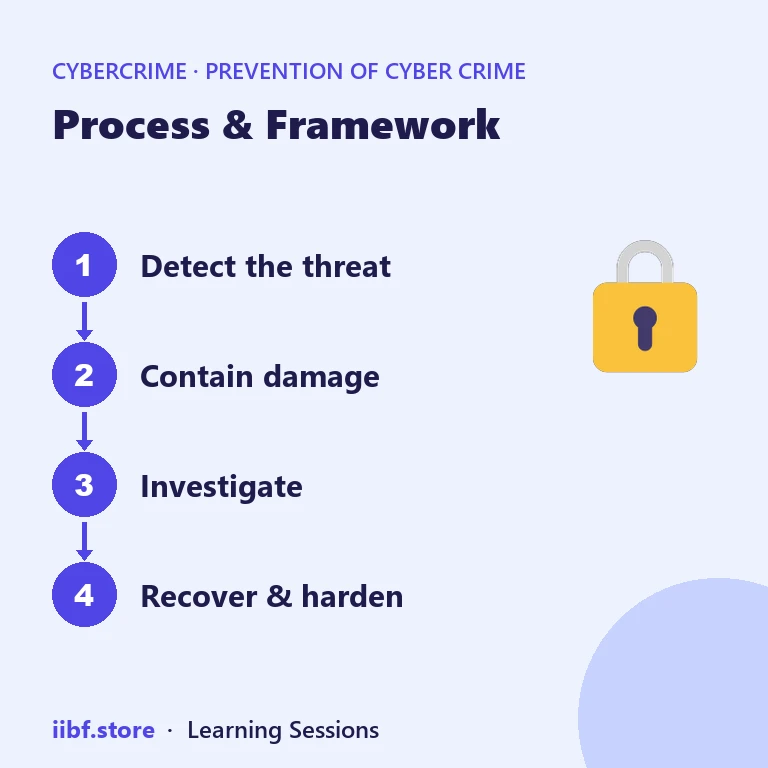
These controls sit inside a legal framework. The Information Technology Act, 2000 defines offences like unauthorised access and data theft and prescribes penalties, while the Reserve Bank of India issues supervisory directions requiring banks to maintain board-approved cyber security policies, run periodic vulnerability assessments, and report material incidents. Neither the Act nor RBI's directions replace the other — the Act criminalises the act, RBI's framework mandates the bank-side controls that prevent it.
Risk management in banking is rarely confined to one silo. Just as a treasury desk measures interest-rate exposure using Macaulay duration and modified duration to know how much a bond portfolio will move, an IT risk team measures cyber exposure through vulnerability scores and control gaps — different metrics, same underlying discipline of quantifying risk before it turns into a loss.
🚨 Incident Management When Prevention Fails
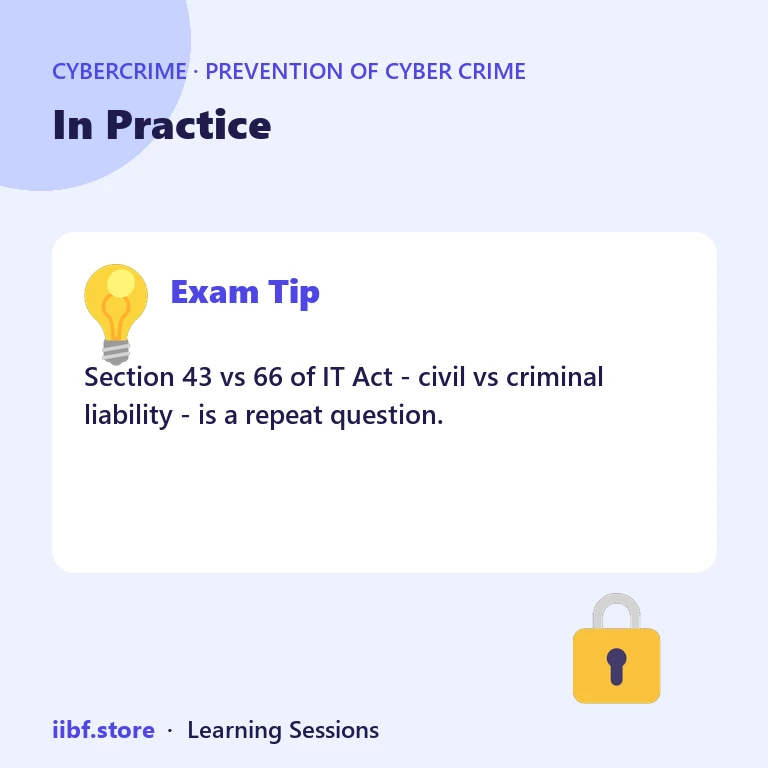
No control stack is airtight, which is why the incident management chapter exists as a distinct topic. It covers detection, containment, eradication, recovery, and the post-incident review that feeds lessons back into the fraud-protection controls covered earlier.
Detection speed decides the size of the loss. A card skimming device or a compromised net banking session left unnoticed for hours can drain far more than one caught within minutes by transaction-monitoring alerts. Containment — isolating the affected system, forcing password resets, freezing suspicious accounts — has to happen before eradication, or the attacker simply re-enters through the same open door.
Once an incident touches customer funds, the question of who bears the loss follows a separate but related framework. Read our detailed piece on customer liability in unauthorised transactions to see how RBI apportions liability between the bank and the customer depending on how quickly the fraud was reported and where the fault lay.
📌 Remember: Incident management is a lifecycle, not a single step. Detection without proper containment simply buys the attacker more time inside the network.
| Threat Type | Typical Channel | Bank's Core Defence | Usually Insider-Enabled? |
|---|---|---|---|
| Malware / keylogger | Email attachment, infected download | Endpoint protection, patch management | ❌ No |
| Unauthorised access / hacking | Weak or reused credentials | Multi-factor authentication, access reviews | Often |
| Denial-of-service | Public-facing net banking portal | Traffic filtering, capacity redundancy | Rare |
| Social engineering | Phone call, message, fake support request | Staff awareness training, verification callbacks | Rare |
| Data theft by insider | Legitimate system access misused | Segregation of duties, activity logging | ✅ Yes |
🧠 Practice MCQs: Computer Insecurity Threats in Banking
Q1. Which best describes "computer insecurity" as used in the IIBF syllabus? (a) A specific malware family (b) Any technical or human weakness that allows unauthorised access or disruption (c) A type of denial-of-service attack (d) A penalty clause under the IT Act, 2000
Answer: (b) — Computer insecurity is the underlying weakness, not any single attack type.
Q2. What is the key difference between a "channel" and a "method" of cyber crime? (a) They are interchangeable terms (b) A channel is the pathway to reach the system; a method is what the attacker does once inside (c) A channel only applies to mobile banking (d) A method always needs physical branch access
Answer: (b) — Channels (email, web, phone) are the entry pathway; methods (malware, injection, social engineering) are the technique used after entry.
Q3. Which attacker category is hardest to stop with perimeter defences like firewalls? (a) Opportunistic script-based attackers (b) An insider with legitimate system access (c) A denial-of-service botnet (d) A phishing email sender
Answer: (b) — An insider already holds valid credentials, so access reviews and segregation of duties matter more than perimeter controls.
Q4. Which statement about the regulatory framework covering Indian banks is correct? (a) RBI's directions replace the IT Act, 2000 entirely (b) The IT Act, 2000 defines cyber offences and penalties, while RBI mandates bank-side security controls and reporting (c) Only private banks must follow RBI's cyber security directions (d) The IT Act, 2000 applies only outside India
Answer: (b) — The two frameworks are complementary: the Act criminalises the act, RBI's directions mandate the controls that prevent and report it.
Q5. In incident management, why must containment happen before eradication? (a) Containment is optional if detection was fast (b) Eradication always comes first (c) Without containment, the attacker can re-enter through the same open door during eradication (d) They are the same activity
Answer: (c) — Removing malware without first isolating the system leaves the entry point open for the attacker to return.
Want chapter-wise mock tests with 100+ MCQs? Start practising free →
What is the difference between computer insecurity and a cyber attack?
Computer insecurity is the underlying weakness — an unpatched system, a weak password, an untrained employee. A cyber attack is the actual attempt to exploit it. Insecurity can sit unexploited for months; the attack is the event that turns it into a loss.
Does the IT Act, 2000 apply to all Indian banks equally?
Yes. It applies across India regardless of whether the bank is public sector, private, or a small finance bank, and its penalty provisions apply uniformly to anyone committing the defined offences.
Who is responsible for a bank's cyber security policy?
RBI's supervisory framework requires banks to hold a board-approved cyber security policy, distinct from their general IT policy, reviewed periodically by senior management. Responsibility does not sit with the IT department alone.
Is insider misuse covered under the same rules as external hacking?
Both fall under computer insecurity, but the defences differ. External hacking is countered with firewalls and authentication; insider misuse needs access reviews and activity logging since the person already has legitimate access.
Computer insecurity is the thread running through this entire subject — every channel, method, hacker category, and control ultimately traces back to a weakness that was left open. Lock down that mental model and the rest of the Prevention of Cyber Crime paper becomes a matter of matching scenarios to controls. Put it into practice with a full-length mock on iibf.store/tests before exam day.
Practice this topic
Take a free mock test, download chapter PDFs, or watch a video class — all included on iibf.store.