Cyber Crime Prevention Checklist for Bankers: IIBF Guide
Every IIBF candidate studying Prevention of Cyber Crime eventually asks the same practical question: what does a working cyber crime prevention checklist for bankers actually look like on a branch floor, not just in a textbook definition? Regulators expect banks to move beyond awareness posters and build layered, verifiable controls that a teller, a relationship manager, and a back-office officer can each apply in seconds. This article builds that checklist from first principles, ties it to the categories tested in the Prevention of Cyber Crime paper, and shows how prevention, detection, and response fit together as one continuous control chain rather than three separate topics to memorise.
Banks in India lose crores every year not because criminals invent new technology, but because basic controls are skipped under time pressure. A prevention checklist earns its place only when every item on it maps to a real failure mode seen in actual fraud cases — a verification step skipped, a privileged access left open, a suspicious login ignored for too long. That is the lens IIBF examiners use, and it is the lens this guide uses too.
🔍 Understanding the Cyber Crime Threat Landscape in Banking
Before any checklist can be useful, a banker must be able to classify what kind of threat is in front of them. Cyber crime against banks generally falls into three buckets: crimes against the bank's own systems (hacking, malware, denial-of-service), crimes that use the bank as a channel to defraud customers (phishing-linked transfers, fraudulent instructions), and crimes that exploit insiders (privilege misuse, data leakage). Each bucket needs a different first line of defence, which is exactly why a single "install antivirus and move on" approach fails in exam scenarios and in real branches alike.
The IIBF syllabus expects candidates to read a fact pattern and correctly identify the threat category before naming the control, because the control that stops external hacking (network segmentation, patching, firewalls) is not the control that stops insider misuse (access reviews, segregation of duties, audit trails). Foundational reading on this classification is covered well in Introduction to Cyber Crimes, which sets up the taxonomy examiners build questions around, and in Cyber Crime Methods, which walks through how each attack path is actually executed step by step.
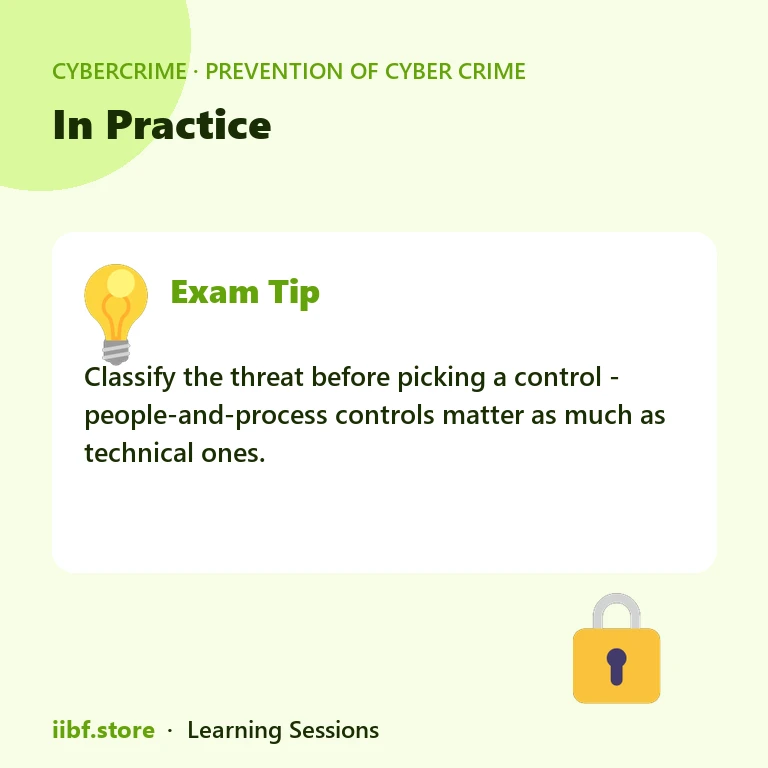
💡 Exam Tip: When a question describes a symptom (slow systems, unexpected outbound traffic, unauthorised fund transfer), first classify it as external attack, channel fraud, or insider misuse — then pick the control. Examiners frequently offer a technically correct but wrongly-categorised option as a distractor.
🛡️ Building a Practical Prevention Checklist for Front-line Staff
A usable checklist has to be short enough to follow under pressure and specific enough to close real gaps. For front-line and operations staff, five items do most of the work: verify any change-of-details request through an independent registered channel, never act on a fund-transfer instruction received only by email or chat, lock the workstation on every walk-away, report any unexpected system pop-up or slowdown immediately rather than trying to fix it personally, and never share one-time passwords, tokens, or admin credentials under any pretext, including a caller claiming to be from IT or the RBI.
For officers with system access, the checklist extends further: least-privilege access reviewed quarterly, dual control on high-value or bulk transactions, mandatory patching windows that are not skipped for "business as usual" pressure, and logging that is actually reviewed rather than merely retained. A structured walkthrough of how these controls stop fraud before it completes money movement is available in Computer Fraud Protection, which is the chapter examiners draw most heavily from for scenario-based questions in this paper.
⚠️ Common Mistake: Candidates often assume prevention means only technical controls (firewalls, encryption). IIBF questions weight people-and-process controls — verification calls, dual authorisation, access reviews — just as heavily, because most successful frauds exploit a process gap, not a technical one.
👨💻 Know Your Adversary: Hacker Types and Motives
Prevention design changes once you know who you are defending against. The syllabus distinguishes between different categories of computer hackers by motive and method: those seeking financial gain through direct theft or resale of data, those conducting reconnaissance for a later, larger attack, insiders misusing legitimate access for personal benefit, and state-linked or ideologically motivated actors targeting critical infrastructure rather than immediate profit. A control set built only against opportunistic outsiders will miss the insider who already has a valid login, and a control set built only against insiders will miss a well-resourced external group probing for weeks before acting.
This is why banks layer controls instead of relying on any single one: perimeter defence to slow external actors, behavioural monitoring to catch anomalies regardless of who triggers them, and access governance to limit the blast radius of any single compromised credential. The chapter on Computer Hackers breaks down these adversary profiles in the depth IIBF exams test, and pairs well with revision of related channel-specific frauds such as QR code and payment link fraud and SIM swap fraud in banking, both of which are adversary tactics rather than standalone crime categories.
📌 Remember: A hacker's motive determines their persistence. Financially motivated attackers move fast and leave once blocked; state-linked or insider actors are patient and will wait out a single control failure. Design detection for both timelines, not just the fast one.
📋 Incident Response: What to Do When Prevention Fails
No checklist prevents everything, which is why the Prevention of Cyber Crime paper also tests incident management as a control in its own right, not an afterthought. The moment a suspected compromise is identified — an unauthorised transaction, a locked-out account, a suspicious outbound data transfer — the priority sequence is contain, preserve evidence, notify, and only then investigate root cause. Containment means isolating the affected system or freezing the account without destroying logs that forensic teams will need. Preserving evidence means resisting the urge to "just fix it" before the state of the system is recorded, because overwritten logs are the single most common reason banks cannot later establish what actually happened.
Timely internal escalation also protects customers: fund-transfer chains can sometimes still be halted at an intermediary bank if flagged within hours, but that window closes fast. A methodical breakdown of the contain-preserve-notify-investigate sequence, along with the roles different teams play at each stage, is covered in Incident Management. Candidates should also revise how this response sequence interacts with statutory reporting timelines, discussed in CERT-In incident reporting directions, since exam scenarios frequently combine an internal-response question with a compliance-timeline question in the same case study.
Officers dealing with newer settlement channels should also stay current on adjacent risk areas outside pure banking fraud, since IIBF papers occasionally cross-reference treasury and investment topics — for instance, understanding non-SLR investment norms for banks helps candidates see how operational risk controls parallel investment-limit controls elsewhere in a bank's risk framework.
| Prevention Layer | Primary Owner | Detects Insider Threats? | Detects External Attacks? |
|---|---|---|---|
| Employee verification checklist | Front-line staff | ❌ | ✅ |
| Dual control & segregation of duties | Operations / branch ops head | ✅ | ❌ |
| Access reviews & least privilege | IT security / compliance | ✅ | ❌ |
| Perimeter defence (firewall, patching) | IT / infosec team | ❌ | ✅ |
| Behavioural & transaction monitoring | Fraud risk / SOC | ✅ | ✅ |
Notice that only behavioural and transaction monitoring covers both threat directions, which is exactly why examiners treat it as the highest-value control in scenario questions — and why real banks are investing more in monitoring than in any single perimeter tool.
🧠 Practice MCQs: Cyber Crime Prevention Checklist for Bankers
Q1. A branch officer receives an email, purportedly from a senior manager, instructing an urgent fund transfer with no call-back verification requested. What is the FIRST correct action? (a) Process the transfer since it appears urgent (b) Reply to the email asking for confirmation (c) Verify the instruction through an independent, previously known contact channel (d) Forward the email to IT and wait for a response before doing anything
Answer: (c) — Independent verification through a known channel is the standard prevention control against business-email-style instruction fraud; replying to the same email does not confirm authenticity.
Q2. Which control is MOST effective at limiting damage from a compromised insider credential? (a) Firewall rules (b) Least-privilege access with regular review (c) Antivirus software (d) Customer awareness posters
Answer: (b) — Least-privilege access limits what any single compromised credential, including an insider's, can actually access or move.
Q3. In incident response, why must evidence be preserved BEFORE remediation begins? (a) It is a regulatory formality with no investigative value (b) Overwriting logs or restoring systems early can destroy forensic evidence needed to establish root cause (c) Preservation is only required for law enforcement, not internal audit (d) It delays customer notification unnecessarily
Answer: (b) — Premature remediation is the most common reason banks cannot later reconstruct how a breach occurred.
Q4. Which category of hacker is typically described as the MOST patient, willing to wait out a single failed control attempt? (a) Opportunistic financially-motivated attacker (b) State-linked or ideologically motivated actor (c) Script kiddie testing tools (d) Customer reporting a false alarm
Answer: (b) — State-linked or ideologically motivated actors typically pursue long-term objectives and are willing to probe repeatedly over time, unlike opportunistic attackers who move on quickly.
Q5. Which prevention layer is correctly described as detecting BOTH insider misuse and external attacks? (a) Perimeter firewall alone (b) Employee verification checklist alone (c) Behavioural and transaction monitoring (d) Physical branch security alone
Answer: (c) — Behavioural and transaction monitoring flags anomalies regardless of whether the actor is an outsider or an insider with valid credentials, making it the broadest single control.
Want chapter-wise mock tests with 100+ MCQs? Start practising free →
❓ Frequently Asked Questions
What is the single most important item on a bank's cyber crime prevention checklist?
No single item is sufficient on its own, but independent verification of any fund-movement or detail-change instruction — never trusting a request received only through one channel — stops the largest share of successful frauds because it defeats social engineering regardless of the technical method used.
Does prevention of cyber crime only cover external hackers?
No. IIBF's Prevention of Cyber Crime syllabus explicitly covers insider threats, process failures, and channel-based fraud alongside external hacking, since real losses in Indian banks come from all four sources, not external attacks alone.
Why does incident management matter if prevention controls are strong?
Because no control set is complete; incident management is the control that limits damage once prevention has already failed, and IIBF exams test it as a distinct, scored topic rather than folding it into prevention.
Where can official guidance on bank cybersecurity expectations be verified?
The Reserve Bank of India publishes cybersecurity and IT governance circulars directly on its website, which candidates should treat as the primary source over any secondary summary, including this one.
🎯 Turning This Checklist Into Exam-Ready Recall
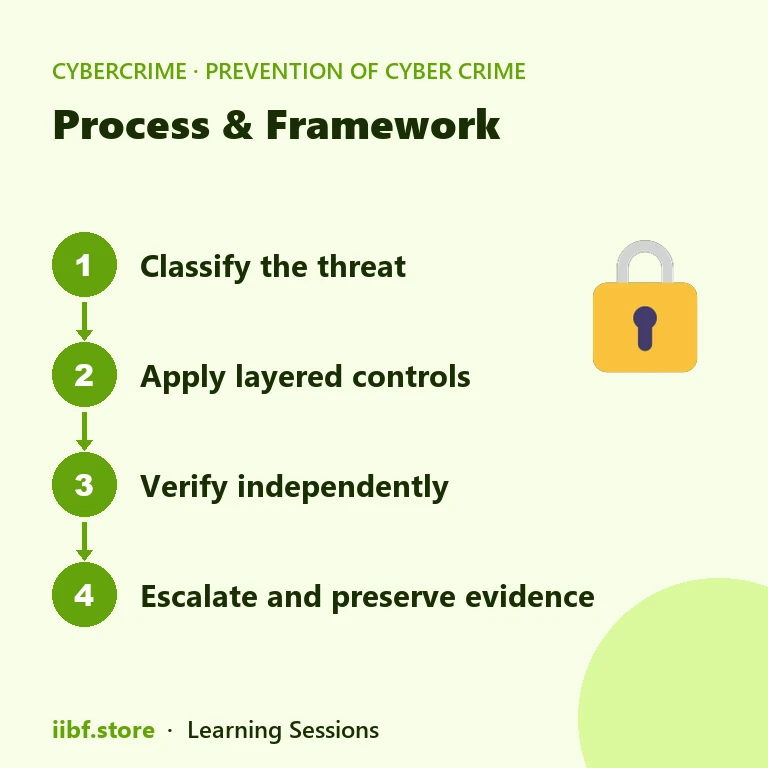
A checklist is only useful if it survives the pressure of an exam hall the same way it survives the pressure of a branch floor. The pattern to remember is simple: classify the threat, apply the layered control that matches that classification, and know the incident-response sequence for when a control fails anyway. Revisit the linked chapters on channels of cyber crime alongside this checklist to connect method with control, and browse more coverage under the Prevention of Cyber Crime tag for related exam-focused reading.
For authoritative, continuously updated regulatory expectations on bank cybersecurity governance, refer directly to the Reserve Bank of India's published guidance at rbi.org.in. To convert this reading into exam performance, work through timed, chapter-wise practice sets rather than re-reading notes alone — start a free mock test and measure where your recall actually breaks down under time pressure.
Practice this topic
Take a free mock test, download chapter PDFs, or watch a video class — all included on iibf.store.