Corporate Governance in Banking: Ethics, Board and Whistle-Blowers
Sound corporate governance in banking is the invisible architecture that keeps depositors safe, markets stable and public trust intact. For anyone preparing for the Ethics in Banking certification, governance is not an abstract boardroom topic — it is the practical discipline that decides how power is exercised, how risk is owned, and how a whistle-blower can raise an alarm without fear. This guide explains the pillars of banking governance, the role of the board and its committees, and the mechanisms that turn ethical intentions into enforceable practice.
At its simplest, corporate governance in banking is the system of rules, relationships and controls by which a bank is directed and held accountable. Because banks are highly leveraged custodians of other people's money, their governance failures spill over into the wider economy far more violently than those of an ordinary company. That is why regulators, boards and individual officers all carry a heightened duty of care — and why ethical conduct is treated as a supervisory concern, not merely a private virtue.
Why Governance Matters More in Banks
An ordinary firm risks its shareholders' capital when it fails. A bank, by contrast, funds most of its balance sheet with public deposits and interbank borrowing, so a single institution's collapse can trigger contagion across the financial system. This structural fragility is the reason corporate governance in banking is subject to intense regulatory oversight. The Reserve Bank of India, whose supervisory framework is published at rbi.org.in, sets fit-and-proper criteria for directors, caps on tenure, and expectations for board composition precisely because weak governance is a leading cause of bank distress.
Good governance rests on a few durable principles: a clear separation between ownership and management, an independent and competent board, transparent disclosure, and a culture where uncomfortable questions are welcomed rather than punished. When these hold, a bank can absorb shocks and correct course early. When they fail — through a dominant CEO, a rubber-stamp board, or suppressed internal warnings — losses accumulate quietly until they become unmanageable. History across jurisdictions shows that most banking crises are, at their root, governance and ethics failures dressed up as credit or liquidity events.
The Board, Its Committees and the Three Lines of Defence
The board of directors is the apex of corporate governance in banking. Its job is not to run the bank day to day but to set strategy, approve the risk appetite, and hold management to account. Effective boards work through specialised committees — audit, risk management, nomination and remuneration, and a customer service or stakeholder committee — each with defined mandates and, ideally, a majority of independent directors. The audit committee, in particular, is the guardian of financial integrity and the natural home for whistle-blower oversight.
Operationally, banks organise control through the three lines of defence. The first line is the business itself, which owns and manages its risks. The second line comprises independent risk management and compliance functions that set policy and challenge the first line. The third line is internal audit, which provides independent assurance to the board that the first two lines are working. When these lines are clearly separated and adequately resourced, problems surface early. When they blur — for instance, when compliance reports to the very business it must police — accountability evaporates. Understanding this structure is essential for the Ethics in Banking exam, and it is reinforced throughout our CAIIB and certification course.
Whistle-Blower Mechanisms and Ethical Culture
Policies alone do not create integrity; culture does. A robust whistle-blower mechanism is the safety valve of corporate governance in banking, allowing employees, vendors and even customers to report fraud, mis-selling or breaches of the code of conduct through a protected channel. RBI-regulated entities are expected to maintain such mechanisms, typically routed to the audit committee, with strict confidentiality and a firm bar on retaliation. A whistle-blower policy that exists on paper but is quietly ignored is worse than none, because it lulls the board into false comfort.
Beyond formal channels, an ethical culture is built through tone at the top, aligned incentives, and consistent consequences. Remuneration that rewards short-term sales without regard to conduct will always breed mis-selling, no matter how many training modules staff complete. Regulators increasingly expect banks to embed conduct considerations into performance appraisal and to claw back bonuses where misconduct is later discovered. For candidates, the takeaway is that governance and ethics reinforce each other: structures create accountability, and culture makes people use it. Reinforce these ideas with our practice tests and quick-recall match games, and stay current through IIBF news updates.
Frequently Asked Questions
What is corporate governance in banking?
Corporate governance in banking is the system of rules, relationships and controls through which a bank is directed and held accountable. Because banks hold public deposits, their governance is subject to close regulatory oversight to protect depositors and the wider financial system.
What are the three lines of defence?
The first line is the business, which owns its risks; the second line is independent risk management and compliance; the third line is internal audit, which gives independent assurance to the board. Keeping these lines separate ensures problems are identified and escalated properly.
Why are whistle-blower mechanisms important?
A whistle-blower mechanism lets staff and stakeholders report fraud or misconduct through a protected, confidential channel, usually to the audit committee, without fear of retaliation. It is a critical early-warning system that supports strong governance and ethical culture.
What role does the board play in bank governance?
The board sets strategy and risk appetite, approves policies, and holds management accountable. It works through committees such as audit, risk, and nomination and remuneration, ideally with a majority of independent directors, and oversees the whistle-blower framework.
Conclusion and Next Steps
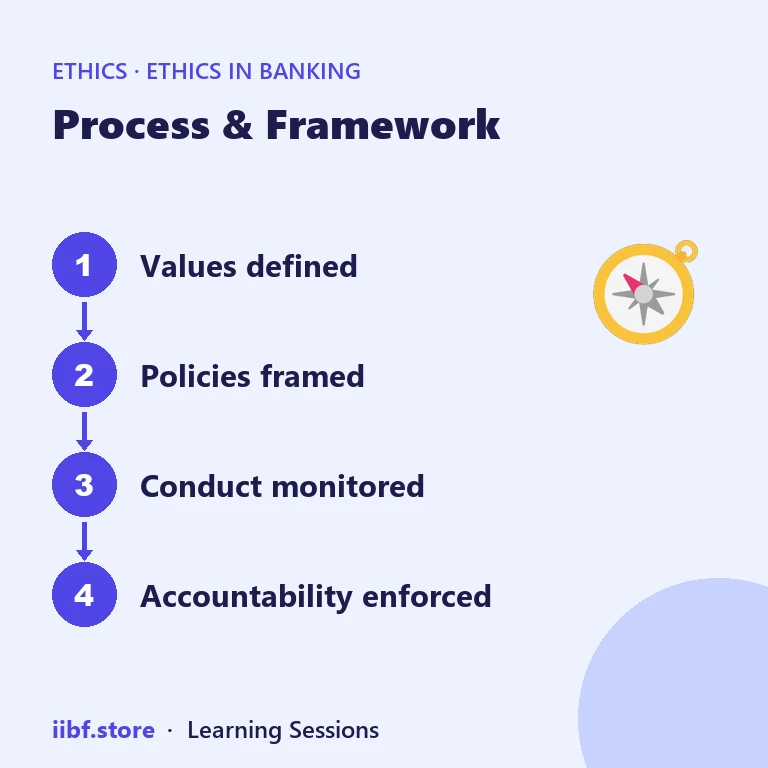
Strong corporate governance in banking is the difference between an institution that quietly self-corrects and one that drifts toward crisis. The board, its committees, the three lines of defence, and a genuinely protected whistle-blower channel together form a system where ethics is enforced rather than merely encouraged. For the Ethics in Banking exam and for a real career in the profession, internalise these structures and remember that culture is what makes them work. Put your knowledge to the test on our mock tests and deepen your preparation with the full certification course.
Quick quiz on this topic
5 exam-style questions from our free test bank — check yourself before you move on.
Practice this topic
Take a free mock test, download chapter PDFs, or watch a video class — all included on iibf.store.