Ethical Marketing in Banking: A Complete IIBF Ethics Guide
When a bank rewards its staff for the number of policies bundled with every loan, the line between selling and serving gets blurry fast. Ethical marketing in banking is the discipline that keeps that line visible — it asks whether a product is being sold because the customer needs it, or because a target sheet demands it. For IIBF's Ethics in Banking paper, this is one of the most practically tested ideas, because it sits at the exact point where commercial pressure meets customer trust.
📢 What Is Ethical Marketing in Banking?
Ethical marketing in banking means promoting and selling financial products in a way that is honest, suitable to the customer's needs, and free from pressure tactics or hidden terms. It goes beyond simply obeying advertising law — it asks whether the customer, after the sale, would still feel they were treated fairly if they understood everything the bank knew at the time.
Banking products are unusually easy to mis-sell because they are intangible, complex, and often sold to customers who lack the technical vocabulary to evaluate them. A fixed deposit is simple; a unit-linked insurance plan bundled with a locker facility is not. Ethical marketing closes that information gap rather than exploiting it.
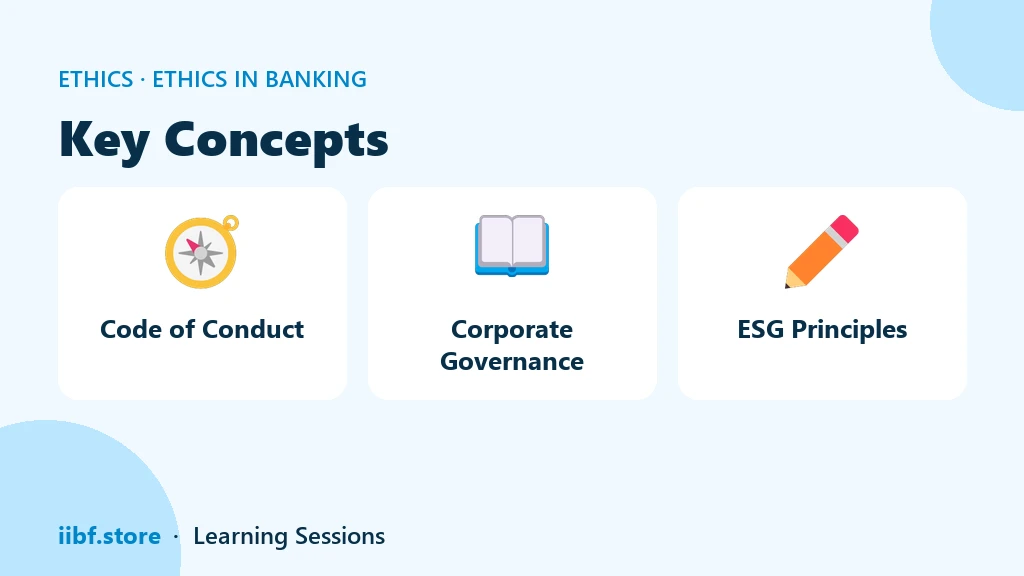
Three elements typically define it: truthful representation of returns and risks, voluntary consent free of coercion, and suitability — meaning the product actually fits the customer's income, goals, and risk appetite. The Ethical Dimensions: Marketing chapter of the IIBF syllabus treats these as inseparable, not as a checklist to tick after the sale is closed.
💡 Exam Tip: Questions often test whether you can distinguish "aggressive selling" (legal but pushy) from "unethical selling" (misleading or unsuitable) — the deciding factor is always disclosure and suitability, not sales volume.
🎯 Key Principles Guiding Ethical Bank Marketing
Four principles recur across ethics literature and IIBF material: transparency, suitability, fairness in comparison, and respect for customer autonomy. Transparency means every material fact — charges, lock-in periods, penalty clauses, and the difference between guaranteed and market-linked returns — is stated upfront, not buried in a footnote.
Suitability requires the bank to match the product to the customer's actual profile rather than to whichever product carries the highest incentive that month. Selling a five-year insurance-linked product to a customer who has explicitly asked for a short-term, liquid deposit fails this test even if every disclosure form was technically signed.
Fairness in comparison means advertisements and sales pitches should not misrepresent a competitor's product or exaggerate relative advantages — for instance, quoting only the best-case return of a market-linked plan while omitting the downside scenario. Respect for autonomy means the customer's "no" is final, and repeated calls or pressure after a decline cross into unethical territory.
Banks that internalise these principles usually build them into the earliest stages of product design covered in Building an Ethical Organization, rather than treating ethics as a compliance patch applied at the point of sale.
⚠️ Common Ethical Lapses in Banking Marketing
The most frequently examined lapse is tied selling — making one product's approval conditional on buying another, such as insisting a loan applicant purchase a life insurance policy before disbursal. This removes genuine choice and is treated as a serious ethical and regulatory breach.
Churning is a second lapse: encouraging a customer to switch or surrender an existing investment and buy a new one mainly to generate fresh commission, with little real benefit to the customer. It is particularly damaging in insurance-linked products where surrender charges erode the customer's capital.
Other recurring lapses include selling complex derivative or structured products to customers who cannot reasonably assess the risk, and target-driven cross-selling where relationship managers push products purely to meet monthly quotas. Digital channels add newer variants — dark patterns in app flows that make an add-on insurance product harder to decline than to accept.
⚠️ Common Mistake: Students often assume mis-selling only means lying about a product. In exams, unsuitable selling of an otherwise accurately described product is equally wrong — suitability, not just honesty, is the test.
| Marketing Practice | Ethical? | Why |
|---|---|---|
| Loan approval made conditional on buying an insurance policy | ❌ | Tied selling removes genuine choice |
| Recommending a product only after checking income and risk profile | ✅ | Meets the suitability principle |
| Switching a customer's investment mainly to earn fresh commission | ❌ | Churning benefits the seller, not the customer |
| Disclosing charges, lock-in, and a cooling-off period upfront | ✅ | Transparent, respects customer autonomy |
| Quoting only best-case returns on a market-linked plan | ❌ | Misleading by omission of downside risk |
These practices are examined against the broader shift in banking conduct discussed in Banking Ethics Changing Dynamics, which frames how sales pressure has evolved alongside product complexity.
🏛️ Regulatory Guardrails: RBI and IIBF Perspective
Indian regulation does not leave ethical marketing to voluntary goodwill alone. RBI's Fair Practices Code framework, applicable to banks and NBFCs, requires clear pre-sale disclosure of terms, prohibits coercive bundling, and mandates that marketing communication not mislead on cost or risk. Banks are expected to build these expectations into staff incentive structures, not just into customer-facing brochures — a recurring theme on the RBI's official guidance on fair customer practices.
IIBF's Ethics in Banking curriculum situates these regulatory guardrails within a broader professional-conduct framework: regulation sets the floor, but ethical marketing asks banks to go beyond minimum compliance to genuine customer-centric selling. This distinction is a favourite examiner angle.
Grievance redressal is the practical backstop when marketing goes wrong: a mis-sold customer has recourse through the bank's internal ombudsman, and repeated substantiated complaints trigger internal audit and retraining. This accountability loop separates a genuinely ethical marketing culture from one that merely avoids getting caught.
🧭 Building an Ethical Marketing Culture in Banks
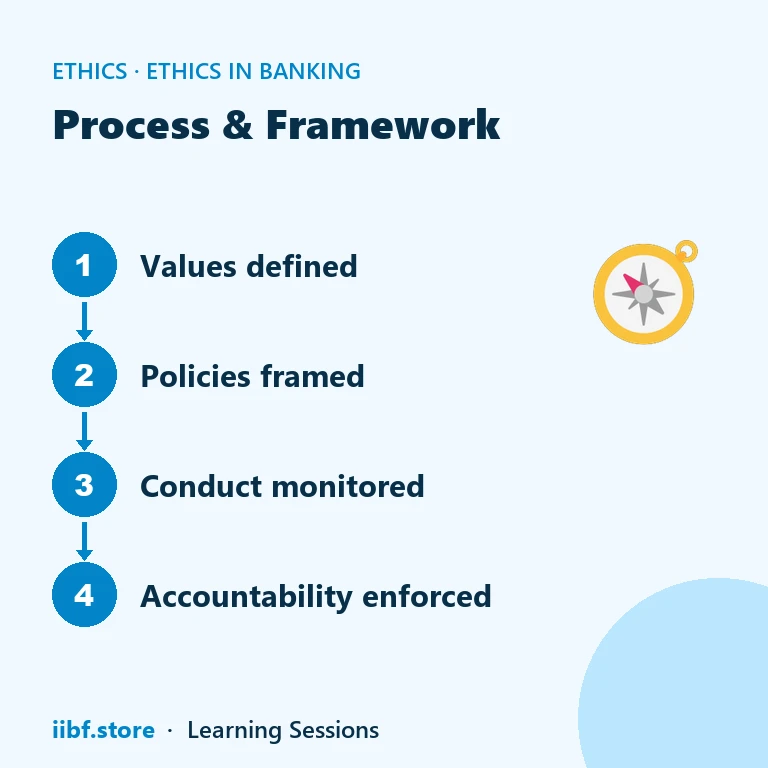
A sustainable fix is structural, not just aspirational. Incentive design matters most: if bonuses are tied purely to sales volume, ethical intent erodes under pressure regardless of the training given. Balanced scorecards that weight customer retention, complaint ratios, and product suitability alongside sales numbers tend to produce healthier outcomes.
Training that goes beyond product features to cover real dilemmas — what to do when a customer insists on a product that is clearly unsuitable, or when a manager pressures a quota — builds judgment rather than rote compliance. This mirrors the individual-level reasoning explored in the syllabus's treatment of personal ethical decision-making under pressure.
Mandatory cooling-off periods for insurance and investment products, plain-language disclosure summaries instead of dense legal text, and independent post-sale verification calls are practical controls many banks now use. Marketing that survives an unannounced post-sale audit call — where the customer confirms they understood exactly what they bought — is a reasonable working definition of ethical marketing in practice.
📌 Remember: Ethical marketing is judged at the point of understanding, not the point of signature — a signed form does not retroactively make an unsuitable sale ethical.
🧠 Practice MCQs: Ethical Marketing in Banking
Q1. A bank makes loan approval conditional on the customer purchasing a life insurance policy from its own subsidiary. This practice is best described as: (a) Cross-selling (b) Tied selling (c) Digital marketing (d) Direct marketing
Answer: (b) — Tied selling removes genuine customer choice by linking an unrelated product's purchase to loan approval.
Q2. "Churning" in the context of ethical bank marketing refers to: (a) Automating loan disbursal (b) Repeatedly switching a customer's investments mainly to generate fresh commission (c) Cross-verifying KYC documents (d) Renewing a fixed deposit at maturity
Answer: (b) — Churning benefits the seller through repeated commissions while eroding the customer's capital through surrender charges.
Q3. The "suitability principle" in ethical marketing requires that: (a) The highest-margin product is always recommended (b) A product matches the customer's actual needs, income, and risk profile (c) Only senior customers receive product advice (d) Products are sold only through digital channels
Answer: (b) — Suitability means the product genuinely fits the customer's profile, not merely that disclosure forms were signed.
Q4. Which of the following is an example of ethical, fair bank marketing? (a) Pre-ticked consent boxes for add-on insurance (b) Quoting only best-case returns on a market-linked plan (c) Full upfront disclosure of charges, lock-in period, and a cooling-off window (d) Pressuring a customer who has already declined a product
Answer: (c) — Complete pre-sale disclosure with a genuine cooling-off period reflects transparency and respect for customer autonomy.
Q5. RBI's Fair Practices Code framework primarily addresses ethical marketing concerns by: (a) Fixing uniform interest rates across all banks (b) Mandating clear pre-sale disclosure and prohibiting coercive bundling (c) Banning all cross-selling activity (d) Restricting banks from advertising online
Answer: (b) — The Fair Practices Code requires transparent disclosure and prohibits coercive tied selling — the floor ethical marketing should exceed.
Want chapter-wise mock tests with 100+ MCQs? Start practising free →
❓ Frequently Asked Questions
Is ethical marketing the same as following RBI's advertising rules?
Not quite. Regulation sets the minimum legal standard for disclosure, while ethical marketing asks banks to prioritise customer suitability even where a practice is technically compliant.
What is the difference between cross-selling and mis-selling?
Cross-selling recommends a genuinely relevant additional product based on the customer's needs. Mis-selling pushes an unsuitable or poorly disclosed product, often to meet a sales target rather than serve the customer.
Why do banking exams test marketing ethics so heavily?
Because marketing sits at the frontline where profit motive and customer trust most directly collide, making it a rich source of judgment-based exam questions.
How can a customer identify unethical marketing when buying a bank product?
Warning signs include pressure to decide immediately, bundled products presented as mandatory, and reluctance to provide written disclosure documents before the sale is finalised.
Ethical marketing is judgment, not just compliance
Ethical marketing rests on one test: would the sale still look fair if the customer knew everything the bank knew? Explore related ground in fraud prevention in bank branches, the internal safeguards discussed under vigilance administration in banks, and code of conduct for bank directors for governance context. For a cross-subject angle, see sensitivity analysis in credit appraisal. Browse the Ethics in Banking archive and the latest updates at IIBF news and notifications.
Prefer revising from a printed book?
Chapter-wise books with MCQs after every chapter — minimal pages, complete coverage, delivered anywhere in India. Every book has a free sample to read first.
132 pages · 225 MCQs
Learning Sessions · Ashish Sir
188 pages · 435 MCQs
Learning Sessions · Ashish Sir
117 pages · 236 MCQs
Learning Sessions · Ashish Sir
Learning Sessions · Ashish Sir
118 pages · 299 MCQs
Learning Sessions · Ashish Sir
Learning Sessions · Ashish Sir
Learning Sessions · Ashish Sir
Learning Sessions · Ashish Sir
115 pages · 255 MCQs
Learning Sessions · Ashish Sir
Learning Sessions · Ashish Sir
334 pages · 936 MCQs
Learning Sessions · Ashish Sir
Learning Sessions · Ashish Sir
115 pages · 344 MCQs
Learning Sessions · Ashish Sir
107 pages · 240 MCQs
Learning Sessions · Ashish Sir
90 pages · 150 MCQs
Learning Sessions · Ashish Sir
Learning Sessions · Ashish Sir
131 pages · 672 MCQs
Learning Sessions · Ashish Sir
221 pages · 831 MCQs
Learning Sessions · Ashish Sir
128 pages · 524 MCQs
Learning Sessions · Ashish Sir
107 pages · 445 MCQs
Learning Sessions · Ashish Sir
148 pages · 478 MCQs
Learning Sessions · Ashish Sir
151 pages · 465 MCQs
Learning Sessions · Ashish Sir
148 pages · 375 MCQs
Learning Sessions · Ashish Sir
216 pages · 895 MCQs
Learning Sessions · Ashish Sir
109 pages · 300 MCQs
Learning Sessions · Ashish Sir
104 pages · 360 MCQs
Learning Sessions · Ashish Sir
82 pages · 297 MCQs
Learning Sessions · Ashish Sir
151 pages · 600 MCQs
Learning Sessions · Ashish Sir
98 pages · 282 MCQs
Learning Sessions · Ashish Sir
Quick quiz on this topic
5 exam-style questions from our free test bank — check yourself before you move on.
Practice this topic
Take a free mock test, download chapter PDFs, or watch a video class — all included on iibf.store.