Corporate Governance in Banks: IIBF Ethics Exam Guide
Corporate governance in banks is the framework of ownership, board composition, committee structure, disclosure and accountability that keeps a bank answerable to its depositors, its regulator and its shareholders — in roughly that order of priority. The IIBF Ethics paper does not treat it as a soft, opinion-based topic. It tests it as a rules subject, with named statutory sections, prescribed committee compositions, tenure caps and age limits that you either know or you do not.
The reason governance sits differently in a bank than in a manufacturing company is leverage. A bank runs largely on other people's money, so a board failure stops being a shareholder problem and becomes a public problem very quickly. That single fact explains almost every rule below.
🏛️ Why Bank Governance Is Regulated Separately
An ordinary company answers to the Companies Act, 2013 and, if listed, to SEBI's Listing Obligations and Disclosure Requirements Regulations, 2015. A bank answers to both of those and to the Banking Regulation Act, 1949, plus a thick layer of RBI directions that override the general law wherever they are stricter.
The justification is structural. Deposits are repayable on demand, capital is thin relative to the balance sheet, and the failure of one institution transmits stress to others through the payment system and the interbank market. Governance is therefore treated as a prudential control, not a compliance formality — it sits alongside capital adequacy and liquidity as a supervisory concern.
Three consequences follow, and each is examinable. First, the regulator gets a say in who sits on the board: RBI approval is required for key appointments, and RBI can remove or add directors in defined circumstances. Second, the regulator prescribes which committees must exist and who may chair them, rather than leaving it to the articles of association. Third, the regulator prescribes how long a person may stay, through tenure and age caps that have no equivalent in general company law.
If you are building the conceptual base for this, the chapter on ethics at the organisational level is the natural companion reading, because it frames governance as the institutional expression of individual ethical duty rather than as a separate silo.
💡 Exam Tip: When a question sets the Companies Act against an RBI direction, the stricter requirement applies to the bank. Examiners love this because candidates default to the general law and miss the banking overlay.
⚖️ The Statutory Spine: BR Act, Companies Act, SEBI LODR
Learn the sections as a map, not as a list. The Banking Regulation Act, 1949 supplies the banking-specific provisions. Section 10A governs board composition and requires that not less than fifty-one per cent of the total number of directors have special knowledge or practical experience in specified fields such as accountancy, agriculture and rural economy, banking, cooperation, economics, finance, law and small-scale industry. Section 10B deals with the chairman and whole-time directors. Section 35B requires prior RBI approval for amendments touching the appointment, re-appointment or termination of the chairman, managing director or whole-time director, and for their remuneration. Sections 36AA and 36AB give RBI the power to remove managerial personnel and to appoint additional directors.
The Companies Act, 2013 supplies the general corporate layer. Section 149 covers board composition and independent directors, Section 166 codifies directors' duties, Section 177 mandates the audit committee and, in sub-section (9), the vigil mechanism through which directors and employees can report genuine concerns. Section 178 covers the nomination and remuneration committee and the stakeholders relationship committee, and Section 135 covers corporate social responsibility.
For listed banks, SEBI LODR adds Regulation 17 on the board, Regulation 18 on the audit committee, Regulation 19 on nomination and remuneration, Regulation 21 on risk management and Regulation 25 on independent directors, together with the annual disclosure obligations under Regulation 34. Read the primary text on the RBI notifications portal rather than relying on summaries, because circulars are amended more often than textbooks are reprinted.
🧩 Board Committees and Who May Chair Them
RBI's governance circular of 26 April 2021 is the most quotable source here. It applies to private sector banks, small finance banks, payments banks and wholly owned subsidiaries of foreign banks.
Memorise the headline rules verbatim. The chair of the board must be an independent director. The Audit Committee of the Board must be composed only of non-executive directors, with a majority independent, and its chair must be an independent director who chairs no other committee. The remaining committee rules are set out below.
| Committee | Primary source | Composition rule | Core mandate |
|---|---|---|---|
| Audit Committee of the Board | BR Act framework, Sec. 177 Companies Act, RBI 2021 circular, LODR Reg. 18 | Only non-executive directors; majority independent; independent chair who chairs no other committee | Financial reporting, internal and statutory audit, related-party transactions |
| Risk Management Committee | RBI 2021 circular, LODR Reg. 21 | Majority non-executive directors; chaired by an independent director | Enterprise risk appetite, credit, market, liquidity and operational risk oversight |
| Nomination and Remuneration Committee | Sec. 178 Companies Act, RBI 2021 circular, LODR Reg. 19 | Only non-executive directors; at least one member from the Risk Management Committee; independent chair, not the board chair | Fit-and-proper screening, succession, compensation policy |
| Customer Service Committee | RBI customer-service framework | Board-level committee with non-executive participation | Grievance redress quality, Internal Ombudsman escalations, service standards |
The customer service committee is the board-level hook for grievance redress. Since 1 July 2026 the Reserve Bank – Integrated Ombudsman Scheme, 2026 has replaced the 2021 scheme, with a ninety-day complaint window, an award ceiling of Rs 30 lakh and a separate limit of Rs 3 lakh for consequential loss.
🛡️ Fit and Proper, Tenure Caps and Independence
Composition rules are meaningless without a screening test, so RBI operates a fit and proper regime. Every candidate for the board signs a declaration and undertaking covering qualifications, experience, track record, integrity, pending criminal or regulatory proceedings, defaults and any conflicting directorships. The Nomination and Remuneration Committee is the body that applies the test, and it must do so at appointment and on a continuing basis, not once and forever.
Tenure and age caps then stop entrenchment. Under the 26 April 2021 circular, a managing director and CEO or whole-time director who is not a promoter or major shareholder may hold office for a maximum of fifteen years; where the incumbent is a promoter or major shareholder, the cap tightens to twelve years, extendable to fifteen only in extraordinary circumstances and with RBI's approval. A non-executive director may serve on a bank's board for a continuous period of not more than eight years. The upper age limit is seventy years for an MD and CEO or whole-time director, and seventy-five years for the chair and other non-executive directors.
Independence is the third leg. An independent director must be free of material pecuniary relationships with the bank, its promoters and its subsidiaries, and must not be a substantial shareholder. The practical exam trap is conflating "non-executive" with "independent": every independent director is non-executive, but many non-executive directors are not independent. The chapter on building an ethical organization develops the same distinction from the cultural side.
⚠️ Common Mistake: Candidates write "eight years" as the cap for every director. The eight-year ceiling is for non-executive directors. The MD and CEO limits are twelve or fifteen years depending on promoter status.
🔍 Disclosure, Assurance and the Three Lines of Defence
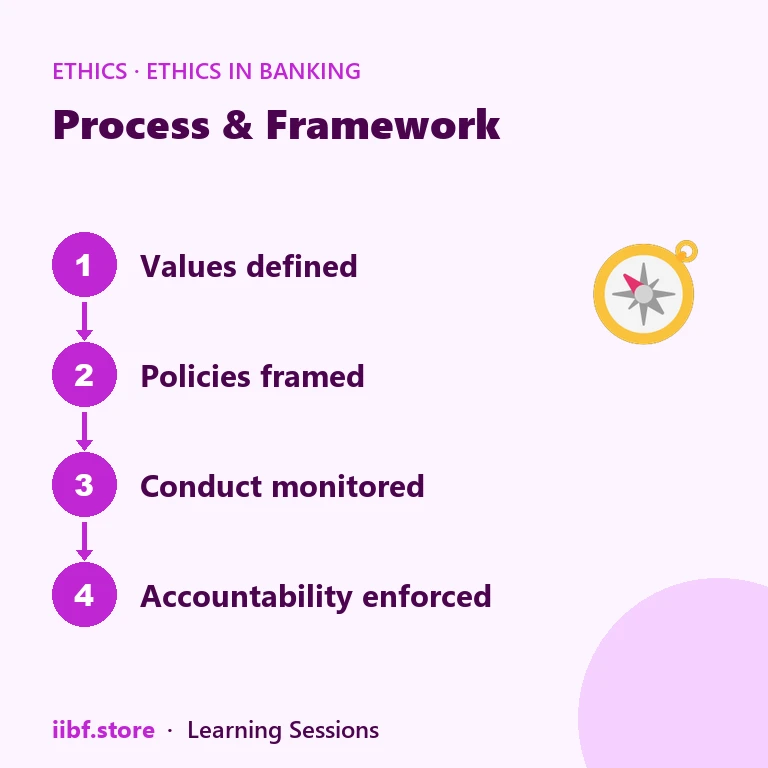
Governance fails quietly when the board cannot see what the business is doing, so assurance functions and disclosure complete the framework. The standard supervisory model is the three lines of defence: the business unit owns and manages risk, the risk and compliance functions independently set limits and monitor them, and internal audit gives objective assurance to the Audit Committee. Each line reports along a path that does not run through the line it tests.
Two officers anchor the second and third lines. The Chief Compliance Officer holds a defined minimum tenure, reports to the MD and CEO or the board, and cannot be given business targets. The Chief Risk Officer is similarly insulated, with removal requiring board approval and reporting to the regulator. The Internal Ombudsman, governed by RBI's 2023 Master Direction on Internal Ombudsman for regulated entities, reviews complaints the bank proposes to reject before the customer escalates externally.
Disclosure is where governance becomes visible. Annual reports carry board composition, attendance, committee membership, remuneration, related-party transactions and, for larger listed entities, sustainability disclosures. Bad-loan divergence disclosures and penalties imposed by RBI also sit here. Governance quality drives lending discipline too — see how the board's risk appetite translates into credit screening in our note on ESG risk assessment in bank lending.
The enforcement arm deserves separate study: our guides to vigilance administration in banks and to the bank's anti-corruption policy in banks cover how governance failures are investigated. Record-keeping obligations interlock with all of this, as explained in record retention under PMLA.
📌 Remember: In public sector banks, corruption complaints under the PIDPI Resolution, 2004 go to the Central Vigilance Commission. For private and foreign banks, RBI is the nodal agency under its Protected Disclosures Scheme.
🧠 Practice MCQs: Corporate Governance in Banks
Q1. Under RBI's circular of 26 April 2021, the Audit Committee of the Board of a private sector bank must be composed of: (a) only executive directors (b) only non-executive directors (c) a majority of executive directors (d) any mix approved by the MD and CEO
Answer: (b) — The ACB must consist only of non-executive directors, with a majority being independent and an independent chair.
Q2. Which section of the Banking Regulation Act, 1949 requires prior RBI approval for provisions relating to the appointment, re-appointment or termination of a banking company's chairman, managing director or whole-time director? (a) Section 10A (b) Section 21 (c) Section 35B (d) Section 45
Answer: (c) — Section 35B is the approval gateway; Section 10A deals with board composition and Section 21 with control over advances.
Q3. Under the Companies Act, 2013, the vigil mechanism for directors and employees to report genuine concerns is mandated by: (a) Section 135 (b) Section 149 (c) Section 166 (d) Section 177
Answer: (d) — Section 177(9) mandates the vigil mechanism; Section 135 is CSR, 149 is board composition and 166 is duties of directors.
Q4. In a public sector bank, a complaint alleging corruption by an employee, filed under the PIDPI Resolution, is routed through: (a) the Central Vigilance Commission (b) the Reserve Bank of India (c) SEBI (d) the Ministry of Corporate Affairs
Answer: (a) — The CVC is the designated agency under the PIDPI Resolution, 2004 for public sector banks.
Q5. Under RBI's 26 April 2021 governance circular, the maximum continuous tenure of a non-executive director on the board of a private sector bank is: (a) five years (b) eight years (c) ten years (d) twelve years
Answer: (b) — Eight continuous years, with an upper age limit of seventy-five years for non-executive directors.
Want chapter-wise mock tests with 100+ MCQs? Start practising free →
❓ Frequently Asked Questions
Does RBI's 26 April 2021 governance circular apply to public sector banks?
No. It applies to private sector banks including local area banks and small finance banks, payments banks, and wholly owned subsidiaries of foreign banks. Public sector banks are governed by their respective statutes and by Government of India instructions, though the underlying principles are broadly similar.
Can the same person chair the board and the Audit Committee?
No. The board chair must be an independent director, and the Audit Committee chair must be an independent director who does not chair any other committee of the board. The Nomination and Remuneration Committee chair also cannot be the chair of the board.
What is the difference between a non-executive director and an independent director?
A non-executive director simply holds no executive role in the bank. An independent director is additionally free of material pecuniary relationships with the bank, its promoters and its subsidiaries, and is not a substantial shareholder. Every independent director is non-executive; the converse is not true.
How much of the IIBF Ethics paper is governance-based?
Governance runs through the organisational-level modules rather than sitting in one chapter, so expect questions in every section that deals with the bank as an institution. Section numbers, committee composition and tenure caps are the highest-yield facts. More material is collected on our Ethics in Banking tag hub.
🚀 Key Takeaways and Next Step
Learn governance as four linked blocks: the statutory spine, the mandated committees, the fit-and-proper and tenure limits, and the assurance-plus-disclosure layer. Almost every examinable fact hangs off one of those four hooks. Pair this with the chapter on ethics, financial services and regulation, then test recall under time pressure. Take a free chapter-wise Ethics mock test →
Prefer revising from a printed book?
Chapter-wise books with MCQs after every chapter — minimal pages, complete coverage, delivered anywhere in India. Every book has a free sample to read first.
132 pages · 225 MCQs
Learning Sessions · Ashish Sir
188 pages · 435 MCQs
Learning Sessions · Ashish Sir
117 pages · 236 MCQs
Learning Sessions · Ashish Sir
Learning Sessions · Ashish Sir
118 pages · 299 MCQs
Learning Sessions · Ashish Sir
Learning Sessions · Ashish Sir
Learning Sessions · Ashish Sir
Learning Sessions · Ashish Sir
115 pages · 255 MCQs
Learning Sessions · Ashish Sir
Learning Sessions · Ashish Sir
334 pages · 936 MCQs
Learning Sessions · Ashish Sir
Learning Sessions · Ashish Sir
115 pages · 344 MCQs
Learning Sessions · Ashish Sir
107 pages · 240 MCQs
Learning Sessions · Ashish Sir
90 pages · 150 MCQs
Learning Sessions · Ashish Sir
Learning Sessions · Ashish Sir
131 pages · 672 MCQs
Learning Sessions · Ashish Sir
221 pages · 831 MCQs
Learning Sessions · Ashish Sir
128 pages · 524 MCQs
Learning Sessions · Ashish Sir
107 pages · 445 MCQs
Learning Sessions · Ashish Sir
148 pages · 478 MCQs
Learning Sessions · Ashish Sir
151 pages · 465 MCQs
Learning Sessions · Ashish Sir
148 pages · 375 MCQs
Learning Sessions · Ashish Sir
216 pages · 895 MCQs
Learning Sessions · Ashish Sir
109 pages · 300 MCQs
Learning Sessions · Ashish Sir
104 pages · 360 MCQs
Learning Sessions · Ashish Sir
82 pages · 297 MCQs
Learning Sessions · Ashish Sir
151 pages · 600 MCQs
Learning Sessions · Ashish Sir
98 pages · 282 MCQs
Learning Sessions · Ashish Sir
Quick quiz on this topic
5 exam-style questions from our free test bank — check yourself before you move on.
Practice this topic
Take a free mock test, download chapter PDFs, or watch a video class — all included on iibf.store.