Crossing of Cheques under NI Act: Types, Effects, Banker Liability
A cheque comes to your counter or clearing desk with two neat parallel lines drawn across its face. A customer asks, "Can I just take cash against this?" A colleague says it is fine because the drawer is a known party. Who is right? This is exactly the kind of situation that crossing of cheques under NI Act is meant to govern, and it is a favourite area in the CAIIB Banking Regulations and Business Laws paper because it connects statute, branch practice and bank liability in a few short sections.
In this guide we go through the law as a senior colleague would: what a crossing is, the two types, the extra effect of the words "not negotiable", what a paying banker and a collecting banker must do, and where banks lose money when they get it wrong. Everything below is taken from Chapter XIII of the Negotiable Instruments Act, 1881 (sections 123 to 131A). You can cross-check the Act on the India Code portal, and always follow the official syllabus on iibf.org.in.
What is a crossed cheque and why does the law allow it?
An open (uncrossed) cheque can be paid in cash across the counter to whoever presents it, provided the paying banker pays in due course. That is convenient, but it is also risky: if the cheque is lost or stolen, the finder can walk to the drawee branch and encash it. Crossing is a simple safeguard. It is a direction on the face of the cheque that tells the drawee banker not to pay cash over the counter but to pay only through another banker. Because payment then travels through a bank account, the money leaves a trail, and the true owner has a better chance of tracing it.
The Act does not define crossing in one sentence. Instead, sections 123 and 124 tell you which markings are deemed to be a crossing and what kind of crossing they create. That is why exam questions on the topic are almost always "which section, which words, which consequence".
Who may cross a cheque?
Section 125 deals with crossing after issue. Where a cheque is uncrossed, the holder may cross it generally or specially. Where it is crossed generally, the holder may cross it specially. In either case, the holder may add the words "not negotiable". Where a cheque is crossed specially, the banker to whom it is crossed may cross it again specially to another banker, his agent, for collection. Note the direction of travel: section 125 only provides for a holder making a crossing more restrictive; it gives the holder no power to remove one.
General crossing and special crossing
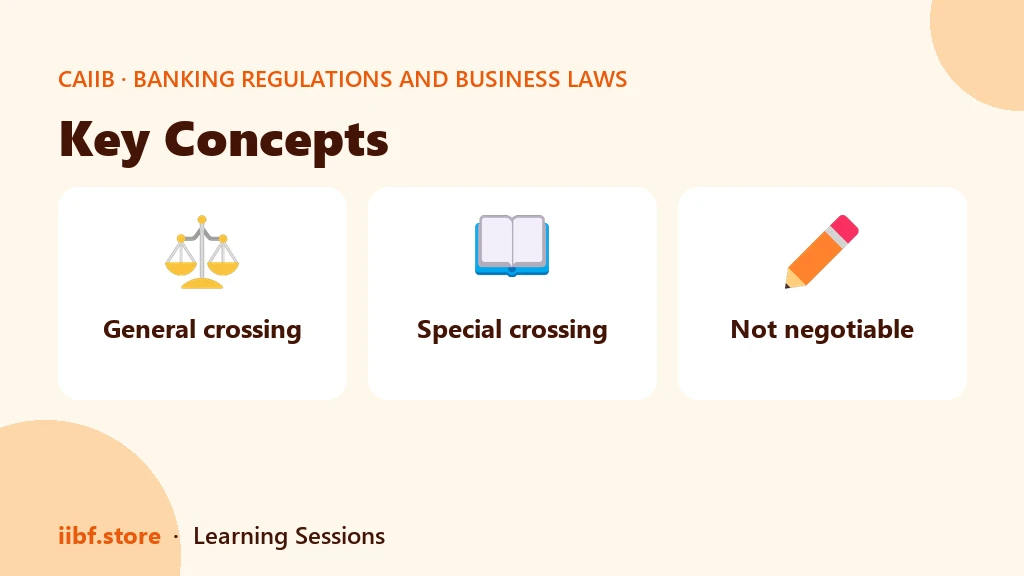
The two types of crossing are the core of crossing of cheques under NI Act, so learn the exact language.
General crossing (section 123)
A cheque is crossed generally where it bears across its face an addition of the words "and company" (or any abbreviation of them) between two parallel transverse lines, or of two parallel transverse lines simply, either with or without the words "not negotiable". Notice that the two lines alone are enough. The words "and company" are optional, and so are the words "not negotiable".
Special crossing (section 124)
A cheque is crossed specially where it bears across its face the name of a banker, either with or without the words "not negotiable". The cheque is then crossed to that banker. Here the parallel lines are not essential; the name of the banker is what creates the crossing.
Quick comparison
| Point | General crossing | Special crossing |
|---|---|---|
| Section | 123 | 124 |
| What is written | Two parallel transverse lines, with or without "and company" or "not negotiable" | Name of a banker, with or without "not negotiable" |
| Drawee banker may pay to | Any banker | Only the banker named, or his agent for collection |
| Section that restricts payment | 126 | 126 |
| Can the holder convert it? | Yes, may cross it specially (section 125) | Named banker may cross again specially to his agent for collection |
Remember one point that students often miss: both types of crossing stop cash payment at the drawee branch, and the crossing does not make the cheque non-transferable. The cheque remains negotiable unless the words "not negotiable" are added, which brings us to the third element.
The words "not negotiable" (section 130)
This is the most misunderstood phrase in the chapter. Many candidates assume that "not negotiable" means the cheque cannot be transferred. The Act says something narrower. Under section 130, a person taking a cheque crossed generally or specially, bearing in either case the words "not negotiable", shall not have, and shall not be capable of giving, a better title to the cheque than that which the person from whom he took it had.
In plain language: the cheque can still be transferred, but the transferee gets only the title his transferor had. If the cheque was stolen, a later taker cannot claim to be a clean holder. This takes away the special protection that a holder in due course would otherwise enjoy under the Act. Section 9 defines a holder in due course as a person who, for consideration, became the possessor of the instrument before the amount became payable and without sufficient cause to believe that any defect existed in the title of the person from whom he derived his title. A "not negotiable" crossing limits what such a taker can claim.
A note on "account payee"
On cheque leaves you will also see "A/c payee" or "account payee only" written between the lines. Sections 123 to 131A speak of the "and company" crossing, the banker's name and the words "not negotiable". They do not set out "account payee" as a statutory crossing. Treat it as a customary instruction in banking practice and answer from the Act's text when a question asks about statutory crossings.
How the paying banker must act (sections 126 to 129)
Now put yourself in the drawee branch. The cheque is drawn on your bank. What do the sections require?
- Section 126: if the cheque is crossed generally, the banker on whom it is drawn shall not pay it otherwise than to a banker. If it is crossed specially, he shall not pay it otherwise than to the banker to whom it is crossed, or his agent for collection.
- Section 127: if a cheque is crossed specially to more than one banker, except when crossed to an agent for the purpose of collection, the drawee banker shall refuse payment.
- Section 128: if the drawee banker pays a crossed cheque in due course, he (and, where the cheque has reached the payee, the drawer) is placed in the same position as if the amount had been paid to and received by the true owner.
- Section 129: a banker who pays a generally crossed cheque otherwise than to a banker, or a specially crossed cheque otherwise than to the banker to whom it is crossed or his agent for collection, is liable to the true owner for any loss sustained because of that wrong payment.
"Payment in due course" is defined in section 10: payment in accordance with the apparent tenor of the instrument, in good faith and without negligence, to a person in possession of it under circumstances that do not give reasonable ground for believing that he is not entitled to receive payment. So a paying banker who follows the crossing and also acts in good faith and without negligence is protected. A banker who ignores the crossing is exposed.
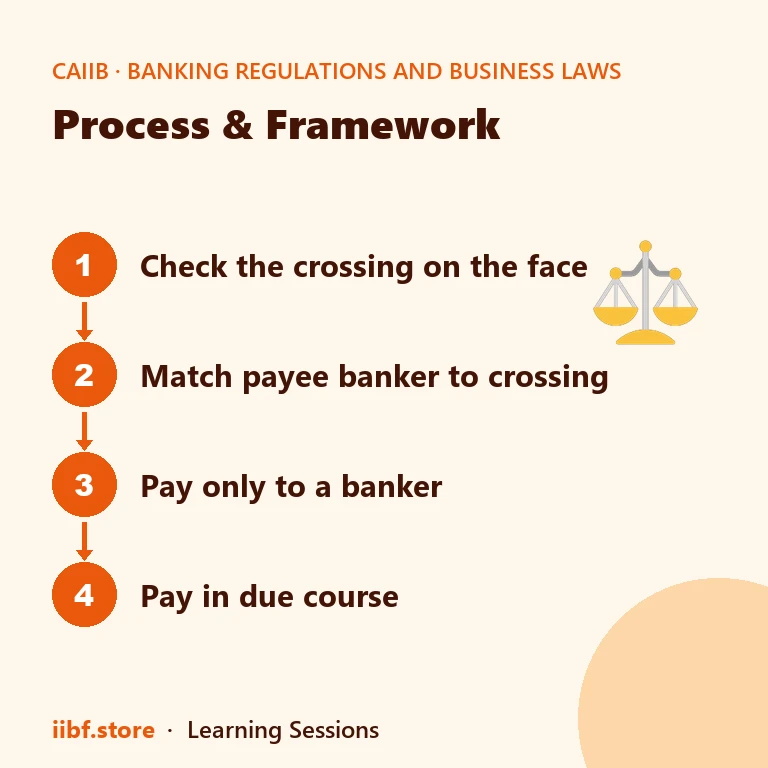
Step by step at the drawee branch
- Look at the face of the cheque and identify whether it is open, generally crossed or specially crossed.
- For a special crossing, read the banker's name. Check that the presenting bank is that banker or its agent for collection.
- Check whether there is more than one special crossing. If so, confirm the second is only to an agent for collection; otherwise refuse (section 127).
- Pay only to a banker, never in cash across the counter, for a crossed cheque.
- Apply the usual checks: signature, balance, date, alterations and stop-payment, and pay in due course in good faith without negligence.
A worked branch case
Consider a simple case. Ravi draws a cheque for a supplier, Meena Traders, and crosses it generally. A clerk at Meena Traders loses it. A stranger finds it and presents it at the drawee branch, asking for cash. The cashier must refuse, because section 126 permits payment on a generally crossed cheque only to a banker. If the cashier pays cash anyway, section 129 makes the bank liable to the true owner for any loss, and the protection of section 128 is not available because the payment was not made as the Act requires.
Now change the facts. The stranger opens an account at another bank, deposits the cheque and withdraws the money. That bank is a collecting banker. Whether it is liable to Meena Traders depends on section 131, which we turn to next.
The collecting banker's protection (section 131)
Collecting bankers handle a huge number of crossed cheques every day. If the title of a customer to a cheque turns out to be defective, can the true owner sue the collecting bank? Section 131 gives a defence. A banker who has in good faith and without negligence received payment for a customer of a cheque crossed generally or specially to himself shall not, in case the title to the cheque proves defective, incur any liability to the true owner of the cheque by reason only of having received such payment.
Three conditions matter, and exam questions frequently test each one:
- Good faith: the collecting banker acts honestly.
- Without negligence: for example, he does not ignore obvious red flags such as a cheque payable to a company being credited to a personal account of an employee without enquiry.
- For a customer: the protection is for a cheque collected for an account holder.
The Explanation to section 131 adds that a banker receives payment of a crossed cheque for a customer even if he credits the customer's account before receiving payment. A further Explanation, added for truncated cheques, makes it the duty of a banker who receives payment based on the electronic image of a truncated cheque held with him to verify the prima facie genuineness of the cheque to be truncated and any fraud, forgery or tampering apparent on the face of the instrument that can be verified with due diligence and ordinary care. Section 131A applies the whole Chapter to drafts as defined in section 85A, as if the draft were a cheque.
How IIBF tests crossing of cheques under NI Act
In CAIIB BRBL the topic appears as short factual questions rather than long essays. Typical patterns include:
- Identify the type of crossing from a description of the face of the cheque.
- Name the section that prohibits a banker from paying a generally crossed cheque otherwise than to a banker.
- State the effect of the words "not negotiable" on a taker's title.
- Apply the collecting banker's protection to a scenario with or without negligence.
- Spot the drawee's duty when a cheque is crossed specially to two bankers.
Common traps
- Confusing "not negotiable" with "not transferable". The cheque can still be transferred; only the quality of title changes.
- Forgetting that two parallel lines alone make a general crossing.
- Mixing up section 126 (duty of paying banker) with section 131 (protection of collecting banker).
- Assuming the drawee banker can always pay a specially crossed cheque to any banker.
If you want to practise these patterns systematically, the CAIIB Banking Regulations and Business Laws course covers the Negotiable Instruments Act with worked examples, and the BRBL printed book gives chapter-wise MCQs for revision. When you are ready to test yourself, attempt the CAIIB mock tests, and see the current CAIIB offer page for what is available. More notes are in the free study material library.
Practice questions
Question 1
A cheque bears only two parallel transverse lines across its face. What is the nature of the crossing? Options: (a) special crossing, (b) general crossing, (c) restrictive crossing, (d) no crossing. The answer is (b). Under section 123, two parallel transverse lines simply, with or without the words "and company" or "not negotiable", amount to a general crossing.
Question 2
A drawee banker pays cash to a bearer on a cheque crossed generally and the true owner suffers loss. Under which section is the banker liable to the true owner? Options: (a) section 126, (b) section 128, (c) section 129, (d) section 131. The answer is (c). Section 129 makes a banker who pays a generally crossed cheque otherwise than to a banker liable to the true owner for the loss. Section 126 lays down the duty, while section 129 states the consequence of breach.
Question 3
X steals a cheque crossed generally and marked "not negotiable" and transfers it to Y, who gives value in good faith. What title does Y get? Options: (a) a clean title as holder in due course, (b) no better title than X had, (c) full title if he deposits it quickly, (d) title limited to the amount of value given. The answer is (b). Under section 130, the taker of a cheque bearing the words "not negotiable" neither has nor can give a better title than his transferor had.
Quick revision points
- Chapter XIII of the NI Act, sections 123 to 131A, governs crossed cheques.
- Section 123: general crossing. Section 124: special crossing. Section 125: crossing after issue.
- Section 126: payment only to a banker, or to the named banker or his agent for collection.
- Section 127: specially crossed to more than one banker, the drawee shall refuse payment, except where the second is an agent for collection.
- Section 128: payment in due course of a crossed cheque places the paying banker and the drawer in the position as if the true owner had been paid.
- Section 129: wrong payment makes the banker liable to the true owner.
- Section 130: "not negotiable" means the taker cannot get a better title than the transferor.
- Section 131: the collecting banker is protected if he acts in good faith and without negligence for a customer.
- Section 131A: the Chapter applies to drafts as if the draft were a cheque.
Frequently asked questions
What are the two types of crossing of cheques under NI Act?
The two types are general crossing under section 123 (two parallel transverse lines, with or without "and company" or "not negotiable") and special crossing under section 124 (the name of a banker, with or without "not negotiable").
Can a crossed cheque be paid in cash over the counter?
No. Under section 126 a generally crossed cheque must not be paid otherwise than to a banker, and a specially crossed cheque must not be paid otherwise than to the banker named or his agent for collection. Paying cash exposes the bank to liability under section 129.
Does "not negotiable" mean a cheque cannot be transferred?
No. Section 130 says the taker of such a cheque shall not have, and cannot give, a better title than the person from whom he took it. The cheque can still be transferred, but the taker does not get the protection of a clean title.
Who protects the collecting banker and when?
Section 131 protects a collecting banker who received payment in good faith and without negligence for a customer of a crossed cheque, even if the customer's title later proves defective.
Can the holder cross an open cheque?
Yes. Under section 125 a holder of an uncrossed cheque may cross it generally or specially, may add "not negotiable" to a crossed cheque, and a general crossing may be made special.
Conclusion
Crossing of cheques under NI Act is short but rich in exam value. Remember the sequence: sections 123 and 124 define the two crossings, section 125 lets the holder add to them, sections 126 to 129 govern the paying banker, section 130 explains "not negotiable", and section 131 protects the collecting banker who acts in good faith and without negligence. Link each section to a branch situation and you will answer both factual and case-based questions with confidence. Keep your notes aligned with the official syllabus and the exact wording of the Act, and revise this topic with the mock tests before the upcoming exam cycle; check the official schedule on iibf.org.in.
Prefer revising from a printed book?
Chapter-wise books with MCQs after every chapter — minimal pages, complete coverage, delivered anywhere in India. Every book has a free sample to read first.


















































Quick quiz on this topic
5 exam-style questions from our free test bank — check yourself before you move on.
Practice this topic
Take a free mock test, download chapter PDFs, or watch a video class — all included on iibf.store.
Keep reading