Prepayment Charges on Floating Rate Loans: RBI Rules for Bankers
A customer walks up to your counter in January with a bonus in hand and one question: "Sir, if I put five lakh into my home loan today, will the bank charge me anything?" Ten years ago the honest answer might have been "yes, two per cent". Today, for most retail borrowers, the answer is different, and the reason is a single set of RBI Directions. If you are preparing for JAIIB Retail Banking and Wealth Management, prepayment charges on floating rate loans is exactly the kind of live regulatory topic that turns into a tricky MCQ, and exactly the kind of question a branch customer will ask you across the table.
In this article we go through the rule as the Reserve Bank has actually written it, clause by clause, then see how it plays out in a branch, and finally how IIBF is likely to test it. We have read the Directions on the RBI website; the links are given at the end of the article so you can verify everything yourself.
What is a pre-payment charge, and why did RBI step in?
A pre-payment charge (also called foreclosure charge or part-payment charge) is a fee that a lender levies when a borrower repays all or part of a loan before the contractual schedule. The lender's argument has always been simple: it priced the loan expecting interest income over many years, and early repayment disturbs that income and its funding plan. The borrower's argument is equally simple: it is my money, and I am reducing your credit risk, so why should I pay for it?
The practical problem was inconsistency. Different lenders charged different percentages, some applied the charge only on full closure, some on part payment as well, and customers often discovered the charge only when they tried to shift the loan to another lender. A charge that stops a borrower from moving to a cheaper lender hurts competition. That is why the Reserve Bank of India issued the Reserve Bank of India (Pre-payment Charges on Loans) Directions, 2025, which apply from 1 January 2026.
Who is covered?
Clause 4 of the Directions covers commercial banks (excluding payments banks), co-operative banks, NBFCs and All India Financial Institutions. For a bank employee this is the headline: the rule is not limited to scheduled commercial banks. It reaches urban co-operative banks, state and central co-operative banks and NBFCs as well, though the detailed treatment differs by lender category, as we will see below.
The Directions apply to loans and advances sanctioned or renewed on or after 1 January 2026. Old loans sanctioned earlier continue under their original terms until they are renewed. This is a favourite examination trap, so keep it in mind. The term "loans" includes term loans and demand loans.
The core rule: prepayment charges on floating rate loans
Clause 5 of the Directions is the heart of the matter. It deals only with floating rate loans, which are the loans whose interest rate moves with an external benchmark such as the repo rate. Most home loans, many loans against property and a good share of MSE loans sit in this bucket. Let us take the clause in the order the RBI has written it.
Individuals, non-business purposes (clause 5(i))
No pre-payment charge can be levied on a floating rate loan given to an individual for any purpose other than business. The rule holds whether the individual borrows alone or with co-obligants. So a home loan, a car loan on floating rate, an education loan or a personal loan on floating rate to a salaried person, all fall here. There is no distinction between a public sector bank, a private bank or an NBFC for this category.
Individuals and MSEs, business purposes (clause 5(ii))
Here the Directions differentiate by lender category:
- Clause 5(ii)(a): commercial banks (excluding small finance banks, regional rural banks and local area banks), Tier 4 urban co-operative banks, NBFCs in the upper layer and All India Financial Institutions cannot levy any pre-payment charge on floating rate business loans to individuals and MSEs, again with or without co-obligants.
- Clause 5(ii)(b): small finance banks, regional rural banks, Tier 3 urban co-operative banks, state co-operative banks, central co-operative banks and NBFCs in the middle layer cannot levy a charge on business loans where the sanctioned amount or limit is up to Rs 50 lakh.
The MSE term is read as defined under the MSMED Act, 2006. Notice the design: the smaller, more specialised lenders get relief on the larger business tickets, because their cost of funds and balance sheet structure are different. The borrower in the small ticket segment, which is where most MSEs sit, is protected in every case.
Source of funds and lock-in (clause 5(iii))
The bar on charges applies regardless of the source of funds used for full or partial pre-payment, and there can be no minimum lock-in period. Earlier, some lenders refused to waive charges if the customer repaid out of money borrowed from a competitor. That argument is now closed for covered loans.
Dual or hybrid rate loans (clause 5(iv))
For loans that are fixed for an initial period and floating later, treatment depends on whether the loan is a floating rate loan at the time of pre-payment. During the floating phase the bar applies; during the fixed phase the lender's policy governs.
Key concepts you must be able to explain
Before moving to examples, fix the vocabulary. The exam does not usually ask you to quote clause numbers, but it will ask whether you can apply the ideas correctly. If you want the complete retail loan portfolio covered in one place, the full JAIIB RBWM course goes through home, vehicle, education and personal loans together with the regulatory overlay.
- Floating rate loan: the interest rate is linked to an external benchmark and resets as the benchmark moves. A fixed rate loan stays at one rate for the contract period.
- Co-obligant: a co-borrower or guarantor who shares liability. The Directions say the protection holds with or without co-obligants, so adding a spouse as co-applicant does not bring back the charge.
- Key Facts Statement (KFS): the standardised pre-contract disclosure sheet that gives the borrower the key terms in simple form. Whether pre-payment charges apply must be clearly shown there where a KFS is required.
- Sanction letter and loan agreement: the documents in which the same fact must also appear.
- Cash credit and overdraft: revolving facilities. They have their own rule on non-renewal, covered below.
What if the loan is not covered by clause 5?
Clause 5 does not ban pre-payment charges everywhere. For the cases it does not cover, clause 6 sets the general rule: the charge, if any, follows the lender's board-approved policy. For term loans the charge must be based on the amount prepaid, and for cash credit or overdraft facilities, closure before the due date can attract a charge calculated on an amount up to the sanctioned limit.
In practice this means three situations still need a policy look-up: business loans above Rs 50 lakh from the lender categories listed in clause 5(ii)(b), loans from lender types that are not named in clause 5(ii) at all (for instance Tier 1 and Tier 2 urban co-operative banks for business loans), and loans that are not floating rate. The Directions do not give a separate prohibition for fixed rate loans, so the loan agreement and the lender's policy decide. This is why the disclosure rule matters so much.
Cash credit and overdraft non-renewal (clause 7)
A borrower who does not wish to renew a cash credit or overdraft facility pays no pre-payment charge if notice of non-renewal is given before the period stated in the loan agreement and the facility is closed on the due date. The point to remember for branch work: notice must be given in time, and the closure must happen on the due date.
Lender-initiated pre-payment (clause 8)
If the bank or NBFC itself initiates the pre-payment, for example by recalling a facility, no charge can be levied on the customer. This is common sense, but it is worth noting because an examiner can build a statement around it.
Disclosure: the three rules that protect the customer
Beyond the ban, the Directions contain three disclosure disciplines that every branch officer must follow.
- Clarity at sanction (clause 9): whether pre-payment charges apply must be clearly stated in the sanction letter and the loan agreement, and in the KFS where it is required.
- No surprises later (clause 9): a charge that was not disclosed upfront cannot be imposed afterwards.
- No revival of waived charges (clause 10): a charge or fee that was earlier waived cannot be levied at the time of pre-payment.
The Directions also repeal the earlier circulars and Master Direction paragraphs listed in the Annex from the effective date, so the old instructions on this subject should not be quoted as current.
A step-by-step way to answer any pre-payment charge question
Whether it is a customer at the counter or an exam scenario, the same sequence works. Use it every time and you will rarely go wrong.
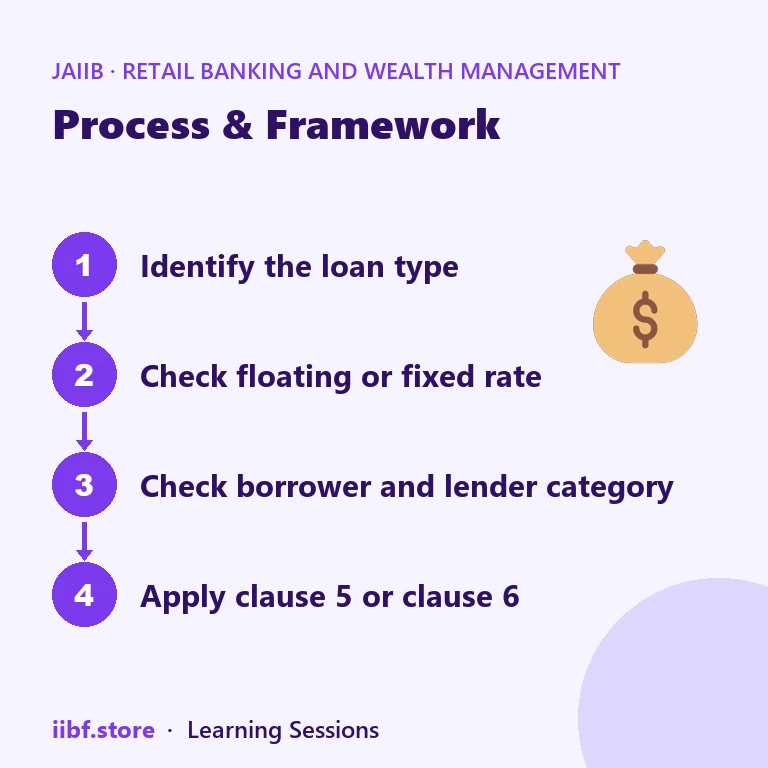
- Identify the loan. Is it a term loan, demand loan, cash credit or overdraft? Was it sanctioned or renewed on or after 1 January 2026?
- Check the rate type. Floating, fixed, or dual? For dual, which phase is running at the time of pre-payment?
- Check the borrower and purpose. An individual for a non-business purpose, or an individual or MSE for business?
- Check the lender category. A commercial bank other than SFB, RRB and LAB, or one of the clause 5(ii)(b) lenders? If the latter, is the sanctioned amount up to Rs 50 lakh?
- Confirm the disclosure. Look at the sanction letter, agreement and KFS. If a charge was never disclosed, it cannot be levied.
A worked example from the branch
Consider Mrs Verma, a school teacher, who took a floating rate home loan from a public sector bank after 1 January 2026. Her outstanding is Rs 28 lakh and she receives a Rs 4 lakh bonus. She wants to put the entire bonus into the loan.
Under an older style of practice with, say, a 2 per cent charge on the amount prepaid, she would have paid Rs 8,000 for the privilege of reducing her debt. This is purely an illustration of how such charges worked, not a figure from the Directions. Under clause 5(i), no charge can be levied on a floating rate loan to an individual for a non-business purpose. It makes no difference that her husband is a co-applicant, and it makes no difference whether the Rs 4 lakh comes from her bonus or from a loan against her gold taken from another lender.
Now change the facts. Mr Rao runs a small trading firm that qualifies as an MSE and has a Rs 70 lakh floating rate business loan from a regional rural bank. Because the sanctioned amount is above Rs 50 lakh, clause 5(ii)(b) does not shield him. Clause 6 applies, and the bank may charge in line with its policy, but only if the charge was disclosed upfront in the sanction letter, agreement and KFS. If it was not disclosed, the bank cannot raise it at closure.
| Borrower and purpose | Lender category | Charge allowed? |
|---|---|---|
| Individual, non-business purpose | All covered lenders | No (clause 5(i)) |
| Individual or MSE, business purpose | Commercial banks other than SFB, RRB, LAB; Tier 4 UCB; upper-layer NBFC; AIFI | No (clause 5(ii)(a)) |
| Individual or MSE, business purpose, sanction up to Rs 50 lakh | SFB, RRB, Tier 3 UCB, StCB, CCB, middle-layer NBFC | No (clause 5(ii)(b)) |
| Business loan above Rs 50 lakh | Same lenders as the row above | As per policy, if disclosed (clause 6) |
| Lender-initiated pre-payment | Any covered lender | No (clause 8) |
Why this matters for a retail banker
There are three practical consequences you will see in your branch.
First, balance transfers become easier. If a customer wants to move a floating rate home loan to another bank for a lower spread, the old lender cannot block the move with a pre-payment fee. Your branch may therefore see more inbound take-over requests, and also more outbound pre-closure requests. Retention conversations should focus on a rate reset, not on the penalty.
Second, part-payment becomes a mainstream tool. Customers can apply bonuses, maturing deposits and other lump sums to reduce principal. On a floating rate home loan, the usual benefit is a shorter tenure or a lower EMI. Your job is to explain the options clearly, without pushing the customer toward the choice that suits the bank's liquidity.
Third, documentation discipline matters more. Because an undisclosed charge cannot be levied, any gap in the KFS or the sanction letter hurts the bank. Check that the pre-payment line is filled in correctly for every sanction.
If you want the loan-side computations that sit under this chapter, the RBWM printed book with chapter-wise MCQs is a good companion for the retail loan chapters, and the JAIIB books page lists the other papers in the set.
How IIBF tests prepayment charges on floating rate loans
Questions on this topic usually appear as one of four patterns: a direct statement about whether charges can be levied, a scenario with a borrower and lender type, a question on disclosure, and an exception question. IIBF expects you to apply the principle, so read the scenario for three triggers: the rate type, the borrower type and the lender type. Practise such scenarios under timed conditions with the JAIIB mock tests, and if you want to see the offers running for the exam, look at the JAIIB offer page.
Common traps
- Assuming the ban covers all loans. It covers floating rate loans for the listed borrower and lender combinations. Fixed rate loans fall under clause 6 and the lender's policy.
- Forgetting the Rs 50 lakh threshold, which applies only to the clause 5(ii)(b) lender group and only for business loans.
- Applying the Directions to loans sanctioned before 1 January 2026 that have not been renewed.
- Missing the co-obligant point. The ban holds with or without co-obligants.
- Forgetting that disclosure is mandatory even where a charge is permitted.
Practice question 1
Mr Singh took a floating rate personal loan from a commercial bank in March 2026 and wishes to close it using funds borrowed from a friend. Can the bank levy a pre-payment charge? The answer is no. Clause 5(i) bars charges on floating rate non-business loans to individuals, and clause 5(iii) says the bar applies regardless of the source of funds and with no lock-in period.
Practice question 2
A small finance bank has sanctioned a floating rate business loan of Rs 40 lakh to an MSE. Can it levy a charge on pre-payment? No. Clause 5(ii)(b) bars a charge for SFBs on business loans where the sanctioned amount is up to Rs 50 lakh.
Practice question 3
A bank did not mention any pre-payment charge in the sanction letter, but its internal policy permits one. At closure the bank wants to collect it. The bank cannot. Clause 9 says charges not disclosed upfront cannot be imposed later.
Quick revision points
- Directions name: Reserve Bank of India (Pre-payment Charges on Loans) Directions, 2025; effective 1 January 2026.
- Applies to loans sanctioned or renewed on or after that date.
- Covered: commercial banks (excluding payments banks), co-operative banks, NBFCs, AIFIs.
- Floating rate, individual, non-business: no charge, with or without co-obligants.
- Floating rate, business loans: no charge for the clause 5(ii)(a) group; for the clause 5(ii)(b) group, no charge up to Rs 50 lakh sanction.
- No dependence on source of funds; no lock-in period.
- Dual or hybrid: depends on whether floating at the time of pre-payment.
- Lender-initiated pre-payment: no charge. Cash credit or overdraft non-renewal with timely notice: no charge.
- Disclosure in sanction letter, agreement and KFS; undisclosed charges not allowed; waived charges not revived.
Frequently asked questions
Are there any pre-payment charges on a floating rate home loan taken by an individual?
For loans sanctioned or renewed on or after 1 January 2026, no. Clause 5(i) of the RBI Directions bars charges on floating rate loans to individuals for non-business purposes, with or without co-obligants.
Do the Directions apply to my old home loan?
They apply to loans and advances sanctioned or renewed on or after 1 January 2026. An older loan continues on its original terms until it is renewed, so check the loan agreement.
Can a bank charge pre-payment fees on a fixed rate loan?
The Directions do not give a separate prohibition for fixed rate loans. Under clause 6, a charge can apply as per the lender's approved policy, but it must be disclosed upfront in the sanction letter, loan agreement and KFS.
Does the Rs 50 lakh limit apply to home loans?
No. The Rs 50 lakh threshold in clause 5(ii)(b) relates to business loans from specified lender categories such as small finance banks and regional rural banks. Non-business floating rate loans to individuals are covered by clause 5(i) without any threshold.
Can the bank charge if I repay using another bank's loan?
For loans covered by clause 5, no. The bar applies regardless of the source of funds used for full or partial pre-payment, and no minimum lock-in period can be imposed.
Conclusion
Prepayment charges on floating rate loans are now the exception rather than the rule for individual borrowers and for small business borrowers. The structure to remember is simple: first identify the rate type, then the borrower and purpose, then the lender category and sanctioned amount, and finally check the disclosure. For the examination, practise applying this sequence to scenarios rather than memorising clause numbers. For the branch, make sure every sanction letter and KFS states the position clearly, because an undisclosed charge cannot be collected later.
Always read the primary text yourself. The RBI's summary page is at rbi.org.in, and the full Directions are at the RBI notification page. For the official JAIIB schedule and syllabus, visit iibf.org.in, and use the upcoming exam cycle's notice for current details.
Prefer revising from a printed book?
Chapter-wise books with MCQs after every chapter — minimal pages, complete coverage, delivered anywhere in India. Every book has a free sample to read first.


















































Quick quiz on this topic
5 exam-style questions from our free test bank — check yourself before you move on.
Practice this topic
Take a free mock test, download chapter PDFs, or watch a video class — all included on iibf.store.