Advance Remittance for Imports under FEMA: 2026 Rules Explained
A customer walks into your branch with a proforma invoice from an overseas supplier and says, "They want fifty per cent in advance, otherwise they will not ship." The remittance is not for goods that have already arrived, so there is no bill of entry, no bill of lading and nothing to tie the payment to. Whether you can send that money, and on what conditions, is the question behind advance remittance for imports under FEMA. For anyone studying International Trade Finance, it is one of the cleanest topics to master, because the rule changed on 1 October 2026 and examiners love a topic where the old answer and the new answer differ.
In this article we go through the legal basis, the new decision flow for an Authorised Dealer (AD) bank, what happens when the goods never arrive, how the entry is closed in IDPMS, and how IIBF frames questions on it. Read the rule text once and you will be able to answer both a branch query and an exam question in the same breath.
What is advance remittance for imports and why does it carry risk?
When an importer pays the foreign supplier before the goods are shipped or received, the payment is called an advance remittance. Normally, import payments follow documents: the AD bank receives the shipping documents, the bill of entry is filed, and the remittance is made against evidence that the goods have actually come into India. In an advance, the sequence is reversed, and the bank is sending foreign exchange out of the country on the strength of a promise.
The risk is straightforward. The supplier may not ship, may ship late, or may ship goods different from what was ordered. If the money has already left, recovering it from a foreign party is slow and expensive. For the bank, there is also a regulatory risk: advance outflows can be misused for round-tripping, for disguised capital transfers or for trade-based money laundering. That is why the regulator ties every advance to a genuine commercial need and to follow-up in the Import Data Processing and Monitoring System (IDPMS).
The legal basis
The governing instrument is the Foreign Exchange Management (Export and Import of Goods and Services) Regulations, 2026, notified by the Reserve Bank as Notification No. FEMA 23(R)/2026-RB on 13 January 2026 under the Foreign Exchange Management Act, 1999. These Regulations come into force from 1 October 2026, and they replaced the earlier 2015 export regulations. Before that date, import advances were governed through the RBI Master Direction on Import of Goods and Services (FED Master Direction No. 17/2016-17), which you can still see on the RBI Master Directions page. Always check the latest RBI Directions issued under the Regulations and your own bank's board-approved policy before you handle a live case.
The rule in the 2026 Regulations: what changed
Under the old Master Direction, an AD bank could allow advance remittance for import of goods, but if the amount was above USD 200,000 the importer had to furnish an unconditional, irrevocable standby letter of credit or a guarantee from an international bank of repute. There were waivers and special cases, and the ceiling was a fixed number that every banker memorised.
The 2026 Regulations take a different approach. Regulation 10(3) says that an Authorised Dealer may permit advance remittance for import after satisfying itself of the genuineness of the requirement for advance remittance, and that the AD may consider specifying thresholds for advance payment, beyond which the payment may require a standby letter of credit or a guarantee. In other words, the fixed USD 200,000 line is no longer written into the Regulation itself. The decision moves to the bank's own assessment and its internal policy.
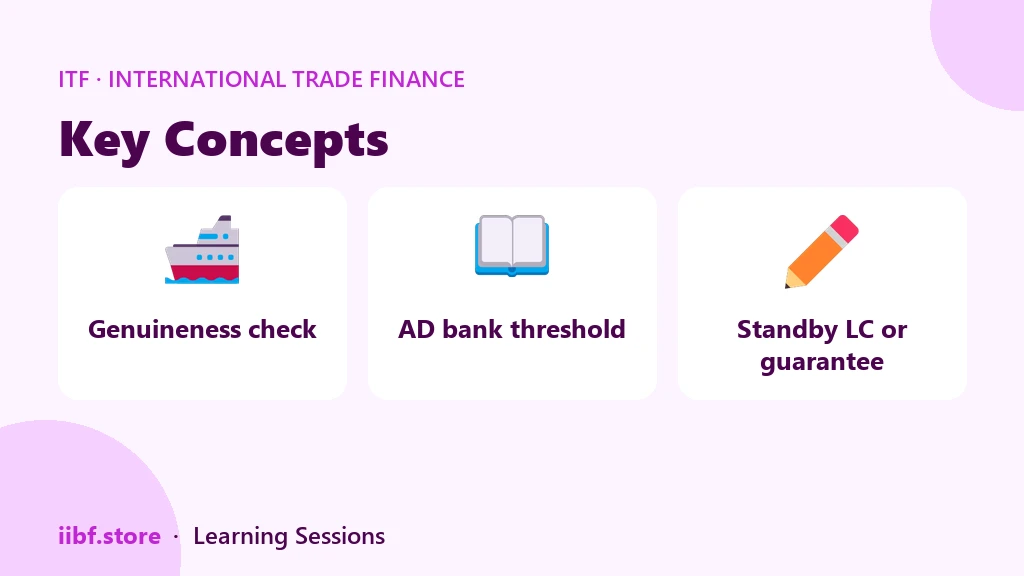
Three ideas to hold on to
- Genuineness first. The AD must be satisfied that the advance is truly required, for example because the supplier is a manufacturer who produces to order or because the commercial terms of the contract demand it.
- Threshold is the bank's call. The word used is "may consider specifying". The Regulation does not give one national number, so each bank decides the level beyond which it wants a standby LC or guarantee.
- Security is not optional forever. Once a customer has defaulted on a past advance, security becomes compulsory, as we see below.
How an AD bank handles the request step by step
Think of the process as five checkpoints. The same flow works whether the advance is small or large; only the depth of the check changes.
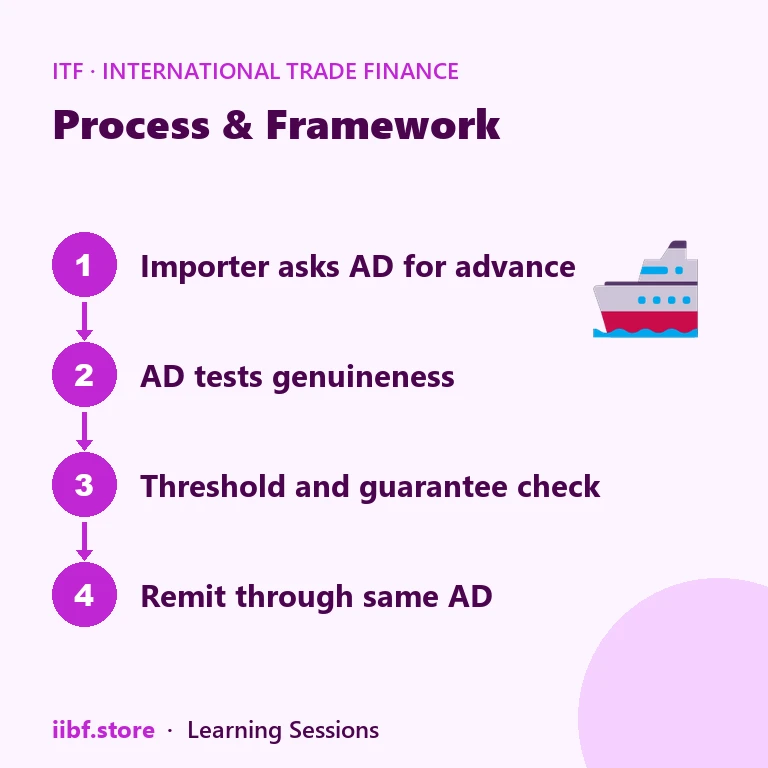
- Receive the request and the contract documents. Ask for the purchase order, proforma invoice or sale contract that shows the advance term, the supplier's name and the expected shipment period.
- Test genuineness. Is the supplier known? Does the item match the importer's business? Is the amount reasonable against the order value? Has this customer imported before, and were earlier IDPMS entries closed on time?
- Apply the bank's threshold. If the advance crosses the level in the bank's policy, take a standby letter of credit or a guarantee as security. Below that level, the bank may go ahead on the basis of its assessment.
- Remit and record. The advance and all later payments for that import should be routed through the same AD bank. The bank enters the outward remittance in IDPMS.
- Follow up until the entry is marked off. When goods arrive, the bill of entry details are linked to the advance in IDPMS and the entry is marked off after the payment for the import has been made.
Routing through the same AD bank
Regulation 10(2) requires an importer who makes an advance payment to route the advance and any subsequent payments through the same Authorised Dealer. The importer may shift to another AD, but only after intimating the change to both banks. This rule exists so that one bank holds the full picture of the transaction and can follow it to closure. A branch officer should never accept a request to pay the balance through a different bank without checking this point.
Interest and gold or silver
Two smaller rules come in the same regulation family. First, if interest is payable on a delayed import payment, it must not exceed the all-in-cost ceiling for trade credit under the Foreign Exchange Management (Borrowing and Lending) Regulations, 2018, as amended. Second, Regulation 11 puts a complete bar on advance remittance for import of gold or silver. This applies notwithstanding the rest of the Regulations, so no amount of customer standing can unlock it.
What happens when the import does not materialise
This is the part most students under-prepare. If the supplier fails to ship, Regulation 12(1) says the importer must repatriate the advance payment if the import does not happen within the contract period or the extended period. The AD bank monitors the open IDPMS entry and chases the importer.
Regulation 12(2) then gives the penalty. If the advance is not brought back within the contract period or the extended period allowed by the AD, or if the IDPMS entry has not been marked off in the manner provided in Regulation 18(1)(j), then any future advance payment for imports by that importer requires an unconditional, irrevocable standby letter of credit or a guarantee from an international bank of repute, or a guarantee of an Authorised Dealer in India issued against a counter-guarantee of an international bank of repute. So the bank's discretion, which was wide for a clean customer, disappears for a defaulter.
Closing a stuck entry
Sometimes repatriation is impossible, for example because the foreign supplier has gone out of business. Under Regulation 18(1)(j), the AD may, on the importer's written request citing reasons, close the IDPMS entry for the advance where no import has taken place and repatriation is not possible, after being satisfied that the reasons are genuine. Regulation 18(1)(k) similarly lets the AD close an entry where the import was settled at a reduced value. Note that the bank must be satisfied of the genuineness of the reasons; it is not a rubber stamp.
Old rule versus 2026 rule: advance remittance for imports under FEMA at a glance
| Point | Earlier Master Direction (goods) | 2026 Regulations (from 1 October 2026) |
|---|---|---|
| Basis for permitting | AD may allow advance, subject to listed conditions | AD may permit after satisfying itself of genuineness (Reg. 10(3)) |
| Security trigger | Fixed figure of USD 200,000, above which standby LC or guarantee was needed | Threshold specified by the AD in its policy; no fixed figure in the Regulation |
| Routing | Through the same AD bank | Same AD bank; change allowed after intimating both (Reg. 10(2)) |
| Gold and silver | Advance for gold was restricted | No advance remittance permitted for gold or silver (Reg. 11) |
| Import not materialised | Repatriation and follow-up norms | Repatriate; failing which every future advance needs standby LC or guarantee (Reg. 12) |
| Time for making import payment | Fixed outer period in the Master Direction | Period in the underlying contract; AD may extend for reasons cited (Reg. 9) |
The first four rows are where examiners usually focus. The shift from a rule-based ceiling to a principle-based test is the single most important idea to carry into the hall.
A worked example from a branch
M/s Kaveri Textile Machines, an existing customer, wants to pay a German manufacturer an advance against a custom-built spinning unit. Your bank's policy says advances above a certain internal level need a standby LC. Walk through the case.
- The contract shows the manufacturer builds to order and requires an advance, so the commercial need is genuine.
- The importer has cleared every earlier IDPMS entry on time, so there is no default history.
- The advance is above the bank's internal level, so the bank asks for an unconditional, irrevocable standby LC or a guarantee from an international bank of repute, or an AD guarantee backed by such a counter-guarantee.
- The advance is remitted and entered in IDPMS. The balance is later paid through the same bank.
- Machines arrive, the bill of entry is linked, and the entry is marked off after payment is complete.
Now change one fact: the manufacturer cancels the order and does not refund. Regulation 12 kicks in. The importer must try to repatriate the advance; if it cannot, the bank can close the entry on a reasoned request, but every future advance by that importer will need a standby LC or guarantee.
How IIBF tests this topic
The International Trade Finance paper rewards candidates who separate three layers: the Regulation (what the law says), the bank's own policy (what the AD decides) and the transaction (what happened in this case). Typical question patterns are:
- Statement-based questions asking which of the given statements about import advances is correct.
- "Except" questions, where three conditions are true and one is invented, such as a rule that advance for gold is allowed up to a limit.
- Case questions asking what the AD should do when an advance is unrecovered and the importer applies for a fresh advance.
- Match-the-following questions pairing IDPMS with imports and EDPMS with exports.
Three practice questions
Q1. Under the 2026 Regulations, advance remittance for import of goods may be permitted by an AD bank after (a) approval of the Reserve Bank in every case, (b) satisfying itself of the genuineness of the requirement, (c) the importer obtaining a bank guarantee in all cases, (d) the Directorate General of Foreign Trade certifying the order. The correct answer is (b). Regulation 10(3) puts the genuineness test on the AD; security applies where the bank's threshold is crossed, not in every case.
Q2. An importer paid an advance, the supplier did not deliver, and the advance has neither been repatriated within the contract or extended period nor the entry marked off in IDPMS. What follows? The correct reading is that every future advance payment for imports by that importer requires an unconditional, irrevocable standby LC or an acceptable guarantee under Regulation 12(2). The earlier advance does not simply vanish, and the bank cannot waive the security on the strength of past relationship.
Q3. Which of the following advances is barred outright? The answer is advance remittance for import of gold or silver, under Regulation 11. Students sometimes choose capital goods or services because they sound risky, but those are covered by the genuineness test and the bank's thresholds.
Common traps
- Quoting USD 200,000 as if it is written in the 2026 Regulations. It belongs to the earlier Master Direction; the new text leaves the threshold to the AD.
- Mixing IDPMS (imports) with EDPMS (exports).
- Forgetting that the security is triggered by the importer's non-repatriation, not by the supplier's default alone.
- Ignoring the same-AD routing rule.
Quick revision points on advance remittance for imports under FEMA
- Governing text: FEMA (Export and Import of Goods and Services) Regulations, 2026, Notification No. FEMA 23(R)/2026-RB, in force from 1 October 2026.
- Advance allowed after the AD is satisfied about genuineness; the AD may specify thresholds beyond which a standby LC or guarantee is needed.
- Advance and later payments go through the same AD; change only after intimating both banks.
- Interest on delayed import payment is capped at the all-in-cost ceiling for trade credit under the 2018 Borrowing and Lending Regulations.
- No advance for gold or silver.
- If the import does not happen, repatriate; if not repatriated or the IDPMS entry is not marked off, future advances need an unconditional, irrevocable standby LC or guarantee.
- The AD may close an advance entry on a reasoned request where no import occurred and repatriation is not possible.
Stay alert for updates, because RBI issues Directions and amendments under the Regulations from time to time. The official IIBF website carries syllabus notices, and you should confirm the upcoming exam cycle schedule there.
Prepare this topic the right way
Trade finance becomes easy when you practise it as a flow rather than a list. Our International Trade Finance course walks through import and export payment rules with branch examples, and the ITF printed book gives chapter-wise MCQs you can attempt after each module. When you finish a unit, take the ITF mock tests to check whether you can spot the traps listed above under time pressure. For quick reading between shifts, the free study material library is a useful companion, and revising advance remittance for imports under FEMA from two or three sources makes the new rule stick.
Frequently asked questions
Is the USD 200,000 limit still applicable for import advances?
The USD 200,000 figure belongs to the earlier Master Direction on Import of Goods and Services. The 2026 Regulations, in force from 1 October 2026, do not write a fixed figure; they let the AD bank specify thresholds beyond which a standby letter of credit or guarantee may be required. Check your bank's current policy.
Can a bank allow an advance for importing gold?
No. Regulation 11 states that no advance remittance is permitted by an Authorised Dealer for the import of gold or silver, notwithstanding other provisions of the Regulations.
What if the foreign supplier does not ship the goods?
The importer must repatriate the advance within the contract period or the extended period allowed by the AD. If it is not repatriated or the IDPMS entry is not marked off, future import advances by that importer need an unconditional, irrevocable standby LC or an acceptable guarantee.
Can the importer pay the balance through a different bank?
Only after intimating both Authorised Dealers. The default rule is that the advance and subsequent payments are routed through the same AD bank.
Which system tracks import advances?
The Import Data Processing and Monitoring System (IDPMS). The AD enters outward remittances, tracks the entry and marks it off after ensuring that payment for the import has been made.
Conclusion
The core of advance remittance for imports under FEMA after 1 October 2026 is simple: the AD bank tests genuineness, applies its own threshold for a standby LC or guarantee, routes everything through one bank, tracks the entry in IDPMS, and becomes strict if an earlier advance was never recovered. Remember the contrast with the old fixed USD 200,000 line, remember the bar on gold and silver, and remember the consequence of non-repatriation. Those four points will carry you through both the branch counter and the ITF paper. For the broader picture of how this fits with documentary credits, collections and guarantees, work through the full syllabus step by step, and always verify the latest RBI Directions before you apply a rule in live work.
Prefer revising from a printed book?
Chapter-wise books with MCQs after every chapter — minimal pages, complete coverage, delivered anywhere in India. Every book has a free sample to read first.


















































Practice this topic
Take a free mock test, download chapter PDFs, or watch a video class — all included on iibf.store.
Keep reading