Emphasis of Matter in Bank Audit Report: CAAP Guide
You are reviewing the draft audit report of a mid-sized bank. The financial statements are clean, the auditor is comfortable with the numbers, yet the report carries one extra paragraph headed "Emphasis of Matter" that points to a note on a large court case. Does that mean the auditor is unhappy with the accounts? Is the opinion qualified? This is exactly the confusion that examiners love to exploit, and it is why emphasis of matter in bank audit report is a topic worth mastering for the Certified Accounting and Audit Professional (CAAP) paper.
In this guide we will go through what an Emphasis of Matter (EOM) paragraph is, what the standard says, how it differs from an Other Matter paragraph, a Key Audit Matter and a modified opinion, and how you should answer questions on it. Everything about the standard below is taken from SA 706 (Revised) as published by ICAI.
What is an emphasis of matter paragraph?
Every bank's financial statements are audited, and the auditor's report ends in an opinion. Sometimes the auditor feels that one item, although properly accounted for and disclosed, is so important that a reader must not miss it. For that, the auditor adds a short, separate paragraph. That paragraph is the Emphasis of Matter paragraph.
SA 706 (Revised), "Emphasis of Matter Paragraphs and Other Matter Paragraphs in the Independent Auditor's Report", defines it as a paragraph that refers to a matter appropriately presented or disclosed in the financial statements that, in the auditor's judgment, is of such importance that it is fundamental to users' understanding of the financial statements. The standard applies to audits of periods beginning on or after 1 April 2018. You can read the full text on the ICAI website (SA 706 Revised).
Three words in that definition decide most exam questions: appropriately presented or disclosed, fundamental and users' understanding. If the matter is not in the financial statements, it cannot be an EOM. If it is not fundamental, the paragraph is not needed. And the whole purpose is to help the reader, not to warn the bank.
Where a bank auditor's report comes from
A banking company prepares its balance sheet and profit and loss account in the forms given in the Third Schedule to the Banking Regulation Act, 1949 (Form A and Form B), as near thereto as circumstances admit. Section 30 requires the accounts to be audited by a person qualified to be a company auditor. For a nationalised bank or the State Bank of India, the auditor reports to the Central Government on matters such as whether the balance sheet is full and fair, whether explanations sought were satisfactory, whether transactions were within the bank's powers and whether branch returns were adequate for audit. The ICAI study material on Audit of Banks also notes that the report must comply with SA 700, SA 705, SA 706, SA 710 and SA 720. So the EOM paragraph sits inside a framework of statutory reporting, not in place of it.
Key concepts behind emphasis of matter in bank audit report
Before any worked example, fix the vocabulary. Most wrong answers in CAAP come from mixing these terms.
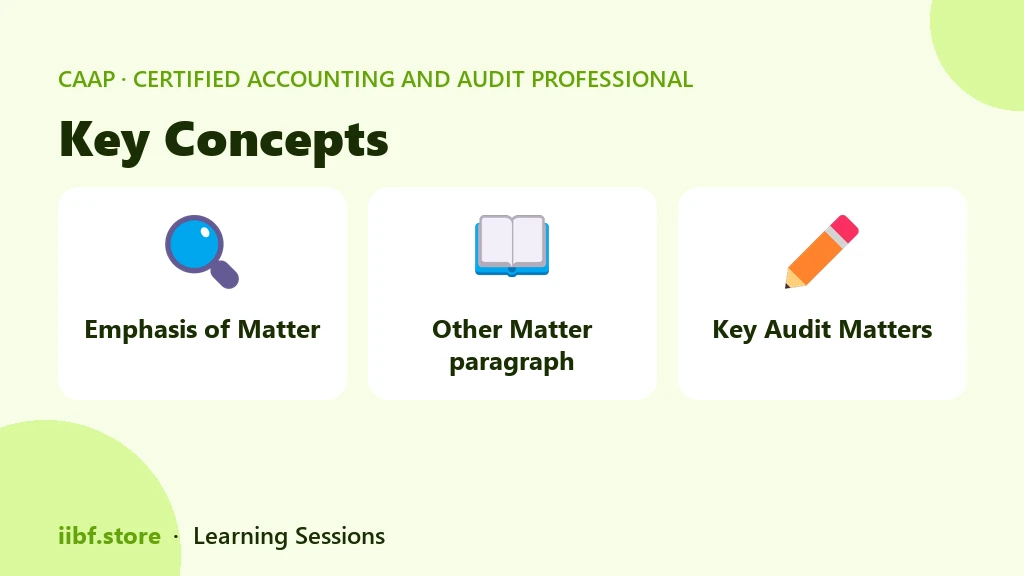
Emphasis of Matter versus Other Matter
An EOM refers to something that is presented or disclosed in the financial statements. An Other Matter (OM) paragraph refers to something that is not presented or disclosed in the financial statements but is relevant to users' understanding of the audit, the auditor's responsibilities or the auditor's report. An OM paragraph may be included only if law or regulation does not prohibit it. In a bank setting, an OM could be used where, for example, the comparative figures were audited by another firm.
Emphasis of Matter versus Key Audit Matters
Key Audit Matters (KAMs) are the matters of most significance in the audit, selected by the auditor from the matters communicated with those charged with governance (TCWG). SA 706 says that if a matter has been determined to be a KAM under SA 701, it cannot also be given an EOM paragraph. The standard also says that when SA 701 applies, an EOM paragraph is not a substitute for describing individual KAMs. For listed banks, this separation is important: a heavily judgemental area such as loan loss provisioning is usually a KAM, while a one-off external event may be an EOM.
Emphasis of Matter versus a modified opinion
An EOM is allowed only when the auditor would not be required to modify the opinion under SA 705 (Revised) because of that matter. The standard is explicit that including an EOM paragraph does not affect the opinion. It is also not a substitute for a qualified opinion when the situation requires one, nor for the disclosures that management must make. If the bank has failed to disclose something properly, the answer is a modified opinion, not an EOM.
| Feature | Emphasis of Matter | Other Matter | Key Audit Matter | Modified opinion |
|---|---|---|---|---|
| Standard | SA 706 | SA 706 | SA 701 | SA 705 |
| Matter is in the financial statements? | Yes, properly disclosed | No | Usually yes | Misstatement, or inability to get evidence |
| Effect on opinion | Opinion not modified | Opinion not modified | Opinion not modified | Opinion is qualified, adverse or disclaimed |
| Heading | Includes the term "Emphasis of Matter" | "Other Matter" or other appropriate heading | "Key Audit Matters" section | Basis for modified opinion section |
| Why used | Fundamental to understanding the statements | Relevant to understanding the audit or report | Most significant in the audit | Statements not fairly presented, or scope limited |
When does a bank auditor add an EOM paragraph?
SA 706 gives examples of circumstances in which an auditor may consider an EOM necessary. Translated into a bank's world, they look like this:
- Uncertainty about exceptional litigation or regulatory action. A large claim against the bank, or a regulatory proceeding whose outcome is not yet known, and which is disclosed in the notes.
- A significant subsequent event. Something that occurs between the balance sheet date and the date of the auditor's report, such as a major fraud being detected.
- Early application of a new accounting standard, where permitted, with a material effect on the financial statements.
- A major catastrophe that has had, or continues to have, a significant effect on the bank's financial position, for example floods affecting a concentrated loan portfolio.
Appendix 1 of the standard also lists other SAs that require an EOM, such as where a prescribed financial reporting framework would be unacceptable but for the fact that law prescribes it. The standard adds a caution: widespread use of EOM paragraphs may diminish the effectiveness of the communication. So auditors use them sparingly, and so should you in an exam answer.
Step-by-step: how the auditor decides and drafts the paragraph
Think of the decision as a short checklist. Examiners often give a scenario and ask "what should the auditor do?". Following these steps gives you a safe, structured answer.
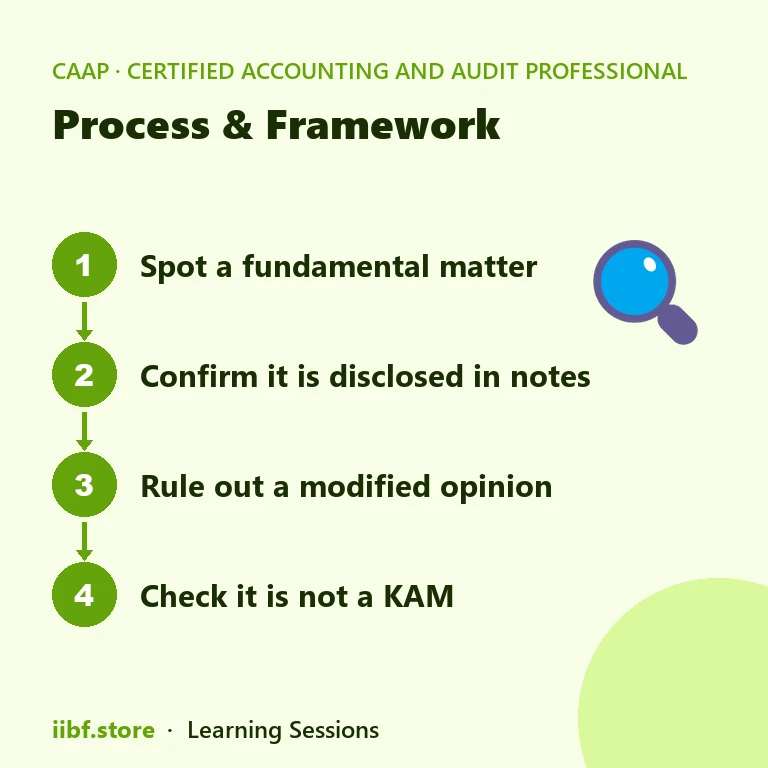
- Identify a matter that is fundamental. During the audit the team notes an item, say a pending tax dispute, which the user of the statements must not overlook.
- Confirm it is properly disclosed. The note must exist and describe the matter fully. If the note is missing or misleading, you are in modification territory.
- Rule out a modified opinion. The matter, once disclosed, must not require a qualified or adverse opinion under SA 705 (Revised).
- Check it is not already a KAM. Where SA 701 applies, the same matter cannot be both a KAM and an EOM.
- Communicate with TCWG. Paragraph 12 of SA 706 requires the auditor, who expects to include an EOM or OM paragraph, to communicate with those charged with governance about it and the wording. In a bank, that usually means the Audit Committee of the Board.
What the paragraph must contain
Paragraph 9 of SA 706 sets out three requirements. The paragraph must be in a separate section with a heading that includes the term "Emphasis of Matter". It must clearly refer to the matter emphasised and to where the relevant disclosures that fully describe it can be found in the financial statements, and it may refer only to information presented or disclosed there. And it must indicate that the auditor's opinion is not modified in respect of the matter emphasised.
An illustrative wording, for study purposes only, would read: "We draw attention to Note X to the financial statements, which describes the uncertainty relating to the outcome of the legal proceedings against the Bank. Our opinion is not modified in respect of this matter." Notice there is no judgement on whether the bank will win or lose, and no new fact is introduced.
Where to place it in the report
The standard leaves placement to the auditor's judgement, depending on the significance of the information. If the EOM relates to the applicable financial reporting framework, it may be placed immediately after the Basis of Opinion section. If the report has a Key Audit Matters section, the EOM may sit directly before or after it, and the auditor may add context to the heading, such as "Emphasis of Matter - Subsequent Event", to distinguish it from KAMs.
A worked branch-audit style example
Consider a private sector bank. At year-end, a civil court has restrained the bank from recovering a large collateralised exposure, and the bank has disclosed the dispute, the amount involved, the provision held and the uncertainty in a note. The auditor has examined the provision and finds it reasonable. How should the auditor report?
| Question | Finding | Conclusion |
|---|---|---|
| Is the matter disclosed in the notes? | Yes, with amount and provision | EOM is possible |
| Is the provision or disclosure inadequate? | No, auditor is satisfied | No modified opinion |
| Is it already a KAM? | No, it is not among the matters of most significance | EOM can be used |
| Does the auditor expect to add the paragraph? | Yes | Discuss with Audit Committee first |
| Effect on opinion | None | State that opinion is not modified |
Now change one fact: the bank has not disclosed the dispute at all. Here the problem is not a matter for emphasis. The financial statements lack a required disclosure, so the auditor must consider a qualified or adverse opinion under SA 705. This is the single most common trap in questions on emphasis of matter in bank audit report.
Going concern, litigation and bank-specific reporting
Two cross-links often appear in questions. First, going concern: SA 706 clarifies that an EOM is not a substitute for reporting under SA 570 (Revised) when a material uncertainty exists on the entity's ability to continue as a going concern. That situation has its own reporting section. Second, the Companies Act reporting under Rule 11 of the Companies (Audit and Auditors) Rules, 2014: according to the ICAI material, the auditor's report must also state, among other matters, whether the bank has disclosed the impact of pending litigations on its financial position, whether provision has been made for material foreseeable losses on long-term contracts including derivative contracts, and whether there has been any delay in transferring amounts to the Investor Education and Protection Fund. A litigation note that satisfies the first of these may also be the matter on which the auditor places an EOM.
Do not confuse any of this with the Long Form Audit Report (LFAR), which is a separate, detailed report that bank auditors furnish as required by the bank's terms of appointment, as the ICAI study material explains. The EOM paragraph belongs to the main audit report on the financial statements. If you want to revise the surrounding reporting structure, read the related study material on our free material page.
How CAAP and IIBF test emphasis of matter
Questions on this topic are usually conceptual, framed as statements to be marked true or false, or as short scenarios. For the latest syllabus and exam schedule, always refer to the official IIBF website, and prepare with the full Certified Accounting and Audit Professional course, the CAAP printed book with chapter-wise questions and the CAAP mock tests.
Common traps
- Saying an EOM "qualifies" the opinion. It never does.
- Using an EOM for a matter that is not disclosed in the financial statements. That would be an Other Matter, or a modification.
- Treating an EOM as a replacement for a KAM, or using both for the same matter.
- Forgetting the requirement to discuss the paragraph with those charged with governance.
- Writing that the paragraph may contain new information. It may refer only to what is in the financial statements.
Practice question 1
Which statement about an Emphasis of Matter paragraph in a bank's audit report is correct? (a) It modifies the opinion; (b) It refers to a matter properly disclosed in the financial statements and the opinion is not modified; (c) It refers to matters not disclosed in the financial statements; (d) It replaces a Key Audit Matter.
Answer: (b). By definition, an EOM refers to a matter appropriately presented or disclosed in the financial statements, and the paragraph must state that the opinion is not modified. Option (c) describes an Other Matter paragraph, and option (d) is wrong because the standard says an EOM is not a substitute for describing individual KAMs.
Practice question 2
A bank has failed to disclose a material contingent liability in its notes. The auditor wants to draw attention to it through an EOM paragraph. Is that appropriate? (a) Yes, an EOM is the right tool; (b) No, because the omission of a required disclosure calls for a modified opinion under SA 705; (c) Yes, but only in the LFAR; (d) No, because EOM is only for going concern.
Answer: (b). An EOM is available only for a matter that is already appropriately disclosed, and it is not a substitute for the disclosures that management must make. Where a required disclosure is missing, the auditor must consider qualifying or giving an adverse opinion.
Practice question 3
Before including an EOM paragraph, the auditor should: (a) obtain RBI approval; (b) communicate with those charged with governance about the paragraph and its wording; (c) remove the matter from the notes; (d) issue a separate certificate.
Answer: (b). Paragraph 12 of SA 706 requires communication with TCWG regarding the expectation to include the paragraph and its wording.
Quick revision points
- EOM: matter properly disclosed in the financial statements and fundamental to understanding them.
- OM: matter not in the financial statements but relevant to understanding the audit, responsibilities or report, and not prohibited by law.
- Neither paragraph modifies the opinion; the EOM must say so.
- A matter determined to be a KAM under SA 701 cannot also be an EOM or OM.
- Separate section, heading containing "Emphasis of Matter", clear reference to the note.
- Discuss the expected paragraph and wording with TCWG.
- Not a substitute for SA 705 modification, management's disclosures or SA 570 going concern reporting.
- Use sparingly: widespread use dilutes the message.
Frequently asked questions
What is an emphasis of matter paragraph in a bank's audit report?
It is a separate paragraph that draws attention to a matter already properly presented or disclosed in the financial statements and judged fundamental to users' understanding. SA 706 (Revised) governs it, and it does not change the auditor's opinion.
Does an emphasis of matter paragraph mean the audit opinion is qualified?
No. The paragraph must state that the opinion is not modified in respect of the matter emphasised. A qualified opinion arises under SA 705 when there is a material misstatement or the auditor cannot obtain sufficient evidence, which is a different situation.
What is the difference between an emphasis of matter and a key audit matter?
A KAM is a matter of most significance in the audit, communicated under SA 701. An EOM draws attention to a disclosed, fundamental matter under SA 706. A matter determined to be a KAM cannot also be given an EOM paragraph.
Does the auditor have to discuss the paragraph with the bank's management or board?
Yes. SA 706 requires the auditor who expects to include an EOM or OM paragraph to communicate with those charged with governance about the expectation and the wording. In a bank, this is usually the Audit Committee of the Board.
Can an emphasis of matter be used instead of reporting a going concern uncertainty?
No. SA 706 states that an EOM is not a substitute for reporting under SA 570 (Revised) when a material uncertainty exists about the entity's ability to continue as a going concern.
Conclusion
For the CAAP exam, remember that emphasis of matter in bank audit report is a communication tool and not a verdict. The matter is already disclosed, it is fundamental, it does not change the opinion, it is not a KAM, and the auditor discusses it with those charged with governance before it goes in. Build the habit of running every scenario through the five-step test above, and you will avoid the usual traps. For structured practice, use the CAAP course, book and mock tests linked in this article, and always cross-check the standard text on the ICAI website before the exam.
Prefer revising from a printed book?
Chapter-wise books with MCQs after every chapter — minimal pages, complete coverage, delivered anywhere in India. Every book has a free sample to read first.


















































Practice this topic
Take a free mock test, download chapter PDFs, or watch a video class — all included on iibf.store.