SIM Swap Fraud in Banking: Warning Signs You Must Know (2026)
Every month, hundreds of Indian bank customers lose their entire savings within minutes of losing mobile network signal — and most never see it coming. This is the anatomy of sim swap fraud in banking: a crime where the attacker never touches your card, never guesses your password, and never breaches the bank's servers. Instead, the fraudster convinces a telecom operator to issue a duplicate SIM in your name, silently hijacking every OTP, alert and one-time link your bank sends you. For JAIIB, CAIIB and Prevention of Cyber Crime candidates, this topic sits at the intersection of telecom regulation, banking law and fraud typology — exactly the kind of cross-subject question IIBF loves to test. Browse more coverage on our Prevention of Cyber Crime tag hub as you prepare.
📱 What Is SIM Swap Fraud in Banking
SIM swap fraud in banking is a fraud typology where a criminal impersonates a genuine mobile subscriber to get the victim's number transferred onto a new SIM card that the fraudster physically controls. The moment the telecom network activates that duplicate SIM, the victim's old SIM goes dead, and every SMS, call and OTP meant for the account holder now lands with the criminal instead.
This is different from card skimming or a data breach — no banking system is hacked at all. The weak link is the identity-verification step at the telecom counter or online portal, which is why this topic is studied as a channel of cyber crime rather than a pure technology failure. Our Channels Of Cyber Crimes chapter classifies this alongside other social-engineering-driven routes into an account.
Once the fraudster's SIM goes live, they can receive net-banking OTPs, reset UPI PINs via "forgot password" flows, and authorise beneficiary additions — all without ever logging into the bank from a device the victim would recognise as suspicious. The account itself was never compromised in the technical sense; only the delivery channel for one-time credentials was hijacked, which is why purely device-based fraud checks often miss this pattern entirely.
Examiners frame this as a lesson in layered authentication: an OTP is only as trustworthy as the channel that carries it, and a mobile number is not a fixed, tamper-proof identity anchor the way many candidates assume it to be.
🕵️ How Fraudsters Execute a SIM Swap Attack
The attack is methodical and rarely opportunistic. First, the fraudster harvests enough personal and KYC-level data about the target — name, date of birth, registered address, sometimes the last four digits of an ID document — usually gathered well in advance through unrelated data leaks or social-engineering calls.
Next, they approach the telecom operator, either at a retail outlet or through an online SIM-replacement request, claiming the original SIM is lost or damaged, and submit forged or copied identity proof to request a duplicate. If the verification step is weak or the outlet staff is complicit or careless, the operator deactivates the genuine SIM and activates the new one in the fraudster's handset.
From that point, the attacker races the clock: reset net-banking credentials, add a new beneficiary, and push funds out before the victim even realises their phone has gone silent. It is a faster, quieter cousin of ransomware attacks on banks — no malware, no ransom note, just a hijacked identity. The stolen funds are frequently laundered through the same networks used for illegal loan apps and digital lending fraud, since both schemes rely on disposable bank accounts to move money quickly.
💡 Exam Tip: If a question describes an OTP-based fraud where the victim's phone suddenly shows "No Service," think SIM swap first — not phishing or card skimming.
⚖️ Legal Framework and Who Bears the Loss
SIM issuance and replacement fall under Department of Telecommunications and TRAI regulation, which mandates identity verification and a short non-porting window after a swap specifically to slow down misuse. Once the fraud crosses into unauthorised fund transfer, it becomes a matter for banking law and criminal law together — falling within the scope of instructions the Reserve Bank of India issues to banks on fraud risk management, since the loss originates in a telecom-side lapse but materialises as a banking transaction.
Banks that detect a fraud pattern of this kind must move with the same urgency that drives the CERT-In incident reporting directions for other categories of cyber incidents — early reporting materially improves the odds of freezing funds before they exit the banking system. Liability apportionment between the bank, the telecom operator and the customer depends on how quickly each party acted and whether the standard verification process was actually followed at the telecom end. Our Introduction To Cyber Crimes chapter maps this shared-liability logic across other fraud categories.
| Indicator | Genuine SIM Replacement | SIM Swap Fraud |
|---|---|---|
| Customer initiates the request in person or via verified app | ✅ Yes | ❌ Rarely |
| Sudden, unexplained "No Service" on the phone | ❌ Uncommon | ✅ Classic first sign |
| OTPs and bank alerts stop arriving without explanation | ❌ No | ✅ Yes |
| Large fund transfer within hours of the SIM change | ❌ No | ✅ Typical pattern |
| Preceded by a call/SMS asking to "update KYC" urgently | ❌ No | ✅ Very common lead-in |
🚩 Red Flags Bank Staff and Customers Must Catch
For customers, the earliest and most reliable red flag is total loss of mobile signal that does not resolve after a restart, especially if it follows an unexpected call about a "SIM upgrade" or "KYC re-verification." A second signal is silence — no OTP arriving for a transaction the customer never initiated, or worse, for one they did not even attempt.
For bank staff, the pattern shows up differently: a dormant or low-activity account suddenly adding a new beneficiary, followed within hours by a high-value transfer to that same beneficiary. A registered mobile number change flagged immediately before a large transaction is one of the strongest correlating signals available to a fraud-monitoring desk.
Our Incident Management chapter walks through how these scattered signals — telecom-side, transaction-side and behavioural — should be triaged together rather than in isolation, since no single flag is conclusive on its own.
A third, often-overlooked signal is timing: fraudsters tend to strike late at night or over a weekend, when a customer is least likely to notice a dead phone quickly and branch staff availability for manual verification is at its lowest. Training front-line staff to treat "mobile number recently changed" as a standing red flag, not just a data field, closes a gap that purely automated rules can miss.
⚠️ Common Mistake: Candidates often assume SIM swap fraud requires the victim to click a phishing link. It doesn't — the attack targets the telecom process, not the banking app directly.
🛡️ Bank-Side Prevention and Response Protocol
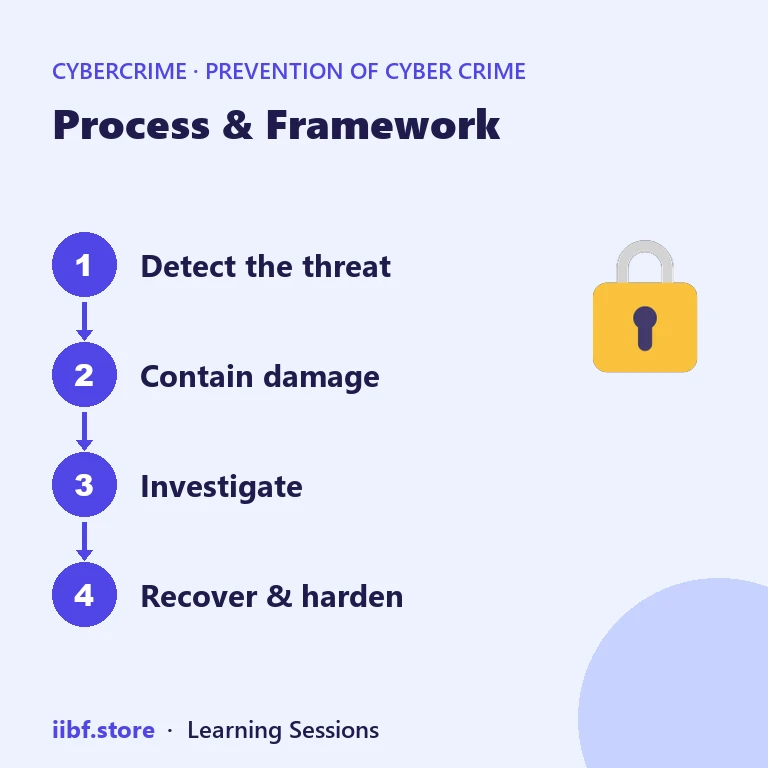
The single most effective control is a mandatory cooling period on high-value transactions and beneficiary payouts immediately after a registered mobile number or device change — this converts a race against the clock into a window the bank can use to verify the change. Velocity checks that flag "new beneficiary plus large transfer within a short span" catch a large share of these cases automatically.
Cross-checking telecom-side signals — where available through industry data-sharing arrangements — against banking-side mobile number updates adds another layer, since a SIM swap event and a net-banking password reset happening close together is a strong fraud indicator on its own. Banks also run customer-awareness campaigns urging account holders to contact the branch or fraud desk the moment their phone loses signal unexpectedly, rather than waiting it out. Our Computer Fraud Protection chapter covers how these layered controls are designed to work together rather than as standalone checks.
None of these controls work in isolation — a cooling period without a velocity check just delays the loss instead of preventing it, and a velocity check without staff training generates false alerts that get ignored. The strongest banks treat SIM-swap defence as one coordinated workflow spanning the call centre, the fraud desk and the branch, not three separate silos each guarding its own step.
📌 Remember: A cooling period after a mobile number or SIM change is the single control that most consistently interrupts a SIM swap attack before funds leave the account.
🧠 Practice MCQs: SIM Swap Fraud in Banking
Q1. What is the first noticeable warning sign of SIM swap fraud in banking for a customer? (a) Sudden "No Service" or total loss of mobile network signal (b) An increase in mobile data usage (c) Slow banking app loading (d) A physical bank statement arriving late
Answer: (a) — Loss of signal usually means the genuine SIM was deactivated the moment the duplicate SIM went live on the fraudster's device.
Q2. What telecom-side safeguard is specifically designed to blunt SIM swap fraud in banking? (a) A mandatory cooling-off period before a newly issued SIM can fully route OTPs (b) Free SIM replacement for every customer (c) Unlimited daily SIM swaps per number (d) Removing ID verification for e-SIM requests
Answer: (a) — A short non-porting window after a SIM swap gives the genuine subscriber time to notice and report before the new SIM is fully trusted.
Q3. In a typical SIM swap attack, what must the fraudster obtain BEFORE approaching the telecom operator? (a) Enough personal/KYC details about the victim to impersonate them (b) Physical access to the victim's old SIM card (c) A court order (d) The victim's core banking login
Answer: (a) — The attacker first gathers KYC-level personal data, typically through phishing or social engineering, to convincingly request a duplicate SIM.
Q4. Which bank-side control is MOST effective against sim swap fraud in banking? (a) A cooling/hold period on high-value transactions right after a registered mobile number change (b) Printing more chequebooks (c) Raising ATM withdrawal limits (d) Disabling SMS alerts to cut complaint volume
Answer: (a) — Delaying large transactions immediately after a mobile number or SIM change gives the bank a window to verify the change is genuine before funds move.
Q5. Which authority primarily governs SIM issuance and replacement rules relevant to SIM swap fraud investigations in India? (a) Telecom Regulatory Authority of India (TRAI) / Department of Telecommunications (b) Securities and Exchange Board of India (SEBI) (c) Insurance Regulatory and Development Authority (IRDAI) (d) Registrar of Companies
Answer: (a) — SIM issuance, KYC and replacement processes are governed by DoT/TRAI telecom regulation, which banks and investigators rely on when tracing SIM swap-linked fraud.
Want chapter-wise mock tests with 100+ MCQs? Start practising free
Is SIM swap fraud the same as phishing?
No. Phishing is often the first step used to collect personal details, but SIM swap fraud in banking specifically means a criminal gets the victim's mobile number transferred to a SIM they control, so they can intercept OTPs directly instead of tricking the victim into typing them.
Can a bank reverse a transaction that happened right after a SIM swap?
It depends heavily on how fast it is reported and whether the credit at the beneficiary end can still be intercepted; reporting to the bank's fraud desk within minutes materially improves recovery chances.
Does switching to an eSIM eliminate SIM swap risk?
No. eSIM activation still relies on the same telecom KYC and verification process, so it remains exposed to the same social-engineering route if that process is compromised at the operator's end.
How is this topic usually tested in the IIBF Prevention of Cyber Crime exam?
Expect scenario-based questions asking you to identify the fraud pattern, the earliest red flag, and the correct sequence of bank and telecom response steps, rather than plain definitions.
🎯 Conclusion: Make SIM Swap Detection Second Nature
SIM swap fraud in banking succeeds because it exploits a gap between two systems — telecom and banking — that rarely talk to each other in real time. Just as PV01 and DV01 in treasury quantify interest-rate exposure so a desk can act before a limit breach, banks need the same anticipatory discipline here: flag the mobile-number change, hold the payout, and verify before the window closes.
For your exam, keep the sequence straight — data harvesting, telecom impersonation, SIM deactivation, OTP interception, fund transfer — and you will handle any scenario-based question on this topic confidently. Test yourself with a full JAIIB or CAIIB mock set, or check the latest fraud trends on our IIBF news page, before attempting the chapter-end test on iibf.store/tests.
Practice this topic
Take a free mock test, download chapter PDFs, or watch a video class — all included on iibf.store.