D-SIB Capital Surcharge: RBI's Systemic Risk Buffer
Every CAIIB Risk in Financial Services candidate eventually meets the D-SIB capital surcharge — the extra capital cushion RBI forces onto banks it considers "too big to fail." It sits at the intersection of systemic risk, concentration risk and regulatory capital, and examiners love it precisely because it forces you to connect three ideas at once: why some banks are special, how RBI measures that, and what it costs the bank in capital terms. This guide walks through the framework end to end — origin, methodology, bucket structure and the exam angles you are most likely to face.
🏦 Why Some Banks Are "Too Big to Fail"
A Domestic Systemically Important Bank (D-SIB) is a bank whose distress or failure would cause a disproportionate disruption to the domestic financial system because of its size, interconnectedness, or the essential services it provides. Unlike a mid-sized regional lender, a D-SIB's failure ripples through payment systems, interbank markets and depositor confidence simultaneously — the very definition of systemic risk. RBI formalised its D-SIB framework in July 2014, drawing on the Basel Committee's G-SIB methodology but calibrated for the Indian banking system. The logic is simple: if a bank enjoys an implicit "too big to fail" subsidy from the market (cheaper funding because creditors assume the government won't let it collapse), it should be made to internalise that risk by holding more loss-absorbing capital than an ordinary bank. This is what separates the D-SIB surcharge from ordinary capital adequacy norms — it is not about a bank's individual credit book, but about the externality its failure would impose on everyone else.
💡 Exam Tip: D-SIB is about systemic footprint, not asset quality. A bank can have a clean loan book and still be a D-SIB purely because of its size and interconnectedness.
📊 RBI's D-SIB Bucketing and Capital Surcharge Structure
RBI assesses every eligible bank once a year using four indicators of systemic importance: size, interconnectedness, substitutability (the difficulty of replacing the bank's services), and complexity of operations. Each bank gets a composite systemic importance score, and banks crossing the threshold are slotted into one of five buckets. Each bucket carries a progressively higher additional Common Equity Tier 1 (CET1) requirement, over and above the standard capital conservation buffer and minimum CET1 norms.
| Bucket | Additional CET1 Surcharge | Systemic Importance | Typical Occupant |
|---|---|---|---|
| Bucket 1 | 0.20% of RWA | Lowest | ✅ Large private banks near the threshold |
| Bucket 2 | 0.40% of RWA | Low-Medium | Usually vacant in most years |
| Bucket 3 | 0.60% of RWA | Medium | ✅ India's largest public sector bank |
| Bucket 4 | 0.80% of RWA | High | Reserved, empty until escalation |
| Bucket 5 | 1.00% of RWA | Highest | Empty — acts as a deterrent bucket |
The empty higher buckets are deliberate: RBI wants an incentive structure where a bank that grows dramatically more systemic faces a steep, escalating capital cost, discouraging unchecked balance-sheet expansion purely for scale. The surcharge is additive — a D-SIB must meet its normal CET1 minimum, the capital conservation buffer, and then this surcharge on top, all in the form of CET1 capital specifically (not Tier 2 or AT1), because loss-absorption at the point of stress needs to be equity, not subordinated debt.
🔗 The Transmission Channels: Why Interconnectedness Matters
A D-SIB's systemic risk rarely comes from a single bad loan — it comes from network effects. Understanding this requires the same toolkit used to assess portfolio credit risk, where correlated exposures across borrowers, sectors and counterparties compound losses instead of diversifying them away. The same correlation logic that drives portfolio-level credit losses also drives systemic contagion: when a D-SIB is the counterparty in a large share of interbank lending, derivatives, and payment settlements, its distress transmits directly into other institutions' balance sheets. This is precisely why RBI's supervisory approach to D-SIBs increasingly leans on the analytical techniques taught under credit risk models — stress-testing not just a bank's own book, but its second-round effects on counterparties. A related concentration angle worth revising alongside this topic is the large exposures framework, which caps how much exposure any single bank — D-SIB or not — can take to a single counterparty group, precisely to prevent the kind of concentrated failure that a systemically important bank's collapse could trigger economy-wide.
⚠️ Common Mistake: Students often confuse the D-SIB surcharge with the countercyclical capital buffer (CCyB). CCyB varies with the credit cycle for the whole system; the D-SIB surcharge is bank-specific and driven by systemic footprint, not the phase of the credit cycle.
🌐 G-SIBs, D-SIBs, and India's Position Globally
The Basel Committee on Banking Supervision (BCBS) designates Global Systemically Important Banks (G-SIBs) using a five-indicator methodology that adds cross-jurisdictional activity to the four factors RBI uses domestically — a sensible omission for India's framework, since a purely domestic bank's systemic footprint is not primarily international. No Indian bank currently features on the BCBS G-SIB list, but RBI's own D-SIB list has, since its first publication in 2015, consistently included the State Bank of India, joined later by ICICI Bank and HDFC Bank as their balance sheets scaled up. Systemic importance is never purely a domestic story, though — banks with material cross-border books also carry sovereign and country exposure risk, which is where students should revise country risk management in banks alongside this topic, since both frameworks ultimately protect the same thing: financial system stability against concentrated, correlated failure. Liquidity considerations matter too — a D-SIB under stress needs liquid buffers precisely tuned by the LCR and NSFR norms covered under liquidity risk in financial services, since a capital surcharge alone cannot substitute for a bank's ability to meet short-term outflows during a run.
📌 Supervisory Response and the Annual Review Cycle
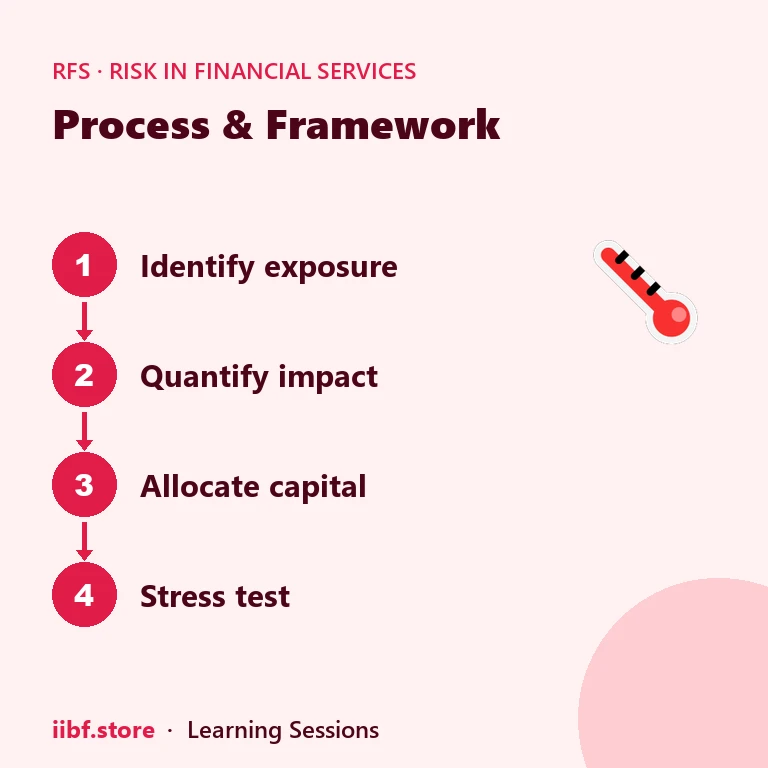
RBI reviews and republishes the D-SIB list every year based on data as of the preceding March-end, and banks are given time to build up to the required surcharge in a phased manner once newly designated. Beyond the higher CET1 requirement, D-SIB status also triggers enhanced supervisory intensity — more frequent on-site inspections, tighter reporting cadences, and closer monitoring of large exposures and interbank linkages. This enhanced scrutiny extends to how the bank manages default correlation risk across its lending book, which ties back to the market risk module's treatment of correlated price and credit shocks hitting a bank's trading and banking books simultaneously — exactly the kind of compound stress a D-SIB's failure could transmit system-wide. Settlement-channel contagion is another transmission path worth cross-referencing, since a D-SIB is typically also a major participant in payment and settlement systems; a useful companion read here is settlement risk in banking, which covers Herstatt-style timing mismatches that can freeze interbank settlement exactly when a D-SIB is under stress.
Read more Risk in Financial Services exam guides to connect this topic with credit, market and liquidity risk chapters before your CAIIB attempt. For the primary regulatory text and the latest published D-SIB list, always cross-check with RBI's official website rather than relying on secondary summaries, since the bucket allocations are revised annually.
🧠 Practice MCQs: D-SIB Capital Surcharge
Q1. Which regulator issues and administers the D-SIB framework for Indian banks? (a) SEBI (b) RBI (c) IRDAI (d) NABARD
Answer: (b) — The Reserve Bank of India designates and supervises Domestic Systemically Important Banks under its 2014 framework.
Q2. In which year did RBI first issue its D-SIB framework? (a) 2014 (b) 2010 (c) 2012 (d) 2016
Answer: (a) — RBI released the D-SIB framework in July 2014, with the first list of designated banks published in 2015.
Q3. Into how many buckets does RBI's D-SIB framework classify systemically important banks? (a) 3 (b) 4 (c) 5 (d) 6
Answer: (c) — There are five buckets, each carrying a progressively higher additional CET1 surcharge from 0.20% to 1.00% of risk-weighted assets.
Q4. What form must the D-SIB additional capital requirement take? (a) Countercyclical buffer (b) Capital conservation buffer (c) Leverage ratio buffer (d) Additional Common Equity Tier 1 (CET1) requirement
Answer: (d) — The D-SIB surcharge must be met specifically with CET1 capital, on top of existing minimum CET1 and conservation buffer requirements.
Q5. Which indicator is used by BCBS for G-SIBs but NOT part of RBI's D-SIB assessment methodology? (a) Cross-jurisdictional activity (b) Size (c) Interconnectedness (d) Substitutability
Answer: (a) — RBI's D-SIB methodology uses size, interconnectedness, substitutability and complexity; cross-jurisdictional activity is a G-SIB-specific indicator not used domestically.
Want chapter-wise mock tests with 100+ MCQs? Start practising free →
What does D-SIB stand for?
D-SIB stands for Domestic Systemically Important Bank — a bank whose failure would cause disproportionate disruption to India's financial system due to its size, interconnectedness, complexity or lack of substitutability.
Which banks are currently classified as D-SIBs in India?
Since the framework's introduction, State Bank of India, ICICI Bank and HDFC Bank have been designated as D-SIBs; RBI reviews and republishes the list annually based on the latest available data, so students should confirm the current list on RBI's website before an exam.
Is the D-SIB surcharge the same as the capital conservation buffer?
No. The capital conservation buffer applies uniformly to all banks under Basel III; the D-SIB surcharge is an additional, bank-specific CET1 requirement layered on top, based purely on a bank's systemic importance score.
What happens if a bank's systemic importance score falls in a later review?
If a bank's score drops below the threshold for its current bucket, RBI can reclassify it into a lower bucket or remove its D-SIB tag altogether at the next annual review, reducing its additional capital requirement accordingly.
The D-SIB capital surcharge is one of the cleanest examples in the RFS syllabus of regulation designed around externalities rather than individual bank risk — master the bucket logic and the four indicators, and the MCQs on this topic become largely mechanical. Reinforce it by practising cross-linked questions on credit concentration and liquidity buffers, then attempt a full mock test to see how examiners combine these threads. Explore the CAIIB course plan →
Prefer revising from a printed book?
Chapter-wise books with MCQs after every chapter — minimal pages, complete coverage, delivered anywhere in India. Every book has a free sample to read first.
Learning Sessions · Ashish Sir
132 pages · 225 MCQs
Learning Sessions · Ashish Sir
188 pages · 435 MCQs
Learning Sessions · Ashish Sir
117 pages · 236 MCQs
Learning Sessions · Ashish Sir
Learning Sessions · Ashish Sir
118 pages · 299 MCQs
Learning Sessions · Ashish Sir
Learning Sessions · Ashish Sir
Learning Sessions · Ashish Sir
115 pages · 255 MCQs
Learning Sessions · Ashish Sir
Learning Sessions · Ashish Sir
334 pages · 936 MCQs
Learning Sessions · Ashish Sir
Learning Sessions · Ashish Sir
115 pages · 344 MCQs
Learning Sessions · Ashish Sir
107 pages · 240 MCQs
Learning Sessions · Ashish Sir
90 pages · 150 MCQs
Learning Sessions · Ashish Sir
Learning Sessions · Ashish Sir
131 pages · 672 MCQs
Learning Sessions · Ashish Sir
221 pages · 831 MCQs
Learning Sessions · Ashish Sir
128 pages · 524 MCQs
Learning Sessions · Ashish Sir
107 pages · 445 MCQs
Learning Sessions · Ashish Sir
148 pages · 478 MCQs
Learning Sessions · Ashish Sir
151 pages · 465 MCQs
Learning Sessions · Ashish Sir
148 pages · 375 MCQs
Learning Sessions · Ashish Sir
216 pages · 895 MCQs
Learning Sessions · Ashish Sir
109 pages · 300 MCQs
Learning Sessions · Ashish Sir
104 pages · 360 MCQs
Learning Sessions · Ashish Sir
82 pages · 297 MCQs
Learning Sessions · Ashish Sir
151 pages · 600 MCQs
Learning Sessions · Ashish Sir
98 pages · 282 MCQs
Learning Sessions · Ashish Sir
Practice this topic
Take a free mock test, download chapter PDFs, or watch a video class — all included on iibf.store.
Keep reading