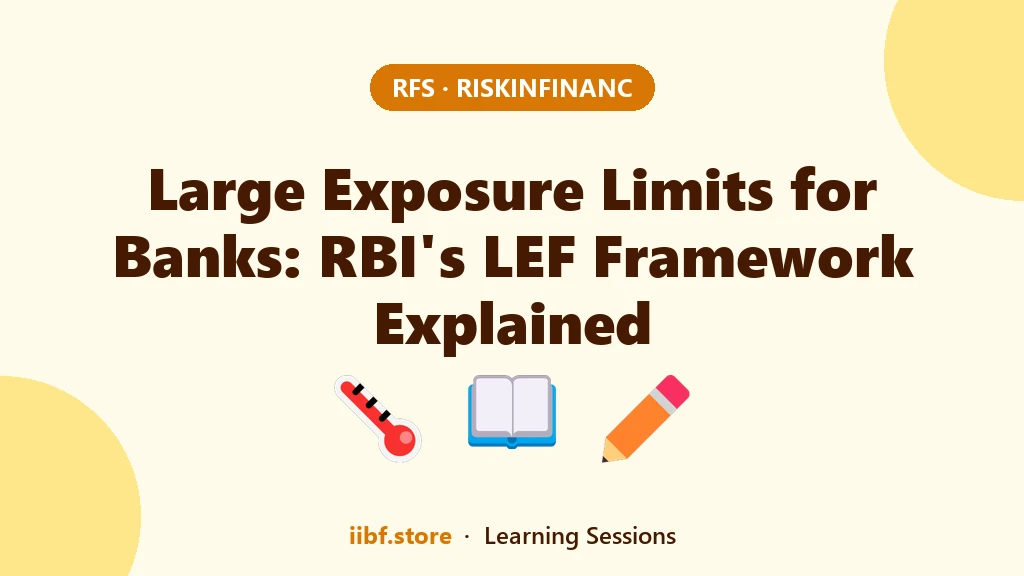
Large Exposures Framework: RBI Limits for Banks (2026)
Every bank that lends heavily to one big borrower learns the same painful lesson: a single default can wipe out capital built over years. The large exposures framework is the Reserve Bank of India's answer to that danger — a hard, quantitative ceiling on how much a bank may lend to any one counterparty or group. For CAIIB Risk in Financial Services candidates, it is one of the most examinable and least intuitive parts of the credit-risk syllabus.
Unlike softer, judgement-based controls, this framework works with fixed percentages of capital that leave little room for interpretation. That precision is exactly why examiners love it: the numbers are testable, and a candidate either knows them or does not. This guide walks through the RBI limits, how eligible capital and exposure are measured, and the traps that catch even experienced bankers.
📊 What Is the Large Exposures Framework?
The large exposures framework (LEF), issued by RBI and fully effective from 1 April 2019, caps the amount a bank can be exposed to a single counterparty or a group of connected counterparties. Its purpose is to limit the maximum loss a bank could suffer if a major borrower suddenly failed, so that even a worst-case default does not threaten the bank's solvency. It is the regulatory backbone of concentration control, sitting alongside the bank's internal prudential limits.
The framework applies to all exposures — funded and non-funded, on-balance-sheet and off-balance-sheet, and across both the banking book and the trading book. Aligned with the Basel Committee's standard on large exposures, it deliberately uses Tier 1 capital rather than total capital as its anchor, making the ceilings tougher than the older single- and group-borrower norms they replaced. To see how these limits fit within a bank's overall control architecture, study the Credit Risk Management Framework chapter, which places the LEF inside the wider governance stack of policies, limits and board oversight.
🏦 Single and Group Counterparty Limits
The two headline ceilings are simple to state but easy to confuse under exam pressure. A bank's exposure to a single counterparty must not exceed 20% of its eligible capital base at any time. Where the bank's board judges the circumstances to be exceptional, it may permit an additional buffer of up to 5%, taking the absolute maximum to 25%. For a group of connected counterparties — entities linked by control or by economic interdependence — the ceiling is 25% of the eligible capital base, with no discretionary top-up.
💡 Exam Tip: Remember the pair as "20 and 25". Single = 20% (board may stretch to 25%); group = 25% flat. If a question mentions "connected counterparties", it is testing the group limit.
| Parameter | Single counterparty | Group of connected counterparties |
|---|---|---|
| Base limit | 20% of eligible capital base | 25% of eligible capital base |
| Board discretion to raise? | ✅ Yes, up to +5% (max 25%) | ❌ No additional buffer |
| Capital anchor | Tier 1 capital | Tier 1 capital |
| Applies to trading book? | ✅ Yes | ✅ Yes |
Understanding why concentration matters at the portfolio level makes these numbers stick. A single 25% exposure that defaults erases a quarter of a bank's core capital in one stroke — a shock explored in depth in the Portfolio Credit Risk chapter, where correlation and concentration effects are quantified.
🧮 How Eligible Capital and Exposure Are Measured
The denominator in every LEF calculation is the eligible capital base, which RBI defines as the bank's Tier 1 capital as per the last audited balance sheet, updated for subsequent capital changes as reported to RBI. Using Tier 1 rather than total (Tier 1 + Tier 2) capital is deliberate: it ties the ceiling to the highest-quality, loss-absorbing capital and prevents banks from inflating headroom with subordinated debt.
The numerator — the exposure value — is measured on a gross basis before certain credit risk mitigants and is the higher of the sanctioned limit or outstanding, aggregated across all facilities. This links directly to the mechanics covered in the Measurement of Credit Risk chapter. A useful discipline here is to know how the measured obligor exposure relates to the borrower's internal risk grade — a theme you will also meet when studying obligor risk rating, which drives how much of that headroom a bank is comfortable using.
⚠️ Common Mistake: Candidates apply the limits to total capital funds. LEF uses Tier 1 capital only. Using total capital gives a wrongly generous ceiling and a wrong answer.
⚠️ Connected Counterparties, Interbank Exposure and Reporting
Two counterparties are "connected" when one controls the other, or when they are so economically interdependent that the failure of one would likely cause the other to fail. Banks must group such entities and apply the 25% ceiling to their combined exposure — a rule that catches promoter groups and supply-chain-linked borrowers who might otherwise be financed separately.
Interbank exposures are also captured. For domestic systemically important banks and global systemically important banks, exposure to another such bank is tightly capped (a G-SIB's exposure to another G-SIB is limited to 15% of eligible capital), reflecting how interconnected large banks amplify shocks. This is the concentration-control counterpart to the payment-and-settlement dimension covered under settlement risk in banking.
Finally, reporting: a bank must report to RBI any exposure that, in aggregate, equals or exceeds 10% of its eligible capital base — the definition of a "large exposure". This reporting threshold sits well below the breach limits, giving the supervisor an early view of building concentrations before they become dangerous.
📌 Remember: 10% = reportable large exposure; 20% = single-counterparty ceiling; 25% = group ceiling. The 10% is a monitoring trigger, not a breach.
Concentration control does not stand alone — it works with liquidity buffers and franchise protection. For the wider picture, review liquidity risk in financial services and the emerging discipline of ESG risk management in banks, both of which interact with how a bank sizes and diversifies its book. You can browse every related note under the Risk in Financial Services topic hub, and practise the full syllabus on our CAIIB course.
🧠 Practice MCQs: Large Exposures Framework
Q1. The "eligible capital base" used in RBI's large exposures framework is: (a) Total capital funds (b) Tier 1 + Tier 2 capital (c) Tier 1 capital (d) CET1 capital only
Answer: (c) — LEF ceilings are anchored to Tier 1 capital, the highest-quality loss-absorbing layer.
Q2. A bank's exposure to a single counterparty must not normally exceed: (a) 15% (b) 20% (c) 25% (d) 40% of the eligible capital base
Answer: (b) — The single-counterparty ceiling is 20%, extendable to 25% only by board discretion in exceptional cases.
Q3. The exposure ceiling for a group of connected counterparties is: (a) 20% (b) 25% (c) 30% (d) 40% of the eligible capital base
Answer: (b) — Groups are capped at 25%, with no additional board buffer permitted.
Q4. An exposure must be reported to RBI as a "large exposure" when it equals or exceeds: (a) 5% (b) 10% (c) 15% (d) 20% of the eligible capital base
Answer: (b) — The 10% reporting trigger is a monitoring threshold, well below the breach limits.
Q5. Under exceptional circumstances approved by its board, a bank may raise the single-counterparty limit to a maximum of: (a) 22% (b) 25% (c) 30% (d) 35%
Answer: (b) — The additional buffer is up to 5%, taking the absolute maximum to 25%.
Want chapter-wise mock tests with 100+ MCQs? Start practising free →
❓ Large Exposures Framework FAQs
When did RBI's large exposures framework take full effect?
The framework became fully effective from 1 April 2019, replacing the earlier single- and group-borrower exposure norms.
Why does the framework use Tier 1 capital instead of total capital?
Tier 1 is the highest-quality, permanently loss-absorbing capital. Anchoring limits to it makes the ceilings stricter and prevents banks from inflating headroom with subordinated Tier 2 debt.
What makes two borrowers "connected counterparties"?
They are connected if one controls the other, or if they are so economically interdependent that the failure of one would likely cause the other to fail. Their exposures are then aggregated under the 25% group ceiling.
Is the 10% threshold a breach limit?
No. The 10% level only defines a reportable "large exposure" for supervisory monitoring. The actual breach ceilings are 20% for a single counterparty and 25% for a group.
The large exposures framework turns concentration risk from a vague worry into a precise, enforceable set of numbers — 10% to report, 20% for a single name, 25% for a group, all measured against Tier 1 capital. Master these limits, know why Tier 1 is the anchor, and you will handle every LEF question the CAIIB RFS paper can throw at you. Put it to the test with a timed mock exam today.
Prefer revising from a printed book?
Chapter-wise books with MCQs after every chapter — minimal pages, complete coverage, delivered anywhere in India. Every book has a free sample to read first.
Learning Sessions · Ashish Sir
132 pages · 225 MCQs
Learning Sessions · Ashish Sir
188 pages · 435 MCQs
Learning Sessions · Ashish Sir
117 pages · 236 MCQs
Learning Sessions · Ashish Sir
Learning Sessions · Ashish Sir
118 pages · 299 MCQs
Learning Sessions · Ashish Sir
Learning Sessions · Ashish Sir
Learning Sessions · Ashish Sir
115 pages · 255 MCQs
Learning Sessions · Ashish Sir
Learning Sessions · Ashish Sir
334 pages · 936 MCQs
Learning Sessions · Ashish Sir
Learning Sessions · Ashish Sir
115 pages · 344 MCQs
Learning Sessions · Ashish Sir
107 pages · 240 MCQs
Learning Sessions · Ashish Sir
90 pages · 150 MCQs
Learning Sessions · Ashish Sir
Learning Sessions · Ashish Sir
131 pages · 672 MCQs
Learning Sessions · Ashish Sir
221 pages · 831 MCQs
Learning Sessions · Ashish Sir
128 pages · 524 MCQs
Learning Sessions · Ashish Sir
107 pages · 445 MCQs
Learning Sessions · Ashish Sir
148 pages · 478 MCQs
Learning Sessions · Ashish Sir
151 pages · 465 MCQs
Learning Sessions · Ashish Sir
148 pages · 375 MCQs
Learning Sessions · Ashish Sir
216 pages · 895 MCQs
Learning Sessions · Ashish Sir
109 pages · 300 MCQs
Learning Sessions · Ashish Sir
104 pages · 360 MCQs
Learning Sessions · Ashish Sir
82 pages · 297 MCQs
Learning Sessions · Ashish Sir
151 pages · 600 MCQs
Learning Sessions · Ashish Sir
98 pages · 282 MCQs
Learning Sessions · Ashish Sir
Practice this topic
Take a free mock test, download chapter PDFs, or watch a video class — all included on iibf.store.
Keep reading