Inside the JAIIB IE and IFS Book: Modules, Chapters and MCQs
It is 9:30 at night. You reached home late, the branch had a rush of clearing and cash, and now a syllabus called Indian Economy and Indian Financial System is staring at you. You do not need another long reading list. You need to know, before you spend money or evenings, what you are actually going to open and how long it will take to get through it. This is a plain walk through the JAIIB IE and IFS book so you can picture using it, whether or not you ever buy it.
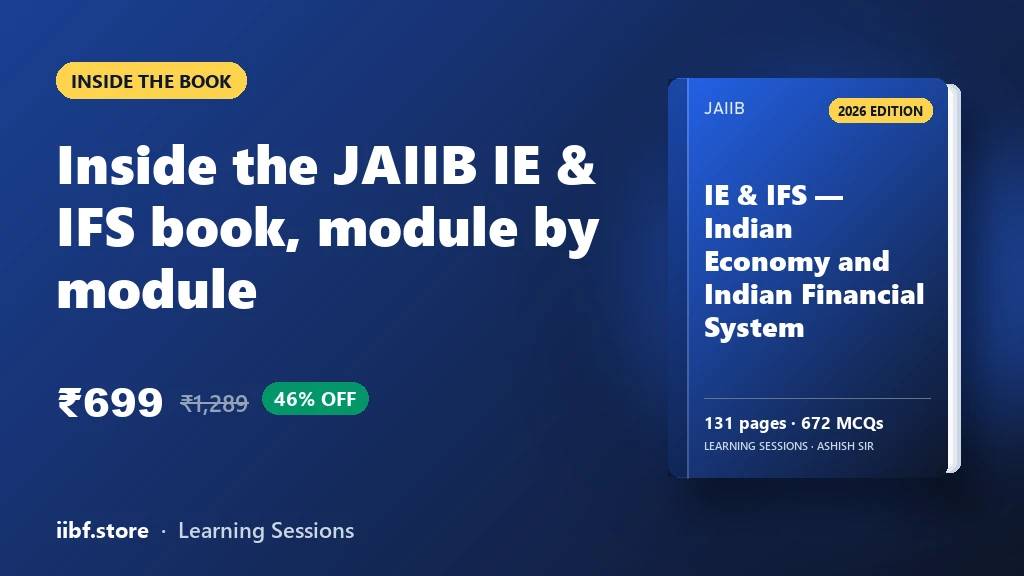
The short version: it is a printed book with 131 pages, 45 chapters, 672 questions and a set of case studies, organised into four modules that follow the paper itself. Below, we open it module by module, look at what a single chapter feels like, and then work out who should (and should not) pick it up.
Why a working banker needs a map before a book
Most bank employees preparing for JAIIB are not full-time students. You have targets, audits, customers at the counter and, often, a family waiting. In that situation the biggest enemy is not difficulty; it is not knowing where you are. Without a map, every evening begins with the question "what should I read today?" and half your energy is gone before you start.
A good book solves that by giving you a fixed order and a fixed size for every unit of study. When each chapter is short and each module is a clear block, you can decide on Sunday that "this week is Module B" and simply do it. That is the real value of knowing the structure of the JAIIB IE and IFS book in advance: it turns an endless subject into 45 small, countable jobs.
What the paper is really asking
Indian Economy and Indian Financial System sits in the first stage of the JAIIB. It is not a calculation-heavy paper like accounting; it is a concept-and-recall paper. You are expected to understand how the economy is organised, what economic ideas sit behind banking, how the financial system and its regulators fit together, and what products and markets exist. That is why short, clean notes plus repeated question practice usually work better than reading a thick reference text once.
For the official exam cycle, scheme and notices, always check the IIBF website. Nothing in this article replaces that.
The four-module layout, chapter by chapter
The JAIIB IE & IFS printed book is built around the paper's four modules. Here is how the 45 chapters are spread.
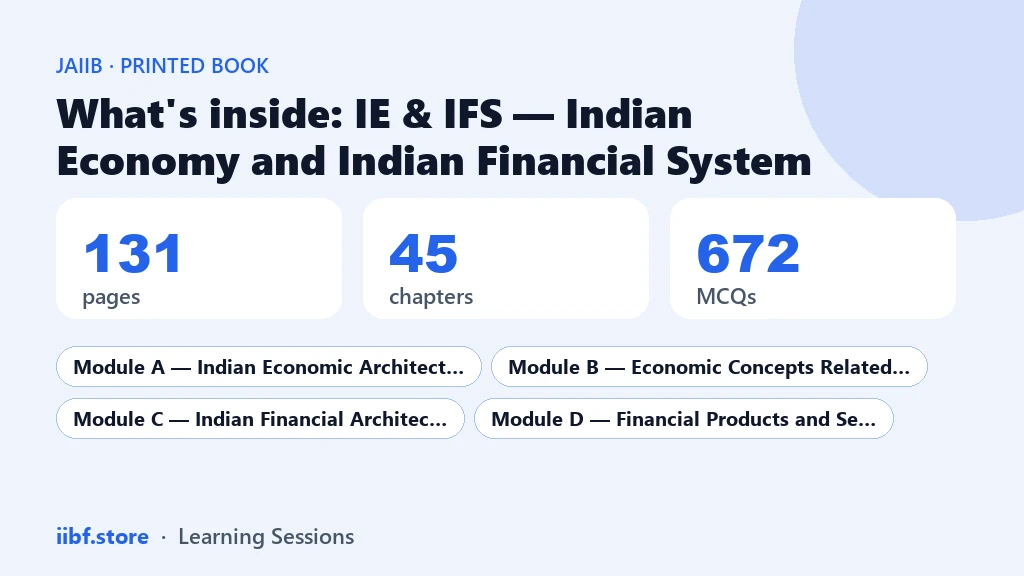
| Module | Theme | Chapters |
|---|---|---|
| Module A | Indian Economic Architecture | 11 |
| Module B | Economic Concepts Related to Banking | 8 |
| Module C | Indian Financial Architecture | 9 |
| Module D | Financial Products and Services | 17 |
Module A: Indian Economic Architecture (11 chapters)
This module is the big-picture tour of the economy. It starts with an overview of the Indian economy, moves through economic planning, the sectors of the economy, and the role of the priority sector and MSME. It then covers infrastructure including social infrastructure, globalisation and its impact on India, economic reforms, and foreign trade policy with foreign investments. The last chapters deal with international economic organisations such as the World Bank and IMF, climate change and the Sustainable Development Goals, and the issues facing the Indian economy.
Module B: Economic Concepts Related to Banking (8 chapters)
Here the economics becomes the bank's own language: fundamentals of economics (micro, macro and types of economies), supply and demand, money supply and inflation, theories of interest, business cycles, monetary and fiscal policy, national income and GDP concepts, and the Union Budget. It is the shortest module, and many candidates find it the most satisfying because the ideas connect directly to what they see at work.
Module C: Indian Financial Architecture (9 chapters)
This is the structure of the financial system. You get an overview of the Indian financial system, the Indian banking structure, the Banking Regulation Act, 1949 and RBI Act, 1934, development financial institutions, micro finance institutions, NBFCs and insurance companies. It closes with the regulators and their roles, and reforms and developments in the banking sector.
Module D: Financial Products and Services (17 chapters)
The largest module, with 17 chapters, covers financial markets and the products traded in them: money and capital markets, bond markets, stock exchanges, forex, the interconnection of markets, merchant banking, derivatives including credit default swaps, factoring, forfaiting and TReDS, venture capital, leasing and hire purchase, credit rating agencies, mutual funds, insurance products, pension funds (including APY and NPS), para-banking services, and REITs and InvITs. Because Module D alone is more than a third of the book, plan more evenings for it than for the others.
What one chapter looks like in practice
Picture a single chapter, say Money Supply and Inflation from Module B. The book is designed so that each chapter follows the same rhythm: concise notes first, then the key points you should be able to repeat without looking, and then MCQs to test whether the notes stuck.
- Concise notes: the concept stated plainly, without the padding of a reference text, so a chapter can be read in one sitting.
- Key points: the lines worth revising on the bus or during a lunch break.
- MCQs: questions that make you recall rather than recognise.
Across the whole book there are 672 questions, and the extras include 50 case studies carrying 200 questions. The point of this layout is repetition without re-reading. You read once, mark the key points, and then let the questions find the gaps.
Here is an honest limit: a book alone will not give you exam-hall speed. Use it for understanding and first-round practice, then add timed mocks. You can attempt free practice on the IIBF Store mock tests page and browse the free study material before deciding anything.
A four-step routine for using the book each week
You do not need a complicated plan. You need one that survives a bad week at the branch. This routine works with any module and any amount of time, and it is the one we would follow with the JAIIB IE and IFS book if we were back in your seat.
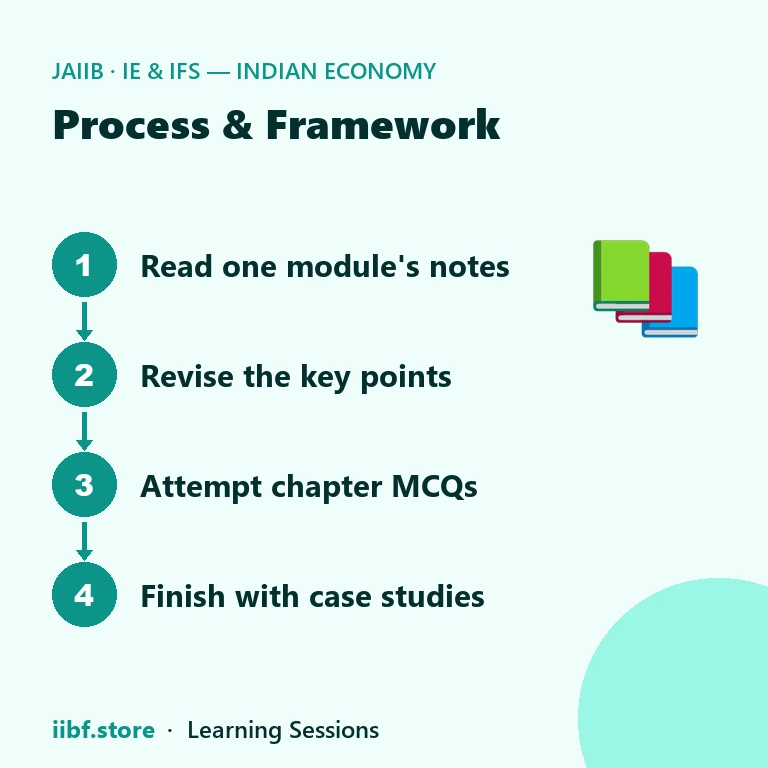
- Read one module's notes. Pick a single module for the week. Read two or three chapters per sitting, not the whole module in one night.
- Revise the key points. The next day, go through only the key points. If you cannot explain a point aloud in a sentence, mark it.
- Attempt the chapter MCQs. Do them without looking at the notes. Wrong answers are useful: they tell you exactly which lines to re-read.
- Finish with case studies. When a module is done, attempt its related case studies to see whether you can apply ideas rather than just recall them.
A sample week
| Day | What to do | Time |
|---|---|---|
| Mon, Tue | Read 2 chapters of the chosen module | 40 min each |
| Wed | Revise key points, mark weak ones | 25 min |
| Thu | Attempt chapter MCQs | 30 min |
| Fri | Re-read marked points only | 20 min |
| Weekend | One timed mock and review of errors | 90 min |
These timings are a suggestion, not a promise. If your week is heavier, keep the order and shrink the quantity. Consistency beats volume, especially when you are tired.
How to avoid the common traps
- Starting with Module D because it is the biggest. It is better to begin with Module A or B, build the vocabulary, and let Module D feel familiar when you reach it.
- Reading everything twice before touching a question. Try questions early. They tell you where your attention should go.
- Memorising lists without understanding. The regulators, institutions and products in Modules C and D are easier to hold when you connect each to its role.
- Ignoring the current exam notices. Check the official IIBF site for the upcoming exam cycle before you finalise your schedule.
If you are also planning the later stage, the JAIIB course page and the IIBF Store blog have more method articles that pair well with this one.
Who gets the most out of this book
The JAIIB IE and IFS book suits you best if you:
- prefer paper and a pen to a screen after a full day of work;
- want the paper broken into small, trackable chapters;
- learn by testing yourself rather than by re-reading;
- are starting the paper from scratch and need a structure more than a library.
It is less suited if you only want a last-night summary, or if you need a long, essay-style treatment of every topic. In that case, use it alongside the official material rather than instead of it.
The book page, here, is the place to check the current price and the free sample. At the time of writing it is listed at ₹699 against an MRP of ₹1,289 (46% off, 2026 edition), but prices may change and the book page is always current. You can also compare other titles on the IIBF Store books page.
Final word
You do not have to love economics to clear this paper. You have to show up in small, regular doses and to practise questions honestly. With 45 chapters in four modules, the JAIIB IE and IFS book gives you the shape of that journey. Pick one module this week, finish it, and let momentum do the rest.
Frequently asked questions
How many pages and chapters does the book have?
The book has 131 pages and 45 chapters, divided into four modules: Module A with 11 chapters, Module B with 8, Module C with 9 and Module D with 17.
How many practice questions are included?
There are 672 questions in the book. The extras also include 50 case studies carrying 200 questions.
Is there a free sample before I order?
Yes, the book page offers a free sample so you can see the layout and the style of the notes before you decide.
Is the book enough on its own to clear the paper?
It is a strong base for understanding and first-round practice, but exam-hall speed comes from timed mocks. Pair it with mock tests and check the IIBF website for the official schedule and syllabus.
Prefer revising from a printed book?
Chapter-wise books with MCQs after every chapter — minimal pages, complete coverage, delivered anywhere in India. Every book has a free sample to read first.
131 pages · 672 MCQs
Learning Sessions · Ashish Sir
221 pages · 831 MCQs
Learning Sessions · Ashish Sir
128 pages · 524 MCQs
Learning Sessions · Ashish Sir
107 pages · 445 MCQs
Learning Sessions · Ashish Sir
148 pages · 478 MCQs
Learning Sessions · Ashish Sir
151 pages · 465 MCQs
Learning Sessions · Ashish Sir
148 pages · 375 MCQs
Learning Sessions · Ashish Sir
216 pages · 895 MCQs
Learning Sessions · Ashish Sir
109 pages · 300 MCQs
Learning Sessions · Ashish Sir
104 pages · 360 MCQs
Learning Sessions · Ashish Sir
82 pages · 297 MCQs
Learning Sessions · Ashish Sir
151 pages · 600 MCQs
Learning Sessions · Ashish Sir
98 pages · 282 MCQs
Learning Sessions · Ashish Sir
132 pages · 225 MCQs
Learning Sessions · Ashish Sir
188 pages · 435 MCQs
Learning Sessions · Ashish Sir
117 pages · 236 MCQs
Learning Sessions · Ashish Sir
Learning Sessions · Ashish Sir
118 pages · 299 MCQs
Learning Sessions · Ashish Sir
Learning Sessions · Ashish Sir
Learning Sessions · Ashish Sir
Learning Sessions · Ashish Sir
115 pages · 255 MCQs
Learning Sessions · Ashish Sir
Learning Sessions · Ashish Sir
334 pages · 936 MCQs
Learning Sessions · Ashish Sir
Learning Sessions · Ashish Sir
115 pages · 344 MCQs
Learning Sessions · Ashish Sir
107 pages · 240 MCQs
Learning Sessions · Ashish Sir
90 pages · 150 MCQs
Learning Sessions · Ashish Sir
Learning Sessions · Ashish Sir
Quick quiz on this topic
5 exam-style questions from our free test bank — check yourself before you move on.
Practice this topic
Take a free mock test, download chapter PDFs, or watch a video class — all included on iibf.store.