Inside the JAIIB PPB Book: 56 Chapters, 4 Modules, 831 MCQs
It is 9:40 at night. You have closed the branch, reached home, eaten something quick, and now the Principles and Practices of Banking syllabus is staring at you. KYC, clearing, lending, NPAs, CBS, ethics. It feels endless, and the thick reference books you collected over the years do not make it feel shorter. If that is you, this walk-through of the JAIIB PPB book is meant to help you picture exactly what you would be studying from, before you spend a rupee or an evening on it.
Even if you never buy it, you will leave with a way to look at any PPB material: how to split the paper into four blocks, how to study one chapter in a fixed loop, and how to decide what to skip on a tired night.
Why PPB feels harder than it is
Principles and Practices of Banking is not difficult in the way a numerical paper is difficult. It is difficult because it is wide. You are expected to know how a banker treats a customer, how a loan is appraised and recovered, how technology and digital payments work, and how ethics applies to day-to-day banking. Many of us do some of this at the branch, so we assume we know it, and then the exam asks about a case law or a guideline we have never handled.
Three habits make it worse for working candidates:
- Starting at chapter 1 every time. The early chapters get read five times, the later ones never.
- Reading without testing. Everything looks familiar on the page, and the gap shows up only in the exam hall.
- Studying by branch experience. Your daily work covers a slice of the paper, not all of it.
The fix is not more hours. It is a structure that tells you, on any given night, what to open and what to do with it. That is what we will look at now.
How the JAIIB PPB book is organised
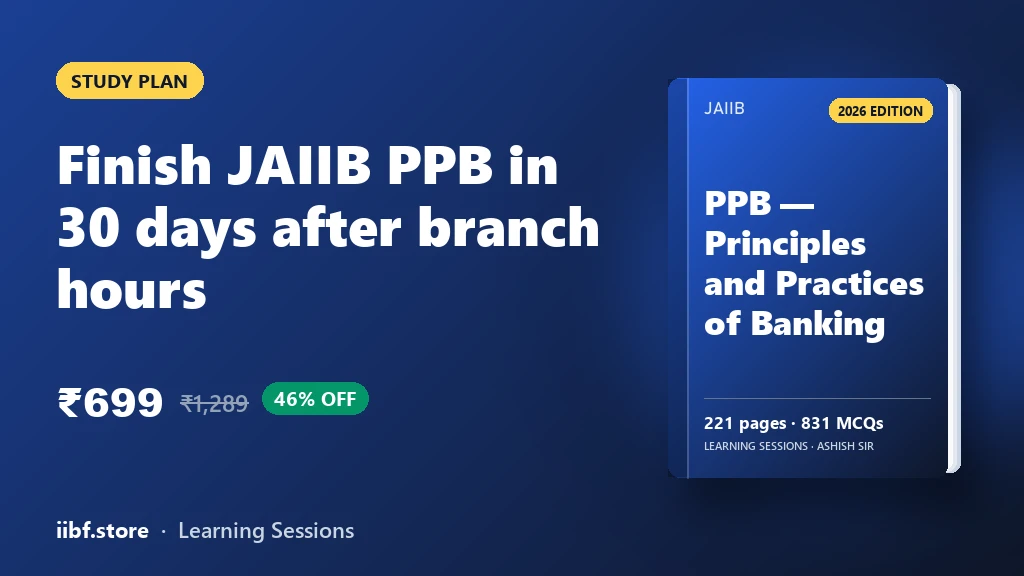
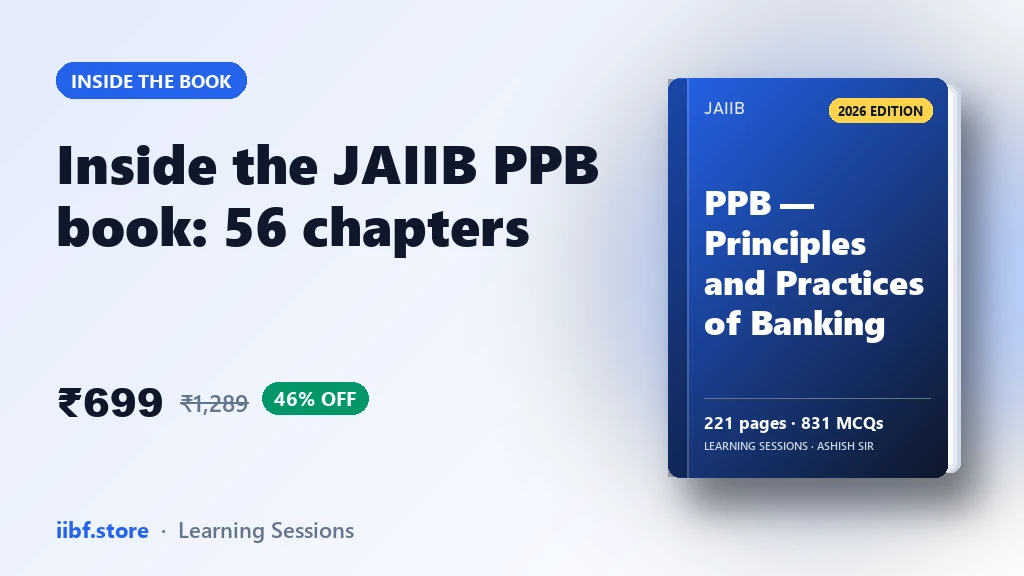
The JAIIB PPB book is a printed book of 221 pages covering 56 chapters, split into four modules. It carries 831 questions in all, plus 70 case studies (280 questions) as an extra. The 2026 edition is the one described here.
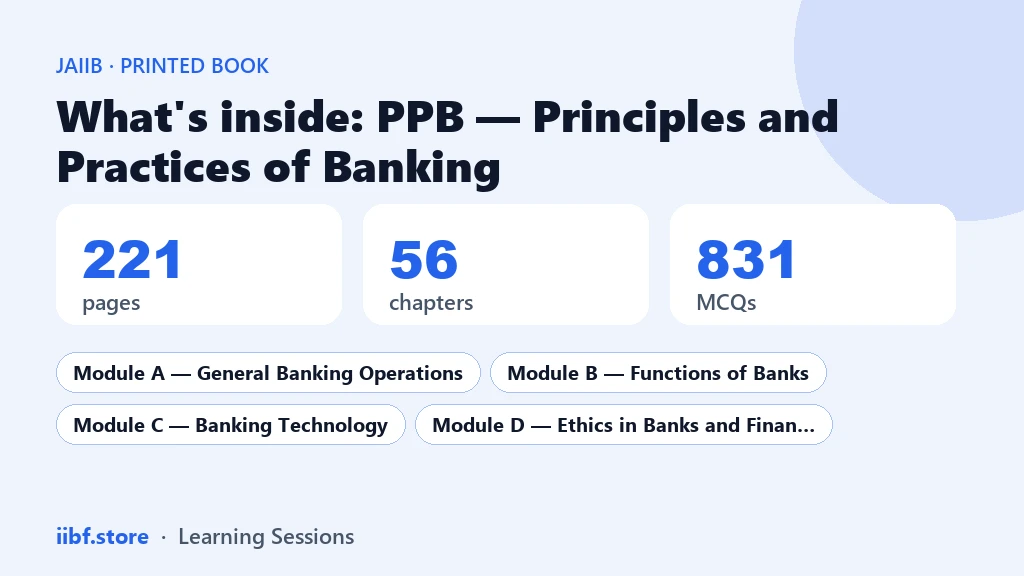
Here is how the 56 chapters are spread across the modules.
| Module | Theme | Chapters |
|---|---|---|
| Module A | General Banking Operations | 21 |
| Module B | Functions of Banks | 21 |
| Module C | Banking Technology | 9 |
| Module D | Ethics in Banks and Financial Institutions | 5 |
Table: chapter count per module in the JAIIB PPB book.
Notice the shape. Modules A and B together hold 42 of the 56 chapters. Module C is nine chapters and Module D just five. When you are short of time, that tells you where the bulk of your reading will go, and also that the small modules are quick wins you should not leave for the last night.
Module A: General Banking Operations
This is the module closest to what you do at the counter and in the back office. It opens with the banker-customer relationship, then runs through AML and KYC guidelines and their operational aspects, opening accounts for different kinds of customers, deposit accounts, the clearing system and cash management services. It also includes foreign exchange remittance facilities for individuals, NRI business and foreign currency accounts for residents.
The module then moves into payment and collection of cheques, with separate chapters on case laws about the responsibility of the paying bank and of the collecting bank. It closes with ancillary services, financial inclusion, customer service guidelines, duties and rights of banker and customer, the Bank Ombudsman Scheme, the Consumer Protection Act and the Right to Information Act.
Module B: Functions of Banks
This is the lending-and-recovery module. It begins with principles of lending and working capital assessment, appraisal of credit facilities and operational aspects of loan accounts. Then come collateral, types of charges and documentation, followed by non performing assets, laws relating to recovery of dues, and SARFAESI and CERSAI.
The middle of the module covers contracts of indemnity and guarantee, letters of credit, deferred payment guarantees and laws related to bills finance. The last stretch handles retail products such as credit cards, home, personal and consumer loans, then priority sector lending, agricultural finance, finance to MFIs and co-lending arrangements with NBFCs, MSMEs, government sponsored schemes and Self Help Groups.
Module C: Banking Technology
Nine chapters: bank computerisation, operational aspects of the CBS environment, alternate delivery channels and digital banking, data communication networks, digital payment systems and NPCI, the role of technology upgradation, security considerations, cyber crimes and fraud risk management, and technology trends in banking.
Module D: Ethics in Banks and Financial Institutions
Five chapters: ethics, business ethics and banking; ethics at the individual level; ethical dimensions for employees; work ethic and the workplace; and banking ethics and its changing dynamics. These are short and often scored easily if you have read them even once with attention.
What one chapter looks like
A syllabus list is only a map. What matters is what you do with a single chapter, so here is the pattern the book follows. Each chapter gives you concise notes first, then the key points you should be able to repeat without looking, and then MCQs to test whether the notes actually stayed in your head.
Take a chapter like "Types of Charges" from Module B as an example of how you would use it:
- Read the notes once, slowly, with a pencil. Mark only what surprises you.
- Close the book and say the key points aloud, or write them in four or five lines.
- Open the key points again and check what you missed.
- Attempt the MCQs for that chapter and note which ones you got wrong, and why.
One chapter, done this way, can fit into a single evening. It does not feel heroic, and that is the point. A plan that needs a free Sunday will fail by the second week; a plan that needs 45 tired minutes can survive a month-end.
With 831 questions across 56 chapters, the question bank is large enough that you meet the same concept several times from different angles. That repetition, not a single long read, is what makes a fact stay.
The extras: 70 case studies
Beyond the chapters, the book adds 70 case studies carrying 280 questions. Case-style questions ask you to apply a rule to a short situation rather than recall a definition, which is closer to how a bank officer actually thinks. They suit the lending, recovery and customer-service chapters especially.
A sensible way to use them: do the chapter first, and only then try the related case studies. If you attempt cases before you know the rules, you will only get frustrated and learn nothing from the answers.
A four-step plan for using the JAIIB PPB book
You do not need a complicated calendar. This four-step loop works whether you have three weeks or three months, and you can scale each step to the time you have.
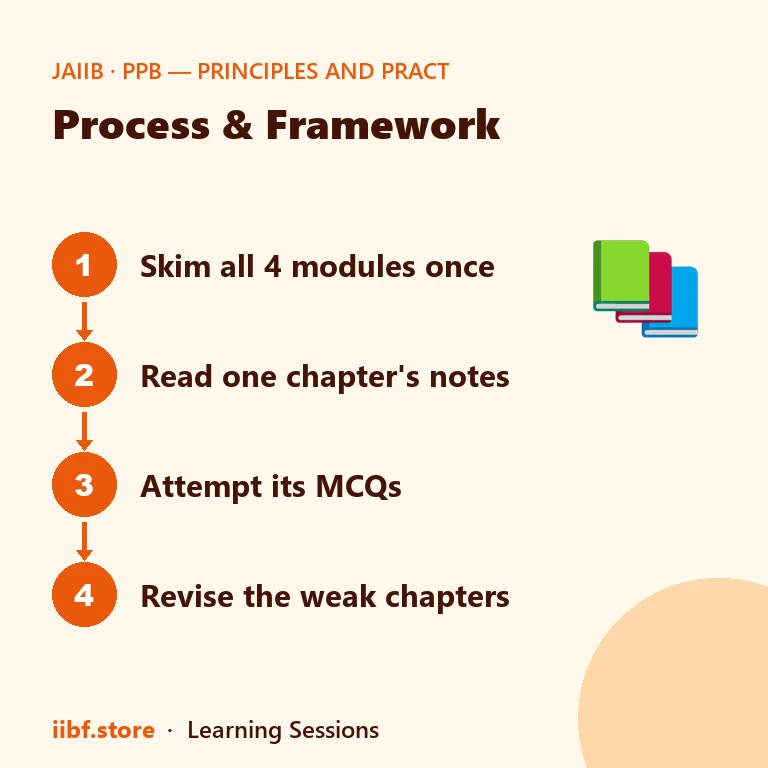
- Step 1: Skim all four modules once. Spend an evening or two just flipping through the headings and the shortest chapters. You are building a map, not memorising.
- Step 2: Read one chapter's notes. Go module by module, but start with the one you feel weakest in. Do not touch the next chapter until the first is done.
- Step 3: Attempt its MCQs. Do them the same day while the chapter is fresh. Mark every miss.
- Step 4: Revise the weak chapters. Keep a short list of chapters where you scored badly and come back to them at the weekend.
Be honest about one limit. A book gives you knowledge and practice questions; it does not give you exam-hall speed. Pair your reading with timed mock tests. You can start with the free mock tests at iibf.store/tests and look through the free PDFs at iibf.store/free-material to see whether your weak spots match.
Who gets the most out of this book
A printed book is not for everyone, so here is a straight answer on fit.
- Candidates who study away from a screen. If you have spent the whole day on CBS screens, a printed book at night is a relief to the eyes.
- People who want one structured source. Four modules, 56 chapters, one flow. Useful if your current notes are scattered across PDFs and photos.
- Those who learn by testing themselves. The question count suits you if you improve by answering rather than rereading.
- First-time and repeat candidates alike. A fresh attempt benefits from the map; a repeat attempt benefits from the targeted MCQs on weak chapters.
It will suit you less if you only learn from video lectures, or if you need a book to explain topics from absolute zero with long worked discussions. In that case, treat the book as your revision and practice companion rather than your only source.
Price and what to check before ordering
The book is listed at ₹699 against an MRP of ₹1,289, which is a 46% discount at the time of writing. Prices and offers can change, so the book page is always the current source. There is a free sample you can read first, which is the best way to judge the writing style and layout before you decide. You can also browse the rest of the range at iibf.store/books and see the full JAIIB course options at iibf.store/course/jaiib.
For the exam schedule, syllabus updates and official notifications, always rely on the Institute's own site at www.iibf.org.in. Plan around the upcoming exam cycle once you have confirmed dates there.
Final word
The honest summary of the JAIIB PPB book is simple: 221 pages, 56 chapters in four modules, 831 questions and 70 case studies, built around a notes-then-key-points-then-MCQs rhythm. Whether you pick this one or another source, the method matters more than the cover. Map the paper, take one chapter per evening, test yourself the same day, and return to what you missed. For more preparation guides, the iibf.store blog has plenty of material to read alongside.
Frequently asked questions
How many chapters and modules does the book have?
It has 56 chapters in four modules: Module A (General Banking Operations) with 21, Module B (Functions of Banks) with 21, Module C (Banking Technology) with 9, and Module D (Ethics in Banks and Financial Institutions) with 5.
How many questions are included?
The book carries 831 questions, and the extras include 70 case studies with 280 questions.
Can I read a sample before ordering?
Yes. A free sample is available on the book page at https://iibf.store/books/jaiib-ppb-printed-book, so you can check the layout and style first.
Is the book alone enough to clear the paper?
No single resource guarantees a result. Use it for structured reading and practice, and add timed mock tests so that you build speed and exam-hall habits.
Prefer revising from a printed book?
Chapter-wise books with MCQs after every chapter — minimal pages, complete coverage, delivered anywhere in India. Every book has a free sample to read first.
221 pages · 831 MCQs
Learning Sessions · Ashish Sir
131 pages · 672 MCQs
Learning Sessions · Ashish Sir
128 pages · 524 MCQs
Learning Sessions · Ashish Sir
107 pages · 445 MCQs
Learning Sessions · Ashish Sir
148 pages · 478 MCQs
Learning Sessions · Ashish Sir
151 pages · 465 MCQs
Learning Sessions · Ashish Sir
148 pages · 375 MCQs
Learning Sessions · Ashish Sir
216 pages · 895 MCQs
Learning Sessions · Ashish Sir
109 pages · 300 MCQs
Learning Sessions · Ashish Sir
104 pages · 360 MCQs
Learning Sessions · Ashish Sir
82 pages · 297 MCQs
Learning Sessions · Ashish Sir
151 pages · 600 MCQs
Learning Sessions · Ashish Sir
98 pages · 282 MCQs
Learning Sessions · Ashish Sir
132 pages · 225 MCQs
Learning Sessions · Ashish Sir
188 pages · 435 MCQs
Learning Sessions · Ashish Sir
117 pages · 236 MCQs
Learning Sessions · Ashish Sir
Learning Sessions · Ashish Sir
118 pages · 299 MCQs
Learning Sessions · Ashish Sir
Learning Sessions · Ashish Sir
Learning Sessions · Ashish Sir
Learning Sessions · Ashish Sir
115 pages · 255 MCQs
Learning Sessions · Ashish Sir
Learning Sessions · Ashish Sir
334 pages · 936 MCQs
Learning Sessions · Ashish Sir
Learning Sessions · Ashish Sir
115 pages · 344 MCQs
Learning Sessions · Ashish Sir
107 pages · 240 MCQs
Learning Sessions · Ashish Sir
90 pages · 150 MCQs
Learning Sessions · Ashish Sir
Learning Sessions · Ashish Sir
Quick quiz on this topic
5 exam-style questions from our free test bank — check yourself before you move on.
Practice this topic
Take a free mock test, download chapter PDFs, or watch a video class — all included on iibf.store.