Digital Payment Fraud Prevention: A Banker's Guide for the IIBF Exam
Effective digital payment fraud prevention is now a core competency for every banker preparing for the IIBF Prevention of Cyber Crime examination. As UPI, card, and internet-banking volumes scale into the billions of monthly transactions, fraudsters have shifted from crude attacks to socially engineered scams that exploit customer trust rather than technical loopholes. This guide walks through the offences, the legal framework, the reporting machinery, and the practical controls a bank officer must know cold — so that digital payment fraud prevention becomes second nature both in the exam hall and at the branch counter. We keep every figure qualitative or sourced, because the IIBF examiner rewards conceptual clarity over memorised numbers that change year to year.
Understanding the Threat Landscape
Digital payment fraud rarely begins with hacking. It begins with a phone call, an SMS, or a spoofed webpage that convinces a customer to part with an OTP, PIN, or card number. The Reserve Bank of India and law-enforcement agencies broadly group these frauds into three families: identity theft (where credentials are stolen and reused), authorisation frauds (where the victim is tricked into approving a transaction), and account-takeover frauds (where the attacker gains full control of the account). Understanding this taxonomy is the first step in digital payment fraud prevention, because each family demands a different control.
The channels through which these attacks arrive are well documented in the IIBF syllabus. Fraudsters use vishing calls impersonating bank staff, phishing emails carrying credential-harvesting links, SIM-swap attacks that intercept OTPs, screen-sharing apps that let a remote scammer watch a live session, and fake payment-request links on UPI. A banker who has studied the channels of cyber crimes can quickly map a customer complaint to the likely attack vector and respond appropriately. Recognising the human element — that the customer is manipulated, not merely breached — reframes prevention as a mix of technology, verification discipline, and continuous customer education rather than firewalls alone.
The Legal and Regulatory Framework
India's response to payment fraud rests on the Information Technology Act, 2000, as amended in 2008, supported by relevant provisions of the criminal code and a stack of RBI circulars. The IT Act criminalises identity theft (Section 66C), cheating by personation using a computer resource (Section 66D), and unauthorised access and data theft (Sections 43 and 66). For a banker, the operationally important layer is the RBI's customer-protection framework, which sets out the principle of limited liability: where a fraud results from a bank deficiency or a third-party breach with no customer fault, and the customer reports promptly, the customer's liability is intended to be reduced or nil. Prompt reporting is therefore the single most powerful lever in digital payment fraud prevention from a consumer-redress standpoint.
Beyond liability rules, the regulatory framework mandates strong customer authentication, additional factor of authentication for card-not-present transactions, transaction alerts, and cooling-off or velocity controls on new payees and devices. The Securities and Exchange Board of India applies parallel expectations in the securities space. Bankers preparing for the exam should read primary material rather than summaries; the authoritative source is the Reserve Bank at rbi.org.in, where master directions on digital payment security controls and customer liability are published and periodically revised. Because thresholds and turnaround times are updated, always confirm the current figure before quoting it in a customer conversation or a written answer.
Reporting, Response, and Incident Management
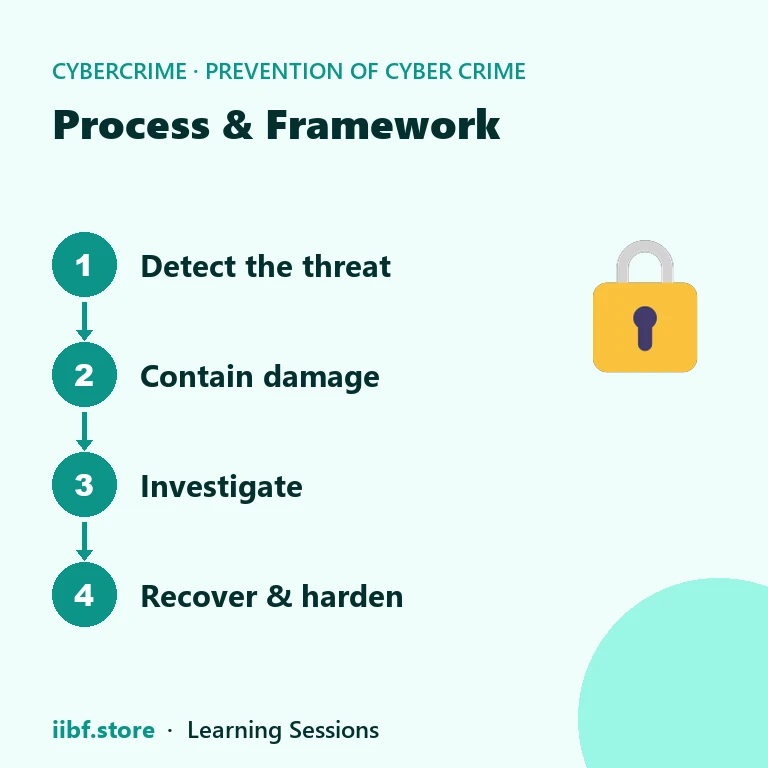
When a fraud occurs, speed decides the outcome. India's coordinated response runs through the National Cyber Crime Reporting Portal and its financial-fraud helpline number 1930, which lets a victim freeze the flow of stolen funds before they are layered and withdrawn. Inside the bank, a structured incident management process must kick in: log the complaint, block the compromised instrument, raise a chargeback or lien where funds are traceable, preserve logs as evidence, and file the mandatory report to the regulator and to CERT-In where a security incident is involved. A disciplined workflow turns a chaotic complaint into a recoverable case, which is the essence of operational digital payment fraud prevention.
The table below summarises the key reporting channels a banker should have memorised, because the exam frequently tests who to contact and how fast. Timelines shown are indicative of the regulatory intent to act within a short window; confirm the exact current period against the RBI and MHA sources before relying on a specific number.
| Channel / Mechanism | Purpose | Indicative Timeline |
|---|---|---|
| Helpline 1930 / cybercrime.gov.in | Freeze and trace stolen funds; register FIR-linked complaint | Report within the golden hour |
| Bank fraud-reporting channel | Block instrument, invoke limited-liability protection | Report as soon as noticed (prompt) |
| CERT-In (cert-in.org.in) | Report cyber security incidents affecting the institution | Within the mandated notification window |
| RBI customer-liability process | Determine shared vs zero liability; credit shadow reversal | Resolution within regulator-set days |
Practical Controls and Customer Education
Technology alone cannot stop a customer who is talked into approving a payment. The strongest digital payment fraud prevention programmes therefore combine layered controls with relentless awareness. On the technology side, banks deploy device binding, behavioural and rule-based transaction monitoring, geo-velocity checks, cooling periods on newly added beneficiaries, and dynamic risk scoring that steps up authentication when a transaction looks anomalous. Understanding computer insecurity at the endpoint level — malware, unpatched software, and rogue apps — helps officers advise customers on hygiene that closes the most common gaps.
On the human side, the message to customers is simple and must be repeated endlessly: the bank never asks for OTP, PIN, CVV, or card number over call, SMS, or email; a payment request that debits your account is never a way to receive money; and screen-sharing apps should never be installed at a stranger's instruction. Branch staff should be trained to spot a distressed customer mid-scam and to intervene before the transaction completes. For structured revision, work through the subject's full library via the Prevention of Cyber Crime tag hub, and pressure-test your recall with a timed mock test or reinforce terminology with the vocabulary match game. Keeping an eye on the latest IIBF news ensures your answers reflect current circulars rather than outdated norms.
Frequently Asked Questions
What is digital payment fraud prevention in banking?
It is the combined set of legal, technological, procedural, and educational measures a bank uses to stop unauthorised or socially engineered payment transactions. It spans strong authentication, transaction monitoring, prompt reporting, RBI limited-liability rules under the customer-protection framework, and continuous customer awareness so that OTPs, PINs, and card details are never shared with fraudsters.
Which sections of the IT Act 2000 cover payment fraud?
Section 66C deals with identity theft, Section 66D covers cheating by personation using a computer resource, and Sections 43 and 66 address unauthorised access and data theft. These provisions, read with the customer-liability circulars issued by the RBI, form the operational backbone that a banker must apply when handling a fraud complaint.
What should a customer do immediately after a fraudulent transaction?
Report at once — call the national cyber-crime financial helpline 1930 or file on cybercrime.gov.in, and simultaneously inform the bank to block the instrument. Prompt reporting within the earliest possible window preserves the customer's protection under the RBI limited-liability framework and improves the chance of freezing and recovering the stolen funds.
Why does prompt reporting matter so much for limited liability?
Under the RBI customer-protection framework, a customer's financial liability generally reduces the sooner a fraud is reported, and can be nil where there is no customer fault and reporting is prompt. Delay shifts more of the loss to the customer, so speed of reporting is the single most valuable habit in payment-fraud response.
Conclusion
Digital payment fraud is a moving target, but the exam and the job reward the same disciplines: know the offences and their IT Act sections, understand the RBI customer-liability logic, run a tight incident-management workflow, and never stop educating customers. Master these and digital payment fraud prevention stops being a topic to cram and becomes a professional reflex. Ready to test yourself under exam conditions? Take a full-length Prevention of Cyber Crime mock test now, then revisit weak areas through the study chapters and revision resources on iibf.store.
Practice this topic
Take a free mock test, download chapter PDFs, or watch a video class — all included on iibf.store.