Ransomware Attack Prevention for Bankers: IIBF Guide 2026
Ransomware attack prevention has become a core banking priority as extortion malware increasingly targets financial institutions, encrypting core banking servers and demanding crypto payments within hours of the intrusion. For JAIIB and CAIIB candidates, understanding how these attacks unfold — and the layered defences that RBI-regulated banks must deploy — is essential exam material under the Prevention of Cyber Crime module. This article breaks down the attack vectors, the mandatory regulatory controls, and the incident-response playbook every banker should know before test day, along with the practice questions examiners tend to favour.
🦠 How Ransomware Infiltrates Banking Systems
Ransomware rarely arrives as a single dramatic breach — it usually begins with a small, ordinary-looking foothold. Attackers most commonly gain entry through phishing emails carrying malicious macros, exposed Remote Desktop Protocol (RDP) ports left open by branch IT staff, or compromised credentials bought on dark-web marketplaces. Once inside, the malware moves laterally across the network, escalating privileges before it encrypts file servers, core banking databases, and backup shares almost simultaneously. Understanding the anatomy of this intrusion is easier once you have studied how computer hackers typically operate and the broader cyber crime methods examiners expect you to recognise. Supply-chain compromise is a growing vector too: a vulnerable vendor plugin can become the entry point, bypassing perimeter defences entirely. Unpatched core banking software and removable media round out the common infection routes examiners like to test.
🏛️ RBI and CERT-In Mandates Banks Must Follow
Regulatory expectations are not optional reading — they are frequently the exact subject of exam questions. Every RBI-regulated entity must maintain a Board-approved Cyber Crisis Management Plan (CCMP) and report any ransomware or significant cyber incident to CERT-In within strict statutory timelines, as detailed in the RBI's cyber security framework circular for banks. The updated CERT-In directions tightened this further, requiring incident reporting within six hours of detection and mandating that banks retain system logs for a minimum rollover period so forensic teams can reconstruct the attack timeline. Banks must also conduct periodic vulnerability assessment and penetration testing (VAPT), submit cyber-resilience self-assessments, and appoint a Chief Information Security Officer (CISO) who reports independently of the IT function. Examiners often frame questions around who must be notified first — internal escalation to the CISO and CCMP team always precedes external disclosure.
💡 Exam Tip: Memorise the CERT-In six-hour reporting window — it is one of the most frequently tested numbers in this chapter.
🔐 Layered Defences: Backups, Segmentation, and Endpoint Controls
No single control stops ransomware; banks rely on layered, overlapping defences so that if one fails, another contains the damage. The starting point is the 3-2-1 backup rule — three copies of data, on two different media types, with one copy kept offline and immutable so encryption malware cannot reach it. Network segmentation is equally critical: core banking servers, ATM switches, and branch LANs should sit in isolated zones so a single infected workstation cannot reach the CBS database directly. Endpoint Detection and Response (EDR/XDR) tools monitor for the unusual file-encryption behaviour ransomware exhibits, often stopping an attack mid-execution. Strong computer fraud protection controls, multi-factor authentication on privileged accounts, and disciplined patching close the gaps attackers exploit most. These layers complement the controls covered under digital payment fraud prevention, since a compromised server can be used to manipulate payment rails too.
| Defence Layer | What It Does | Mandatory under RBI Framework? |
|---|---|---|
| Offline immutable backups | Guarantees clean restore even if live backups are encrypted | ✅ |
| Network segmentation (CBS/ATM/branch) | Stops lateral spread from one infected node | ✅ |
| 24x7 SOC / SIEM monitoring | Detects anomalous encryption activity in real time | ✅ |
| Employee phishing simulations | Reduces successful initial-access attempts | ✅ |
| Standalone cyber insurance policy | Transfers some financial loss risk | ❌ (recommended, not mandated) |
⚠️ Common Mistake: Candidates often assume cyber insurance satisfies RBI's resilience requirements — it does not replace mandatory technical and reporting controls.
🚨 Incident Response When Ransomware Strikes
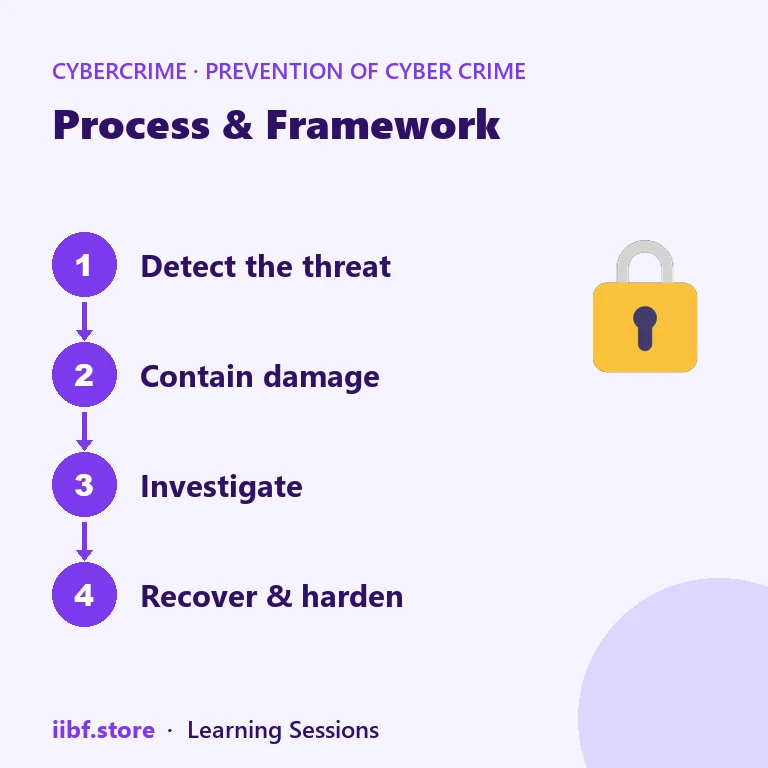
Once encryption begins, response speed determines how much of the bank stays operational. The standard sequence taught in the incident management chapter is: isolate the affected segment immediately, contain spread by disabling shared credentials and switching, preserve forensic evidence (memory dumps, logs) before wiping any machine, and only then begin eradication and recovery from verified clean backups. CERT-In and law-enforcement notification runs in parallel with containment, not after it — delaying the six-hour report to "assess the situation first" is itself a compliance failure. RBI guidance and most CISOs strongly discourage paying the ransom: payment funds further criminal activity, rarely guarantees a working decryption key, and can itself trigger sanctions-related scrutiny under foreign exchange rules. A bank's operational-risk posture during such a crisis mirrors the discipline banks apply elsewhere — much as a well-designed stressed asset resolution framework contains credit-risk fallout, a rehearsed ransomware playbook contains operational-risk fallout before it cascades into customer-facing outages.
🧑💻 Building a Cyber-Aware Workforce
Technology controls fail without disciplined people and processes behind them. Regular phishing simulations, mandatory security-awareness refreshers, and clear escalation paths turn every employee into a sensor rather than a weak link. Least-privilege access — ensuring staff can only reach the systems their role genuinely requires — limits how far a single compromised login can travel, and pairs naturally with the broader awareness built through phishing vishing prevention training, since credential theft remains the single most common ransomware entry point. Vendor risk assessments matter just as much: a bank is only as secure as its weakest connected partner, so periodic audits of payment gateways and outsourced vendors are now standard practice. Table-top drills, where the CCMP team rehearses a simulated ransomware event, help surface gaps before a real incident does. For a structured, exam-oriented walk-through of this entire subject area, the Prevention of Cyber Crime tag hub collects every related chapter and article in one place.
📌 Remember: The weakest link in ransomware defence is almost always a person, not a firewall — training and least-privilege access matter as much as any technical control.
🧠 Practice MCQs: Ransomware Attack Prevention
Q1. What is the CERT-In mandated timeline for banks to report a significant ransomware incident? (a) 72 hours (b) 24 hours (c) 6 hours (d) 30 days
Answer: (c) — CERT-In directions require reporting of significant cyber incidents, including ransomware, within six hours of detection.
Q2. Which backup practice is specifically designed to survive a ransomware encryption event? (a) Daily incremental backup on the same server (b) Offline immutable backup copy (c) RAID mirroring only (d) Cloud sync with live write access
Answer: (b) — An offline, immutable backup cannot be reached or altered by ransomware that has already encrypted live and networked systems.
Q3. In a bank's incident response sequence, which step should occur first after ransomware is detected? (a) Pay the ransom (b) Isolate the affected network segment (c) Notify customers publicly (d) Reformat all servers immediately
Answer: (b) — Immediate isolation and containment prevent further lateral spread before eradication and recovery begin.
Q4. Who in a bank's structure is responsible for independently overseeing cyber security and reporting outside the IT function? (a) Branch Manager (b) Chief Information Security Officer (CISO) (c) Compliance Clerk (d) External Auditor only
Answer: (b) — The CISO reports independently of IT operations to ensure objective oversight of cyber security posture, as required under RBI guidance.
Q5. Why do RBI guidelines and most CISOs discourage paying a ransomware demand? (a) It is always illegal under the IT Act (b) It rarely guarantees a working decryption key and funds further crime (c) Insurance always covers it fully (d) It resolves the incident instantly
Answer: (b) — Payment does not guarantee recovery, encourages repeat attacks, and can raise separate regulatory and sanctions concerns.
Want chapter-wise mock tests with 100+ MCQs? Start practising free →
What is ransomware in the context of banking cyber security?
Ransomware is malicious software that encrypts a bank's files or systems and demands payment, typically in cryptocurrency, for a decryption key, often causing severe operational disruption to core banking services.
How quickly must a bank report a ransomware attack to CERT-In?
Under CERT-In directions, significant cyber incidents including ransomware must be reported within six hours of detection, in parallel with internal containment steps.
Does cyber insurance replace RBI's mandatory cyber security controls?
No. Cyber insurance can help transfer some financial loss but does not substitute for mandatory technical controls, reporting obligations, or a Board-approved Cyber Crisis Management Plan.
Should a bank ever pay a ransomware demand?
RBI guidance and industry practice strongly discourage payment, since it rarely guarantees data recovery, funds further criminal activity, and can trigger additional regulatory scrutiny.
Ransomware attack prevention is now a standing agenda item for every bank's risk committee, and IIBF examiners test it in exactly that operational spirit. Reinforce these controls, reporting timelines, and response steps with a full CAIIB course practice set, or jump straight into topic-wise mock tests to lock in the six-hour CERT-In window and the incident-response sequence before exam day.
Practice this topic
Take a free mock test, download chapter PDFs, or watch a video class — all included on iibf.store.