DRA Exam 2026: Eligibility, Training Hours & IIBF Syllabus Guide
If you want a career in loan recovery with a bank, an NBFC, or an asset reconstruction company, the DRA exam is your gateway. The Certificate Examination for Debt Recovery Agents, conducted by IIBF, is not optional either — the Reserve Bank of India mandates that anyone employed as a recovery agent must hold this certification. This complete 2026 guide covers the eligibility, the exact training hours, the exam pattern, and the syllabus so you can plan your attempt with confidence.
Watch the video below for a quick overview of the DRA exam, then read on for the details and the strategy.
DRA Exam 2026 Complete Guide · Watch on YouTube
Why the DRA certification is compulsory
Following RBI guidelines on the recovery of dues and repossession of security, banks and financial institutions can only engage recovery agents who have undergone the prescribed training and cleared the DRA exam. The idea is simple: recovery is a sensitive, customer-facing job, and an untrained agent can expose a bank to reputational and legal risk. The certificate, issued by the Indian Institute of Banking & Finance, is the industry-accepted proof that an agent understands the legal framework, the code of conduct, and the do's and don'ts of fair recovery.
That mandate is exactly why demand for certified agents stays steady, and why clearing the DRA exam opens doors across banks, NBFCs, and recovery agencies.
Eligibility and the 50/100 hour training rule
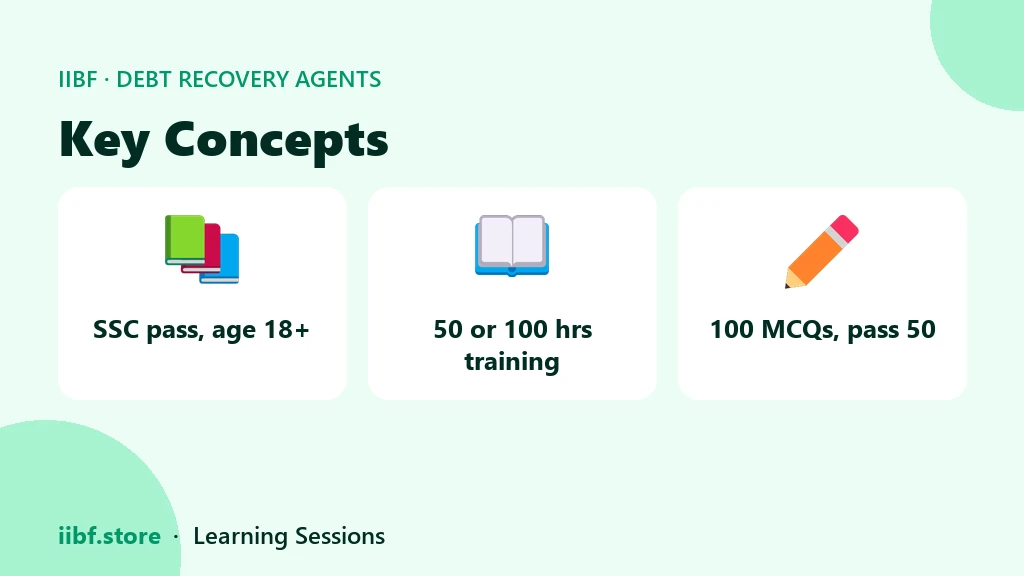
The eligibility bar is deliberately accessible so that the profession stays open. To apply you must have passed at least the SSC (10th standard) or above, and you must have completed 18 years of age on the date of application for training. There is no upper age limit.
The training requirement is the part candidates most often get wrong, so read it carefully. Before you can appear for the DRA exam, you must complete mandatory in-person training at an IIBF-accredited institute, and the number of hours depends on your qualification:
| Your qualification | Mandatory training |
|---|---|
| Undergraduate (below graduation) | 100 hours |
| Graduate and above | 50 hours |
Full attendance for the entire duration of the programme is essential — you cannot partially attend and still qualify. Once the training is completed, the institute registers you, and you become eligible to sit for the examination.
DRA exam pattern and passing marks
The DRA exam is refreshingly straightforward compared with JAIIB or CAIIB. Here is what to expect on exam day:
- Questions: 100 objective-type multiple choice questions.
- Total marks: 100.
- Duration: 2 hours (120 minutes).
- Mode: Online, conducted once a month or more frequently as decided by IIBF.
- Negative marking: None — so attempt every question.
- Passing marks: A minimum of 50 out of 100.
With no negative marking and a 50% pass bar, the DRA exam is very clearable on the first attempt provided you have paid attention during training and revised the core legal concepts.
What the DRA syllabus covers
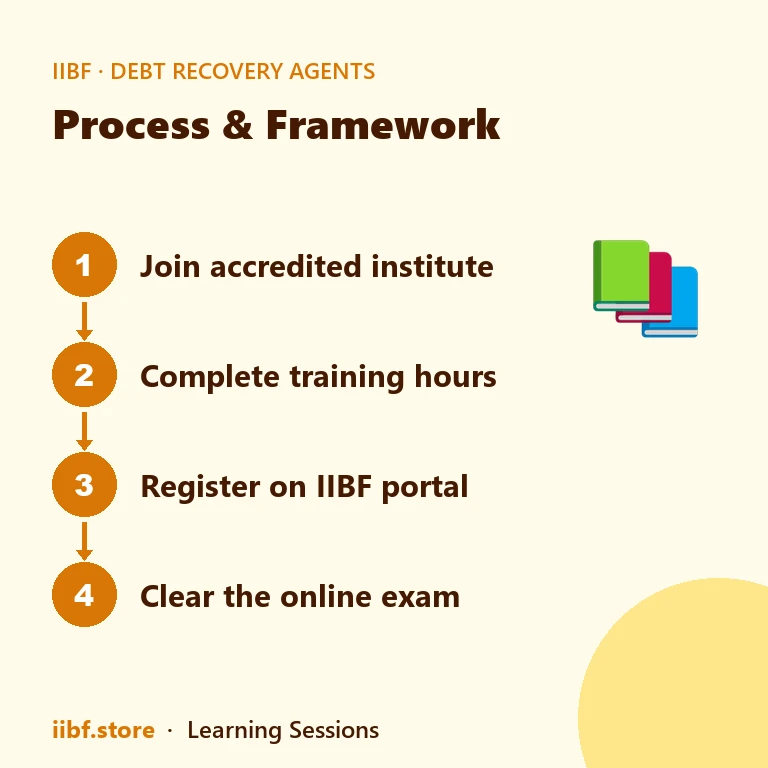
The syllabus is built around what a recovery agent genuinely needs on the ground. Broad areas include:
- Basics of banking and the banker–customer relationship.
- The RBI framework on recovery of dues and repossession of security.
- Fair Practices Code and the code of conduct for recovery agents.
- Non-performing assets (NPA) and the recovery process.
- Soft skills, ethics, and communication in recovery situations.
- Relevant legal provisions, including the SARFAESI Act and recovery through Lok Adalats and DRTs.
Notice that a large part of the paper is about conduct, not just law. Examiners want to confirm you understand the ethical boundaries of recovery, because that is where agencies most often get into trouble.
How to prepare and clear the DRA exam on the first attempt
Treat the training seriously — the trainers cover most of what appears in the paper. Alongside, practise MCQs to build speed and confidence. Our online mock tests let you rehearse under real exam timing, and the study planner keeps your revision on track in the days before your slot. If you are also eyeing a broader banking career, exploring the JAIIB course is a natural next step after certification. Always confirm the current rules, fees, and exam calendar on the official IIBF DRA page before you register, as IIBF periodically updates its notifications.
Career prospects after clearing the DRA exam
Passing the DRA exam is not just a compliance box to tick — it is a genuine career enabler. Once certified, you can be formally engaged by banks, non-banking financial companies, microfinance institutions, and specialised recovery agencies. As lending grows across retail loans, credit cards, vehicle finance, and small-business credit, the volume of accounts that eventually need recovery support grows with it, and every one of those agents must be certified. That structural demand is why the certification retains its value year after year.
The role itself rewards people who combine firmness with empathy. A good recovery agent understands the borrower’s situation, explains the consequences of default clearly, and negotiates a realistic repayment path — all within the boundaries the RBI Fair Practices Code sets out. Because the certificate proves you know those boundaries, employers treat it as a mark of professionalism rather than a mere formality. Many agents use the DRA qualification as a stepping stone into broader credit and collections roles, and some go on to team-lead or agency-owner positions.
If you are early in your banking journey, it also pairs well with further study. Understanding recovery deepens your grasp of credit risk, which is central to mainstream banking exams. So think of the DRA exam not as the end of your learning but as a practical, income-generating first step that sits comfortably alongside more advanced certifications. Plan your training dates, register on time, revise the conduct rules, and you will clear it comfortably on your first attempt.
Frequently asked questions
Is the DRA certification mandatory to work as a recovery agent?
Yes. As per RBI's mandate, DRA certification is compulsory to be employed as a debt recovery agent in India. Banks and NBFCs can only engage certified agents.
How many hours of training are required before the DRA exam?
Undergraduates must complete 100 hours of training and graduates must complete 50 hours, at an IIBF-accredited institute, with full attendance, before they can appear for the examination.
What is the passing mark for the DRA exam?
You need a minimum of 50 out of 100. The paper has 100 objective MCQs, runs for two hours, is conducted online, and carries no negative marking.
What is the minimum qualification for the DRA exam?
You must have passed SSC (10th standard) or above and have completed 18 years of age on the date of application for training. There is no upper age limit.
Prefer revising from a printed book?
Chapter-wise books with MCQs after every chapter — minimal pages, complete coverage, delivered anywhere in India. Every book has a free sample to read first.
107 pages · 240 MCQs
Learning Sessions · Ashish Sir
132 pages · 225 MCQs
Learning Sessions · Ashish Sir
188 pages · 435 MCQs
Learning Sessions · Ashish Sir
117 pages · 236 MCQs
Learning Sessions · Ashish Sir
Learning Sessions · Ashish Sir
118 pages · 299 MCQs
Learning Sessions · Ashish Sir
Learning Sessions · Ashish Sir
Learning Sessions · Ashish Sir
Learning Sessions · Ashish Sir
115 pages · 255 MCQs
Learning Sessions · Ashish Sir
Learning Sessions · Ashish Sir
334 pages · 936 MCQs
Learning Sessions · Ashish Sir
Learning Sessions · Ashish Sir
115 pages · 344 MCQs
Learning Sessions · Ashish Sir
90 pages · 150 MCQs
Learning Sessions · Ashish Sir
Learning Sessions · Ashish Sir
131 pages · 672 MCQs
Learning Sessions · Ashish Sir
221 pages · 831 MCQs
Learning Sessions · Ashish Sir
128 pages · 524 MCQs
Learning Sessions · Ashish Sir
107 pages · 445 MCQs
Learning Sessions · Ashish Sir
148 pages · 478 MCQs
Learning Sessions · Ashish Sir
151 pages · 465 MCQs
Learning Sessions · Ashish Sir
148 pages · 375 MCQs
Learning Sessions · Ashish Sir
216 pages · 895 MCQs
Learning Sessions · Ashish Sir
109 pages · 300 MCQs
Learning Sessions · Ashish Sir
104 pages · 360 MCQs
Learning Sessions · Ashish Sir
82 pages · 297 MCQs
Learning Sessions · Ashish Sir
151 pages · 600 MCQs
Learning Sessions · Ashish Sir
98 pages · 282 MCQs
Learning Sessions · Ashish Sir
Practice this topic
Take a free mock test, download chapter PDFs, or watch a video class — all included on iibf.store.
Keep reading