CAIIB ABM Statistics MCQs: Practice Questions & Quick Revision 2026
If the statistics section of CAIIB ABM has ever made you freeze mid-paper, you are in good company. Yet here is the quiet secret every topper knows: CAIIB ABM statistics is one of the most predictable, most rewarding parts of the Advanced Bank Management syllabus. The formulas are fixed, the question patterns repeat year after year, and once you have drilled a handful of MCQs, you can bank 8–12 marks almost on autopilot. This quick-revision guide walks you through exactly that — the concepts, the formulas, and the worked practice questions the examiner keeps recycling.
The short video below runs through a set of CAIIB ABM statistics MCQs in five minutes. Watch it first, then use the notes underneath to lock the logic in for good.
Statistics Exam Practice MCQs · CAIIB ABM Quick Revision · Watch on YouTube
Why CAIIB ABM statistics is a scoring goldmine
Most candidates treat the statistics chapter as an intimidating wall of Greek symbols. It is not. Unlike theory-heavy modules where the answer depends on interpretation, a numerical question has exactly one correct option, and that option falls straight out of a formula. If you plug the numbers correctly, the mark is yours. That is why examiners love CAIIB ABM statistics MCQs — they separate candidates who practised from candidates who only read.
The chapter also rewards speed. A well-drilled candidate solves a mean-or-standard-deviation MCQ in under a minute, freeing time for the wordier ABM case studies. So the goal of your revision is not to become a statistician; it is to recognise the question type instantly and reach for the right formula without hesitation.
The core formulas you must memorise
Nearly every CAIIB ABM statistics MCQ is built on one of the measures below. Commit this table to memory and you have covered the bulk of what the exam can throw at you.
| Measure | What it tells you | Formula (ungrouped data) |
|---|---|---|
| Mean | The average value | Σx ÷ n |
| Median | The middle value when data is sorted | Value at (n+1)÷2 position |
| Mode | The most frequent value | Highest-frequency observation |
| Range | Spread from smallest to largest | Highest − Lowest |
| Variance | Average squared deviation | Σ(x − mean)² ÷ n |
| Standard Deviation | Typical distance from the mean | √Variance |
| Coefficient of Variation | Relative variability (%) | (SD ÷ Mean) × 100 |
Two habits save marks here. First, always check whether the question gives you ungrouped data (a simple list) or grouped data (a frequency table) — the formula changes slightly. Second, remember the empirical relationship the examiner loves: Mode = 3 × Median − 2 × Mean. It appears at least once in most sittings.
Worked MCQs: how the exam actually asks them
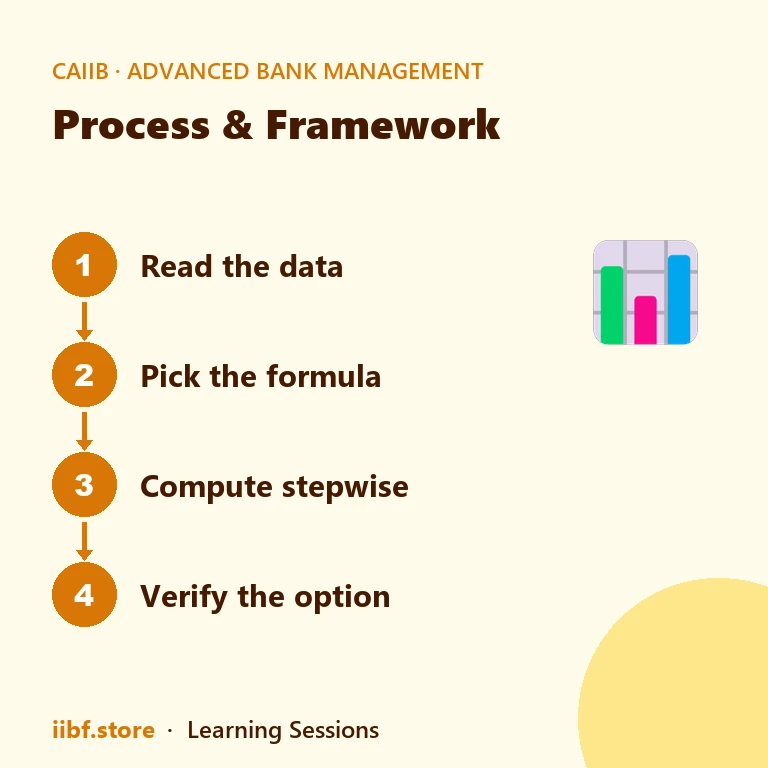
Theory only sticks when you apply it. Here are two representative CAIIB ABM statistics questions, solved the way you should solve them under time pressure.
Question 1. The daily cash withdrawals (in ₹ lakh) at a branch over five days are 12, 15, 15, 18, 20. Find the mean and mode.
Solution: Mean = (12 + 15 + 15 + 18 + 20) ÷ 5 = 80 ÷ 5 = 16. The value 15 occurs twice, more than any other, so mode = 15. Notice how the mean can differ from the most common value — a classic trap option.
Question 2. Two loan portfolios have the same mean return of 10%, but Portfolio A has a standard deviation of 2% and Portfolio B has 5%. Which is more consistent?
Solution: Consistency means lower relative variability. Coefficient of Variation for A = (2 ÷ 10) × 100 = 20%; for B = (5 ÷ 10) × 100 = 50%. Portfolio A is more consistent. This is exactly the risk-versus-return logic ABM wants you to internalise.
A 7-day revision plan for statistics
You do not need weeks. A focused week of CAIIB ABM statistics practice is enough to turn a weak area into a strength:
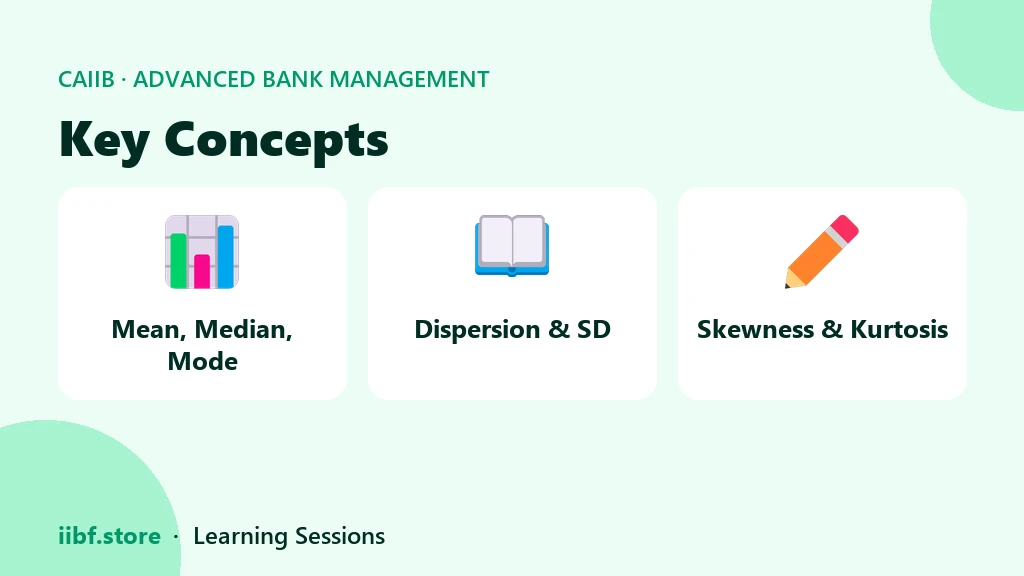
- Days 1–2: Central tendency — mean, median, mode — for both ungrouped and grouped data.
- Days 3–4: Dispersion — range, quartile deviation, variance, standard deviation, coefficient of variation.
- Day 5: Shape — skewness and kurtosis, and what a positive or negative value implies.
- Day 6: Correlation and regression basics, plus probability distributions.
- Day 7: A full timed set of CAIIB ABM statistics MCQs to simulate exam conditions.
Pair this plan with daily reps on our CAIIB mock tests and the formula match game to make recall automatic. When you are ready for structured lessons, the full Advanced Bank Management course covers every statistics sub-topic with more solved examples. You can cross-check definitions against the standard references cited by the Indian Institute of Banking & Finance.
Common traps the examiner sets
Even strong candidates lose easy marks in CAIIB ABM statistics by falling for predictable traps. The most common one is confusing the different averages. When a question describes an income or loan-size dataset and asks for the “typical” value, the mean is often the wrong answer because a few very large values drag it upward — the median is the more honest representative. Read the wording carefully; the examiner chooses it deliberately.
The second trap is mixing up population and sample formulas for variance and standard deviation. For most CAIIB ABM statistics questions you divide by n, but if the question explicitly mentions a sample, some texts divide by n−1. Unless the paper says otherwise, stick with dividing by n and do not overthink it. The third trap is unit confusion: variance is expressed in squared units, while standard deviation and the mean share the original units, so an option quoted in the wrong unit is a giveaway distractor.
Finally, watch out for the coefficient of variation. Candidates instinctively pick the option with the lower standard deviation as “more consistent”, but when two datasets have different means you must compare the coefficient of variation, not the raw standard deviation. Slow down for that one word — consistency — and you will pick up a mark that half the hall gets wrong. Master these traps and CAIIB ABM statistics becomes a reliable source of easy marks rather than a source of stress.
Frequently asked questions
How many statistics questions appear in the CAIIB ABM exam?
It varies by sitting, but statistics and its allied topics typically contribute around 8 to 12 marks. Because the answers are formula-driven, it is one of the highest return-on-effort areas in the whole paper.
Do I need a calculator for CAIIB ABM statistics MCQs?
IIBF allows a simple non-programmable calculator in the online exam, and there is an on-screen calculator too. Most central-tendency and dispersion sums can be done quickly, so practise mental shortcuts as well.
Is there negative marking in CAIIB ABM?
No. CAIIB papers do not carry negative marking, so you should attempt every question, including the statistics MCQs you are unsure of. An educated guess costs you nothing.
What is the passing mark for CAIIB ABM?
You need a minimum of 50 out of 100 in each paper, or 45 in each paper with an aggregate of 50% across all papers of CAIIB. Strong statistics scores make hitting that threshold far easier.
Prefer revising from a printed book?
Chapter-wise books with MCQs after every chapter — minimal pages, complete coverage, delivered anywhere in India. Every book has a free sample to read first.
148 pages · 478 MCQs
Learning Sessions · Ashish Sir
151 pages · 465 MCQs
Learning Sessions · Ashish Sir
148 pages · 375 MCQs
Learning Sessions · Ashish Sir
216 pages · 895 MCQs
Learning Sessions · Ashish Sir
109 pages · 300 MCQs
Learning Sessions · Ashish Sir
104 pages · 360 MCQs
Learning Sessions · Ashish Sir
82 pages · 297 MCQs
Learning Sessions · Ashish Sir
151 pages · 600 MCQs
Learning Sessions · Ashish Sir
98 pages · 282 MCQs
Learning Sessions · Ashish Sir
131 pages · 672 MCQs
Learning Sessions · Ashish Sir
221 pages · 831 MCQs
Learning Sessions · Ashish Sir
128 pages · 524 MCQs
Learning Sessions · Ashish Sir
107 pages · 445 MCQs
Learning Sessions · Ashish Sir
132 pages · 225 MCQs
Learning Sessions · Ashish Sir
188 pages · 435 MCQs
Learning Sessions · Ashish Sir
117 pages · 236 MCQs
Learning Sessions · Ashish Sir
Learning Sessions · Ashish Sir
118 pages · 299 MCQs
Learning Sessions · Ashish Sir
Learning Sessions · Ashish Sir
Learning Sessions · Ashish Sir
Learning Sessions · Ashish Sir
115 pages · 255 MCQs
Learning Sessions · Ashish Sir
Learning Sessions · Ashish Sir
334 pages · 936 MCQs
Learning Sessions · Ashish Sir
Learning Sessions · Ashish Sir
115 pages · 344 MCQs
Learning Sessions · Ashish Sir
107 pages · 240 MCQs
Learning Sessions · Ashish Sir
90 pages · 150 MCQs
Learning Sessions · Ashish Sir
Learning Sessions · Ashish Sir
Quick quiz on this topic
5 exam-style questions from our free test bank — check yourself before you move on.
Practice this topic
Take a free mock test, download chapter PDFs, or watch a video class — all included on iibf.store.