e-RUPI Voucher Based Digital Payments: How It Works in India
Ask any JAIIB or CAIIB candidate to name a cashless payment instrument that needs no bank account, no smartphone app, and no card from the person receiving the money, and most draw a blank. That is exactly the gap e-RUPI voucher based digital payments were built to close. Launched by the National Payments Corporation of India in August 2021, e-RUPI turns a UPI-linked, prepaid, purpose-specific voucher into a payment instrument that a beneficiary can redeem with nothing more than an SMS string or a QR code. For exam purposes this topic sits squarely inside the Digital Banking syllabus, and examiners like to test whether you can separate the issuer, sponsor, and beneficiary roles cleanly. This article walks through each of them.
🎫 What Is e-RUPI and Why It Matters for the Exam
e-RUPI is a cashless, contactless, prepaid, single-use voucher issued for a specific purpose and a specific beneficiary. It is delivered as an SMS string or a QR code sent directly to the beneficiary's registered mobile number, and it can be redeemed at an empanelled service provider without an app download, without an account opening, and without a debit or credit card. Because it rides on the UPI switch, it settles instantly once redeemed, yet it is not a general-purpose UPI transaction — it is locked to one purpose and one recipient.
The instrument was rolled out jointly by NPCI, the Department of Financial Services, the National Health Authority, and partner banks, with the first large deployment used to let corporates and individuals sponsor COVID-19 vaccine doses for others without handling cash. That single use case explains most of its design: the sponsor never hands over money to the beneficiary, and the beneficiary never has to prove eligibility beyond presenting the code. Read the Overview of Digital Banking chapter for how this fits alongside other digital rails covered in the syllabus.
🏦 Issuer, Sponsor and Beneficiary: Mapping the e-RUPI Roles
Four parties sit inside every e-RUPI transaction, and examiners routinely test whether you can tell them apart. The sponsor — a government department, a corporate, or an individual — decides the purpose of the voucher and funds it upfront with the issuing bank; this is the entity that pays. The issuing bank generates the unique, encrypted, one-time voucher against the beneficiary's mobile number and the stated purpose, without opening any account for that beneficiary. The beneficiary simply receives the code by SMS or as a QR image and carries no compliance burden at all. The service provider — a hospital, fair-price shop, or empanelled vendor — validates the code, delivers the service or goods, and then claims settlement from the issuing bank.
Notice what is missing from that list: there is no requirement for the beneficiary to hold a savings account, and no wallet balance sits with them either. The Mobile Banking chapter is a useful companion here, since it covers how banks authenticate the issuer and provider legs of a transaction even when the end beneficiary is outside the formal banking relationship.
💡 Exam Tip: If a question asks "who bears the KYC responsibility in an e-RUPI transaction", the answer is the sponsor and the issuing bank — never the beneficiary.
🔄 Redemption and Settlement Flow Step by Step
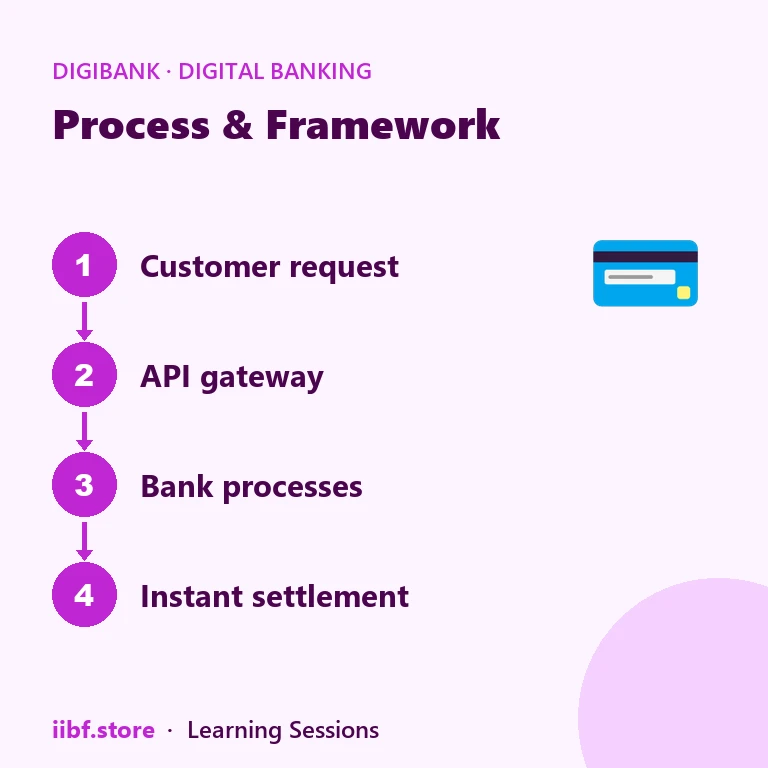
The flow behind e-RUPI voucher based digital payments follows a fixed sequence. First, the sponsor shares the beneficiary's mobile number and the purpose of the voucher with an issuing bank on the e-RUPI platform. Second, the bank generates a one-time, non-transferable code tied to that mobile number and purpose, and delivers it as an SMS string or QR code — no further action is needed from the beneficiary until redemption. Third, the beneficiary visits the specific empanelled service provider and presents the code. Fourth, the provider's system validates the code over the UPI rails and releases the service or goods.
Finally, the provider submits the redeemed code for settlement; funds move from the sponsor's pre-funded pool held with the issuing bank to the provider's account, and the code is marked used so it cannot be redeemed twice. This settlement discipline mirrors the same rigour banks apply to IT service management in banks — a single failed reconciliation step would let a voucher be spent more than once. On the consumer-security side, the checks resemble the broader set of mobile banking security features used to keep any UPI-linked flow tamper-proof. RBI's regulatory oversight of prepaid and UPI-linked instruments is documented on the Reserve Bank of India website for candidates who want the primary source.
Do not confuse this settlement with a wallet top-up: nothing is ever credited to the beneficiary. The value moves only once, from sponsor to provider, at the moment of redemption.
⚖️ e-RUPI vs Digital Wallets vs CBDC
Candidates frequently mix up e-RUPI with a mobile wallet or with the central bank digital currency, so it helps to fix the boundaries. A digital wallet is reloadable, multi-use, and tied to a KYC'd account holder who can spend the balance at any merchant that accepts the wallet. e-RUPI is the opposite on every count: it is single-use, purpose-bound, non-transferable, and the beneficiary carries no KYC obligation because the bank's due-diligence sits with the sponsor and the issuer, not the recipient. This is also why e-RUPI needs no separate video KYC in digital banking check on the beneficiary side at all.
The central bank digital currency is a different animal again — it is a direct liability of the Reserve Bank of India, fungible with cash, held in a digital wallet app, and usable for any general payment the way a currency note is. e-RUPI is not central bank money; it is a bank-issued, closed-loop voucher that only settles at pre-identified redemption points for a pre-identified purpose. Both instruments plug into the wider India Stack and digital public infrastructure that underpins India's digital payment ecosystem, but they solve different problems: one is general-purpose digital cash, the other is a targeted benefit-transfer rail.
| Feature | e-RUPI | Digital Wallet | CBDC (e-Rupee) |
|---|---|---|---|
| Beneficiary needs a bank account | ❌ No | Usually | Yes (digital wallet app) |
| Beneficiary needs a smartphone app | ❌ No | Yes | Yes |
| Reusable / multi-purpose | ❌ Single use, purpose-bound | Reloadable | General purpose |
| Issued by | ✅ Partner banks via NPCI/UPI | Bank or licensed PPI issuer | Reserve Bank of India |
🎯 e-RUPI in Government Welfare and Corporate Use
Government departments use e-RUPI to disburse targeted benefits without routing cash through intermediaries: vaccine-dose sponsorship was the launch use case, and the model extends naturally to fertiliser subsidy disbursal, treatment vouchers under schemes such as Ayushman Bharat, and school-fee or scholarship transfers where the funder wants proof that the money reached the intended purpose rather than the intended person's bank balance. Because redemption happens only at empanelled providers, leakage is structurally harder than with a cash transfer.
Corporates have adopted the same rail for CSR spending and employee welfare — sponsoring health check-ups, meal vouchers, or fuel benefits for staff and vendors without maintaining a prepaid card program. This also serves financial inclusion goals directly: a beneficiary with no bank account and no smartphone can still receive and redeem value, which the Financial Inclusion chapter frames as a core objective of India's digital payments push. For a broader view of how these vouchers sit within the bank's retail digital channel, revisit the Retail Banking - Digital Banking class notes alongside this article.
📌 Remember: e-RUPI is purpose-and-person locked at creation; a wallet is not. That single distinction answers most exam questions on this topic.
🧠 Practice MCQs: e-RUPI Voucher Based Digital Payments
Q1. e-RUPI vouchers are delivered to the beneficiary as (a) a physical prepaid card (b) an SMS string or QR code (c) a mobile wallet top-up (d) a cheque
Answer: (b) — e-RUPI is delivered as a one-time SMS string or QR code redeemable without an app or card.
Q2. In an e-RUPI transaction, who bears the responsibility of funding the voucher upfront? (a) The beneficiary (b) The service provider (c) The sponsor (government department, corporate, or individual) (d) NPCI
Answer: (c) — The sponsor decides the purpose and pre-funds the voucher with the issuing bank; the beneficiary pays nothing.
Q3. Which of the following is NOT required from an e-RUPI beneficiary? (a) A registered mobile number (b) A bank account (c) Presenting the code at the service provider (d) Knowledge of the voucher's purpose
Answer: (b) — No bank account, smartphone app, or card is needed by the beneficiary to redeem an e-RUPI voucher.
Q4. How does e-RUPI differ fundamentally from India's central bank digital currency (CBDC)? (a) e-RUPI is issued directly by RBI (b) e-RUPI is a general-purpose currency (c) e-RUPI is a bank-issued, purpose-bound, single-use voucher, not central bank money (d) There is no difference
Answer: (c) — CBDC is a direct RBI liability usable for any payment; e-RUPI is a closed-loop, purpose-specific voucher issued by partner banks.
Q5. What prevents an e-RUPI voucher from being redeemed twice? (a) The beneficiary's PIN (b) The voucher is marked used at settlement after the first redemption (c) A daily transaction limit (d) A cooling-off period
Answer: (b) — Once the service provider claims settlement, the issuing bank marks the one-time code as redeemed, blocking any repeat use.
Want chapter-wise mock tests with 100+ MCQs? Start practising free →
Is a bank account mandatory to receive an e-RUPI voucher?
No. The beneficiary only needs a registered mobile number to receive the SMS string or QR code; no account, app, or card is required to redeem it.
Who issues e-RUPI vouchers in India?
Partner banks empanelled on the NPCI platform issue e-RUPI vouchers on behalf of a sponsoring government department, corporate, or individual, using UPI rails for redemption and settlement.
Can an e-RUPI voucher be used for any purpose or reused later?
No. Each voucher is single-use and purpose-bound to one beneficiary; it is invalidated the moment it is redeemed at the specified service provider.
How is e-RUPI different from India's CBDC (e-Rupee)?
CBDC is general-purpose digital cash issued directly by the Reserve Bank of India, while e-RUPI is a bank-issued, closed-loop voucher restricted to one purpose and one recipient.
Conclusion: Lock In This Topic Before Exam Day
e-RUPI voucher based digital payments show up in Digital Banking papers precisely because they combine several syllabus threads — UPI infrastructure, purpose-bound instruments, and financial inclusion — into one compact case study. Keep the four roles, the redemption sequence, and the wallet-versus-CBDC distinction sharp, and this topic becomes a reliable scoring area rather than a source of confusion. Browse more coverage on the Digital Banking tag hub, then put the concepts to work with a full-length CAIIB Digital Banking mock test.
Quick quiz on this topic
5 exam-style questions from our free test bank — check yourself before you move on.
Practice this topic
Take a free mock test, download chapter PDFs, or watch a video class — all included on iibf.store.
Keep reading