NPCI Role in Digital Payments: BHIM, UPI and Product Portfolio
Every UPI transfer, every IMPS credit that lands in seconds, every RuPay swipe at a merchant counter runs on rails built and operated by one institution. If you are preparing for the Digital Banking paper, understanding the NPCI role in digital payments is non-negotiable — examiners test ownership structure, product scope, and governance almost every attempt. This article walks through what the National Payments Corporation of India actually is, who owns it, what it operates, and how a bank plugs into its switch.
🏛️ What NPCI Is and Who Owns It
The National Payments Corporation of India (NPCI) is the umbrella organisation for retail payment systems in India. It was incorporated in December 2008 as a Section 25 company under the erstwhile Companies Act, 1956 — now a Section 8 not-for-profit company under the Companies Act, 2013. That structure matters for exams: NPCI is not a government department and not a profit-driven private entity. It exists to build shared payment infrastructure that any eligible bank can use.
NPCI was promoted jointly by the Reserve Bank of India and the Indian Banks' Association (IBA), with ten core promoter banks initially holding equity. Shareholding was later broad-based to over 50 member banks, including public sector, private sector, foreign banks, regional rural banks, urban co-operative banks, and payments banks, so that no single institution dominates. The Reserve Bank retains regulatory oversight as the authority under the Payment and Settlement Systems Act, 2007, even though it does not run NPCI's day-to-day operations. Candidates studying the Overview of Digital Banking chapter will find this ownership-versus-regulation distinction is a recurring theme across the whole subject.
💡 Exam Tip: NPCI is a Section 8 (not-for-profit) company promoted by RBI and IBA — it is a system operator, while RBI remains the regulator under the PSS Act, 2007. Do not mix up the two roles in an MCQ.
💳 The Product Portfolio NPCI Operates
NPCI's real exam weight comes from its product list, because each product has its own use case, settlement logic, and member-bank obligations. Unified Payments Interface (UPI) is the flagship — a real-time, mobile-first system that lets a single app move money between any two bank accounts using a virtual payment address. Immediate Payment Service (IMPS) predates UPI and remains the 24x7 interbank fund-transfer rail behind many net-banking and mobile-banking transfers.
National Automated Clearing House (NACH) handles bulk, recurring debits and credits — EMI collections, dividend payouts, subsidy disbursals — replacing the older ECS mechanism with a centralised, Aadhaar-seeded mandate system. Aadhaar Enabled Payment System (AePS) lets a customer withdraw cash or check balance at a micro-ATM using only Aadhaar number and biometric authentication, a critical financial-inclusion tool covered in the Financial Inclusion chapter. NETC FASTag runs India's electronic toll-collection network on RFID tags linked to a prepaid or bank account. RuPay is India's own domestic card network, competing with Visa and Mastercard on debit, credit, and prepaid rails, while also underpinning card-linked UPI credit lines.
| NPCI Product | Launched | Core Use Case | 24x7 Real-Time |
|---|---|---|---|
| UPI | 2016 | Instant P2P / P2M mobile payments | ✅ |
| IMPS | 2010 | Interbank fund transfer | ✅ |
| NACH | 2016 | Bulk recurring debits/credits, mandates | ❌ (batch cycles) |
| AePS | 2010 | Aadhaar-based micro-ATM cash withdrawal | ✅ |
| NETC FASTag | 2016 (national rollout) | Electronic toll collection | ✅ |
| RuPay | 2012 | Domestic debit/credit/prepaid card network | ✅ |
Read this portfolio alongside the POS (Point of Sale) chapter, since RuPay card acceptance at physical terminals is examined together with card-network basics.
📱 BHIM, NPCI International and Overseas Acceptance
BHIM (Bharat Interface for Money) is NPCI's own UPI application, launched in December 2016 as a reference implementation to show banks and fintechs how a compliant UPI front-end should behave. It matters for exams because it is NPCI's app, distinct from third-party UPI apps such as bank apps or TPAP wallets that merely plug into the same UPI rail. BHIM demonstrated core UPI flows — send, collect, scan-and-pay — before the wider TPAP ecosystem scaled up.
NPCI International Payments Limited (NIPL), a wholly owned subsidiary incorporated in 2020, takes RuPay and UPI beyond India's borders. NIPL partners with overseas payment networks and acquirers so that RuPay cards and UPI-linked payments gain acceptance at merchant and ATM networks in select overseas jurisdictions, and it supports UPI-linked remittance and QR-based acceptance tie-ups abroad. For the exam, remember NIPL's function is expanding overseas acceptance and international partnerships, not domestic scheme management, which stays with the parent NPCI. Sibling coverage of the acceptance side sits in UPI international payments, worth reading right after this chapter.
📌 Remember: BHIM = NPCI's own reference UPI app. NIPL = NPCI's subsidiary for taking RuPay/UPI acceptance overseas. Two different roles, frequently confused in MCQs.
🔗 Governance, Circulars and How a Bank Connects
NPCI issues operating circulars that member banks must implement — transaction limits, dispute-resolution timelines, fraud-risk controls, and market-conduct caps for the apps built on its rails. One widely tested example is the market-share cap NPCI has prescribed for Third-Party App Providers (TPAPs) on UPI, currently set at 30 percent of total UPI transaction volume for any single TPAP, intended to prevent concentration risk in an ecosystem that a handful of apps could otherwise dominate. Compliance timelines for this cap have been extended more than once as NPCI calibrates the transition, so candidates should learn the principle — a volume cap to diversify the UPI app ecosystem — rather than memorising a date that keeps shifting.
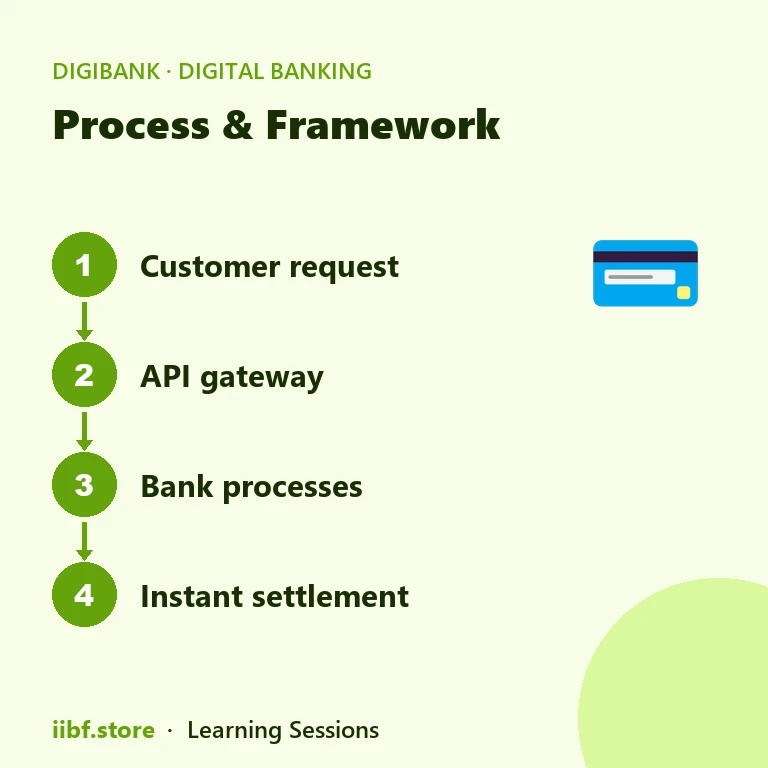
Operationally, a bank connects to NPCI as either a direct member or a sub-member sponsored by a direct member bank. Direct members maintain a settlement account with the Reserve Bank and connect straight to the NPCI switch for real-time messaging and net settlement; smaller banks and payments banks often route through a sponsor bank's connectivity instead of building their own link. Once connected, the bank must comply with NPCI's technical specifications (ISO 8583-based messaging for many products, UPI's own API specification), risk and fraud-monitoring circulars, and settlement-cycle rules published from time to time. This connectivity model is explained further in the Retail Banking - Digital Banking Class 12 and Retail Banking - Digital Banking Class 11 chapters. Broader system-level context sits in the enterprise architecture in banks article for CAIIB candidates connecting this to core-banking integration.
⚠️ Common Mistake: Candidates write that NPCI "regulates" banks. NPCI operates the payment systems and issues operational circulars; the statutory regulator for payment systems remains the Reserve Bank of India under the Payment and Settlement Systems Act, 2007 (rbi.org.in).
For a wider read on where BHIM and UPI sit inside India's payment stack, revisit India Stack and digital public infrastructure and the related video KYC in digital banking piece, since onboarding, KYC, and payment rails are examined as one connected ecosystem. All chapters for this subject are indexed at the Digital Banking tag hub.
🧠 Practice MCQs: NPCI Role in Digital Payments
Q1. NPCI is registered as which type of company under the Companies Act? (a) Section 8, not-for-profit (b) Public listed company (c) Government corporation (d) One-person company
Answer: (a) — NPCI is a Section 8 (formerly Section 25) not-for-profit company promoted by RBI and IBA.
Q2. Which NPCI product is primarily used for bulk recurring mandates such as EMI and dividend payouts? (a) IMPS (b) AePS (c) NACH (d) NETC FASTag
Answer: (c) — NACH handles bulk debit/credit mandates on a batch cycle, replacing the older ECS system.
Q3. BHIM app is best described as: (a) A private fintech wallet (b) NPCI's own reference UPI application (c) An RBI-run banking portal (d) A NACH mandate tool
Answer: (b) — BHIM is NPCI's own UPI app, built as a reference implementation for the UPI ecosystem.
Q4. NPCI International Payments Limited (NIPL) primarily focuses on: (a) Domestic ATM interchange (b) Overseas acceptance of RuPay and UPI (c) Setting RBI monetary policy (d) Issuing bank licences
Answer: (b) — NIPL, NPCI's wholly owned subsidiary, drives RuPay and UPI acceptance and partnerships outside India.
Q5. NPCI's market-share cap for a single UPI Third-Party App Provider (TPAP) is intended to: (a) Maximise one app's dominance (b) Diversify the UPI app ecosystem and limit concentration risk (c) Replace RBI's regulatory role (d) Fix merchant discount rates
Answer: (b) — The TPAP volume cap, set at 30 percent, aims to prevent a single app from dominating UPI transaction volume.
Want chapter-wise mock tests with 100+ MCQs? Start practising free →
❓ FAQs on NPCI's Role in Digital Payments
Is NPCI a government body?
No. NPCI is a Section 8 not-for-profit company promoted by the Reserve Bank of India and the Indian Banks' Association, owned by a broad base of member banks, not a government department.
Does NPCI regulate banks?
No. NPCI operates payment systems and issues operational circulars for its member banks; statutory regulation of payment systems rests with the Reserve Bank of India under the Payment and Settlement Systems Act, 2007.
What is the difference between BHIM and other UPI apps like a bank's mobile app?
BHIM is NPCI's own reference UPI application. Other UPI apps, whether bank apps or third-party providers, connect to the same UPI rail that NPCI operates but are built and owned by separate entities.
How does a bank technically connect to NPCI's switch?
A bank becomes a direct member with its own settlement account and switch connectivity, or a sub-member routing transactions through a sponsor bank that is already a direct member, following NPCI's technical and risk-control specifications.
🎯 Take the Next Step
The NPCI role in digital payments spans ownership structure, a wide product portfolio, BHIM as its reference app, NIPL's overseas push, and the circulars that keep member banks compliant — all frequently tested together in JAIIB and CAIIB Digital Banking papers. Reinforce this with the Mobile Banking chapter, then lock in the concepts with a timed mock test on iibf.store's JAIIB course or explore live rate updates at RBI rates resources.
Quick quiz on this topic
5 exam-style questions from our free test bank — check yourself before you move on.
Practice this topic
Take a free mock test, download chapter PDFs, or watch a video class — all included on iibf.store.
Keep reading