Emerging Technologies Study Plan for Working Bankers: 28 Days
It is 9:40 pm. The branch closed late because of a reconciliation issue, you have eaten something quick, and now you are supposed to open a paper that talks about MapReduce, blockchain forks and neural networks. If this is how your preparation starts, you do not need more motivation. You need an Emerging Technologies study plan that fits a tired evening, a fixed number of days and a syllabus that does not feel endless.
This article gives you exactly that: a 28-day sequence, a table you can paste into your phone notes, and a method for handling the three habits that sink most working candidates (starting too hard, skipping revision, and never testing). Even if you never buy any book, you can use the plan with whatever material you already have.
Why this paper scares people more than it should
Most bankers who open this paper have never written a line of code. The words look heavy: Hadoop, Spark, LSTM, Byzantine agreement. The trap is thinking you must understand them like an engineer. You do not. A certification paper tests whether you can explain what a concept is, where it fits and how a bank uses it. That is a memory-plus-understanding task, and it is very learnable in short sessions.
The three mistakes that cost the most marks
- Reading everything once, testing nothing. The paper is objective. If you have not solved questions, you have not prepared.
- Starting with the hardest module. Machine Learning scares people, so they either avoid it or begin there and burn out in week one. Start where you are comfortable.
- No buffer days. A branch job produces surprises: audits, a transfer, a festival rush. A plan with zero slack collapses on day four.
The syllabus in plain language: five modules, 20 chapters
Before planning days, know the shape of the paper. The Emerging Technologies content is organised into five modules:
- Module A, Introduction to Data Analytics: information value chain and sources of data; storage, extraction and types of analytics; reporting, visualization, AR and VR; analytics tools and their use in banking.
- Module B, Big Data: Big Data, MapReduce and the Hadoop ecosystem; SQL, advanced SQL and in-database analytics; Apache Spark and Big Data in banking.
- Module C, Blockchain: fundamentals, Byzantine agreement and types; forks, side chains and distributed ledgers; smart contracts, trust algorithms and blockchain in banking.
- Module D, Machine Learning (supervised and unsupervised): the largest module, with six chapters from mathematical foundations to graphical models.
- Module E, Artificial Intelligence: AI basics and neural networks, CNNs, recurrent networks and LSTM, NLP, expert systems and AI in banking.
Notice the pattern. Every module ends with, or contains, a banking application. Those chapters are where scenario-style questions come from, so never skip them to save time.
For the official syllabus and the exam schedule of the upcoming exam cycle, always cross-check with the Indian Institute of Banking and Finance website. Do not rely on a forwarded WhatsApp image for dates or rules.
The tool this plan is built around
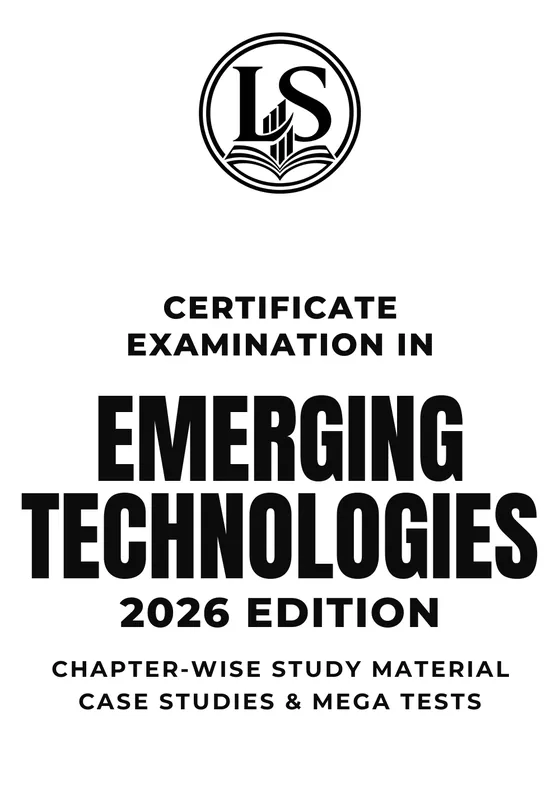
A plan needs one fixed sequence of material, otherwise you waste your best hour each night deciding what to read. The Emerging Technologies book is arranged in the same five modules and 20 chapters listed above, so the days in the table below map one-to-one to its chapter order.
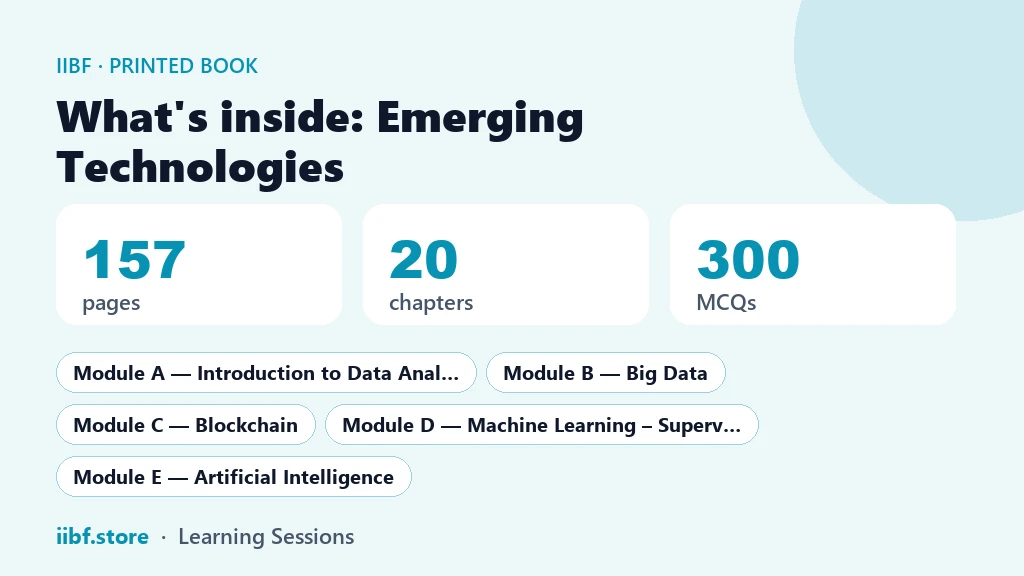
The book runs to 157 pages, which matters for tired readers: that is about eight pages a night across 20 chapters. It carries 300 MCQs, 30 case studies (120 questions) and 5 mega tests (500 questions). At the time of writing it is priced at ₹725 against an MRP of ₹2,398, but prices may change, so the book page is always the current word.
The 28-day Emerging Technologies study plan, day by day
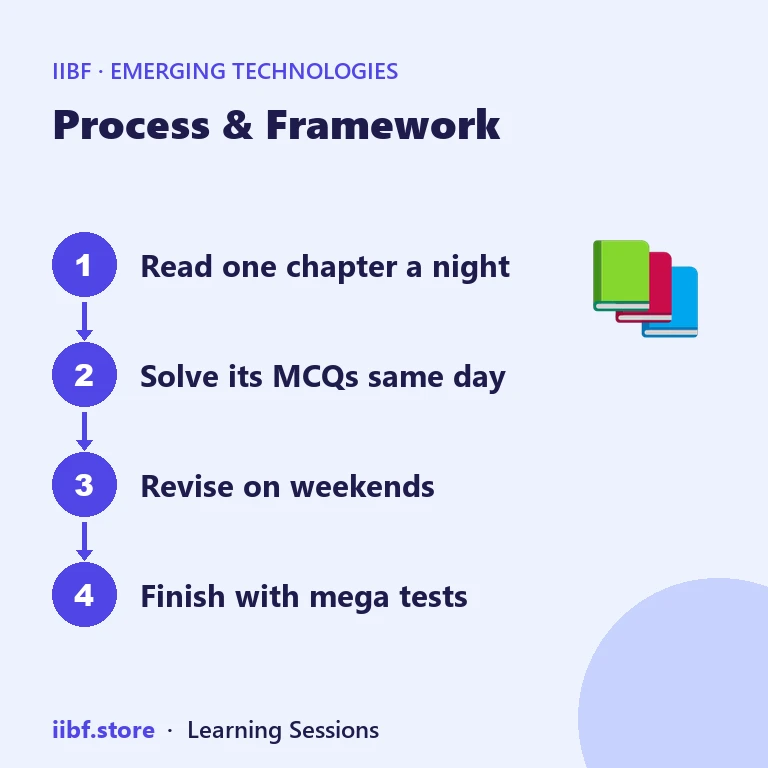
Assume 60 to 90 minutes on weekdays and a longer block on one weekend day. The logic is simple: one chapter per evening, solve that chapter's MCQs the same night, and keep fixed revision days after each cluster of modules. If you spread the 300 MCQs evenly, that is roughly 15 per chapter, which is a comfortable 20 to 25 minutes.
| Days | What to read | MCQ target |
|---|---|---|
| 1 to 4 | Module A, one chapter a day (value chain, storage and analytics types, reporting and AR/VR, tools and banking use) | All MCQs of that chapter, same night |
| 5 to 7 | Module B: Big Data and Hadoop, SQL and in-database analytics, Spark and banking use | All MCQs of that chapter, same night |
| 8 | Revision of Modules A and B (notes only, no new reading) | Redo the questions you got wrong |
| 9 to 11 | Module C: blockchain fundamentals, forks and ledgers, smart contracts and banking use | All MCQs of that chapter, same night |
| 12 to 17 | Module D: six Machine Learning chapters, one per day | All MCQs of that chapter, same night |
| 18 | Revision of Modules C and D | Redo the questions you got wrong |
| 19 to 22 | Module E: AI basics, CNN, RNN and LSTM, NLP and expert systems | All MCQs of that chapter, same night |
| 23 to 24 | The 30 case studies, about 15 a day | 120 case-based questions |
| 25 to 28 | Five mega tests, timed, with one rest or review slot | 500 questions across five tests |
How a single weekday evening should look
- First 10 minutes: skim the previous chapter's heading list. This is a cheap way to keep memory alive.
- Next 35 to 45 minutes: read the day's chapter. Underline definitions and lists. Do not copy notes by hand.
- Last 20 to 25 minutes: solve the chapter's MCQs. For every wrong answer, write one line on why.
That last step is where marks are made. A wrong answer you have explained to yourself rarely repeats.
Handling the heavy middle: Machine Learning in six nights
Days 12 to 17 are where most plans break, so treat them differently. Module D moves from the mathematical foundations to linear models, trees and support vector machines, clustering, dimensionality reduction and graphical models. Do not try to derive anything. Focus on three questions for every technique: what problem does it solve (prediction or grouping), is it supervised or unsupervised, and what is one banking use (credit scoring, fraud flags, customer segments).
If one night goes wrong, do not stretch the plan by a day. Use the next revision day to catch up, which is exactly why days 8 and 18 exist. This is the single most useful habit in any Emerging Technologies study plan: protect the buffer.
A one-page comparison sheet
Make a single page with two columns, supervised and unsupervised, and fill it as you finish chapters. Linear models, decision trees and support vector machines go on one side; clustering, K-means, mixtures and dimensionality reduction go on the other. Exam questions love to ask which technique belongs to which family.
Weekends: where the plan is won or lost
Use one weekend day for a longer block of 3 hours, split in two sittings with a proper break. Spend it on three things: the week's wrong-answer list, a quick re-read of definitions, and free practice. You can pair the book with the free mock tests at iibf.store/tests and the free PDFs at iibf.store/free-material to keep your practice varied without paying for more material.
If your weekend gets eaten by a branch duty, shift the block to the next weekday and cut the reading, not the MCQs. Reading can be thin; practice cannot.
The last week: case studies and mega tests
Days 23 and 24 are for the 30 case studies, which carry 120 questions. These train you to read a short banking scenario and pick the right technology or concept. Days 25 to 28 are for the five mega tests, 500 questions in all. Sit them timed, at the hour you would write the real paper if possible, and review every wrong answer before the next test.
One honest limit: a book alone will not give you exam-hall speed. Speed comes from timed practice, so treat the mega tests as rehearsals, not as extra reading. If a score is low, go back to the module the wrong answers cluster in, not to the whole syllabus.
If you have fewer than 28 days
Compress by doing two lighter chapters on weekday nights where the chapter is short, and keep both revision days. Remove days from the end of Module A and B only if you already work with data tools in your job. Never remove the case studies or at least two mega tests. A 21-day version of this Emerging Technologies study plan works if you can give 90 minutes every night; below that, extend the timeline instead of cutting practice.
For more preparation guides across papers, browse the iibf.store blog, and if you are comparing printed material across subjects, see the full books catalogue. A sample of this paper's book is also available on the book page, so you can judge the style before you order.
Your first three actions tonight
- Write the 28 days on a calendar and mark the two revision days and the weekend blocks first.
- Decide your fixed study slot and tell your family it is non-negotiable for four weeks.
- Open chapter one of Module A and finish only that chapter and its MCQs. Nothing more.
Four weeks of steady, boring evenings beat a two-day panic every time. Follow this Emerging Technologies study plan as written for the first week, then adjust to your own pace.
Frequently asked questions
Can I finish this paper in 28 days while working full time?
Yes, if you can give 60 to 90 minutes on most weekdays and one longer weekend block. The plan assumes one chapter per evening and keeps two revision days as buffer.
Do I need a technical background for Machine Learning and AI?
No. The paper tests concepts, where they fit and how banks use them, not coding or maths derivations. Focus on what each technique does and one banking example.
How many MCQs should I solve each day?
All the MCQs of the chapter you just read. Spread evenly, the 300 chapter MCQs come to roughly 15 per chapter, then the case studies and mega tests follow in the last week.
Where do I check the exam date and official syllabus?
On the official IIBF website. This article does not state dates or rules, as they can change between cycles.
Prefer revising from a printed book?
Chapter-wise books with MCQs after every chapter — minimal pages, complete coverage, delivered anywhere in India. Every book has a free sample to read first.














Practice this topic
Take a free mock test, download chapter PDFs, or watch a video class — all included on iibf.store.