CWMP Study Plan for Working Bankers: 9 Weeks, 71 Chapters
You reach home at eight, the branch targets are still ringing in your head, and the Certified Wealth Management Professional syllabus looks like three separate exams stitched together. Taxation, insurance, estate law, portfolio theory, retirement maths. Where do you even begin? This CWMP study plan is written for exactly that evening: tired, short on time, and wanting a clear answer to "what do I read tonight?"
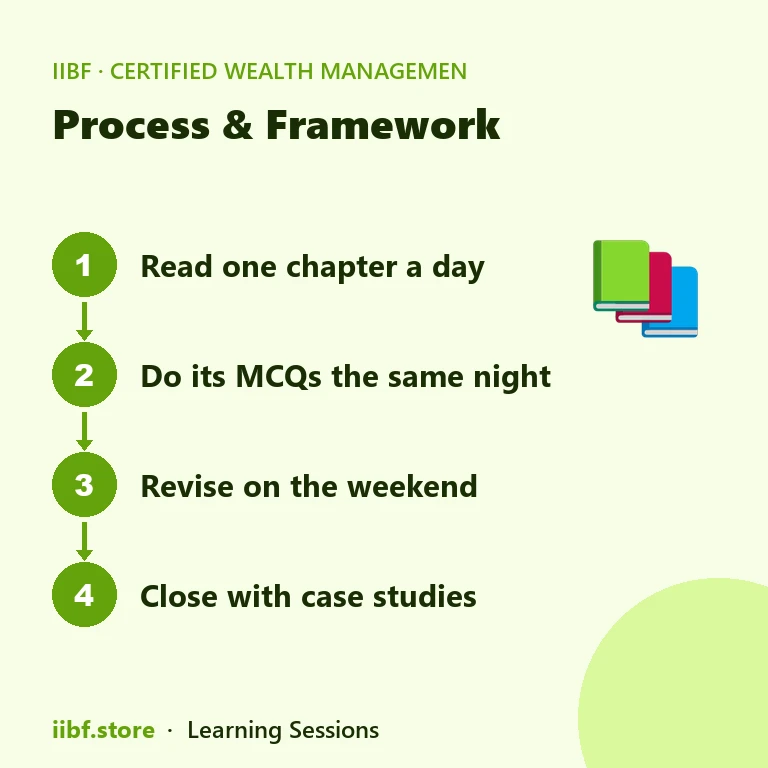
No plan survives contact with a full-time bank job unless it is small enough to do on a bad day. So we will build one around a single idea: one chapter, one set of questions, one short review. Nothing more heroic than that.
Why most CWMP study plans fail by week two
Most people plan from the top. They list every topic, divide by the days left, and get a schedule that assumes four free hours every night. By the second week a late audit, a customer escalation or a family function breaks the chain, and the plan quietly dies.
A workable CWMP study plan does the opposite. It starts from the smallest unit you can finish in one sitting, and it builds in slack. Three things matter:
- The unit is a chapter, not a topic. Chapters have a start and an end, so you get the feeling of finishing something every night.
- Questions come the same day. If you read on Monday and test on Saturday, you are re-learning, not testing. Attempt the chapter's MCQs while the reading is fresh.
- One day a week is a buffer. Sundays are for catching up, not for new material.
It also helps to know the scale before you start. The programme is organised into three papers, and the printed book mirrors that. Once you see the size of each block, the fear shrinks.
The shape of the syllabus in the book
The CWMP printed book runs to 536 pages and 71 chapters, split into eight modules across three papers:
- Paper 1, Module A, Financial Planning: 10 chapters, from the Indian economic environment and financial markets through time value of money, annuities, IRR and NPV, to behavioural finance.
- Paper 1, Module B, Taxation Planning: 13 chapters, from residency and salary through house property, capital gains, deductions and business income to international taxation.
- Paper 2, Module A, Investment Planning: 17 chapters covering risk, equity, bonds, derivatives, mutual funds, portfolio theory, asset allocation and alternative investments.
- Paper 2, Module B, Asset Management: 3 chapters on cash and credit management, financial modelling with ESG, and portfolio management services.
- Paper 2, Module C, Regulatory Environment, Compliance and Law: 6 chapters including the regulatory framework, customer service, grievance redressal and ethics.
- Paper 3, Module A, Risk Management and Insurance: 10 chapters on life, general and health insurance, regulators and intermediaries.
- Paper 3, Module B, Retirement Planning: 6 chapters, from retirement needs analysis to pension reforms and the Payment of Gratuity Act, 1972.
- Paper 3, Module C, Estate Planning: 6 chapters on wills, the Indian Succession Act, trusts, gifts and family arrangements.
What the book gives you to work with
Before we get to the table, here is exactly what you would be studying from. The 2026 edition is set out as three volumes, one for each paper, and the end-of-chapter practice is built in rather than sold separately.
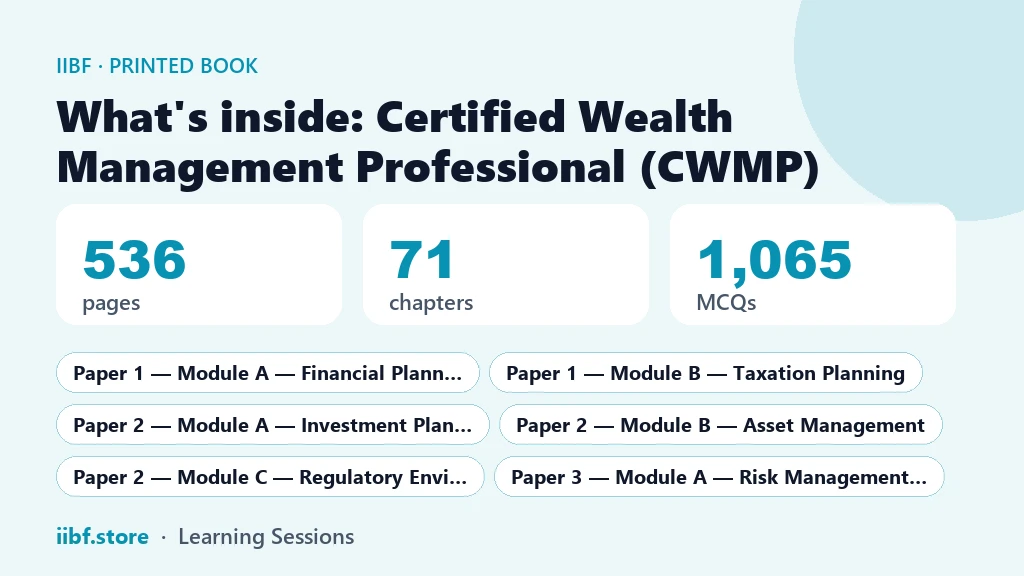
Averaged out, that is roughly 15 questions per chapter, which is a sensible size for a late-evening sitting: perhaps 20 to 25 minutes of reading focus, then the questions. On top of the chapter MCQs, the book includes 90 case studies (360 questions) and 15 mega tests (1,500 questions). Those matter at the end of your plan, not the beginning.
Is a printed book the right tool? For many working people, yes. There is no screen glare at 11 pm, no notification pulling you away, and you can annotate the margins. If you want to see the writing style first, the book page has a free sample you can read before deciding.
The nine-week CWMP study plan, day by day
The table below assumes you study five weekday evenings and one weekend session, with one weekend day left free. It allots time in proportion to chapter count, so the heavier modules (taxation and investment planning) get more days. Treat the day ranges as a guide, not a contract.
| Days | What to read | Chapters | Approx. MCQs |
|---|---|---|---|
| 1 to 8 | Paper 1, Module A: Financial Planning | 10 | about 150 |
| 9 to 20 | Paper 1, Module B: Taxation Planning | 13 | about 195 |
| 21 to 36 | Paper 2, Module A: Investment Planning | 17 | about 255 |
| 37 to 41 | Paper 2, Modules B and C: Asset Management; Regulation, Compliance and Law | 9 | about 135 |
| 42 to 50 | Paper 3, Module A: Risk Management and Insurance | 10 | about 150 |
| 51 to 56 | Paper 3, Modules B and C: Retirement Planning; Estate Planning | 12 | about 180 |
| 57 to 63 | Revision, 90 case studies, mega tests | all | case and mega questions |
Those MCQ figures are simply the book's 1,065 questions spread by chapter count, so expect small differences from chapter to chapter.
A realistic weekday evening
- Read one chapter. Pencil in hand. Mark every definition, formula and number you would not trust yourself to remember.
- Attempt the chapter's MCQs. Do not peek. A wrong answer found tonight is cheap; the same one found in the exam hall is not.
- Write three lines. What did I get wrong, and why? Keep it to three lines so you actually do it.
On the heavier days, such as the capital gains or insurance claims chapters, split the work: read tonight, questions tomorrow morning before the branch opens. The point is momentum, not purity.
How to handle each paper differently
Paper 1: numbers first, rules second
Financial planning and taxation reward practice more than reading. Time value of money, annuities, IRR and NPV only become comfortable after you have worked ten or fifteen examples by hand. In the taxation module, go slowly through residency and the heads of income, because everything later depends on them. A CWMP study plan that rushes these chapters will cost you in the computation questions.
Paper 2: breadth, then regulation
Investment planning is the largest block at 17 chapters, so it deserves its 16 days. Read for concepts first: risk, return, asset classes, portfolio theory. Then return to instruments and products. The regulatory and ethics chapters are shorter and more factual, which makes them ideal for a tired evening when you cannot manage anything heavy.
Paper 3: insurance vocabulary and legal structure
Insurance has a lot of terminology, so build a one-page glossary as you go. Retirement planning is calculation-friendly once you have finished Paper 1. Estate planning is the most legal of the lot: wills, succession, trusts and gifts. Slow down and read the requirements of a valid will twice.
The last week: where the extras earn their place
Days 57 to 63 are not for new reading. Use them like this:
- Days 57 to 59: Work through the 90 case studies, 360 questions in all. Cases test whether you can apply a concept to a client, which chapter MCQs alone do not.
- Days 60 to 62: Attempt mega tests from the set of 15, under a timer, in one sitting. Mark the topics that cost you marks and revisit those chapters.
- Day 63: Rest, skim your three-line notes, and sleep properly.
Be honest with yourself about one limit. A book alone will not give you exam-hall speed. Pair it with timed practice, and use the free mock tests at iibf.store/tests and the free PDFs at iibf.store/free-material to add variety. You can see the other titles at iibf.store/books if you are also looking at a second certificate.
If you fall behind
You will. Everyone does. The rule is simple: never double up. If you miss two evenings, do not read two chapters tonight. Slide the whole table forward and use your buffer day. If you lose a full week, drop the revision day, not the MCQs. Questions are what convert reading into marks.
For official details on the exam schedule, registration and syllabus for the upcoming exam cycle, always check the IIBF website. Dates and rules change, and this plan deliberately does not depend on them. More preparation guides are on the iibf.store blog.
Putting the plan into your week
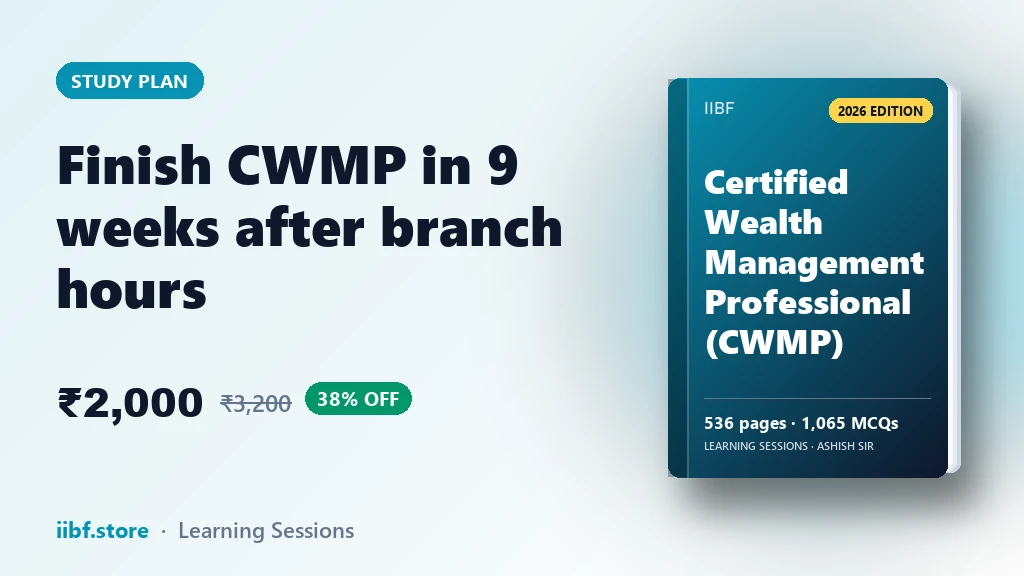
Pick a start date this weekend, mark the seven blocks on a calendar, and place the CWMP printed book where you will see it every evening. The book is listed at ₹2,000 against an MRP of ₹3,200 (38 percent off); prices may change, so the book page always has the current figure. A good CWMP study plan is not clever. It is small enough to survive your worst week at the branch, and that is what gets you to the last day.
Frequently asked questions
Can I finish the CWMP syllabus in nine weeks while working full time?
It is realistic if you keep to one chapter an evening and use weekends for catch-up. Nine weeks is a planning assumption, not an official timeline, so stretch the table if your job is heavy.
How many questions are there in the book?
There are 1,065 end-of-chapter MCQs across 71 chapters, plus 90 case studies (360 questions) and 15 mega tests (1,500 questions).
Which paper should I start with?
Start with Paper 1, because the time value of money and taxation ideas feed into the investment, retirement and estate chapters later. The table above follows the book's own order.
Is there a way to preview the book before ordering?
Yes, the book page has a free sample you can read first. Check the book page for the latest price and edition details.
Prefer revising from a printed book?
Chapter-wise books with MCQs after every chapter — minimal pages, complete coverage, delivered anywhere in India. Every book has a free sample to read first.






















Practice this topic
Take a free mock test, download chapter PDFs, or watch a video class — all included on iibf.store.