Customer Service in Banks Study Plan for Working Bankers
It is 9:30 pm. The branch closed hours ago, the cash tallied late, and you still have a certificate paper waiting. You open the syllabus, see six areas covering products, relationships, behaviour, regulation and ethics, and close it again. If that sounds familiar, this Customer Service in Banks study plan is written for you.
It assumes you can give 60 to 90 minutes on weekdays and a longer block on Sunday. Nothing here needs a coaching class or a month of leave. It needs a fixed order, a small daily target and honest revision. Take the method even if you never buy anything from us.
Why this paper feels harder than it is
Customer service looks like the easy paper. You do it every day at the counter, so you assume you will manage. That assumption is exactly what makes people lose marks. The exam does not ask whether you are polite to customers. It asks you to name a regulatory idea, pick the right grievance route, or choose the correct ethical response among four answers that all sound sensible.
The paper is wide rather than deep. You move from banking products to relationship management, then to soft skills, then to rules and ethics. A tired mind handles this badly if you read randomly. It handles it well if you give each area its own block of days and test yourself straight after reading.
Three habits that decide the result
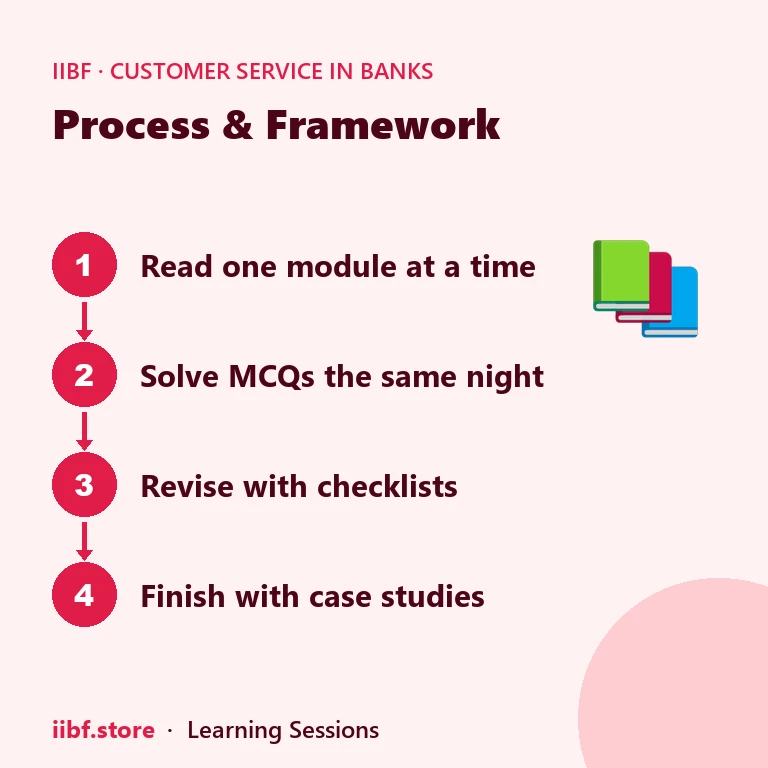
- One module at a time. Finish an area before you open the next. Hopping between topics feels productive and leaves nothing behind.
- MCQs the same night. Reading without questions gives you the feeling of knowing. Questions show what you actually know.
- A wrong-answer notebook. Write only the questions you got wrong, one line each. That notebook is your last-week revision.
Before you fix dates, check the official schedule and syllabus notice on the IIBF website. We deliberately do not quote dates here, because they change from cycle to cycle. Plan backwards from whatever the upcoming exam cycle shows.
How the Customer Service in Banks study plan is built
The plan below follows the order of the Customer Service in Banks book, because a fixed order removes the daily question of what to study today. That question alone eats ten minutes of a tired evening.
The book is organised into six modules. Module A covers banking as a service proposition, with five chapters on products, service design, channels, banking as a service with fintech partnerships, and EASE 7.0. Module B is customer service as a business strategy, with ten chapters on relationships, CRM, service-quality models, feedback and grievances, digital fraud and data governance, branch and controlling-office service, and financial inclusion. Module C covers behavioural aspects across seven chapters, from the customer-first approach and etiquette to difficult customers and conflict handling.
Module D deals with legal and regulatory guidelines in six chapters: fair practices and customer rights, KYC and AML, service committees, digital-banking consumer protection, grievance redress, and MSME customer service. Module E has two chapters on ethics, reputation risk, suitability and mis-selling. Module F holds three revision chapters: comparisons and checklists, service terms in simple language, and a regulatory-dates chapter.
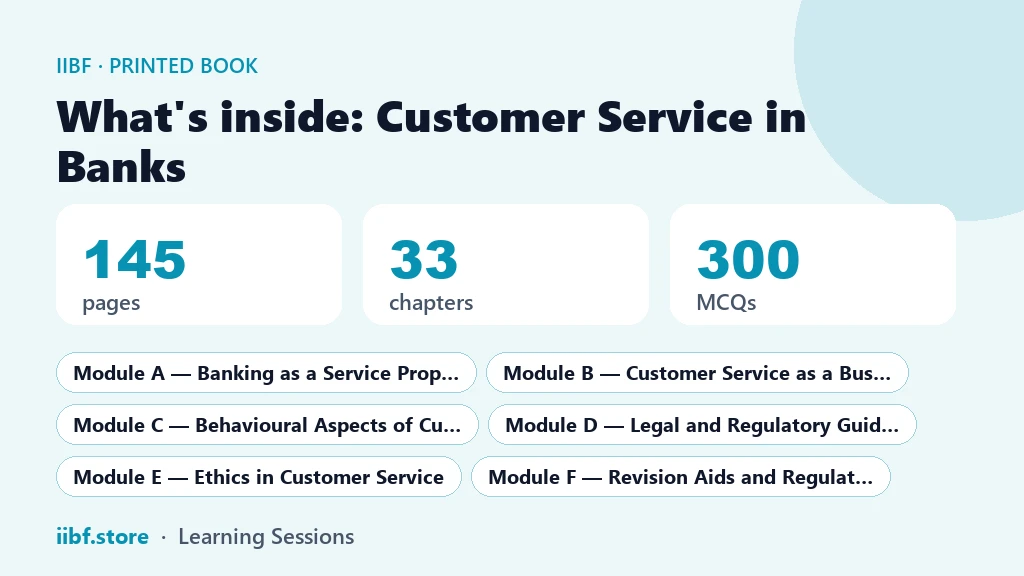
That is 33 chapters and 300 questions in 145 pages, so the average works out to about nine questions per chapter. The printed 2026 edition also lists 30 case studies carrying 120 questions and 5 mega tests carrying 500 questions as extras. Use the numbers to size your daily targets, not to scare yourself. A chapter is short enough to finish in one evening.
The 28-day schedule, module by module
Here is the Customer Service in Banks study plan as a table. The MCQ column is an approximate share of the book's 300 questions, worked out from the chapter count. Treat it as a target, not a rule.
| Days | What to read | MCQs to solve (approx.) |
|---|---|---|
| 1 to 4 | Module A: five chapters on products, service design, channels, fintech partnerships, EASE 7.0 | About 45 |
| 5 to 11 | Module B: ten chapters on relationships, CRM, service-quality models, grievances, fraud, inclusion | About 90 |
| 12 to 16 | Module C: seven chapters on behaviour, etiquette, communication, difficult customers | About 63 |
| 17 to 21 | Module D: six chapters on fair practices, KYC and AML, committees, digital protection, grievance redress, MSME | About 54 |
| 22 to 23 | Module E: ethical dilemmas, suitability and mis-selling cases | About 18 |
| 24 to 25 | Module F: comparisons, checklists, service terms, regulatory dates | About 27 |
| 26 to 28 | Case studies, then mega tests, then your wrong-answer notebook | Case-study and mega-test questions |
Notice the shape. Module B gets the longest block because it has the most chapters, while Module E gets two days because it has only two. You are not giving every area equal time. You are giving each area time in proportion to what is in it.
What one weekday evening looks like
A plan only works if a tired person can follow it at 10 pm. So keep the evening small and the same every day.
The 75-minute evening
- 35 minutes: read one or two chapters from the current module. Read once, with a pencil, and underline only definitions, names of schemes or frameworks, and any rule that has a number or a time limit.
- 25 minutes: solve that chapter's MCQs without looking back. Mark every guess, including the ones you got right.
- 10 minutes: check answers, then write each wrong or guessed question in your notebook in one line, with the reason.
- 5 minutes: close the book and say aloud what the chapter was about. If you cannot, read the first paragraph again tomorrow.
On Sunday, replace one weekday with a longer revision block. Re-read your notebook for the week, then redo only the questions in it. Skip anything you already know cold. This single habit is what separates people who finish the syllabus from people who finish it and forget it.
If you miss a day
You will. A late audit, a customer rush, a family function. Do not squeeze two days into one night. Add the missed day at the end of that module and move the later blocks by one day. A 28-day plan that slips to 31 days is still a plan. A plan abandoned on day nine is not.
How to study each type of chapter
Not every module deserves the same reading style. Adjusting your method saves hours.
Module A and B: build the vocabulary
These modules are full of terms and models. Make a one-page glossary as you go: the term, one line of meaning, one example from your own branch. Examples from your own counter stick far better than textbook ones. For topics such as grievances and digital fraud, link each concept to something you have seen happen.
Module C: do not skip it
Behavioural chapters feel soft, so candidates skim them. But the questions are usually scenario-based, and the right answer is the one that fits the customer-first approach and the professional standard, not the one that is merely kind. Read the options slowly. Two answers will look right; the better one usually protects both the customer and the bank.
Module D: slow down for the rules
Legal and regulatory chapters carry the facts that can be marked wrong outright. Read these with the official source open in another tab. The IIBF site and the regulator's own notices are the final word if anything in any book or video seems unclear. Regulations are updated, so always confirm current wording before the exam.
Module E and F: use them as glue
Ethics cases test judgement across everything you read before. Module F then compresses the whole paper into comparisons and checklists, which makes it ideal for your final week. Do not read Module F first; it only works once the earlier modules are in your head.
The last three days: case studies and mega tests
By day 26 you have read every chapter once and solved the chapter MCQs. Now switch from learning to exam behaviour. Work through the case studies first. They teach you to read a long scenario, pick out the facts that matter and ignore the decoration.
Then attempt the mega tests, one per sitting where you can. Keep to a timer. Afterwards, spend more time on the wrong answers than on the test itself. A mock you do not review is just a way to feel busy. If you want extra practice beyond the book, our free mock tests and the free study material are open to everyone, and the blog has shorter explainers on common weak topics.
One honest limit: a printed book will not give you exam-hall speed by itself. Speed comes from timed practice, so pair whatever you read with mocks in the final week. The Customer Service in Banks study plan above gives you coverage and recall; the mocks give you rhythm.
Where the printed book fits in this plan
The plan works with any good material, but it was designed around the structure of the Customer Service in Banks printed book. That book is 145 pages in the 2026 edition, priced at ₹725 against a printed MRP of ₹2,398. Prices can change, so the book page is always the current source. A free sample is available on the book page if you want to check the writing style before deciding.
Why print for this paper? Because you will mark it, underline it and carry it in the metro or on a branch lunch break. A phone screen invites notifications at the exact moment you are trying to remember the difference between two grievance routes. Paper does not. If you want to compare it with other titles, the full range sits on the books page.
If you are also working on other certificates, you can browse the wider CAIIB material too, but finish one paper at a time. Splitting your evenings across two subjects is the surest way to pass neither.
Final checklist before you start
- Check the upcoming exam cycle and syllabus on the official IIBF website, then count back 28 days.
- Fix one study slot and protect it. Same time, same chair, phone away.
- Keep one notebook for wrong answers and nothing else.
- Finish each module before opening the next.
- Book your last three days for case studies and timed mocks.
The best Customer Service in Banks study plan is the one you will still be following on day 20, when the novelty has gone and the branch is busy. Keep it small, keep it in order, and start tonight with Module A, chapter one.
Frequently asked questions
Is 28 days enough for a working banker?
For most people studying 60 to 90 minutes a day, yes, provided you follow a fixed order and revise from your wrong-answer notebook. If your job is heavy this month, stretch it to 35 days and keep the module order unchanged.
How many questions are in the book?
The book carries 300 questions across 33 chapters, plus 30 case studies with 120 questions and 5 mega tests with 500 questions. The chapter-wise targets in this plan are averages based on those totals.
Can I skip the behavioural module?
No. Behavioural and ethics questions are scenario-based, and they are easy to lose by assuming common sense will be enough. Give Module C its five days.
Where do I find the official exam dates?
Always use the IIBF website, www.iibf.org.in, for the schedule, syllabus and any rule changes for the upcoming exam cycle.
Prefer revising from a printed book?
Chapter-wise books with MCQs after every chapter — minimal pages, complete coverage, delivered anywhere in India. Every book has a free sample to read first.


















Practice this topic
Take a free mock test, download chapter PDFs, or watch a video class — all included on iibf.store.