Operational Risk Management Study Plan for Bankers With a Full-Time Job
You reach home at eight, the branch targets are still ringing in your head, and the syllabus on the desk looks endless. Operational risk does not even feel like a subject you can "just read" - it is loss events, frameworks, committees and capital formulas all mixed together. If that is you, a sensible Operational Risk Management study plan matters more than another set of notes.
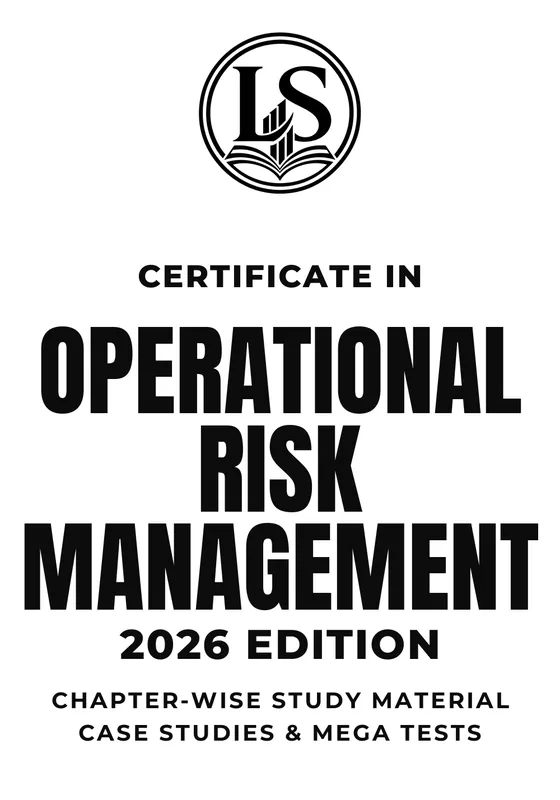
This article gives you a plan you can follow with a full-time job: how to split the paper, how many hours to expect, and how to use MCQs so that your reading actually sticks. You can use it with any material you already have. Where it helps, I will show how the plan fits the chapter order of the Operational Risk Management book from iibf.store.
Why a plan beats "I will study when I get time"
Working bankers rarely fail because they are not smart. They fail because study happens in broken pieces: forty minutes on Tuesday, nothing on Wednesday, a panicked Sunday. By the time you return to Chapter 3, Chapter 1 has gone.
A good Operational Risk Management study plan does three things:
- It fixes the order, so you never waste a tired evening deciding what to open.
- It keeps each sitting small enough to finish, which protects your motivation.
- It puts practice questions right next to the reading, so you find gaps early and not in the exam hall.
Before you start, check the official exam schedule and syllabus on the IIBF website. Work backwards from your date. The plan below is a four-week template; stretch it to six weeks if your branch is in audit or closing season.
Know the paper before you plan it
Operational risk is the risk of loss from failed processes, people, systems or external events. The paper is easier when you see it as four stories rather than 24 separate chapters:
- Module A - Evolution of Risk Management and Operational Risk Frameworks. What risk is, what operational risk is, how regulators responded, and the framework (ORMF) and its link to enterprise risk management.
- Module B - Governance, Identification and Assessment. Culture, event classification, loss data and root cause analysis, RCSA, risk appetite and scenario analysis.
- Module C - Mitigation, Controls, Metrics, Measurement and Capital. Internal control and risk focused internal audit, KRI/KPI/KCI, change management, measurement and the capital charge.
- Module D - Operational Resilience, Continuity, Third-Party, ICT and Climate Risk. Resilience framework, BCP, incident management, third-party dependency, ICT and cyber security, and climate risk.
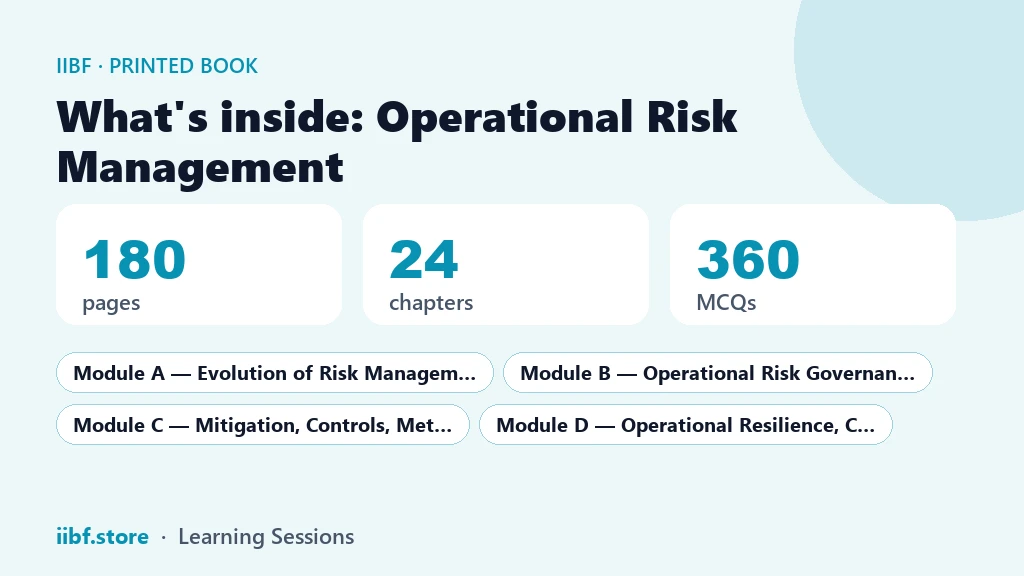
The printed book follows exactly this structure: 24 chapters across the four modules, 180 pages in the 2026 edition, with 360 end-of-chapter MCQs - 15 per chapter on average. That ratio is useful for planning, because it tells you each chapter is a small, finishable unit.
Your time budget
Be honest about hours. Most bankers can manage 60 to 90 minutes on a weekday and 3 to 4 hours on a Saturday or Sunday. Over four weeks that is roughly 45 to 55 hours - enough for one careful pass plus revision of a 180-page paper, if you do not waste it on re-reading the same pages.
The four-step method that works after branch hours
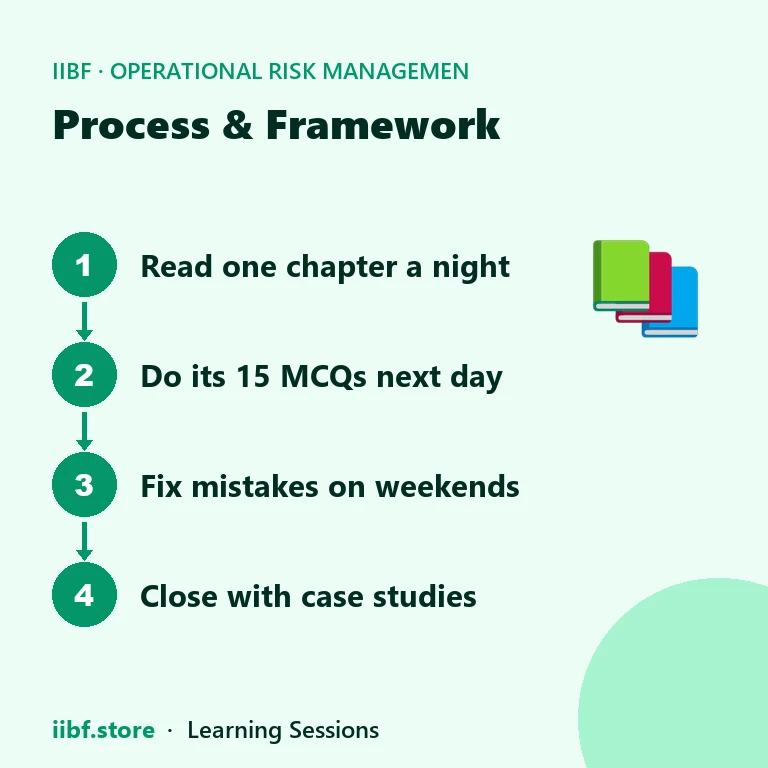
Every weekday evening follows the same loop, so you spend energy on learning and not on deciding:
- Read one chapter (30 to 45 minutes). Underline definitions and lists. In operational risk, lists are marks: the seven event types, the pillars of a framework, the three lines of defence.
- Close the book and write five lines from memory. If you cannot, read it once more.
- Do the chapter MCQs the next day, not the same night. A gap of a few hours tests memory and not short-term recall.
- Log mistakes in a small notebook. Weekends are for those mistakes only.
Day-wise Operational Risk Management study plan (28 days)
Here is the table. It assumes about 6 chapters per module and one chapter per working evening. MCQ counts use the book's 15-per-chapter average; do all of them in the first pass, because that is how you find weak chapters.
| Days | What to read | MCQs |
|---|---|---|
| Days 1-7 | Module A, Chapters 1-6: risk evolution, nature of risk, operational risk concepts, regulatory response, ORMF, ERM | About 90, plus Sunday mistake review |
| Days 8-14 | Module B, Chapters 7-12: governance and culture, event classification, loss data, RCSA, risk appetite, scenario analysis | About 90, plus Sunday review |
| Days 15-21 | Module C, Chapters 13-18: mitigation, internal control and RFIA, KRI/KPI/KCI, change management, measurement, capital charge | About 90, plus Sunday review |
| Days 22-26 | Module D, Chapters 19-24: resilience, BCP, incident management, third-party, ICT and cyber, climate risk | About 90 across 5 days, 1 to 2 chapters on weekends |
| Days 27-28 | Mistake notebook, case studies, one full mock test | Case-study questions and a timed set |
Module A: build the vocabulary (days 1-7)
Go slowly here. Module A sets the language for everything else - operational risk versus credit and market risk, the regulatory background, and how the framework sits inside enterprise risk management. If a term is fuzzy now, Module B will feel like fog.
Module B: the working tools (days 8-14)
RCSA, loss data, risk appetite and scenario analysis are the tools operational risk teams actually use. Link each to something you have seen in a branch: a fraud, a failed NEFT batch, a staff-related error. Examples from your own work become your memory hooks.
Module C: controls and numbers (days 15-21)
This is the heaviest module because it adds measurement and the capital charge. Do not skip the numeric parts; read them twice and solve every related MCQ. If you are weaker with formulas, give the capital charge chapter an extra evening from your buffer.
Module D: resilience and modern risks (days 22-26)
Business continuity, incident management, third-party dependency, cyber security and climate risk are topical, so questions here often test understanding more than pure recall. Read for "why does the regulator care" rather than memorising lines.
Where the book fits, and where it does not
The Operational Risk Management printed book is priced at ₹725 against an MRP of ₹2,398 (70% off); prices may change, so the book page is always current. Beyond the 24 chapters and 360 MCQs, it includes 30 Case Studies (120 questions) and 5 Mega Tests (500 questions). In the plan above, the case studies belong in your last two days and the mega tests in any extra weeks you add. A free sample is available on the book page if you want to check the style before ordering.
One honest limit: a book alone will not give you exam-hall speed. Pair it with timed practice from the free mock tests, and look through the free study material for revision sheets. Other titles are listed on the books page.
How to protect the plan when life interferes
Some days will fail. A late customer, a surprise inspection, a sick child. Build for that.
- Keep a buffer day each week. Sunday is already your catch-up day; treat it as flexible.
- Never skip the five-line recall. If you only have 20 minutes, do recall and MCQs, not fresh reading.
- Do not restart. Missed Day 9? Continue with Day 10 and absorb the missed chapter on the weekend.
- Study the same time daily. A fixed slot, such as 9 to 10:15 pm, removes the daily argument with yourself.
More preparation guides are on the iibf.store blog if you want to see how other papers are planned.
Your first three days
Do not wait for a perfect Monday. Tonight, check your exam window on the IIBF site, pick your 28-day start date, and read Chapter 1. Tomorrow, do its MCQs and note what you got wrong. On Day 3, repeat the loop. By Sunday you will have a rhythm and a mistake notebook, and that is the real start of any Operational Risk Management study plan. Pace beats panic.
Frequently asked questions
Can I finish this paper in less than four weeks while working?
Possible, but only if you can give two chapters a day and your branch load is light. For most bankers, four weeks is realistic and six weeks is comfortable. Compressing further usually means skipping MCQ review, which is where marks are saved.
How many MCQs should I solve per chapter?
Do all of them in the first pass. The book has 360 across 24 chapters, so about 15 each. Redo only the ones you got wrong during weekend review.
Which module is hardest?
Most candidates find Module C hardest because it combines internal control with measurement and the capital charge. Give it your best evenings and the buffer days.
Where do I find the official exam schedule?
Always use the IIBF website at www.iibf.org.in for dates, eligibility and syllabus. This plan is built around the book's chapter order, not around any specific exam date.
Prefer revising from a printed book?
Chapter-wise books with MCQs after every chapter — minimal pages, complete coverage, delivered anywhere in India. Every book has a free sample to read first.

















Practice this topic
Take a free mock test, download chapter PDFs, or watch a video class — all included on iibf.store.