Microfinance Exam Study Plan for Working Bankers: 21 Days

It is 9 pm. You have closed the branch, finished the pending vouchers, travelled home and eaten something. The certificate form is on your phone, the syllabus looks like a mountain, and you have already postponed once. If that sounds familiar, this article is for you. A good Microfinance exam study plan does not ask for six hours a day. It asks for about two hours, every day, in the right order.
Below is a 21-day schedule built for someone who works a full shift. You can follow it with any material you trust, but I have tied it to the chapter order of one specific book so that every day has a clear job. Even if you never buy anything, the method and the table will work for you.
Why a Microfinance exam study plan fails for most working bankers
Most people do not fail because the subject is hard. They fail because the plan was never realistic. Three patterns repeat again and again.
- The big-bang plan. "I will study four hours daily from Monday." By Wednesday there is an audit, a customer escalation or a family function, and the plan is dead.
- The reading-only plan. You read every chapter twice and attempt zero questions until the last week. The exam is a test of recognising the right option in a few seconds, not of how many pages you have turned.
- The random-order plan. Jumping between topics means you never build the story: why microfinance exists, how it is delivered, how it is regulated, and how an institution keeps itself sustainable.
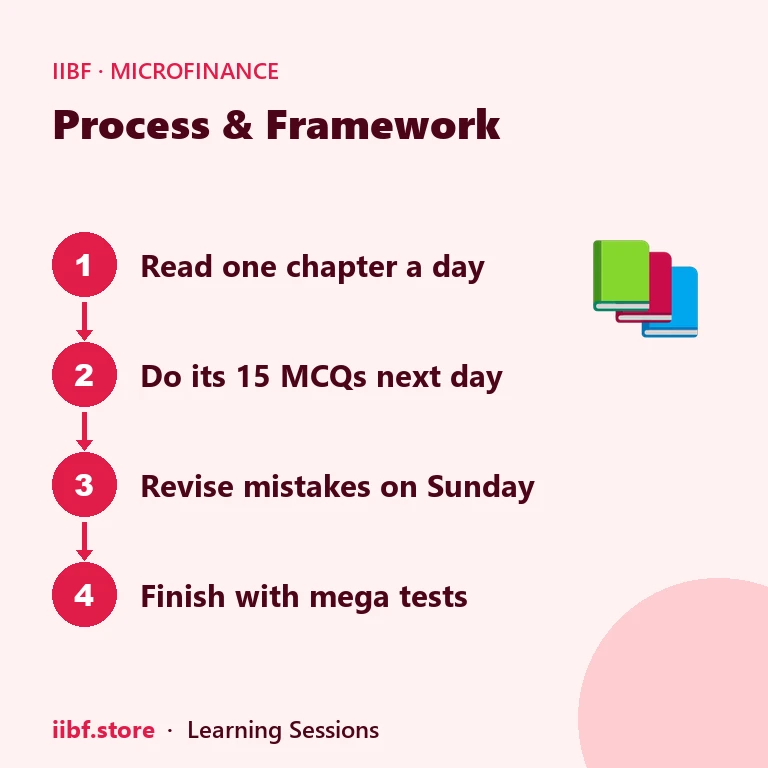
The fix is small and boring: one chapter a day, questions the next evening, one revision slot a week, and tests at the end. That is the whole idea behind this Microfinance exam study plan.
How much time do you really need?
Count your own week honestly. Most branch staff can find 90 to 120 minutes on weekdays and a longer block on Sunday. That is enough. A plan that fits your worst week will survive your best one.
The shape of the paper: two modules, eighteen chapters
Before you plan days, know what you are planning for. The Microfinance printed book for the IIBF certification is organised into two modules, and that structure is a gift to a time-starved student because each module has its own flavour.
Module I: Perspectives in Microfinance (10 chapters)
This is the conceptual half. It starts with poverty and rural credit, goes through the basics of banking, explains why and what microfinance is, and then covers delivery methodologies. It moves on to the regulatory framework, how microfinance evolved in India, recent developments, and three chapters on financial inclusion, including measuring the impact of microfinance. Expect plenty of definitions, institutions and timelines here. Read it as a story, not as a list.
Module II: Operational Aspects of Microfinance (8 chapters)
This is the working half: financial products and services (two parts), financial accounting and reporting (two parts), revenue models, profitability, efficiency and productivity (two parts), risk management, and compliance to various regulations. If you work in a rural or semi-urban branch, much of this will feel familiar. If you sit in a metro corporate branch, give it extra time.
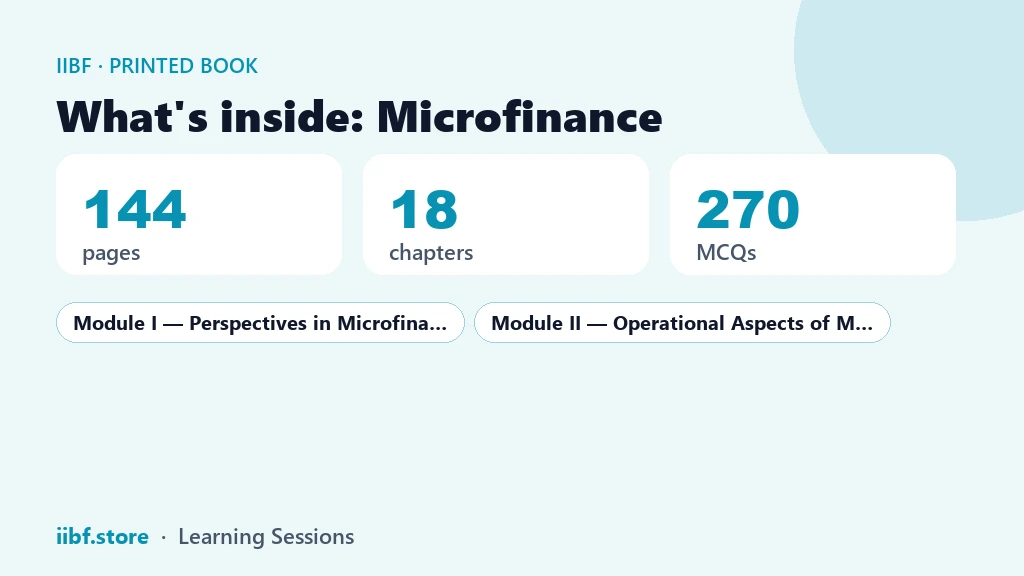
Numbers matter for planning. The book runs to 144 pages, 18 chapters and 270 end-of-chapter questions, which works out to roughly 15 questions per chapter on average. Eight pages and fifteen questions a day is a load you can carry after work. On top of that, the book lists 30 case studies (120 questions) and 5 mega tests (500 questions) for the final stretch. You can read more on the book page, including a free sample.
The 21-day Microfinance exam study plan, day by day
Here is the schedule. Each block is three days: the chapter you read that day, plus the questions of the previous chapter. Eighteen chapters take 18 days; the last three days are for revision and tests. Treat the dates as relative, not as the exam calendar, which you should always take from the official site.
| Days | Read (chapters) | MCQs to attempt |
|---|---|---|
| 1 to 3 | Poverty and Rural Credit; Basics of Banking; Why and What is Microfinance? | About 45 |
| 4 to 6 | Delivery Methodologies; Regulatory Framework; Evolution and Characteristics in India | About 45 |
| 7 to 9 | Recent Developments; Financial Inclusion Part 1 and Part 2 | About 45 |
| 10 to 12 | Financial Inclusion through Banks and Impact; Financial Products and Services Part 1 and Part 2 | About 45 |
| 13 to 15 | Financial Accounting and Reporting Part 1 and Part 2; Revenue Models Part 1 | About 45 |
| 16 to 18 | Revenue Models Part 2; Risk Management; Compliance to Various Regulations | About 45 |
| 19 to 21 | Revision of marked mistakes, case studies, then mega tests | Case studies and mega tests |
The MCQ counts are averages from the book's 270 chapter questions divided across 18 chapters, so some chapters will have a few more and some a few fewer.
What a single weekday looks like
- First 20 minutes: attempt yesterday's chapter questions without looking at the book.
- Next 60 minutes: read today's chapter once, slowly, with a pencil. Mark only what surprised you.
- Last 15 minutes: write three lines in your own words on what the chapter said. If you cannot, read the first page again tomorrow.
How to use the MCQs so they actually teach you
Questions are not a scoreboard; they are a diagnostic. When you get one wrong, do not simply read the answer and move on. Ask which of three things happened: you did not know the fact, you knew it but misread the option, or you guessed. Tag each mistake in the margin with K, M or G.
After a week you will see a pattern. Many bankers find that most of their mistakes are of one type, usually misreading, and that is fixable with a calmer pace rather than more reading. This is also why attempting questions the day after reading works better than the same evening: you are testing memory, not short-term echo.
Use free practice alongside the book
Do not rely on a single source for questions. The free mock tests on iibf.store and the free study material are worth adding in the last week, because they show you how unfamiliar wording feels.
Weekends, revision and the final three days
Sundays are for repair, not for new chapters. Take your K, M and G marks from the week and redo only those questions. Thirty minutes of redoing mistakes beats two hours of rereading chapters you already understand.
Days 19 to 21 are for the case studies and the mega tests. The book lists 30 case studies (120 questions) and 5 mega tests (500 questions). You will probably not finish all five mega tests in three days, and that is fine. Take one under timed conditions, review it properly, and use the rest in whatever time remains before your slot.
An honest limit
A book alone will not give you exam-hall speed. Timed practice does that, so pair any printed material with mock tests. Also, verify the exam pattern, eligibility and schedule on the official IIBF website before you fix your dates. Rules change, and this article does not replace the official notice.
Is a printed book the right tool for this plan?
A printed book suits this plan for a boring reason: no notifications. On a phone, the next WhatsApp message is one swipe away. A 144-page book on your table at night does one thing only. If you prefer screens, that is a valid choice too; what matters is that your tool does not compete with your attention.
If you decide to buy, the Microfinance book is listed at ₹725 against an MRP of ₹2,398. Prices can change, so check the Microfinance book page for the current price, and see the full books list if you are preparing for more than one paper. The blog has more plans for other papers.
Your Microfinance exam study plan, in one paragraph
Pick a start date this week. Read one chapter a night for 18 nights, attempt its questions the next evening, redo your mistakes on Sundays, and spend the last three days on case studies and a mega test. That is the entire Microfinance exam study plan. It is not glamorous, but it is the kind of plan a tired banker can actually finish, and finishing is what clears the paper.
Frequently asked questions
Can I finish Microfinance in 21 days while working full time?
For most people, yes, if you can give about two hours on weekdays and a longer block on Sunday. The book has 144 pages across 18 chapters, so the daily reading load is small. If you miss a day, shift the whole plan by a day instead of doubling up.
Should I read all chapters before attempting questions?
No. Attempt each chapter's questions the evening after you read it. That is how you find your weak points early, while there is still time to fix them.
How many MCQs does the book have?
The book has 270 end-of-chapter questions across 18 chapters, plus 30 case studies (120 questions) and 5 mega tests (500 questions).
Where do I check the official exam schedule and rules?
Always use the official IIBF website at iibf.org.in for the schedule, eligibility and exam pattern. Do not depend on any third-party article for dates.
Prefer revising from a printed book?
Chapter-wise books with MCQs after every chapter — minimal pages, complete coverage, delivered anywhere in India. Every book has a free sample to read first.


















Practice this topic
Take a free mock test, download chapter PDFs, or watch a video class — all included on iibf.store.