ESG in Banking: A Complete Guide for the IIBF Ethics Exam
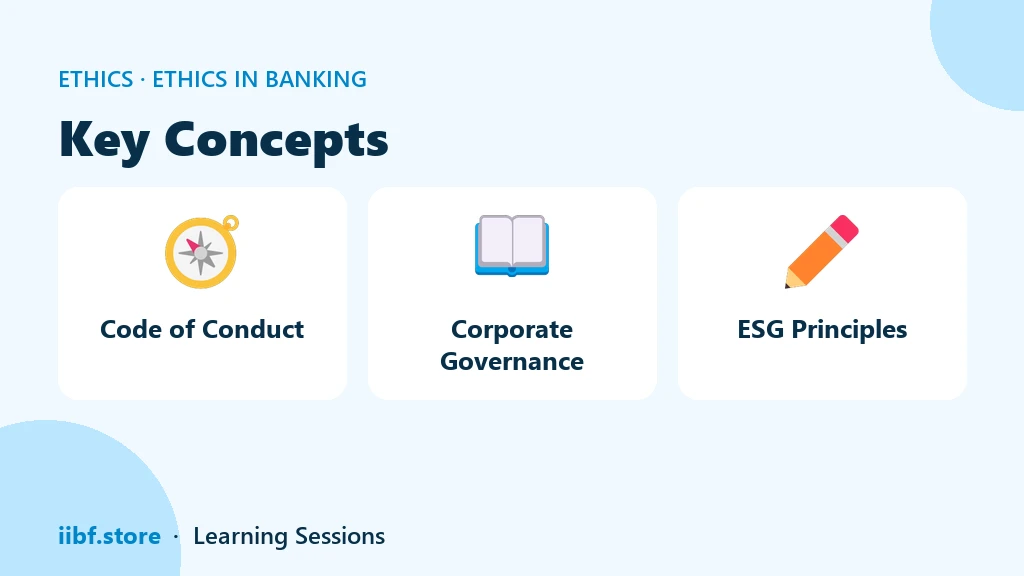
ESG in banking has moved from a boardroom talking point to a core competency that the IIBF Ethics in Banking course now expects every candidate to understand. ESG stands for Environmental, Social and Governance — a framework banks use to measure how responsibly they lend, invest and operate. For the exam, ESG in banking is not a soft topic: it ties directly into environmental ethics, corporate responsibility, disclosure obligations and the ethical foundations that the syllabus tests. This guide explains what ESG means for an Indian banker, why the Reserve Bank of India and SEBI are steadily formalising it, and how the concept connects to the ethical principles you will be examined on. Master this and you gain marks in the ethics paper while genuinely understanding where the profession is heading.
What ESG in banking actually means
At its heart, ESG in banking is the discipline of judging a bank — and the borrowers a bank finances — on three dimensions rather than profit alone. The Environmental pillar asks how lending affects climate, pollution, water and biodiversity: does the bank finance high-emission projects, and does it price climate risk into credit decisions? The Social pillar covers how the institution treats employees, customers and the communities it serves, including fair lending, financial inclusion, data privacy and labour standards. The Governance pillar — the one closest to the ethics syllabus — concerns board independence, transparency, internal controls, anti-corruption safeguards and the honesty of disclosures.
For a banker, ESG is not charity; it is risk management. A borrower that pollutes a river faces regulatory shutdown, a reputational borrower that mistreats staff faces litigation, and a poorly governed company faces fraud — all of which become the lender's credit risk. This is exactly why ESG sits inside an ethics course: it operationalises abstract values like honesty, fairness and stewardship into measurable lending practice. The IIBF chapter on Environmental Ethics lays the philosophical groundwork — that a bank owes duties beyond its shareholders — and ESG is the practical machinery that delivers on that duty.
Why ESG matters for Indian banks and the exam
Indian regulators have made responsible finance a structured expectation rather than a voluntary gesture. SEBI's Business Responsibility and Sustainability Reporting (BRSR) framework requires the country's largest listed companies — which include major banks — to disclose their environmental and social performance in a standardised format, and a BRSR Core with assurance now applies to the top listed entities on a phased basis. The Reserve Bank of India has issued a Framework for Acceptance of Green Deposits and released a discussion paper on climate risk and sustainable finance, signalling that climate-related financial risk is becoming part of prudential supervision. India's own Sovereign Green Bonds, first issued in 2023, show the sovereign borrowing specifically to fund green projects.
For the Ethics in Banking exam, you should be able to explain why these rules exist, not merely list them. ESG regulation exists because information asymmetry — where a borrower hides its true environmental or governance record — is an ethical failure that markets cannot correct on their own. Disclosure frameworks force honesty; assurance forces verification. Understanding this logic is what separates a rote answer from a strong one. The evolving nature of these expectations is captured well in the chapter on Banking Ethics — Changing Dynamics, which frames sustainability as part of the profession's shifting duty to society. You can test your grasp of these ideas on the full-length mocks at iibf.store/tests.
The three pillars mapped to banking practice
The clearest way to remember ESG for the exam is to map each pillar to concrete banking actions and to the regulator that oversees it. Environmental factors show up as green deposits, climate-risk stress testing and refusing to finance projects that breach environmental clearances. Social factors appear as priority-sector lending, grievance redressal, fair recovery practices and protecting customer data under the Digital Personal Data Protection Act, 2023. Governance factors surface as board committees, related-party disclosure, whistle-blower channels and audit independence — the very controls that prevent the frauds and mis-selling scandals ethics courses study.
The table below summarises the mapping. Note how governance, the pillar most tested in an ethics paper, underpins the other two: without honest boards and reliable disclosure, environmental and social claims cannot be trusted.
| Pillar | What it covers | Banking example | Key Indian reference |
|---|---|---|---|
| Environmental | Climate, pollution, resource use | Green deposits; climate risk in credit appraisal | RBI Green Deposits Framework (2023) |
| Social | Customers, staff, communities | Financial inclusion; fair recovery; data privacy | DPDP Act, 2023; RBI Fair Practices Code |
| Governance | Board, controls, disclosure | Whistle-blower channels; audit independence | Companies Act, 2013; SEBI LODR |
| Reporting | Standardised sustainability disclosure | Annual BRSR filing with assurance | SEBI BRSR / BRSR Core |
How ESG connects to the ethics you are tested on
ESG is not a separate subject bolted onto the syllabus — it is applied ethics. Every ESG requirement traces back to a principle the Ethics in Banking course already teaches: honesty (accurate disclosure), fairness (equitable treatment of stakeholders), stewardship (protecting the environment for future generations) and integrity (governance that resists corruption). When a bank green-washes — overstating its environmental credentials — it commits the same ethical breach as any misleading financial statement. When it finances a polluting borrower while claiming to be sustainable, it fails the holistic view of responsibility the syllabus promotes.
This is why the exam rewards candidates who can link a governance failure to its ESG consequence and to the underlying ethical value. Building the internal culture that makes ESG genuine — codes of conduct, tone at the top, ethical training — is exactly the theme of Building an Ethical Organization. Globally, frameworks such as the UN Principles for Responsible Banking guide this shift; you can read the regulatory backdrop directly on the Reserve Bank of India website. For a broader collection of exam-ready notes on these themes, browse the Ethics in Banking tag hub, and reinforce recall with the flashcard-style match game. Keeping current with regulatory shifts through IIBF news updates ensures your answers reflect the latest position rather than an outdated one.
Frequently asked questions
What does ESG stand for in banking?
ESG stands for Environmental, Social and Governance. In banking it is a framework for assessing how responsibly a bank lends, invests and operates — covering climate and environmental impact, treatment of customers and communities, and the quality of board oversight, controls and disclosure.
Is ESG part of the IIBF Ethics in Banking syllabus?
ESG themes appear within the Ethics in Banking course through chapters on environmental ethics, changing banking dynamics and building an ethical organisation. ESG is treated as applied ethics, so understanding it strengthens answers on responsibility, disclosure and governance.
Which Indian regulators drive ESG in banking?
SEBI drives standardised sustainability disclosure through the BRSR and BRSR Core frameworks for large listed entities, while the RBI addresses green deposits and climate-related financial risk through its frameworks and discussion papers. The Companies Act and SEBI LODR underpin governance.
How is ESG different from CSR?
CSR is largely about voluntary community spending, whereas ESG is a risk-and-disclosure framework embedded in how a bank makes core lending and governance decisions. ESG is measured, often assured, and increasingly required by regulators, making it far more central to banking practice.

Conclusion
ESG in banking is where the abstract values of the ethics syllabus become measurable practice: honest disclosure, fair treatment, environmental stewardship and sound governance. For the Ethics in Banking exam, treat ESG as applied ethics — know the three pillars, the Indian regulatory anchors, and the ethical principle behind each rule. Do that and you will handle both direct ESG questions and the broader ethics scenarios with confidence. Ready to test yourself? Attempt a full Ethics in Banking mock test on iibf.store and turn this understanding into exam marks.
Quick quiz on this topic
5 exam-style questions from our free test bank — check yourself before you move on.
Practice this topic
Take a free mock test, download chapter PDFs, or watch a video class — all included on iibf.store.