FD Interest Rates 2026: The RBI Rules Behind Every Deposit

Every time a bank rewrites its deposit card, the same question lands in our inbox: which bank is giving the best FD interest rates right now? It is the wrong first question. Before you compare one bank's number against another, you need to know who sets those numbers and what binds them, because FD interest rates in India are not a free-for-all. They sit inside a Reserve Bank rulebook that tells every bank exactly how much pricing freedom it has, and where that freedom stops.
Ashish Sir covered the latest movement in under a minute. Watch it first, then let us do the part a short video cannot: the whole framework, the way JAIIB and CAIIB actually ask it.
New Fd interest rates update | latest RBI updates · Watch on YouTube
Why FD interest rates move at all
A term deposit rate is the price a bank pays to borrow from you. That price tracks the cost of the bank's alternative funding, and the anchor for that cost is the policy repo rate. When the Monetary Policy Committee cuts the repo rate, borrowing from the RBI window gets cheaper, the call money rate drifts down with it, and a bank no longer needs to pay you as much to keep your money. The reverse holds on the way up.
Transmission on the deposit side is slower than on the lending side, and there is a structural reason for it. Most floating-rate retail loans are now linked to an external benchmark and reprice mechanically every quarter. Term deposits do not reprice at all until they mature. So a rate cut hits a bank's interest income almost immediately, while its interest expense only falls as old high-rate deposits run off and get renewed at the new card rate. That lag is why deposit rates often keep drifting for two or three quarters after the policy move has stopped.
Here is the policy corridor as it stands, taken from the Reserve Bank's own published rates on rbi.org.in:
| Rate | Level (as on 31 July 2026) | What it does |
|---|---|---|
| Policy Repo Rate | 5.25% | The anchor; banks borrow overnight against securities |
| Standing Deposit Facility (SDF) | 5.00% | Floor of the corridor; banks park surplus, no collateral |
| Marginal Standing Facility (MSF) | 5.50% | Ceiling of the corridor; emergency borrowing |
| Bank Rate | 5.50% | Penal rate; also drives PSL shortfall deposit returns |
| Cash Reserve Ratio (CRR) | 3.00% | Share of NDTL parked with RBI, earns nothing |
| Statutory Liquidity Ratio (SLR) | 18.00% | Share of NDTL in approved securities |
Notice the CRR line. Three per cent of every rupee you deposit earns the bank precisely zero. That dead weight is one reason the FD interest rates advertised to you will always sit below what the bank earns on the lending side.
The RBI rulebook: what a bank can and cannot do
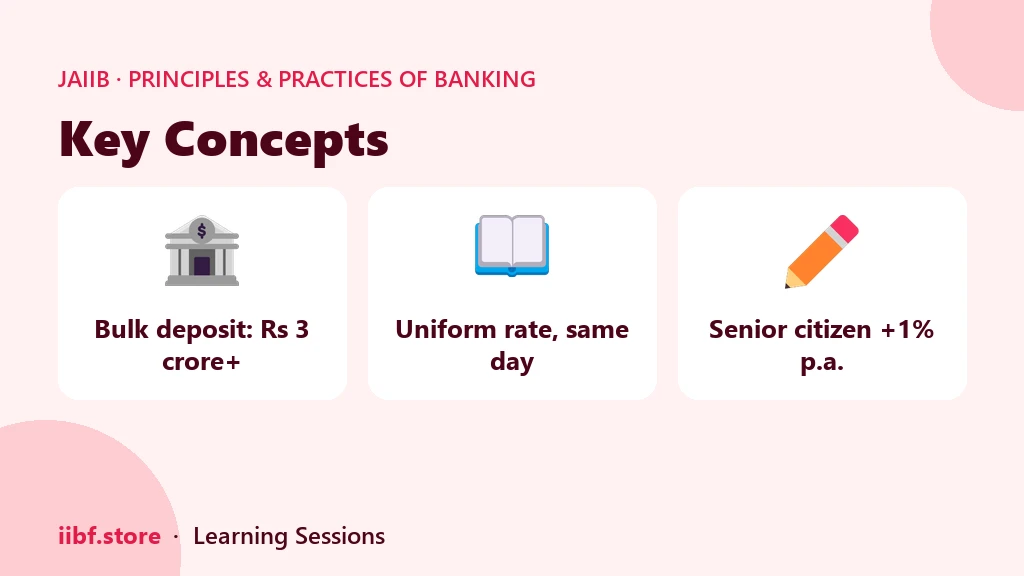
The governing instrument is the Reserve Bank's Master Direction on Interest Rate on Deposits. Its single most important principle is uniformity. Rates must be uniform across all branches and for all customers, and there can be no discrimination in the interest paid between one deposit and another of similar amount accepted on the same date. Your branch manager cannot quietly offer a friend twenty-five basis points more on the same ticket size and tenor. If that sounds obvious, remember that this is exactly the scenario examiners build questions around.
Against that baseline, the Directions permit differential pricing on only three grounds:
- Tenor. A 400-day deposit may be priced differently from a one-year deposit. This is why every bank runs those oddly specific special-tenor buckets.
- Size, but only for bulk deposits. A bank may run a separate bulk rate card. It cannot slice its retail book into a dozen private tiers.
- Absence of a premature withdrawal option. A non-callable deposit locks your liquidity, so the bank may pay more for it.
Anything outside those three is not a pricing strategy, it is a compliance breach.
Bulk deposits, senior citizens and the carve-outs
A bulk deposit is a single rupee term deposit of three crore and above for scheduled commercial banks other than regional rural banks. For RRBs and local area banks the threshold is one crore and above. Get this pair right, because the two-threshold structure is the classic trap: candidates memorise "three crore" and then meet a question framed around an RRB.
On senior citizens, banks may allow additional interest of one per cent per annum on term deposits of resident senior citizens. Two details matter. It is an enabling provision, not a mandate, so the exact quantum sits with the bank within that ceiling. And the concession for a bank's own staff and retired staff is a separate provision entirely; it does not ride on senior citizen status, and the two are not automatically stacked.
Savings deposits work differently again. Interest is calculated on a daily product basis on the end-of-day balance and must be credited at quarterly or shorter intervals. Banks are free to set the savings rate, subject to the same non-discrimination principle within a balance slab.
Premature withdrawal: the right you cannot be signed away from
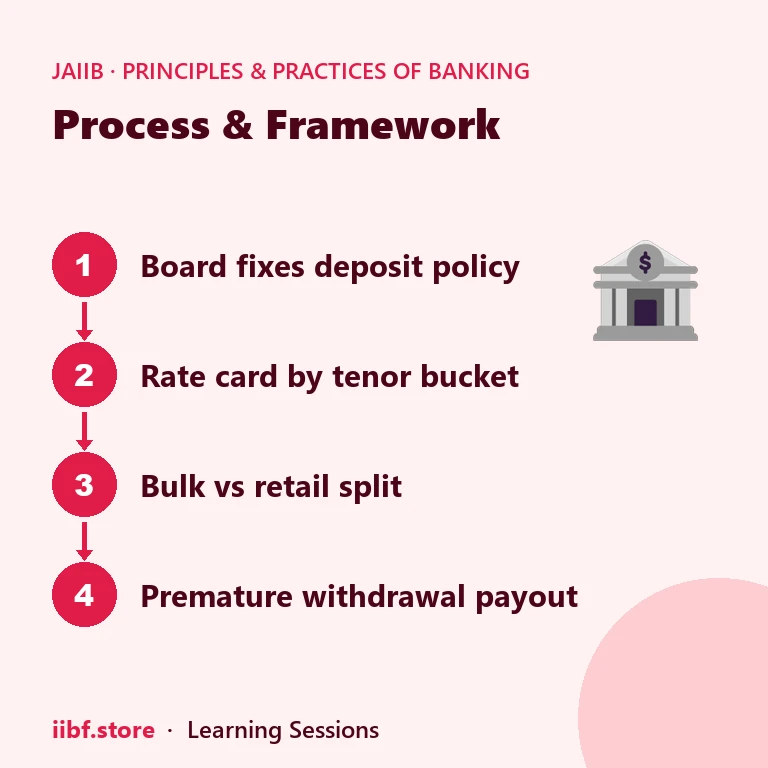
Banks are allowed to offer term deposits without a premature withdrawal option, but with a hard floor: all individual term deposits up to one crore must carry the premature withdrawal facility. Below that ticket, a bank cannot sell you a locked product. Above it, a non-callable deposit is permissible, and that is precisely why non-callable cards carry a small pickup.
When a deposit is broken early, interest is paid at the rate applicable to the amount and the period for which the deposit actually remained with the bank, not the contracted rate, and the bank may levy a penalty on top. This is the arithmetic candidates get wrong most often.
A worked example
Suppose a customer books six lakh for three years at 7.10% and breaks it at the end of month fourteen. The bank's card rate for a one-year deposit on the original booking date was 6.60%, and the bank's stated premature penalty is 0.50%.
The applicable rate is the rate for the period actually run, which falls in the one-year bucket, so 6.60%, minus the 0.50% penalty, giving 6.10%. Interest accrues at 6.10% for fourteen months, not at the 7.10% printed on the receipt. On six lakh that is roughly Rs 42,700 against the roughly Rs 49,700 the customer expected: a Rs 7,000 lesson in why FD interest rates on paper are not FD interest rates in hand.
How this is asked in the exam
Questions on this topic cluster in three places. First, definitional recall: the bulk deposit threshold, split between SCBs and RRBs. Second, permissibility: given a scenario, is the differential rate allowed? Third, computation: a premature withdrawal sum exactly like the one above. Practise all three rather than only the first. Our chapter-wise test series carries the computation variants, and the deposits chapter sits inside JAIIB Principles and Practices of Banking. If you track the policy side week to week, the live RBI rates page is updated as the MPC moves, and a structured study planner will keep the deposits module from being squeezed out in the last fortnight. For the wider set of rate-linked explainers, browse the Learning Sessions blog.
One closing caution for the customer-facing side of your job. Comparison sites quoting the highest FD interest rates in the market are almost always quoting a small finance bank at a special tenor for senior citizens. That is a real rate, but it carries a different risk profile and a different deposit insurance calculation. Read the tenor and the institution before you read the number.
Does the RBI fix deposit rates for banks?
No. The RBI sets the policy repo rate and the framework rules; each bank's board approves its own deposit policy and rate card within those rules. What the RBI mandates is uniformity and non-discrimination, not the level.
What is the bulk deposit threshold?
A single rupee term deposit of three crore and above for scheduled commercial banks other than RRBs, and one crore and above for regional rural banks and local area banks.
Can a bank refuse premature withdrawal on my fixed deposit?
Not on an individual term deposit up to one crore, which must carry the premature withdrawal facility. Above one crore a bank may offer a non-callable deposit, usually at a slightly higher rate.
How much extra interest do senior citizens get?
Banks are permitted to allow additional interest of up to one per cent per annum on resident senior citizens' term deposits. It is an enabling provision, so the actual quantum varies by bank and by scheme.
Quick quiz on this topic
5 exam-style questions from our free test bank — check yourself before you move on.
Practice this topic
Take a free mock test, download chapter PDFs, or watch a video class — all included on iibf.store.
Keep reading