Priority Sector Lending Update 2026: Full Master Class

If you are preparing for JAIIB, CAIIB or an internal promotion exam, there is one chapter you cannot afford to treat as revision filler. The priority sector lending update that came in with the 2025 Master Directions rewrote the numbers most candidates had memorised years ago, and those old numbers are still circulating in half the notes doing the rounds on WhatsApp. This master class walks the current framework end to end.
Ashish Sir's full session is embedded below. Watch it for the classroom treatment, then use this page as the written companion you can revise from in ten minutes on exam morning.
Priority Sector Lending 2026 update Master Class JAIIB CAIIB Promotions · Watch on YouTube
The instrument, and why the old notes are wrong
The governing document is the Master Directions - Reserve Bank of India (Priority Sector Lending - Targets and Classification) Directions, 2025, dated 24 March 2025 and effective from 1 April 2025. It consolidated and replaced the earlier framework, and it has been amended since. Anything dated before April 2025 should be treated as superseded until you have checked it.
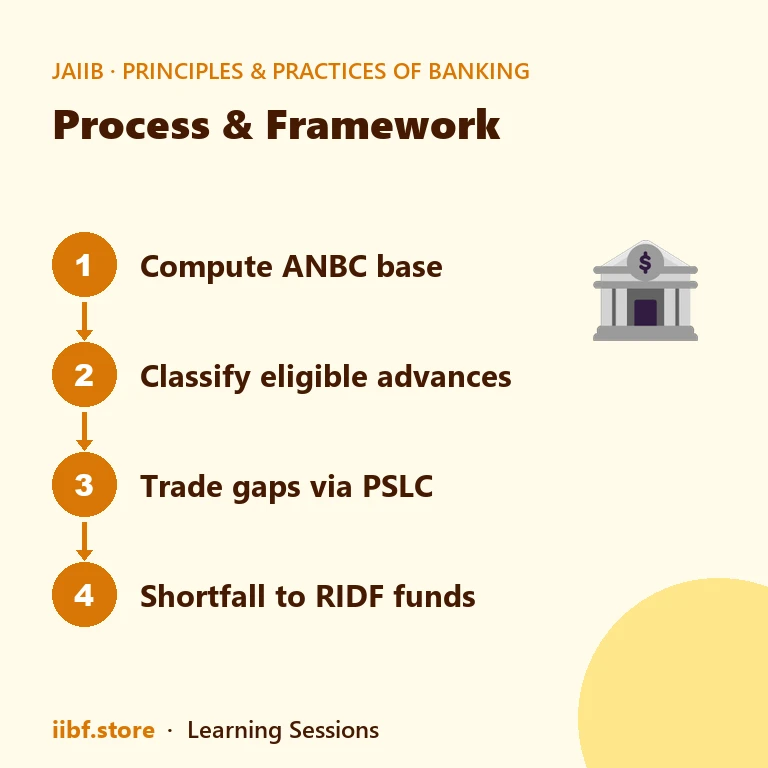
The single biggest source of error in this chapter is the base. Targets are expressed as a percentage of Adjusted Net Bank Credit or the Credit Equivalent of Off-Balance Sheet Exposure, whichever is higher. Not of total advances, and not of net bank credit alone. A related detail worth carrying: all outstanding deposits with the development financial institutions, meaning NABARD, SIDBI, MUDRA and NHB, are added back to Net Bank Credit when computing ANBC.
The targets you must know cold
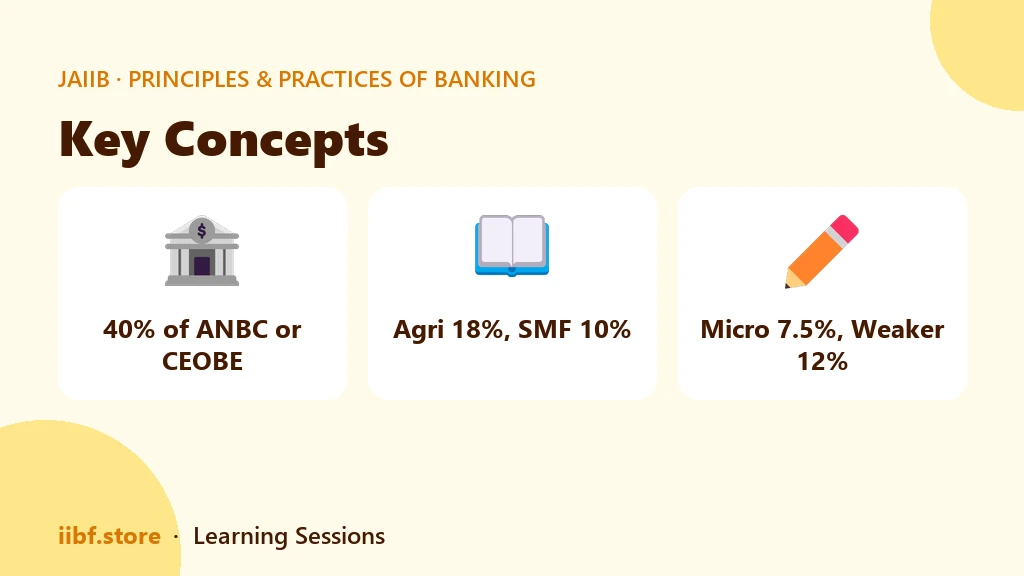
For domestic commercial banks other than RRBs and small finance banks, and for foreign banks with twenty or more branches, the structure is as follows. Read the nesting carefully, because agriculture is not one flat number:
| Category | Target (% of ANBC or CEOBE, whichever higher) | Note |
|---|---|---|
| Total priority sector | 40% | The headline number |
| Agriculture | 18% | Contains the two sub-limits below |
| — Non-corporate farmers (NCF) | 14% | Within the 18% agriculture target |
| — Small and marginal farmers (SMF) | 10% | Within the NCF share |
| Micro enterprises | 7.5% | Separate sub-target under overall PSL |
| Weaker sections | 12% | Cuts across categories |
Two traps live in this table. First, the 18/14/10 structure is nested, not additive; a candidate who adds them and reports 42% for agriculture has misread the framework. Second, micro enterprises at 7.5% is a sub-target for micro specifically, while bank loans to MSMEs as a whole qualify for priority sector classification without a separate overall MSME ceiling.
PSLCs: trading the obligation without moving the loan
No single bank is equally good at every priority segment. A private bank strong in urban micro-enterprise lending may have almost no agricultural reach; a rural-heavy bank may overshoot agriculture and undershoot elsewhere. Priority Sector Lending Certificates let the two settle the difference without transferring any underlying asset.
The mechanics you should be able to recite: there are four types, namely PSLC Agriculture, PSLC Small and Marginal Farmer, PSLC Micro Enterprises and PSLC General. They trade on the Reserve Bank's e-Kuber platform in lots of Rs 25 lakh. All PSLCs expire on 31 March irrespective of when they were bought, so there is a predictable rush in the final quarter. A bank may issue PSLCs up to 50 per cent of the previous year's PSL achievement without an underlying asset transfer. For accounting, the buyer books the fee as an expense and the seller books it as miscellaneous income.
The conceptual point examiners probe: because no loan moves, the credit risk stays with the originating bank. The certificate transfers the regulatory credit and nothing else.
What happens when a bank misses the target
A shortfall does not attract a fine. It attracts a deposit, which in practice is worse, because the money is locked away at a deliberately unattractive return. Banks that fall short contribute to the Rural Infrastructure Development Fund maintained with NABARD and to corresponding funds with NHB, SIDBI and MUDRA. The return is priced off the Bank Rate, and it worsens as the miss widens:
| Shortfall | Interest on the deposit |
|---|---|
| Less than 5 percentage points | Bank Rate minus 2% |
| 5 to less than 10 percentage points | Bank Rate minus 3% |
| 10 percentage points and above | Bank Rate minus 4% |
| No overall shortfall, but a sub-target missed | Bank Rate minus 2% |
Put a number on it. With the Bank Rate at 5.50%, a bank missing by more than ten percentage points earns 1.50% on funds it could otherwise have lent. That gap, not any penalty, is the real cost of a PSL miss, and it is why treasury desks watch the March position so closely.
On-lending: the route through intermediaries
Banks may lend to eligible intermediaries such as NBFCs, HFCs, MFIs and NCDC for onward lending to priority sectors, and claim PSL classification. The guardrails matter as much as the permission. On-lending is capped at 5 per cent of an individual bank's total priority sector lending in the previous financial year. Per-borrower limits apply at the ultimate borrower level, broadly Rs 10 lakh for agriculture term lending and Rs 20 lakh for micro and small enterprises. Intermediaries must furnish an external auditor's certificate confirming that the same asset has not been claimed twice, which is the whole point of the certification: without it, one loan could count as priority sector at two institutions at once.
📖 Also read: escrow account in banking — Escrow Account in Banking: Structure, Uses and Bank's Role
How to revise this for the exam
Build a one-page sheet with three blocks: the target table, the PSLC facts, and the shortfall grid. Most questions in this chapter are recall or a one-step computation off ANBC, so a clean sheet beats re-reading the chapter. Then test yourself rather than re-read; our chapter-wise test series has the ANBC computation variants that catch people out. The chapter sits in JAIIB Principles and Practices of Banking, and the credit-side treatment appears again in CAIIB Advanced Bank Management. Fit the revision into a study planner slot, keep the RBI rates page handy for the Bank Rate, and browse the blog for related explainers. The Master Directions themselves are on rbi.org.in.
One last word for promotion candidates specifically. Interviewers rarely ask you to recite the table. They ask what you would do if your branch were running behind on the small and marginal farmer sub-target in January. The answer that lands mentions the sub-target's nesting inside agriculture, the PSLC SF/MF route as a corrective, and the fact that a sub-target miss alone still costs Bank Rate minus 2%. That is the difference between having learned the chapter and having understood this priority sector lending update.
What is the overall PSL target and the base it applies to?
40 per cent of Adjusted Net Bank Credit or the Credit Equivalent of Off-Balance Sheet Exposure, whichever is higher, for domestic commercial banks and foreign banks with twenty or more branches.
Are the agriculture sub-targets added to the 18 per cent?
No, they are nested inside it. Agriculture is 18%, within which non-corporate farmers carry 14% and small and marginal farmers 10%. Adding them is a common and costly error.
What happens if a bank misses its PSL target?
It contributes the shortfall to RIDF with NABARD and to corresponding funds with NHB, SIDBI and MUDRA, earning Bank Rate minus 2%, 3% or 4% depending on how wide the miss is.
Does buying a PSLC transfer the underlying loan?
No. Only the priority sector credit is transferred. The loan, and its credit risk, stay on the originating bank's books. PSLCs trade on e-Kuber in lots of Rs 25 lakh and expire on 31 March each year.
Quick quiz on this topic
5 exam-style questions from our free test bank — check yourself before you move on.
Practice this topic
Take a free mock test, download chapter PDFs, or watch a video class — all included on iibf.store.
Keep reading