Business Correspondent Model: CAIIB Rural Banking Guide
The business correspondent model lets a bank deliver deposits, withdrawals, remittances and small-value credit through a contracted agent sitting in a village, instead of through a brick-and-mortar branch — and the bank, not the agent, stays answerable to the customer for every rupee that moves. For the CAIIB Rural Banking elective this is one of the highest-yield delivery-channel topics, because examiners keep testing the boundary between what a facilitator may do and what only a correspondent may do.
Get that boundary right and a whole cluster of questions — eligibility, cash handling, liability, banking-outlet status — falls into place.
🏦 What the Business Correspondent Model Is
A Business Correspondent (BC) is a retail agent engaged by a bank to provide banking services at locations other than a bank branch or ATM. The bank signs an agency contract; the BC operates a fixed point outlet, a micro-ATM or a handheld device; the customer's account continues to sit on the bank's core banking system. Nothing about the arrangement makes the BC a banker — it is an outsourcing of the delivery channel, not of the banking business.
The framework traces back to the RBI circular of January 2006 permitting banks to use Business Facilitators and Business Correspondents for financial inclusion. Because a manned fixed point where deposits are accepted or cash is paid out is treated as a place of business, the arrangement sits inside the branch-authorisation discipline built on Section 23 of the Banking Regulation Act, 1949. RBI's 2017 rationalisation of that policy defined a banking outlet as a fixed point service delivery unit manned either by a bank's own staff or by its BC, offering deposits, cash withdrawal, cheque encashment or lending for a minimum of four hours a day on at least five days a week.
That definition is the reason a properly run BC point counts towards a bank's unbanked-rural-centre obligations. Read it alongside the way the wider institutional map is laid out in the chapter on rural credit institutions, because the exam often asks which institution is delivering a service rather than who is funding it.
💡 Exam Tip: A BC outlet is a banking outlet, not a branch. Questions that use the word "branch" for a BC point are testing exactly this distinction — the four-hour, five-day test is the trigger.
🧾 Business Facilitator vs Business Correspondent
The single most examined line in this topic is simple: a Business Facilitator cannot handle cash or conduct a banking transaction; a Business Correspondent can. A facilitator does the soft, pre-transaction work — identifying borrowers, collecting and preliminary-processing applications, creating awareness about savings, promoting and nurturing groups, and following up for recovery through persuasion. The moment money changes hands, you need a correspondent.
The table below is the version worth memorising, because it maps each function to the role that may perform it and flags whether cash is involved.
| Function at the rural outlet | Role permitted to perform it | Cash handling involved |
|---|---|---|
| Identification of borrowers, collection of KYC documents | Facilitator or Correspondent | ❌ |
| Preliminary appraisal and submission of loan applications | Facilitator or Correspondent | ❌ |
| Follow-up for recovery of dues by persuasion only | Facilitator or Correspondent | ❌ |
| Small-value deposits and withdrawals via micro-ATM or AePS | Correspondent only | ✅ |
| Receipt and delivery of small-value remittances | Correspondent only | ✅ |
Two consequences follow. First, an entity may be engaged as a facilitator without ever being authorised to touch cash, which is why some banks run a two-tier village network. Second, disbursement and repayment at the doorstep — the part that actually improves credit turnaround in a village — is available only through the correspondent channel. That is a live issue for group lending, and it connects directly to how repayments are collected under self help group bank linkage, where the animator and the BC often operate in the same hamlet.
👥 Who Can Be Appointed and How Banks Onboard Them
The eligible-entity list widened in stages, and the exam likes the sequence. RBI initially allowed not-for-profit and quasi-institutional entities: NGOs and MFIs set up under Societies, Trust or Cooperative laws, Section 25 companies (now Section 8 companies), post offices, retired bank employees, ex-servicemen and retired government servants. It was later extended to individuals such as kirana and medical shop owners, fair-price shop dealers, agents of small savings schemes and insurers, petrol-pump owners, and finally to for-profit companies, which is what made large corporate BC networks possible.
Non-Banking Financial Companies remain the standing exception: a deposit-taking NBFC cannot be appointed as a BC, and the general bar on NBFCs acting as BCs is subject to the conditions RBI has specified. When a question offers an NBFC among the options, treat it as the trap answer unless the stem itself carves out an exception.
Onboarding is governed by the bank's own board-approved policy, framed within RBI's outsourcing guidelines. That policy fixes due diligence on the agent, the operating area, the intra-day cash-holding limit, per-transaction ceilings, the commission structure, audit and inspection rights, and the exit clause. RBI does not prescribe a single uniform cash limit or distance for every bank — the board does, and the bank remains liable regardless. Candidates who assume a nationwide numeric limit lose easy marks.
⚠️ Common Mistake: Writing that "RBI has fixed the BC cash limit at a specific amount". It has not. The intra-day cash limit and the operating radius come from the bank's board-approved policy under the outsourcing framework.
💵 Transactions, Technology and the Village Counter
At the counter the correspondent typically handles account opening support, cash deposits and withdrawals, balance enquiry and mini-statements, fund transfers, receipt and delivery of small-value remittances, collection of micro-insurance and pension premia, sale of third-party products the bank has approved, and recovery of principal and interest on small loans. Authentication is usually biometric through the Aadhaar Enabled Payment System (AePS) on a micro-ATM, which is what makes the channel interoperable across banks.
Interoperability matters more than it looks. Because AePS routes through the national switch, a customer of one bank can transact at another bank's BC point, so the agent's viability no longer depends on a single bank's customer base in that village. Combined with the account base built up through government financial-inclusion programmes, this is what turned scattered agents into a usable last-mile network across the demographic spread described in the chapter on rural demographic features.
Credit through the channel stays deliberately small. The BC route is designed for small-ticket, high-frequency business — the standardised, rule-driven products where an agent can complete the field work and the branch retains the sanction. Anything requiring judgement on cash flows, security or valuation goes back to the branch, which is exactly the split you see in the appraisal-heavy products covered under the SME finance chapter. If a question asks you to price such an exposure, remember that policy rates move — check the current position on the RBI rates reference page rather than reciting a number from an old book.
🛡️ Liability, Charges and Grievance Redressal
The governing principle is agency law: the BC acts for the bank, so the bank is fully responsible to the customer for the acts and omissions of its correspondent. Outsourcing the activity does not outsource the accountability. KYC verification, account-opening decisions, transaction monitoring and suspicious-transaction reporting stay with the bank even when the paperwork is physically collected in a village.
On charges, RBI's position is that a bank may pay reasonable commission or fee to its correspondent, but the correspondent must not levy a charge of its own on the customer. Any customer-facing charge has to come from the bank's transparent, board-approved schedule, and the customer must be told what it is. Agents collecting an informal "service fee" at the counter is a supervisory concern, not a permitted practice — a favourite one-liner in descriptive papers.
Grievance redressal follows the same logic. A complaint about a BC outlet is a complaint against the bank, and if the bank does not resolve it within the prescribed period the customer can escalate under the RBI Integrated Ombudsman Scheme, which was replaced by the RB-IOS 2026 with effect from 1 July 2026. Under the 2026 scheme the complaint window is 90 days and the award ceiling is Rs 30 lakh, with up to Rs 3 lakh for consequential loss including loss of time and mental agony. Banks must also display the BC's name, the bank's name and the grievance contact at every outlet. The primary framework and the underlying circulars are all published on the RBI notifications portal, which is the source to cite in any written answer.
📈 Where This Fits in the Rural Banking Paper
The correspondent channel is not a standalone chapter question — it recurs wherever the paper asks how a product actually reaches a village household. Sponsor-bank and rural-institution questions link it to ownership and capital, so revise it against regional rural banks structure. Priority-sector questions link it to how compliance is traded between banks, which is covered in priority sector lending certificates.
Structurally, the exam rewards candidates who can place the channel inside the rural economy rather than treat it as a payments gadget. The seasonality of incomes, the dominance of informal lenders and the distance to the nearest branch — the ground covered in the chapter on characteristics of rural society — are the reasons the channel exists at all. A question that asks why doorstep delivery lowers the effective cost of a small loan is really asking about the borrower's travel cost and wage loss, not about the technology.
For revision method, past questions on this topic repeat their framing almost verbatim across attempts, so the drilling technique in CAIIB ABM PYQ transfers directly to the elective. Keep the rest of your elective revision in one place through the Rural Banking elective article hub, and pair each read with a timed attempt so recall is tested and not just recognised.
🧠 Practice MCQs: Business Correspondent Model
Q1. Which activity is a Business Facilitator NOT permitted to perform? (a) Identification of borrowers (b) Preliminary processing of loan applications (c) Cash deposit and withdrawal for customers (d) Follow-up for recovery of dues by persuasion
Answer: (c) — A facilitator may do everything except handle cash or conduct a banking transaction; only a correspondent may do that.
Q2. The branch-authorisation discipline within which a fixed point BC outlet is treated as a banking outlet is built on which provision? (a) Section 21 of the Banking Regulation Act, 1949 (b) Section 23 of the Banking Regulation Act, 1949 (c) Section 45 of the Banking Regulation Act, 1949 (d) Section 42 of the RBI Act, 1934
Answer: (b) — Section 23 governs the opening of a place of business by a banking company, and RBI's banking-outlet definition operates under that policy.
Q3. Under a BC arrangement, who is responsible to the customer for the acts and omissions of the correspondent? (a) The BC agent personally (b) The technology service provider running the micro-ATM (c) The State Level Bankers' Committee (d) The bank that engaged the BC
Answer: (d) — Engagement of a BC is outsourcing of the delivery channel; accountability to the customer remains entirely with the bank.
Q4. Who prescribes the intra-day cash-holding limit and the operating area of a fixed point BC outlet? (a) The bank's board-approved policy (b) RBI, uniformly for all banks (c) NABARD for all rural outlets (d) The district administration
Answer: (a) — RBI leaves these operational limits to each bank's board-approved policy framed under the outsourcing guidelines.
Q5. Which statement about charges in the BC channel is correct? (a) The BC may fix and collect its own fee directly from the customer (b) RBI prescribes a uniform commission payable to every BC (c) The bank may pay reasonable commission to the BC, and any customer charge must follow the bank's transparent board-approved schedule (d) All BC transactions must be free of charge in every case
Answer: (c) — The correspondent is paid by the bank; it cannot levy a charge of its own on the customer.
Want chapter-wise mock tests with 100+ MCQs? Start practising free →
❓ Frequently Asked Questions
Is a Business Correspondent an employee of the bank?
No. A BC is an agent engaged under a contract, governed by the bank's board-approved outsourcing policy. The agent is paid a commission or fee by the bank, not a salary, but the bank still carries full liability towards the customer for the agent's conduct.
Can a Business Correspondent open a bank account on its own?
A BC can complete the field work — sourcing the application, collecting KYC documents and capturing biometrics as permitted by the bank. The verification of KYC and the decision to open the account rest with the bank, which cannot delegate that responsibility.
Does a BC outlet count as a banking outlet for branch-authorisation purposes?
Yes, if it is a fixed point service delivery unit manned by the BC, offering deposits, cash withdrawal, cheque encashment or lending for at least four hours a day on a minimum of five days a week. Anything less is treated as a part-time banking outlet.
Do BC agents need a certification?
IIBF conducts a certificate course for Business Correspondents and Business Facilitators, and banks generally require their agents to clear it as part of onboarding and due diligence. Check your own bank's board-approved policy for the exact requirement.
🚀 Quick Recap and Next Step
Agent not employee, bank liable not agent, board policy not a uniform RBI number, facilitator without cash and correspondent with cash — that is the whole topic in four lines. Learn the banking-outlet test and the eligible-entity sequence on top of it and this section of the paper is secured.
Now convert the reading into marks: attempt a timed set on the CAIIB Rural Banking elective course page and review every wrong answer against the table above.
Prefer revising from a printed book?
Chapter-wise books with MCQs after every chapter — minimal pages, complete coverage, delivered anywhere in India. Every book has a free sample to read first.
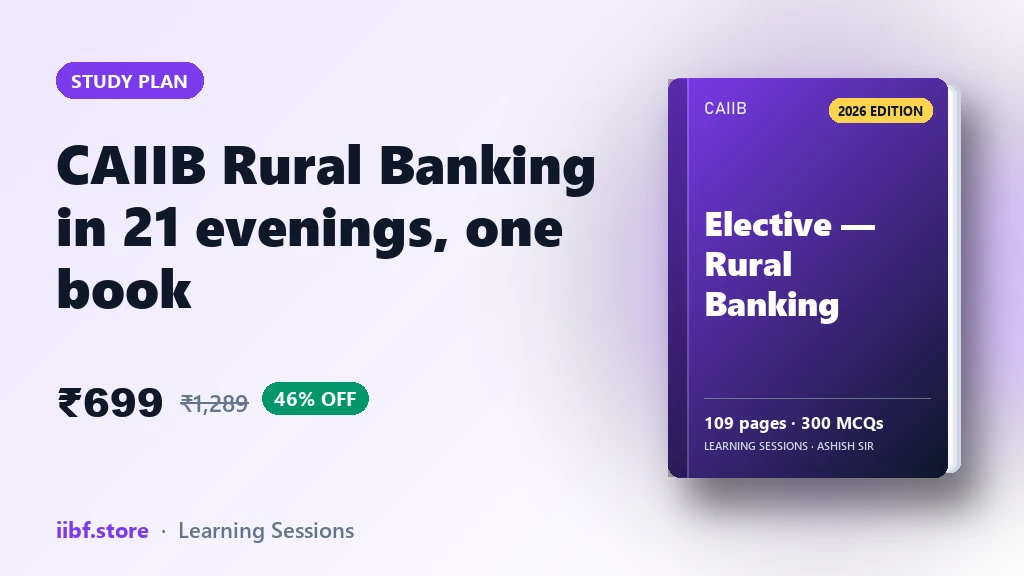
109 pages · 300 MCQs
Learning Sessions · Ashish Sir
148 pages · 478 MCQs
Learning Sessions · Ashish Sir
151 pages · 465 MCQs
Learning Sessions · Ashish Sir
148 pages · 375 MCQs
Learning Sessions · Ashish Sir
216 pages · 895 MCQs
Learning Sessions · Ashish Sir
104 pages · 360 MCQs
Learning Sessions · Ashish Sir
82 pages · 297 MCQs
Learning Sessions · Ashish Sir
151 pages · 600 MCQs
Learning Sessions · Ashish Sir
98 pages · 282 MCQs
Learning Sessions · Ashish Sir
131 pages · 672 MCQs
Learning Sessions · Ashish Sir
221 pages · 831 MCQs
Learning Sessions · Ashish Sir
128 pages · 524 MCQs
Learning Sessions · Ashish Sir
107 pages · 445 MCQs
Learning Sessions · Ashish Sir
132 pages · 225 MCQs
Learning Sessions · Ashish Sir
188 pages · 435 MCQs
Learning Sessions · Ashish Sir
117 pages · 236 MCQs
Learning Sessions · Ashish Sir
Learning Sessions · Ashish Sir
118 pages · 299 MCQs
Learning Sessions · Ashish Sir
Learning Sessions · Ashish Sir
Learning Sessions · Ashish Sir
Learning Sessions · Ashish Sir
115 pages · 255 MCQs
Learning Sessions · Ashish Sir
Learning Sessions · Ashish Sir
334 pages · 936 MCQs
Learning Sessions · Ashish Sir
Learning Sessions · Ashish Sir
115 pages · 344 MCQs
Learning Sessions · Ashish Sir
107 pages · 240 MCQs
Learning Sessions · Ashish Sir
90 pages · 150 MCQs
Learning Sessions · Ashish Sir
Learning Sessions · Ashish Sir
Quick quiz on this topic
5 exam-style questions from our free test bank — check yourself before you move on.
Practice this topic
Take a free mock test, download chapter PDFs, or watch a video class — all included on iibf.store.