Forward Rate Agreement (FRA) Explained for CAIIB BFM 2026
Every treasury dealer has had the same 2 a.m. thought: I know I have to borrow three months from now — what if rates have moved by then? A forward rate agreement is the answer the market invented for exactly that worry. It lets a bank fix the interest rate on a future borrowing or lending today, without moving a single rupee of principal. The short video below breaks the idea down in under five minutes, and this guide then takes it all the way to the numericals CAIIB BFM actually asks.
Future Interest Rate Lock? FRA Explained Simply · Watch on YouTube
What a forward rate agreement actually is
Strip away the jargon and it is a bet on one number. Two parties agree today on an interest rate that will apply to a notional amount, for a defined period, starting on a defined future date. On the day that period starts, they look up the actual market rate. Whoever guessed wrong pays the difference in cash. Nobody lends. Nobody borrows. The notional is a measuring stick, not money.
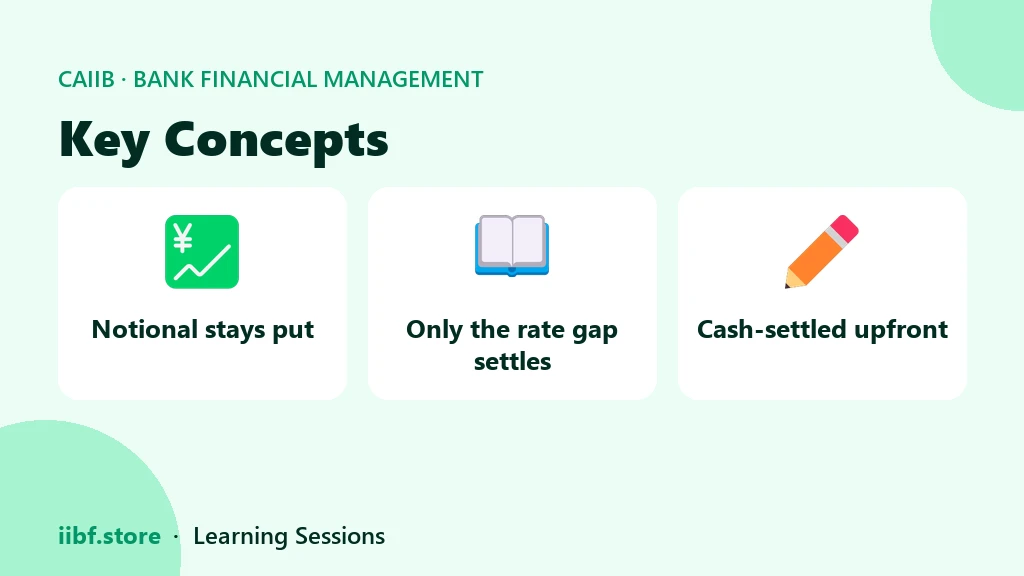
That is why an FRA is called an off-balance-sheet product. Your ten-crore notional never shows up as an asset or a liability. Only the small settlement amount hits the books. This is the single most useful thing to remember, because examiners love to ask whether the notional is exchanged. It is not.
The buyer of the contract is the party that wants protection against rates going up — typically someone who will borrow later. The seller wants protection against rates going down — typically someone who will deposit or lend later. Buy means pay fixed, receive floating. Sell means the reverse.
Reading the 3 x 6 notation without panicking
FRAs are quoted as two numbers, like 3 x 6 or 6 x 12. Students lose easy marks here, so go slowly. The first number is how many months from today the contract period starts. The second is how many months from today it ends. Subtract them and you get the length of the interest period being hedged.
So a 3 x 6 contract starts in three months and ends in six months. It covers a three-month interest period, and the reference rate you compare against is the three-month benchmark. A 6 x 12 contract starts in six months, runs for six months, and settles against the six-month benchmark. The gap between the two numbers always tells you which tenor of the benchmark to use.
The date on which you look up the market rate is the fixing date. In the Indian rupee market that is usually two business days before the settlement date, following the same convention used for other money-market instruments.
The settlement formula, and one worked example
Here is where most candidates trip. The settlement amount is not simply the rate difference times the notional. The cash changes hands at the start of the interest period, but the interest it stands for would only have been paid at the end. So the amount must be discounted back.
The formula is:
Settlement = [ (Reference rate − Contract rate) × Notional × Days ÷ Basis ] ÷ [ 1 + (Reference rate × Days ÷ Basis) ]
The numerator is the plain interest difference. The denominator drags it back to present value. Miss the denominator and your answer will be a few thousand rupees too high — which is exactly the distractor the paper-setter puts in option (b).
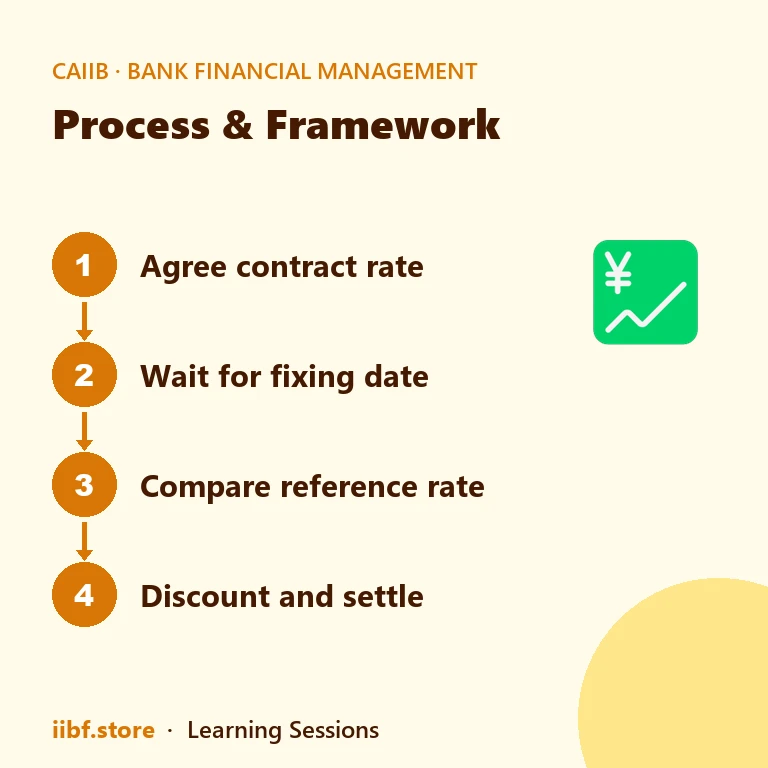
Take a live case. A bank knows it must borrow ₹10 crore in three months for a three-month term. It buys a 3 x 6 forward rate agreement at a contract rate of 6.50%. On the fixing date, the three-month benchmark has risen to 7.20%. The period is 91 days on a 365-day basis.
| Input | Value |
|---|---|
| Notional principal | ₹10,00,00,000 |
| Contract rate agreed today | 6.50% |
| Reference rate on fixing date | 7.20% |
| Days and basis | 91 / 365 |
| Undiscounted interest difference | ₹1,74,521 |
| Discount factor | 1.01795 |
| Settlement received by buyer | ₹1,71,443 |
The bank still borrows in the open market at 7.20% and pays more interest than it hoped. But the ₹1,71,443 it receives on the contract offsets that extra cost almost exactly. Its effective cost lands back at 6.50%. That is the whole point of the hedge — not profit, but certainty.
Flip the market and the logic flips with it. Had the benchmark fixed at 5.80%, the buyer would have paid the seller, and its cheaper market borrowing would have been dragged back up to 6.50%. A hedge removes the bad surprise and the good one alike.
FRA, interest rate futures and swaps side by side
BFM rarely asks about one product in isolation. It asks you to tell three lookalikes apart. Keep this comparison in your head.
| Feature | FRA | Interest rate future | Interest rate swap |
|---|---|---|---|
| Where traded | Over the counter | Exchange | Over the counter |
| Terms | Customised | Standardised | Customised |
| Number of settlements | One | Daily mark to market | Many, over the life |
| Margin | Usually none | Initial plus variation | Collateral by agreement |
| Main risk to watch | Counterparty credit risk | Basis risk | Both, over a longer horizon |
The clean way to hold it together: a swap is a chain of these contracts strung end to end. One link is a forward rate agreement. Many links, priced as a single package, is a swap. A future is the same economic idea, but standardised and pushed onto an exchange with a clearing house in the middle.
Where the RBI rulebook fits
Rupee FRAs are not an informal arrangement. They sit inside the Rupee Interest Rate Derivatives (Reserve Bank) Directions, 2019, which set out who may deal, which benchmarks are permitted, and how hedging is treated against other permitted uses. Read the framework on the regulator's own site at rbi.org.in rather than a coaching summary. BFM questions on eligibility and user classification are lifted straight from the wording.
Two supervisory themes matter for the exam. First, credit exposure. Because there is no clearing house in an over-the-counter trade, the bank carries counterparty risk and must compute a credit equivalent for capital. Second, benchmark integrity, which is why the shift in rupee benchmarks in recent years keeps returning as an update question.
How this shows up in your CAIIB BFM paper
Expect three flavours. A one-line theory question on whether notional is exchanged. A notation question asking what period a 6 x 9 contract covers. And a numerical giving you notional, contract rate, reference rate and days, expecting the discounted settlement.
Drill the third one until the discounting step is automatic. Practise timed sets in the CAIIB test series, keep the benchmark and policy numbers current from the RBI rates tracker, and if your Module C revision keeps slipping, block it properly in the study planner. The full syllabus walkthrough sits on the CAIIB course page, and more revision notes are collected on the blog.
One last framing that helps in the hall. A forward rate agreement is not a loan, not an investment, and not a punt. It is an insurance policy on a single number, bought with a promise instead of a premium. Once that sentence feels obvious, the numericals stop being scary and start being arithmetic.
Is the notional principal exchanged in a forward rate agreement?
No. The notional is only used to calculate the settlement amount. Just the net difference in interest changes hands, which is why the contract stays off the balance sheet.
What period does a 6 x 9 FRA cover?
It starts six months from the deal date and ends nine months from the deal date. So it hedges a three-month interest period, and settles against the three-month reference rate on the fixing date.
Why is the settlement amount discounted?
Because the cash is paid at the start of the interest period, while the interest it stands for would only have been paid at the end. Discounting at the reference rate brings it to present value.
Who gains when the reference rate rises above the contract rate?
The buyer. A buyer pays fixed and receives floating, so a higher reference rate means the seller pays the buyer, offsetting the buyer's costlier actual borrowing.
Quick quiz on this topic
5 exam-style questions from our free test bank — check yourself before you move on.
Practice this topic
Take a free mock test, download chapter PDFs, or watch a video class — all included on iibf.store.
Keep reading