Goal Based Financial Planning: Goals, Asset Mix and Reviews (JAIIB RBWM)
Goal based financial planning is the core skill a JAIIB RBWM candidate must master before advising any retail customer. It means mapping every rupee to a named goal, a fixed time horizon, and a matching investment vehicle. A relationship manager who invests without goals is just guessing. This article breaks goal based financial planning into five practical parts: time-horizon mapping, risk capacity versus risk tolerance, the emergency corpus, SIP and STP mechanics, and the line between a bank RM and a SEBI-registered investment adviser (RIA).
🎯 Mapping Life Goals to Time Horizons
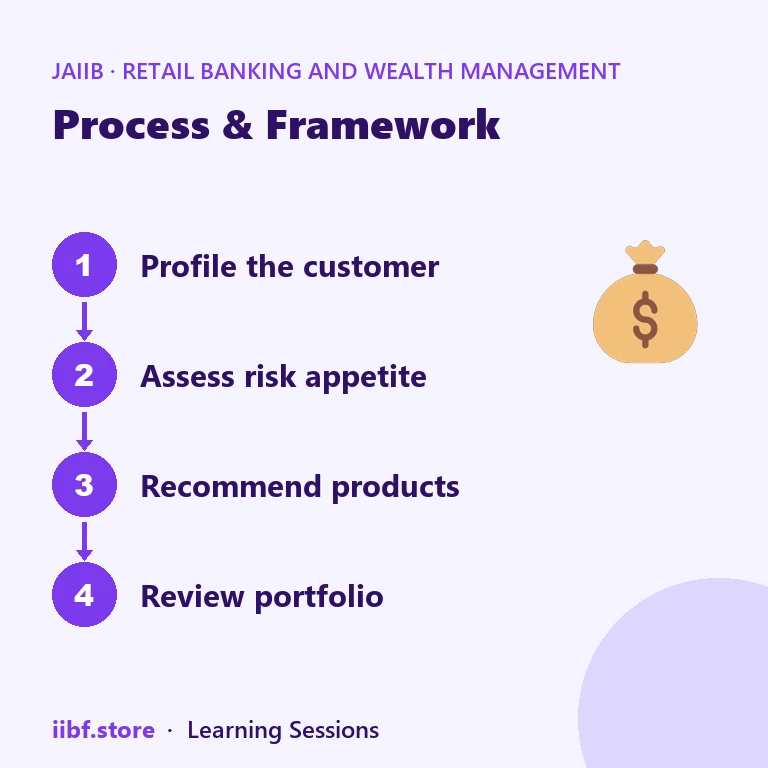
Every customer walks in with goals, not products. A child's education fund, a wedding, a house down payment, and retirement all sit on different timelines. The first step in goal based financial planning is to write down each goal with a rupee target and a target year.
Short-term goals fall inside three years. Medium-term goals run three to seven years. Long-term goals stretch beyond seven years. This horizon decides which asset class a customer can safely use.
A bank RM who understands retail banking fundamentals knows that goal mapping is not a one-time form. It is a conversation that repeats as life events change the numbers. A new job, a second child, or a job loss all shift the horizon.
Inflation is the silent goal-killer. A goal priced today at a fixed sum will cost more when it falls due. Every horizon calculation must build in a realistic inflation assumption, especially for goals ten or more years away, such as retirement or a child's higher education.
| Goal Type | Time Horizon | Risk Capacity Fit | Typical Instrument | Suitable for SIP |
|---|---|---|---|---|
| Emergency corpus | 0-6 months | Very low | Savings/sweep-in deposit | ❌ |
| Short-term goal | 1-3 years | Low | Debt fund/FD | ✅ |
| Medium-term goal | 3-7 years | Moderate | Hybrid/balanced fund | ✅ |
| Long-term goal | 7+ years | Moderate-high | Equity fund via SIP | ✅ |
| Retirement corpus | 15+ years | High, tapering with age | Equity glide to debt via STP | ✅ |
📌 Remember: A goal without a date is just a wish. Attach a year to every goal before you pick a product.
⚖️ Risk Capacity vs Risk Tolerance and the Emergency Corpus
Risk capacity and risk tolerance are not the same thing, and this distinction is tested often in JAIIB RBWM. Risk capacity is the ability to absorb a loss without derailing a goal. It depends on income stability, dependents, and existing assets.
Risk tolerance is the customer's psychological comfort with market swings. A customer can have high capacity but low tolerance, or the reverse. Goal based financial planning must respect the lower of the two, never the higher.
Before any goal gets an equity allocation, the plan needs an emergency corpus in place. This corpus covers three to six months of essential expenses. It sits in a savings account, a sweep-in deposit, or a liquid fund, not in equity.
Skipping the emergency corpus is the single most common planning error a relationship manager sees. A customer without this buffer will break a long-term SIP the moment a medical bill or job gap hits.
⚠️ Common Mistake: Starting an equity SIP before building the emergency corpus. A market dip then forces a forced, loss-making redemption.
🔁 SIP and STP Mechanics for Goal Investing
A Systematic Investment Plan, or SIP, lets a customer invest a fixed sum on a fixed date into a mutual fund scheme. It builds discipline and averages the purchase cost across market cycles.
SIPs suit medium and long-term goals with three or more years to run. They are a poor fit for the emergency corpus or for a goal due within twelve months, where market timing risk is too high.
A Systematic Transfer Plan, or STP, moves a lump sum gradually from one scheme to another, usually from a debt or liquid fund into an equity fund. It suits a customer who has received a windfall, such as a bonus or maturity payout, and wants equity exposure without a single-date risk.
Banks distributing mutual funds sell these products under strict suitability rules. A RM explaining mutual fund distribution by banks must match the SIP or STP structure to the goal horizon, not to the scheme with the highest commission.
As a goal nears its due year, a reverse glide can shift money from equity back into debt. This locks in gains and protects the goal from a late market shock.
💡 Exam Tip: SIP builds a goal corpus over time. STP redeploys an existing lump sum between schemes. Do not confuse the two in the exam.
🛡️ Insurance Gap and Review Cadence
An insurance gap is the difference between the cover a family needs and the cover it actually holds. Goal based financial planning treats life and health insurance as the foundation, not an add-on.
A term plan should replace the income a family would lose if the earning member died early. Many customers under-insure because they confuse investment-linked policies with pure protection cover.
A relationship manager comparing types of life insurance policies should size the term cover first, before discussing any savings-linked product. Health insurance closes a second gap, since a single hospitalisation can wipe out years of SIP contributions if the family has no adequate mediclaim.
Review cadence keeps the plan honest. An annual review checks goal progress, asset allocation drift, and any life event since the last review. A marriage, a birth, a job change, or a new loan all need a fresh look at the plan.
Tax rules also change the numbers over time. A customer revisiting tax planning for retail banking customers alongside the annual review can shift contributions to instruments that still fit the goal and the current tax regime.
🧭 Where the Bank RM Stops and the RIA Begins
A bank RM can explain products, suitability, and risk categories under the retail banking concepts a bank sells. This role stops short of personalised, fee-based investment advice across a customer's full portfolio.
A Registered Investment Adviser works on a different model, regulated under SEBI's Investment Advisers Regulations. An RIA charges a fee, owes a fiduciary duty to the client, and cannot earn distribution commission on the products recommended.
A bank RM distributing mutual funds or insurance earns commission from the manufacturer. This is a legitimate, disclosed model, but it is distribution, not comprehensive advice under a fiduciary standard.
Goal based financial planning that spans multiple asset classes, tax structuring, and estate planning often needs an RIA's holistic view. A customer's full financial picture, including cash flow read from documents like a funds flow statement analysis, may sit outside what a single bank relationship can advise on.
Knowing this boundary protects both the customer and the RM. Recommending products within the bank's approved list is distribution. Directing a customer to a fee-only adviser for cross-institution portfolio advice is the correct, compliant step.
🚀 Put Your Goal Plan Into Practice
Goal based financial planning is a core JAIIB RBWM topic, and exam questions test both the concepts and the numbers. Revise the horizon buckets, the risk capacity versus tolerance distinction, and the RM-RIA boundary before your exam.
Explore more Retail Banking and Wealth Management topics on iibf.store to build a complete RBWM revision plan.
Ready to test yourself? Enrol in the JAIIB course and attempt chapter-wise mock tests to lock in these concepts before exam day.
🧠 Practice MCQs: Goal Based Financial Planning
Q1. In goal based financial planning, which corpus should be built before starting any equity SIP? (a) Retirement corpus (b) Emergency corpus (c) Education corpus (d) Wedding corpus
Answer: (b) — An emergency corpus protects ongoing SIPs from being broken by a sudden expense or income loss.
Q2. A Systematic Transfer Plan (STP) is best used when a customer: (a) wants to average purchase cost every month from salary (b) has received a lump sum and wants to enter equity gradually (c) wants a fixed deposit renewed automatically (d) wants to close a mutual fund folio
Answer: (b) — STP moves an existing lump sum gradually between schemes, reducing single-date market timing risk.
Q3. Risk capacity in goal based financial planning primarily depends on: (a) the customer's psychological comfort with losses (b) the customer's income stability and dependents (c) the fund manager's track record (d) the scheme's expense ratio
Answer: (b) — Risk capacity is a financial measure driven by income stability, dependents, and existing assets, not emotion.
Q4. A Registered Investment Adviser (RIA), unlike a bank RM distributing mutual funds, is required to: (a) sell only bank-manufactured products (b) act as a fiduciary and cannot earn distribution commission (c) offer only equity-linked products (d) skip risk profiling before advice
Answer: (b) — RIAs work on a fee-only, fiduciary basis and cannot earn distribution commission on recommended products.
Q5. For a goal due within twelve months, the most suitable instrument is: (a) an equity SIP (b) a liquid or short-duration debt fund (c) a long-term equity fund via STP (d) an unlisted equity share
Answer: (b) — Short horizons need low market-timing risk, which liquid or short-duration debt funds provide.
Want chapter-wise mock tests with 100+ MCQs? Start practising free →
What is goal based financial planning in simple terms?
It is the process of linking every investment to a specific goal, a target date, and a matching risk profile, instead of investing without a purpose.
How is risk tolerance different from risk capacity?
Risk tolerance is emotional comfort with volatility. Risk capacity is the financial ability to absorb a loss without hurting a goal. A sound plan follows the lower of the two.
Why is an emergency corpus part of goal based financial planning?
It protects ongoing SIPs and long-term goals from being broken by a sudden expense, job loss, or medical emergency.
When should a bank customer move from an RM to a Registered Investment Adviser?
When the customer needs fee-based, fiduciary advice across multiple institutions and asset classes, rather than product distribution from one bank.
Quick quiz on this topic
5 exam-style questions from our free test bank — check yourself before you move on.
Practice this topic
Take a free mock test, download chapter PDFs, or watch a video class — all included on iibf.store.
Keep reading