Types of Life Insurance Policies: JAIIB RBWM Guide (2026)
Every retail banking officer sooner or later fields a question that has nothing to do with a savings account: which life insurance policy should I buy? Banks distribute insurance through bancassurance tie-ups, and JAIIB candidates are expected to know the product menu cold. This guide covers the types of life insurance policies sold across Indian retail banking counters — term, whole life, endowment, money-back and ULIP — with the exam-relevant differences in premium, cover and maturity benefit. Getting this right matters both for serving customers at the branch and for clearing the Retail Banking and Wealth Management paper.
🏦 Why Life Insurance Sits Inside the RBWM Syllabus
Retail banking has moved well past deposits and loans. Most banks now sell life insurance, health cover and general insurance to the same customer who walks in for a fixed deposit, and the referral fees from this cross-sell are a real line item on branch profitability statements. That is why the IIBF RBWM paper tests insurance products alongside mutual funds and pension schemes — a retail banking officer is expected to explain a policy correctly, not just push it.
The chapter on introduction of retail banking frames insurance as one of the three pillars of the retail product basket, next to credit and investment products. A second chapter, retail banking concepts, sets out how a bank's relationship manager is expected to match a product to a customer's stated need rather than sell whatever pays the highest commission. Examiners lean on this distinction often: a question describing a young earner with dependents but a tight budget is testing whether you pick term insurance, not an investment-linked plan.
Selling the wrong policy is also a compliance risk. Mis-selling complaints against bank branches for insurance are one of the most common categories the banking ombudsman handles, so the syllabus treats correct product knowledge as a customer-protection issue as much as a sales one.
📋 Term Insurance vs Whole Life: The Core Difference
Term insurance is pure protection. The policyholder pays a premium for a fixed term — say 20 or 30 years — and the nominee gets the sum assured only if the insured dies within that term. There is no maturity payout if the person survives the term (barring a return-of-premium variant, which costs more). Because there is no savings component, term plans give the highest cover for the lowest premium, which is exactly why they are the first recommendation for a young earner with a home loan and dependents.
Whole life insurance covers the insured for their entire life, or up to a very high age such as 99 or 100, rather than a fixed term. Premiums are higher than term insurance because the insurer is certain to pay out eventually — it is a question of when, not if. Some whole life plans also build a cash value that the policyholder can borrow against, which blurs the line between pure protection and savings.
💡 Exam Tip: If a question asks for the "lowest premium, highest cover" product, the answer is almost always term insurance. If it asks for a policy that pays out even if the insured survives to a very old age, think whole life.
Both products can carry riders — accidental death benefit, critical illness, waiver of premium — that extend the base cover for a small additional premium. Riders are a favourite exam topic because they test whether a candidate understands that a rider cannot exist without an underlying base policy.
💰 Endowment, Money-Back and ULIP Plans
Endowment policies combine insurance with a savings target. The insurer pays the sum assured on death during the term, and if the policyholder survives to maturity, they receive the sum assured plus accumulated bonuses. Premiums are considerably higher than term insurance because part of every premium is set aside as savings rather than pure risk cover.
Money-back policies are a variant of endowment where a percentage of the sum assured is paid out periodically during the term — say every five years — instead of a single lump sum at maturity. This appeals to customers who want interim liquidity, but the periodic payouts reduce the final maturity value, and the effective return is usually lower than a plain endowment plan once you account for the time value of the money paid back early.
Unit Linked Insurance Plans invest part of the premium in market-linked funds chosen by the policyholder — equity, debt or balanced — while the rest funds the insurance cover. The maturity value depends on fund performance, unlike endowment and money-back plans, where the insurer bears the investment risk and guarantees a bonus-linked payout. Charges also differ sharply: ULIPs carry fund management, mortality and premium allocation charges that must be disclosed transparently, and a five-year lock-in applies before the policyholder can exit.
⚠️ Common Mistake: Candidates often assume every insurance-cum-savings product carries market risk. Only ULIPs pass investment risk to the policyholder — endowment and money-back plans are guaranteed-bonus products underwritten by the insurer.
📊 Choosing the Right Policy: A Side-by-Side Comparison
A branch officer's real job is matching the right product to the right need, and the exam rewards candidates who can lay the options side by side rather than recite definitions in isolation. The table below summarises the five product types on the dimensions that come up most often in RBWM questions: premium level, whether the policyholder carries investment risk, and the kind of customer each product suits.
| Policy Type | Premium Level | Investment Risk to Policyholder | Maturity Payout if Survives | Best Suited For |
|---|---|---|---|---|
| Term Insurance | Lowest | ❌ No | ❌ No (unless return-of-premium) | Young earner needing maximum cover |
| Whole Life | High | ❌ No | ✅ Yes, at maturity age | Customer wanting lifelong cover plus a cash value |
| Endowment | High | ❌ No | ✅ Yes, lump sum | Disciplined saver with a fixed goal |
| Money-Back | High | ❌ No | ✅ Yes, staggered | Customer wanting periodic liquidity |
| ULIP | Variable | ✅ Yes | ✅ Yes, market-linked | Investor comfortable with market swings |
Notice that only ULIPs shift investment risk onto the customer. Every other product on this list guarantees the insurer's payout obligation regardless of how markets perform, which is precisely why regulators require extra risk disclosures and a free-look period specifically for ULIPs and not for the guaranteed products.
🧾 Suitability, Riders and Regulatory Guardrails
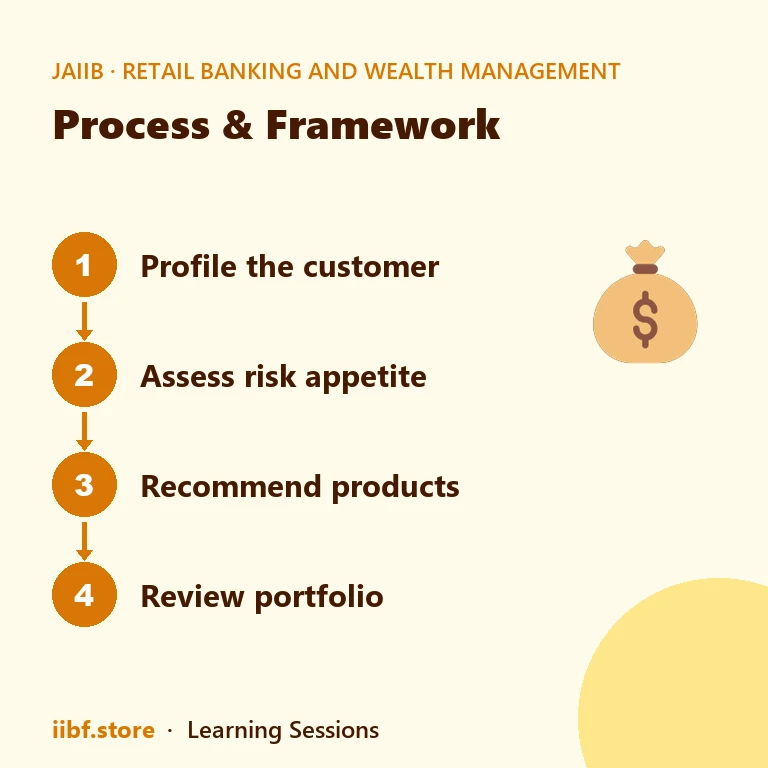
None of this product knowledge matters if the branch sells the wrong policy to the wrong customer, which is why suitability assessment sits right next to product knowledge in the syllabus. A proper needs analysis looks at income, existing cover, dependents, outstanding loans and time horizon before recommending a product — the same discipline covered under risk profiling in wealth management for investment products applies equally to insurance.
Regulatory guardrails exist precisely because insurance is sold, not bought. Every policy carries a free-look period — typically 15 to 30 days — during which the customer can return the policy for a refund if the terms do not match what was explained at sale. The Insurance Regulatory and Development Authority of India, IRDAI, mandates this disclosure along with a standard benefit illustration for every proposal, and bank branches distributing insurance under bancassurance arrangements must follow the same disclosure norms as any other licensed intermediary.
Product mix also feeds back into how a branch is measured. A relationship manager tracked purely on insurance premium collected has an incentive to oversell, which is why good branches fold insurance commission into the same balanced scorecard used for CRM in retail banking, and treat insurance as one input into a customer's overall asset allocation strategies rather than a standalone sale. For the macro backdrop that shapes how much disposable income households actually have to allocate toward insurance and savings, see this guide on fiscal policy and Union Budget in India. For a wider set of RBWM topics, browse the retail banking and wealth management tag hub.
📌 Remember: Free-look period, benefit illustration and suitability assessment are the three regulatory checks tested most often alongside product definitions — know all three, not just the products.
🧠 Practice MCQs: Types of Life Insurance Policies
Q1. Which type of life insurance policy provides the highest sum assured for the lowest premium? (a) Whole life insurance (b) Endowment policy (c) Term insurance (d) Money-back policy
Answer: (c) — Term insurance has no savings component, so the entire premium funds pure risk cover, giving the highest cover per rupee of premium.
Q2. In a Unit Linked Insurance Plan, who bears the investment risk on the fund portion of the premium? (a) The insurance company (b) The policyholder (c) IRDAI (d) The distributing bank
Answer: (b) — ULIPs invest part of the premium in market-linked funds chosen by the policyholder, who bears the gains or losses on that portion.
Q3. A money-back policy differs from a standard endowment policy mainly because it (a) has no maturity value (b) pays a percentage of the sum assured periodically during the term (c) is only available to HNI customers (d) carries no death benefit
Answer: (b) — Money-back policies pay a portion of the sum assured at intervals during the term instead of a single lump sum at maturity.
Q4. The free-look period on a life insurance policy allows the policyholder to (a) change the nominee once a year (b) return the policy for a refund within a specified window if terms do not match what was explained (c) skip one premium without penalty (d) convert term insurance into a ULIP
Answer: (b) — The free-look period, typically 15 to 30 days, lets the customer cancel the policy and get a refund if the sale did not match the disclosed terms.
Q5. Whole life insurance is best described as a policy that (a) covers the insured only for a fixed 20-year term (b) covers the insured for their entire life or up to a very high age (c) invests premiums entirely in equity markets (d) pays out only if the insured survives to maturity
Answer: (b) — Whole life policies cover the insured up to a very high age (often 99 or 100) rather than a fixed term, and pay out on death whenever it occurs.
Want chapter-wise mock tests with 100+ MCQs? Start practising free →
❓ Frequently Asked Questions
What is the main difference between term insurance and endowment insurance?
Term insurance pays out only on death within the policy term and has no maturity value, while endowment insurance pays a lump sum on death or on survival to maturity, at a much higher premium.
Do ULIPs guarantee returns like endowment policies?
No. ULIP returns depend on the performance of the market-linked funds chosen by the policyholder, whereas endowment and money-back policies guarantee a bonus-linked payout underwritten by the insurer.
Why do banks sell life insurance alongside deposit and loan products?
Bancassurance lets banks earn referral income while offering customers a single point of contact for savings, credit and protection needs, which is why product knowledge for insurance sits in the retail banking syllabus.
What is a rider in a life insurance policy?
A rider is an add-on benefit, such as accidental death or critical illness cover, attached to a base policy for an additional premium; it cannot be bought as a standalone product.
Life insurance product knowledge is one of the more practical parts of the RBWM syllabus because it maps directly onto conversations a retail banking officer has every week. Keep the risk-transfer logic straight — term, whole life, endowment and money-back all guarantee the payout, only ULIPs pass investment risk to the customer — and the exam questions on this topic become straightforward. Build speed on the rest of the paper with topic-wise mock tests at iibf.store/tests.
Quick quiz on this topic
5 exam-style questions from our free test bank — check yourself before you move on.
Practice this topic
Take a free mock test, download chapter PDFs, or watch a video class — all included on iibf.store.
Keep reading