GST Latest Updates 2026 for JAIIB AFM: Interest, Late Fee and Bank ITC

Tax questions are where JAIIB AFM GST preparation quietly falls apart. Not because the concepts are hard, but because the rules moved and most circulating notes did not. The slab structure itself was rebuilt in September 2025, and on top of that sit the interest, late fee and penalty provisions that the exam loves precisely because candidates confuse them with one another. The session below is the third part of a GST series for JAIIB AFM; this article turns it into a written reference you can revise from.
GST Latest Updates 2026 | JAIIB AFM Taxation | Important Changes Explained · Watch on YouTube
The slab structure was rebuilt in September 2025
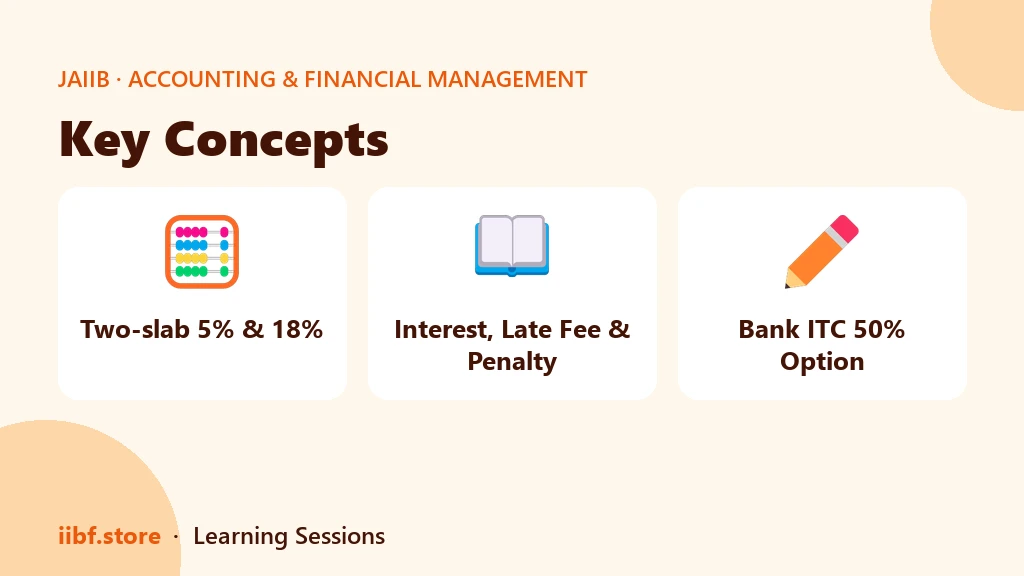
This is the single biggest reason to distrust an old file. At its 56th meeting on 3 September 2025, the GST Council approved a move to a two-rate structure. The 12% and 28% slabs were abolished, leaving 5% as the merit rate and 18% as the standard rate, with a separate 40% rate reserved for sin and luxury goods such as tobacco products, pan masala, aerated beverages and high-end vehicles. The revised rates took effect from 22 September 2025.
If your JAIIB AFM GST notes still present a four-slab table of 5, 12, 18 and 28, that table is now historical. Learn the current three-rate picture, and learn which categories moved, because “which slab does this item now fall in” is an easy question to set and an easy mark to lose.
Interest, late fee and penalty are three different things
This trio is the most reliably examined part of the JAIIB AFM GST syllabus. Candidates lose marks here more often than anywhere else in the chapter, because the three are casually treated as synonyms in everyday conversation and as strictly separate concepts in the exam. Get the distinction clean.
Interest attaches to money that should have reached the government and did not. Delayed payment of tax attracts interest at 18% per annum, computed from the due date until the date of actual payment. Crucially, interest is automatic: the department does not have to issue a separate order for it to become payable. If the payment was late, the interest exists.
Late fee attaches to the return, not the money. It is charged per day of delay in filing under Section 47, subject to a cap notified by the government, and it is payable even where no tax was due. The rates and caps have been revised by notification more than once, so check the current figure rather than trusting a printed number.
Penalty is separate again, and is imposed on top of both. Interest and late fee do not substitute for a penalty, and a penalty does not extinguish the interest.
Input tax credit: the availed-versus-utilised trap
This distinction appears in JAIIB AFM GST papers repeatedly, and it is worth working through with numbers rather than words.
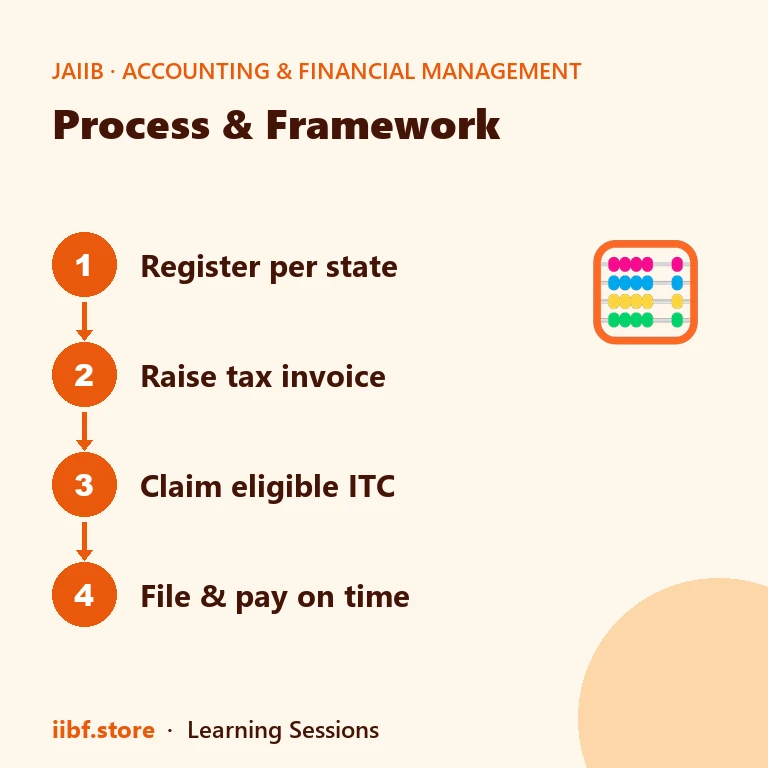
Suppose a bank wrongly avails input tax credit of ₹50,000 and, of that, actually utilises ₹30,000 to discharge its output tax liability. Interest is charged only on the ₹30,000 that was utilised, at 18% per annum, for the period it was wrongly used until it is reversed. The remaining ₹20,000 — availed but never utilised — attracts no interest, provided it is reversed.
The logic is straightforward once you see it: interest compensates the government for money it did not have. Credit sitting unused in the electronic credit ledger never deprived the exchequer of anything. Credit actually set off against tax did.
The mirror side is worth knowing too. Interest does not run in only one direction. Where an eligible refund is delayed beyond the prescribed period, the government becomes liable to pay interest to the taxpayer under Section 56 of the CGST Act. Examiners like this because most candidates assume interest is something only taxpayers pay.
What makes GST different for a bank
This is the part of the JAIIB AFM GST syllabus written specifically for you, and it is the part generic GST material will never cover.
One registration per state. A bank operating across the country does not hold a single GST registration. It registers in each state or union territory where it has a place of business, which means a branch network translates directly into a compliance burden. This is the standard example of GST's cost for multi-state businesses.
The 50% input tax credit option. A banking company or financial institution accepting deposits or extending loans may opt to avail 50% of its eligible input tax credit, forgoing the exercise of tracking credit attributable to taxable versus exempt supplies. It is a simplification, not a concession — the other half is permanently lost. Once exercised, the option cannot be withdrawn during the remaining part of the financial year.
Understand why the option exists. A large part of a bank's income is interest, which is exempt. Without a rule of this kind, every bank would face an enormous apportionment exercise across thousands of input invoices.
| Situation | What is charged | On what amount |
|---|---|---|
| Tax paid after the due date | Interest at 18% p.a. | The tax paid late, from due date to payment |
| Return filed late | Late fee per day, capped | Applies even if no tax is payable |
| ITC wrongly availed but not utilised | No interest, on reversal | Nil |
| ITC wrongly availed and utilised | Interest at the notified rate | Only the utilised portion |
| Eligible refund delayed by the department | Interest payable by the government | The delayed refund, under Section 56 |
The conceptual points still worth marks
Get these right and the JAIIB AFM GST questions stop being about memory alone. Beyond the numbers, GST theory produces reliable one-mark questions. GST is an indirect, destination-based tax — the revenue accrues where consumption happens, not where production does. It replaced a thicket of levies including excise duty, service tax, VAT and entry tax, which is what “one nation, one tax” refers to. It removes the cascading effect, meaning tax on tax, through the input tax credit chain.
That same credit chain is also GST's main enforcement mechanism, and this is a favourite reasoning question. Because a buyer's credit depends on the supplier reporting the transaction correctly, buyers have a direct commercial interest in their suppliers' compliance. The system polices itself in a way the old regime could not.
Do not present GST as flawless, either. Multi-state compliance is a genuine cost, and for banks the 50% rule means real credit is permanently forgone. The exam sometimes asks for disadvantages, and “there are none” is not an option.
When you are ready to test all of this rather than re-read it, the AFM practice tests cover the taxation module separately, and the JAIIB course keeps the taxation chapters in sequence with the rest of the paper. For a fast pass over the terminology, try the concept-matching game, and check current rates and thresholds against our rates and ratios reference before the exam. The authoritative source for anything you are unsure about remains the official GST portal.
What are the GST slabs after the 2025 rationalisation?
Following the 56th GST Council meeting, the 12% and 28% slabs were abolished with effect from 22 September 2025. The structure is now 5% as the merit rate and 18% as the standard rate, with a separate 40% rate for sin and luxury goods such as tobacco, pan masala and aerated beverages.
Is interest payable on input tax credit that was wrongly availed but never used?
No. Interest applies only to the portion of wrongly availed credit that was actually utilised to discharge output tax liability, provided the unused portion is reversed. Credit sitting unused in the electronic credit ledger has not deprived the government of any money.
What is the 50% input tax credit rule for banks?
A banking company or financial institution accepting deposits or extending loans may opt to avail 50% of its eligible input tax credit instead of apportioning credit between taxable and exempt supplies. The remaining half is forgone, and the option cannot be withdrawn during the remaining part of that financial year.
Does a bank need a separate GST registration in every state?
Yes. GST registration is state-wise, so a bank must register in each state or union territory where it has a place of business. This is why multi-state compliance is regularly cited as a practical disadvantage of GST for large branch networks.
Quick quiz on this topic
5 exam-style questions from our free test bank — check yourself before you move on.
Practice this topic
Take a free mock test, download chapter PDFs, or watch a video class — all included on iibf.store.
Keep reading