JAIIB AFM Marathon 2026: All Four Modules in 11 Hours

An eleven-hour session is not something you watch. It is something you work through, and the difference decides whether the day was useful. A JAIIB AFM marathon covering all four modules is essentially a compressed second reading of the paper — valuable if you already have a first reading behind you, close to useless if you are meeting depreciation methods for the first time at hour six. This guide sets out how to use it, module by module, and where the marks actually sit.
The full session is below. Read the module notes after it before you press play, so you know what you are watching for.
JAIIB AFM Mega Marathon · 11 Hours, All Modules Covered · Watch on YouTube
What the paper is made of
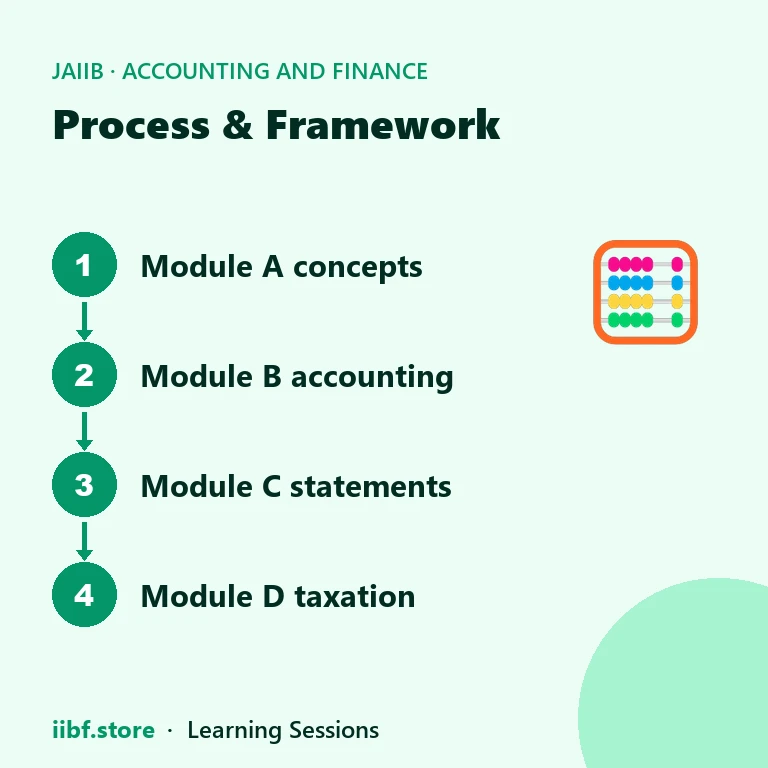
Per the IIBF Rules and Syllabus, Paper III — Accounting and Financial Management for Bankers — runs across four modules:
| Module | Title | Character of the questions |
|---|---|---|
| A | Accounting Principles and Processes | Concept-heavy with short entries and reconciliations |
| B | Financial Statements and Core Banking Systems | Statement preparation and bank-specific formats |
| C | Financial Management | Numerical: time value, capital budgeting, working capital |
| D | Taxation and Fundamentals of Costing | Rules plus costing numericals and variance analysis |
Notice the split. Modules C and D are where calculation speed converts directly into marks, while A and B reward precision about definitions and formats. A marathon treats all four in one sitting, which is exactly why you should not treat them with the same attention.
How to sit through eleven hours without wasting them
Split the session across two or three days rather than one heroic sitting. Retention collapses after roughly ninety minutes of passive input, and a marathon watched end to end produces the comfortable feeling of having covered everything alongside almost no recall the following week.
Keep a notebook open and pause at every worked sum. Solve it yourself before the solution is shown, then compare. If you match, move on immediately. If you do not, write down which step diverged — not the correct answer, the divergent step. That list becomes your revision sheet, and it will be short and specific instead of a rewritten textbook.
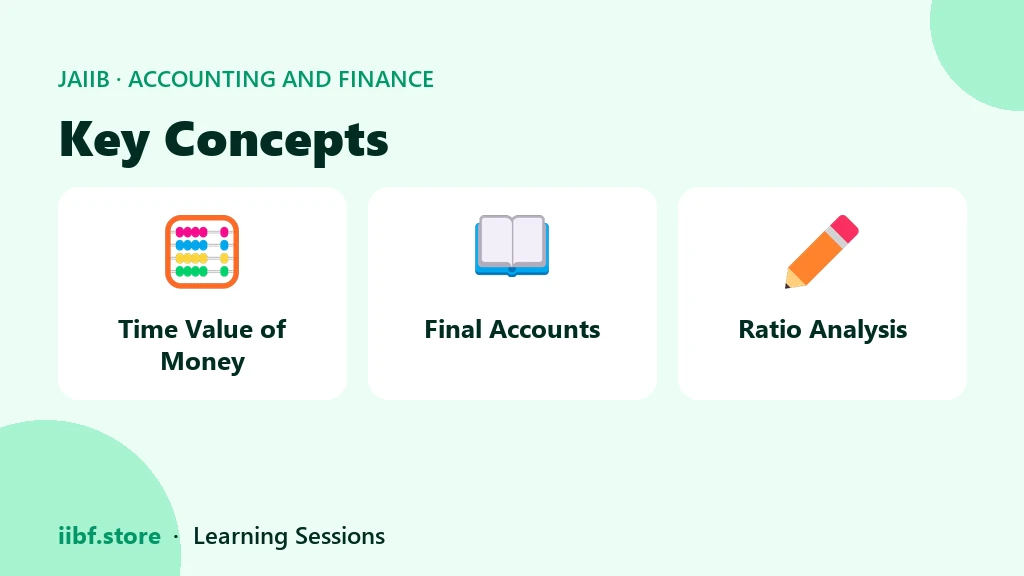
Skip nothing in Module C. Time value of money underpins capital budgeting, which underpins the leasing and valuation questions, so a gap early on propagates. If your discounting is shaky, pause the JAIIB AFM marathon there and fix it before continuing; everything downstream depends on it.
The traps that cost marks every cycle
Three recur reliably. The first is depreciation method confusion: straight line spreads cost evenly, written down value charges a fixed percentage on a falling book value, so the same asset produces very different figures in year three. Read whether the question specifies a method before you compute.
The second is ratio interpretation. Candidates compute current ratio or debt-equity correctly and then misread what a movement means. A rising current ratio is not automatically good; it can signal inventory piling up or receivables ageing. Questions increasingly ask what the number implies, not just what it is.
The third is the marginal versus absorption costing distinction in Module D. Under marginal costing, fixed overheads are period costs and go straight to the income statement. Under absorption costing, they are carried in inventory valuation. When closing stock changes, the two methods report different profits — and explaining why that difference arises is a standard question.
What to do the day after
A marathon is input. The day after has to be output, or the session decays. Attempt a full-length paper under timed conditions on the JAIIB practice tests and mark it honestly. The score matters far less than the pattern of errors: if the losses cluster in one module, you have found your next study block without having to guess.
Then schedule the repeats. Two short revisits — one after three days, one after ten — hold far more than a second JAIIB AFM marathon would. Build them into the study planner so they survive contact with a working week. For formula drilling in short gaps, the match game is a reasonable way to keep definitions warm without opening a book.
On pass requirements, the official position is straightforward: the minimum for a pass is 50 out of 100 in the subject, and a candidate securing at least 45 in each subject with an aggregate of 50 per cent across all subjects in a single attempt is also declared to have completed the examination. Candidates are allowed five attempts within a maximum of three years from registration. The current text is on iibf.org.in, and the paper-wise breakdown is on the JAIIB course pages.
Used properly, a JAIIB AFM marathon is the most efficient revision tool available for this paper, because it forces the four modules into a single coherent view instead of four disconnected readings. Used passively, it is eleven hours you will not get back. The difference is entirely in whether your pen moved.
A quick check before you press play
Ask yourself three things first. Have you read the book once already? Do you have a calculator and a rough notebook within reach? Can you protect three uninterrupted hours today? If any answer is no, fix that before you start. A JAIIB AFM marathon rewards preparation and punishes the lack of it.
Decide your stopping points in advance too. Mark the end of each module as a planned break. Stand up, walk for five minutes, then write two lines on what you just covered before resuming. That short recall step is worth more than the next twenty minutes of video, and it costs almost nothing.
Keep one page as a running error log for the whole session. Every sum you get wrong goes on it, in one line, with the step that failed. By the end you will have a single sheet that is far more useful than any set of notes, because it describes your gaps rather than the syllabus.
Frequently asked questions
Is a marathon enough on its own to pass AFM?
No. It works as a second pass over material you have already read once. Without a first reading and without solving alongside, coverage feels complete while recall stays thin.
Which module should I attempt first in the exam?
Attempt what you are fastest at first to bank marks and settle nerves. For most candidates that means the conceptual questions from Modules A and B before the longer numericals in C and D.
How many attempts do I get for JAIIB?
Five attempts, within a maximum period of three years from the time of registration, whichever is earlier. Subject credits earned in an attempt are retained until that time limit expires.
Do I need to memorise tax rates for Module D?
Focus on the structure and treatment rather than chasing rate tables, since rates change with each Finance Act. Verify anything rate-specific against the syllabus edition applicable to your attempt.
Quick quiz on this topic
5 exam-style questions from our free test bank — check yourself before you move on.
Practice this topic
Take a free mock test, download chapter PDFs, or watch a video class — all included on iibf.store.
Keep reading