HTM, AFS and FVTPL: Bank Investment Classification for CAIIB BFM

Ask three CAIIB candidates how a bank sorts its securities and you will often get three different answers, because the investment classification framework was rebuilt for accounting periods beginning 1 April 2024 and a lot of study material never caught up. The current answer is short: three categories — HTM, AFS and FVTPL — and Held for Trading is not one of them. The Hindi explainer below walks through the distinction in about a minute, and the rest of this page turns it into something you can answer questions from.
HTM, AFS and FVTPL explained in Hindi · Watch on YouTube
Why the old four-category list is wrong
For years the standard line was that a bank's book splits into Held to Maturity, Available for Sale and Held for Trading, with HFT standing as an independent bucket of its own. Under the Reserve Bank of India (Classification, Valuation and Operation of Investment Portfolio of Commercial Banks) Directions, 2023, that is no longer the structure. Held for Trading is a sub-category within FVTPL, not a category of its own. If an option in your question paper lists four independent main categories, it is the distractor.
The reason for the change is worth understanding rather than memorising, because it makes the rest of the chapter fall into place. The new investment classification is driven by the bank's business model for the asset, in the same spirit as global accounting standards. You are no longer labelling a security by what it is; you are labelling it by what the bank intends to do with it.
The one question that decides the category
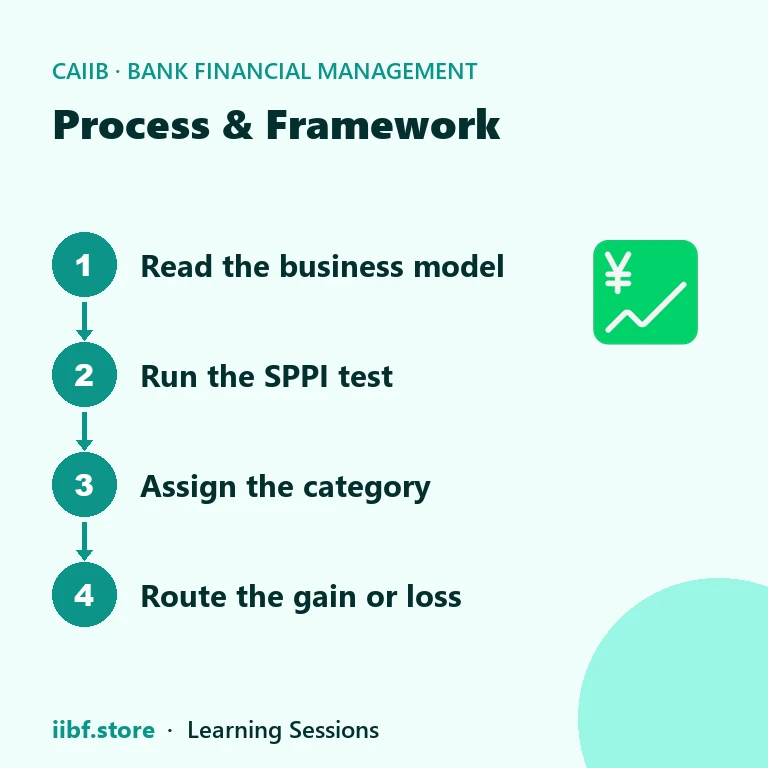
Every classification decision reduces to a single question: what does the bank plan to do with the cash flows?
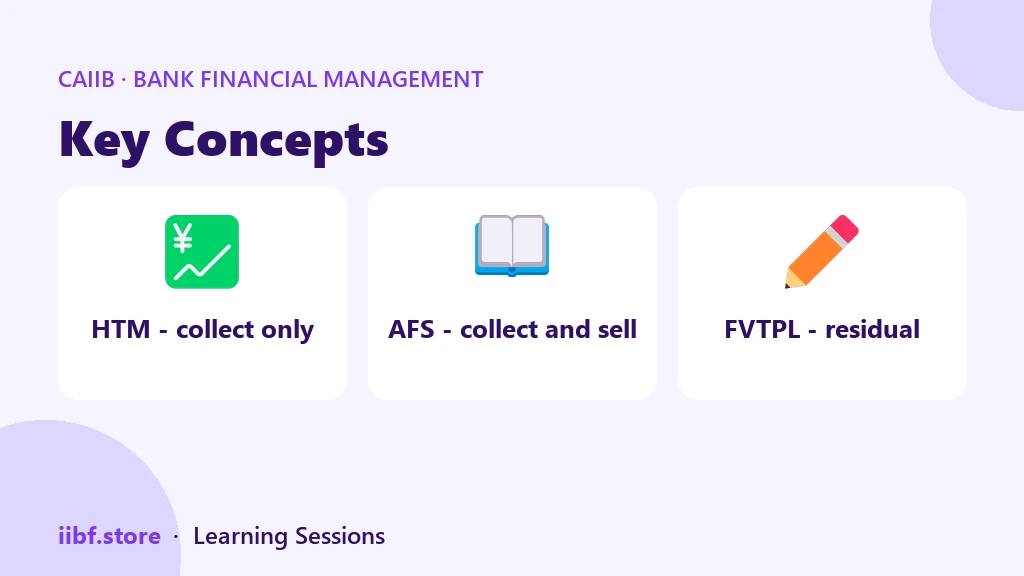
HTM — collect only. The bank acquired the security intending to hold it to maturity and collect the contractual cash flows. In addition, the instrument must satisfy the SPPI criterion: its contractual terms must give rise to cash flows that are solely payments of principal and interest on the principal outstanding. Both conditions, not either.
AFS — collect and sell. The bank still wants the interest and the principal, but it also wants the option to sell if it needs liquidity or if asset-liability management demands it. That dual objective is the whole of the definition.
FVTPL — the residual. Anything that does not meet the conditions for HTM or AFS lands here by default. In practice that means mutual fund units, equity held for trading and a range of structured instruments whose cash flows fail the SPPI test.
Because FVTPL is defined negatively, it never needs a positive test of its own. Run the HTM test first, then the AFS test; whatever is left is FVTPL. Candidates who try to memorise a list of what "belongs" in FVTPL end up guessing on any instrument the list did not anticipate.
The three categories side by side
Once the business model is settled, measurement and accounting follow mechanically. This is the table to reproduce from memory in the exam hall.
| Feature | HTM | AFS | FVTPL (incl. HFT) |
|---|---|---|---|
| Business model | Hold to collect | Hold to collect and sell | Residual |
| SPPI test required | Yes | Yes | Not applicable |
| Measurement | Cost, premium amortised | Fair value, at least quarterly | Fair value; HFT valued daily |
| Fair value changes go to | Not recognised | AFS-Reserve within equity | Profit and Loss Account |
| Typical holdings | SLR government securities held to redemption | Debt held with a liquidity option | Mutual funds, trading equity, structured notes |
The row that decides most marks is the fourth one. Where the fair value change lands is the practical consequence of the entire investment classification exercise, and it is the difference between a bank reporting a volatile profit and a stable one.
Where the gain or loss actually lands
Take one bond and imagine it sitting in each bucket in turn. Yields fall, so its market value rises by ₹10 crore.
In HTM, nothing happens. The security is carried at cost, not marked to market, so the ₹10 crore is invisible in the accounts. Only amortisation of any premium paid, impairment and realised gains on permitted sales touch the profit and loss account. That insulation is exactly why the size of the HTM book matters so much to a bank in a moving rate cycle.
In AFS, the bond is fair valued at least quarterly and the net gain is routed to the AFS-Reserve inside equity. Two details are heavily examined here. The AFS-Reserve is reckoned as Common Equity Tier 1 capital, so the gain does strengthen the capital position. But unrealised gains parked in that reserve are not available for distribution as dividend or coupon — the bank cannot pay out a profit it has not realised.
In FVTPL, the ₹10 crore goes straight to the Profit and Loss Account. If the holding sits in the HFT sub-category, it is valued daily, so the reported number moves with the market every single day.
One bond, three answers, and the only thing that changed was the bank's stated intention at acquisition. That is the sentence to walk into the exam with.
The traps that cost marks
A handful of errors turn up again and again in mock papers built around this investment classification framework, and every one of them is avoidable.
- Treating HFT as a fourth category. It is a sub-category within FVTPL. The distinguishing features are the short-term profit motive and daily valuation, not a separate accounting home.
- Sending AFS gains to the P&L. They go to the AFS-Reserve. Only FVTPL changes hit the profit and loss account directly.
- Forgetting the SPPI test for equity. An equity share has no contractual principal-and-interest cash flow, so it cannot enter HTM however long the bank intends to hold it.
- Quoting the old 25 per cent HTM ceiling. That limit, and the 90-day sale restriction alongside it, belonged to the framework these Directions replaced.
- Assuming free movement between buckets. Reclassification needs Board approval and the prior approval of the Department of Supervision at the Reserve Bank.
How to lock it in before December
This topic rewards drilling over reading. Build the three-column table from a blank page until you can do it in ninety seconds, then switch to application: name an instrument, say the bucket, say the reason, say where the gain goes. Four sentences, ten instruments, and the chapter is done. The CAIIB programme pages place this within the wider BFM treasury syllabus, and the chapter sets in practice tests will expose any bucket you are still guessing at.
If flashcard-style recall suits you better, the matching game is a quick way to fix the category-to-measurement pairs, and a slot in the study planner keeps the revision from slipping to the week before the exam. More BFM walkthroughs are collected on the notes blog, and anything that still looks unfamiliar is worth checking against the Reserve Bank's own text rather than against older coaching notes. Treat the investment classification chapter as one you can finish completely, because unlike much of BFM it has a single right answer for every instrument.
How many investment categories do banks use now?
Three: Held to Maturity, Available for Sale, and Fair Value through Profit and Loss. Held for Trading exists as a sub-category within FVTPL rather than as an independent fourth category.
What is the difference between the HTM and AFS business models?
HTM means the bank intends only to hold the security and collect its contractual cash flows. AFS means the bank wants those cash flows but also keeps the option to sell, typically for liquidity or asset-liability management. Both categories additionally require the instrument to satisfy the SPPI criterion.
Do AFS fair value gains go to the profit and loss account?
No. Net fair value gains and losses on AFS securities are routed to the AFS-Reserve within equity. That reserve counts towards Common Equity Tier 1 capital, but unrealised gains held in it cannot be distributed as dividend or coupon.
Why do mutual fund units fall into FVTPL?
Because their contractual cash flows are not solely payments of principal and interest, so they fail the SPPI criterion and cannot qualify for HTM or AFS. FVTPL is the residual category for exactly this kind of instrument, and its fair value changes flow directly to the profit and loss account.
Quick quiz on this topic
5 exam-style questions from our free test bank — check yourself before you move on.
Practice this topic
Take a free mock test, download chapter PDFs, or watch a video class — all included on iibf.store.
Keep reading