HTM Category Explained: RBI Investment Rules for CAIIB BFM 2026
If your CAIIB BFM notes still list four investment categories, they were written before the rules changed. Since the accounting period beginning 1 April 2024, a bank's entire investment book goes into three buckets, and the HTM category is the one candidates get wrong most often — because almost everything an older syllabus taught about it has been deleted. The 25 per cent ceiling is gone. The 90-day sale restriction is gone. What replaced them is a two-part eligibility test and a hard cap on how much a bank may sell out of the book in a financial year. The short clip below covers the shape of it in under a minute. Read on for the version you can actually answer exam questions from.
HTM investment — CAIIB latest crash course · Watch on YouTube
The two tests a security has to clear
Under the Reserve Bank of India (Classification, Valuation and Operation of Investment Portfolio of Commercial Banks) Directions, 2023, a security only enters the HTM category if it passes both of the following. Miss either one and it cannot sit there, no matter what the treasury desk would prefer.
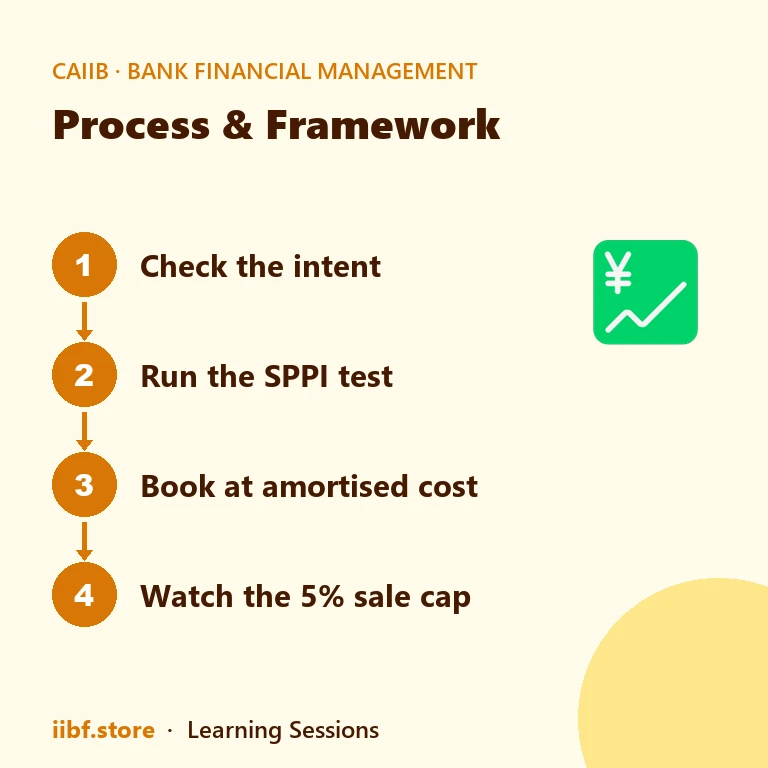
Test one — the intent. The security must be acquired with the intention and objective of holding it to maturity. This is a business-model question, not a wish. A bank that buys a ten-year government security to park surplus SLR funds and collect the coupon until redemption is describing an HTM business model. A bank that buys the same security planning to sell it whenever yields move is not.
Test two — the SPPI criterion. The contractual terms must give rise to cash flows that are solely payments of principal and interest on the principal outstanding. That single line does a lot of work. A plain vanilla dated government security clears it easily. An equity share does not, because there is no contractual payment of principal or interest at all. Mutual fund units do not. A bond whose return is linked to an index, a commodity price or the borrower's profits does not either, because the cash flow is no longer only principal and interest.
Get comfortable with that filter, because examiners love to hand you an instrument and ask which bucket it belongs in. If it is not a debt instrument with contractual principal-and-interest cash flows, the HTM category is closed to it before you even reach the intent question.
The ceilings that no longer exist — and the one that does
Older study material describes an HTM book capped at 25 per cent of total investments, with a further restriction that securities could not be sold within 90 days of acquisition. Both of those were features of the pre-2024 framework and neither survives in the current Directions. There is no percentage ceiling on how large the HTM book may be, and there is no minimum holding period.
What the Reserve Bank put in their place is a limit on churn. In any financial year, the carrying value of investments sold out of HTM must not exceed five per cent of the opening carrying value of the HTM portfolio. Cross that line and the bank needs prior approval from the Reserve Bank. A small set of transactions is carved out of the count — repos and liquidity operations with the central bank and disposals connected with the resolution of stressed assets, for instance — but the default assumption in an exam question should be that a sale counts.
Reclassification between categories is equally tightly held. Banks cannot shuffle securities between HTM, AFS and FVTPL at will: a transfer needs the approval of the Board of Directors and the prior approval of the Department of Supervision at the Reserve Bank. That is a favourite one-mark distinction, because candidates remember the Board and forget the regulator.
Where the HTM category sits against AFS and FVTPL
The cleanest way to hold all three in your head is to ask what the bank intends to do with the cash flows. HTM collects them. AFS collects them but keeps the option to sell. FVTPL is the residual bucket for everything that fits neither description.
| Category | Business model | Measurement | Where fair value changes go |
|---|---|---|---|
| HTM | Hold to collect contractual cash flows; must pass SPPI | Cost, with premium amortised — not marked to market | Nowhere. Only impairment and amortisation touch the P&L |
| AFS | Hold to collect and sell, for liquidity or ALM | Fair value, at least quarterly | Net gains and losses to the AFS-Reserve in equity |
| FVTPL | Residual — everything that fails the other two | Fair value; the HFT sub-category daily | Straight to the Profit and Loss Account |
Note the third row carefully. Held for Trading is no longer an independent fourth category; it is a sub-category sitting inside FVTPL, distinguished by the intent to profit from short-term price movements and by daily valuation. If a question offers you "four categories" as an option, that option is wrong.
What actually hits the profit and loss account
Because securities in the HTM category are carried at cost rather than fair value, day-to-day yield movements never reach the bank's reported profit. That is precisely why the bucket matters commercially: a large HTM book insulates reported earnings from a rising interest-rate cycle. Three things still flow through, though, and they are the ones worth remembering:
- Amortisation of premium. Where a security is acquired above face value, the premium is amortised over the remaining period to maturity, so the carrying value converges on the redemption value.
- Impairment. Carrying at cost is not a licence to ignore credit deterioration. Provisioning requirements continue to apply.
- Realised gains and losses on permitted sales. When a sale does happen within the five per cent window, the difference between sale proceeds and carrying value is recognised.
Contrast that with the AFS treatment, which produces one of the neatest exam points in the whole chapter. Fair value changes on AFS securities are aggregated and routed to the AFS-Reserve, which is reckoned as Common Equity Tier 1 capital — but unrealised gains sitting in that reserve are not available for distribution as dividend or coupon. A bank can count the gain for capital adequacy and still not pay it out.
A worked example you can reuse
Suppose a bank opens the financial year with an HTM portfolio carrying value of ₹40,000 crore. The five per cent test is applied to that opening figure, so the bank may sell securities with a carrying value of up to ₹2,000 crore during the year without seeking prior approval from the Reserve Bank. If the treasury sells ₹1,600 crore in the first half and then wants to offload another ₹900 crore in March, the second leg breaches the cap — the total would reach ₹2,500 crore — and prior approval becomes necessary.
Two traps hide in that arithmetic. The first is that the base is the opening carrying value, not the average or the closing value, so mid-year purchases do not enlarge your allowance. The second is that the test is on carrying value sold, not on sale proceeds or on profit booked. Candidates who apply the percentage to market value get a plausible-looking wrong answer, which is exactly why the question is set that way.
How to revise this before the December attempt
Investments is a chapter where a handful of numbers carry a disproportionate share of the marks, so treat it as a drill rather than a read. Work the classification decision as a flowchart until it is automatic, then move to application: take ten instruments — a G-Sec, a corporate bond, an equity share, a mutual fund unit, a convertible debenture — and bucket each one out loud with the reason. Our CAIIB course pages map this to the rest of the BFM syllabus, and the chapter-wise sets under practice tests will tell you quickly whether the SPPI filter has actually stuck.
Pair that with a schedule you will keep. Set the chapter into your study planner for two short sittings rather than one long one, and keep the current policy numbers open in the RBI rates reference while you revise, because valuation questions often arrive wrapped around a yield or a policy rate. When you want the neighbouring topics, the rest of the BFM revision notes pick up from here.
One last piece of exam hygiene. The HTM category is a genuinely recent rewrite, so a fair amount of coaching material still in circulation describes the old regime. If a source mentions a 25 per cent ceiling or a 90-day lock-in, it is describing the framework that these Directions replaced — verify anything that looks unfamiliar against the Reserve Bank's own text before you commit it to memory.
Is there still a 25 per cent ceiling on the HTM portfolio?
No. The percentage ceiling on the size of the HTM book was a feature of the earlier framework and does not appear in the 2023 Directions, which took effect for accounting periods beginning on or after 1 April 2024. The live constraint today is the five per cent annual limit on sales out of the portfolio.
What does the SPPI criterion mean in plain language?
It asks whether the instrument's contractual cash flows are solely payments of principal and interest on the principal outstanding. A plain debt security clears it. Equity shares, mutual fund units and instruments whose returns are linked to an index or to profits do not, so they cannot be classified as HTM.
Can a bank move a security from HTM to AFS whenever it wants?
No. Reclassification between categories requires the approval of the bank's Board of Directors and, in addition, the prior approval of the Department of Supervision at the Reserve Bank. Candidates frequently remember the Board requirement and drop the regulatory approval.
Is Held for Trading still a separate category?
No. HFT is now a sub-category within FVTPL rather than an independent fourth category. It covers positions taken to profit from short-term price movements, and those positions are valued daily with the changes going straight to the Profit and Loss Account.
Quick quiz on this topic
5 exam-style questions from our free test bank — check yourself before you move on.
Practice this topic
Take a free mock test, download chapter PDFs, or watch a video class — all included on iibf.store.
Keep reading